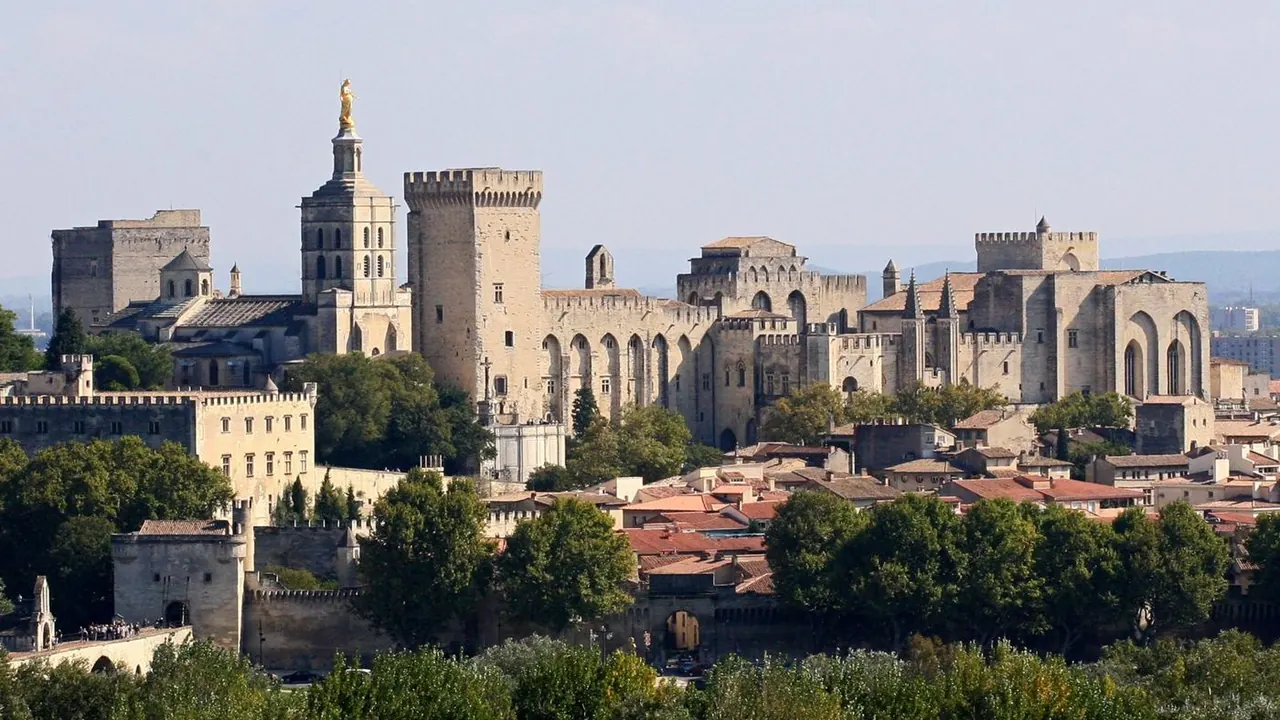
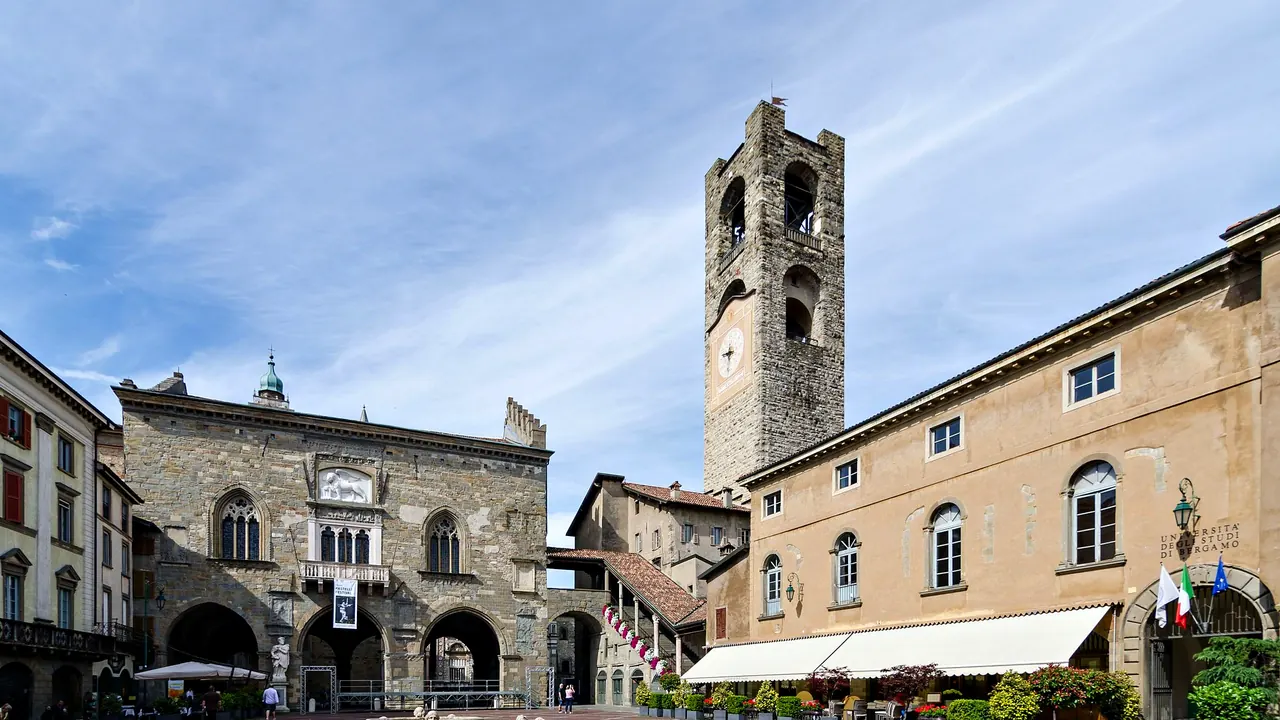
Photos: Avignon by BlueBreezeWiki, CC BY-SA 3.0, cropped; Bergamo by Steffen Schmitz, CC BY-SA 4.0, cropped.
Avignon or Bergamo?
Our verdict in twelve categories, each scored against the same fixed benchmark cities, and the climate month by month, so you can choose for your trip.
Choose Avignon for
- live music and the arts
- day trips
- culture and sights
Avignon suits the traveller who wants to range widely from one base. Within half an hour lie Roman arenas, theatres and the Pont du Gard, with Rhône wine villages, Luberon hilltops and the Camargue not much further. It is also the stronger choice for anyone drawn by the stage, above all in July, when the festival takes over every courtyard and square. Bring a hire car and a tolerance for heat.
Choose Bergamo for
- wellness
- families
- beaches
Bergamo is the gentler, easier stay. Its walled hilltop town is linked to the lower town by funicular, rooms are kinder to the budget, and children have a theme park and a wildlife park close by. Historic spa towns are within reach up the valleys, and the Alps and lakes start almost at the edge of town. It suits families, travellers who want to unwind, and anyone happy to see Lombardy by train.
Scoreboard
Twelve categories on one fixed scale from 0 to 100. The shaded stretch is the gap between the two.
Your match
Pick a travel style or drag the sliders, and both match scores follow your weighting.
Too close to call, 2 points apart
Wins on live music and the arts and day trips with your weighting.
Wins on wellness and families with your weighting.
What matters to you?
Category by category
What the scores mean for a trip.
Beaches & swimming
Neither city is a beach destination, but Bergamo makes summer swimming a little easier. The lidos and grassy shores of Lake Iseo are close, and the Lecco arm of Lake Como is within easy reach, though the shores are pebble, grass or concrete rather than sand.
From Avignon, the regular swim is in the green pools of the Gardon below the Pont du Gard, half an hour away by car. Real sandy beaches in the Camargue are well over an hour's drive away, so most days the pool at your lodging will have to do.
Food & drink
The two eat about equally well, but from opposite kitchens. Avignon cooks in olive oil and herbs: tians, daube, tapenade and summer fruit from the plain, sold at Les Halles. Wine is its real draw, with Châteauneuf-du-Pape and the Côtes du Rhône villages on the doorstep.
Bergamo's cooking is butter, polenta and Alpine cheese. Casoncelli, Taleggio and Strachitunt are the dishes to look for, and the upper town's cheese counters are a sight in themselves. It also has a serious fine-dining tier in the province. Neither city offers much food from beyond its own region.
Culture & sights
The two are well matched, and either one fills two unhurried days. Avignon's draw is the papal palace, the largest Gothic palace in Europe, with the broken bridge, the ramparts and three good museums ranging from Italian primitives to contemporary art.
Bergamo's centrepiece is the whole hilltop Città Alta inside its Venetian walls. Its gem is the marble front of the Cappella Colleoni, and below the hill the Accademia Carrara holds Raphael, Bellini and Mantegna. Avignon offers one great building, while Bergamo offers a complete old town to wander.
Nightlife
Both are quiet towns where evenings end around midnight and clubs barely exist. Avignon's evenings are an aperitif and a glass of Côtes du Rhône on Place Pie, with the big exception of July, when festival crowds keep the old town up until the small hours.
Bergamo's evenings revolve around the long aperitivo in Borgo Santa Caterina, and in summer people drink in the squares and on the walls of the upper town. For a proper night out, Milan is an easy train ride from Bergamo, while from Avignon it means going to Marseille or Montpellier.
Nature & outdoors
Both have superb country close by, but of different kinds. Around Avignon it is the dry limestone of Provence: the bare summit of Mont Ventoux, the Luberon's ochre trails, the Alpilles, the gorges of the Gardon and the Camargue's lagoons and flamingos. These are best in spring and autumn, away from the summer heat.
Bergamo has the Alps almost on its doorstep. Wooded paths climb from the upper town, and Val Brembana and Val Seriana lead to rifugi, high lakes and serious summer hiking. The lakes add sailing, and small ski areas open in winter.
Day trips
Avignon has the richer surroundings. Within half an hour sit the arenas of Nîmes and Arles, the Roman theatre at Orange and the Pont du Gard, an unusually dense cluster of Roman sites. Beyond them come Les Baux, the Luberon villages and the Châteauneuf vineyards, though the villages really need a car.
Bergamo is a very good base too, and more of its trips work by train. Milan is under an hour away, and Lake Iseo and Lake Como are closer still. Brescia, Cremona and Verona make longer days out.
Good for families
Bergamo is the more rewarding choice with children. The funiculars up to the Città Alta and San Vigilio are a treat in themselves. Leolandia, with its rides for young children, is about twenty minutes away by car, and the Le Cornelle wildlife park makes an easy half day.
Avignon has a few good moments, such as the palace's tablet tour, the bridge from the song and the playground on the Rocher des Doms. Beyond those, little in town is made for children, and the river swims and Camargue outings need a car. In both cities the cobbled lanes are hard work with a pushchair.
Getting around
Bergamo is a little easier to get around. Funiculars lift you between the lower and upper towns, the airport is a short bus ride away, and direct trains reach Milan, Brescia and Lecco. A light-rail line even runs up into Val Seriana.
Avignon is simpler in one way, since nearly everything lies within a twenty-minute walk inside the walls. Getting beyond the train lines is harder, though. The hill villages, vineyards and Ventoux have few buses, so a hire car is close to essential, more so than for Bergamo's lakes.
Shopping & style
Neither is a shopping destination, and the best things to buy in both are edible. In Avignon that means tapenade, calissons and Rhône wine from Les Halles, plus printed Provençal cottons and lavender in the lanes off Rue des Marchands.
In Bergamo it means Taleggio, salumi and Valcalepio from the delicatessens of the upper town. For bigger hunts, Avignon shoppers drive to the antiques dealers of L'Isle-sur-la-Sorgue, while Bergamo's shoppers take the train to Milan for fashion.
Affordability
Bergamo is the easier city on the budget. Hotels in the lower town are fairly priced, and plenty of travellers base themselves there to see Lombardy by cheap train and bus. Only the Città Alta and summer weekends push costs up.
Avignon is fair outside high season, with good set lunches and well-priced wine from the producers. July is the problem, when festival rooms inside the walls are booked far ahead at steep rates. Seeing the countryside usually adds the cost of a hire car.
Live music & performing arts
Avignon is far ahead here. Every July the Festival d'Avignon, running since 1947, stages major productions in the Cour d'honneur of the papal palace. Alongside it, the Off fringe fills every cellar and courtyard with well over a thousand shows a day. The Opéra Grand Avignon and a dozen small theatres keep things going for the rest of the year.
Bergamo's stage life centres on its native composer Donizetti. His theatre runs an opera season and an autumn festival of his works, and Bergamo Jazz adds a spring festival. Otherwise the programme is modest, though La Scala is an easy evening trip to Milan.
Wellness & relaxation
Bergamo is the better place to unwind. San Pellegrino Terme, about forty minutes up the valley, has a thermal spa in a grand Belle Époque setting, and the sulphur springs at Trescore Balneario have been used since Roman times. The quiet upper town, especially early and late in the day, adds to the calm.
Avignon has no spa tradition beyond hotel spas and a few massage studios. Rest there means long lunches under plane trees or a farmhouse stay with a pool among the vineyards. July crowds and days of mistral can work against that.
When should you go?
Pick your month. The climate figures are measured averages, not a forecast.
Avignon in July
Bergamo in July
Daytime high, °C
Rainfall in the month, mm
Where the figures come from
Avignon has no rain gauge within 25 km of the centre, so its rainfall comes from a gridded climate dataset read at the city rather than from a gauge further away.
Avignon's sunshine is measured 34 km from the centre, at Nimes / Courbessac.
Bergamo has no rain gauge within 25 km of the centre, so its rainfall comes from a gridded climate dataset read at the city rather than from a gauge further away.
Bergamo's sunshine is measured 64 km from the centre, at Lugano.
Temperature and rainfall are climate normals, averaged over the years shown. Avignon: 2005-2020 (sunshine 1981-2010, rainfall 1991-2020) normals, Avignon / Morières-lès-Avignon (8.6 km from centre). Bergamo: 1991-2020 normals, Bergamo / Orio Al Serio (3.9 km from centre).
Avignon is the warmer and drier of the two. Summer is properly hot, with July highs around 32°C, very little rain and long sunny days. That suits a pool or a river swim in the Gardon, but it is tiring for walking the streets at midday. Late spring and September are the best months for sightseeing and the countryside. The rain arrives in autumn, and October is the wettest month at about 109mm. Winters are mild but often windy.
Bergamo runs a few degrees cooler all year, with summer highs nearer 29°C, which is comfortable for the lakes and the mountain valleys. It is also wetter and cloudier through the warm months, because May to October brings regular rain and thunderstorms rather than a dry summer. Winter is colder than in Avignon, with January highs around 7°C, though that is when the small ski areas open. For city walking, April and late September are the best months in both places.
Which traveller are you?
On a culture and arts trip, Avignon has the edge. The papal palace and several fine museums roughly match Bergamo's upper town and gallery, but Avignon's July festival and its fringe make it one of the world's great theatre towns, and Roman Provence lies close by.
For a relaxing and wellness trip, Bergamo is the better choice. San Pellegrino's Belle Époque thermal spa and the old sulphur springs at Trescore are a short drive away. In Avignon, relaxing mostly means a hotel spa or a farmhouse pool, and the mistral can disturb it.
On a family trip with children, Bergamo does more. Funicular rides, gelato on the walls, Leolandia and Le Cornelle all fill easy days. Avignon has its broken bridge and a palace tour on tablets, but most of its family outings need a car and summer heat.
Before you go
| Measure | Avignon | Bergamo |
|---|---|---|
| Official language | French | Italian |
| Currency | Euro (EUR) | Euro (EUR) |
| Sockets | CE230 V, 50 Hz | CFL230 V, 50 Hz |
| Driving side | Right | Right |
| Time zone | UTC+1, UTC+2 in summer | UTC+1, UTC+2 in summer |
| Emergency number | 112 | 112 |
| Elevation | 10 m | 249 m |
| Main airport | Marseille Provence Airport (MRS)65 km from centre126 non-stop destinations | Il Caravaggio International Airport (BGY)4 km from centre146 non-stop destinations |
| Public holidays this year | 11 days | 13 days |
By the numbers
| Measure | Avignon | Bergamo |
|---|---|---|
| City population | 92,188 | 119,534 |
| People per km² | 1,420 | 2,973 |
| Museums within 10 km | 11 | 21 |
| UNESCO World Heritage sites within 50 km | 6 | 6 |
Where else could you go?
Every comparison below shares a destination with this one, so you can follow Avignon or Bergamo somewhere new.
- Milanvs Bergamo
- Comovs Bergamo
- Luganovs Bergamo
- Aix-en-Provencevs Avignon
- Montpelliervs Avignon
- Marseillevs Avignon