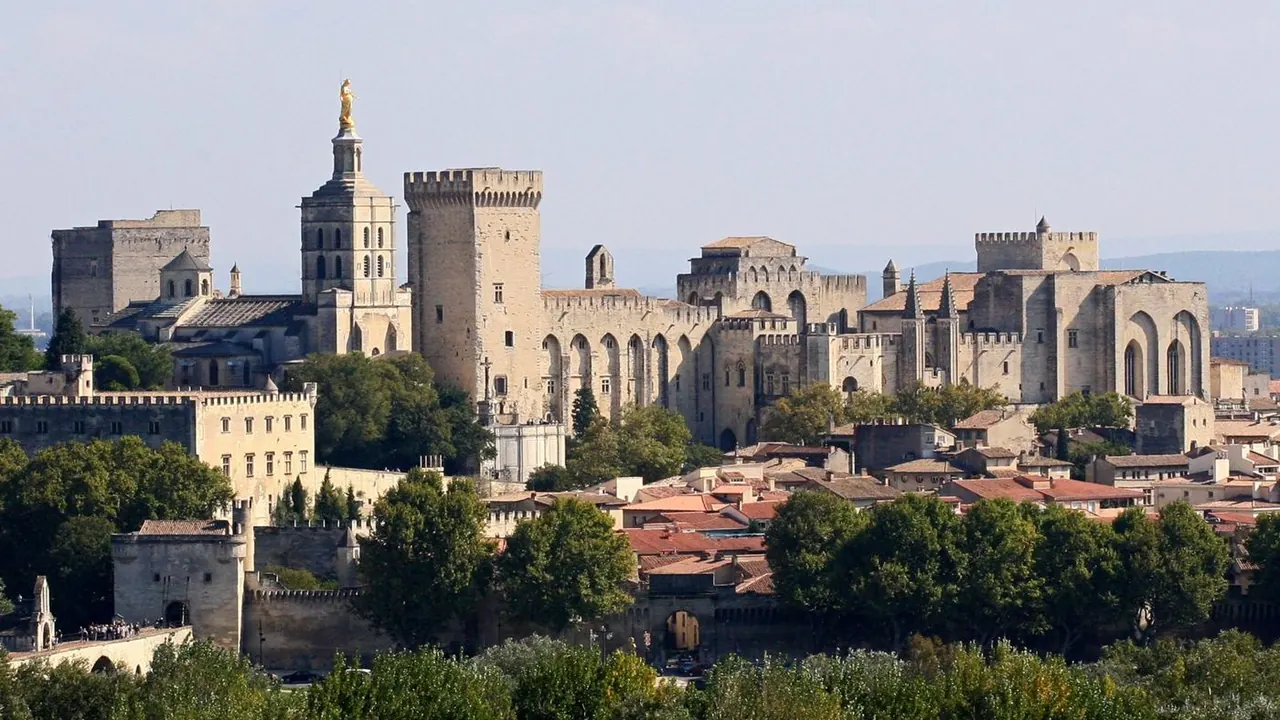
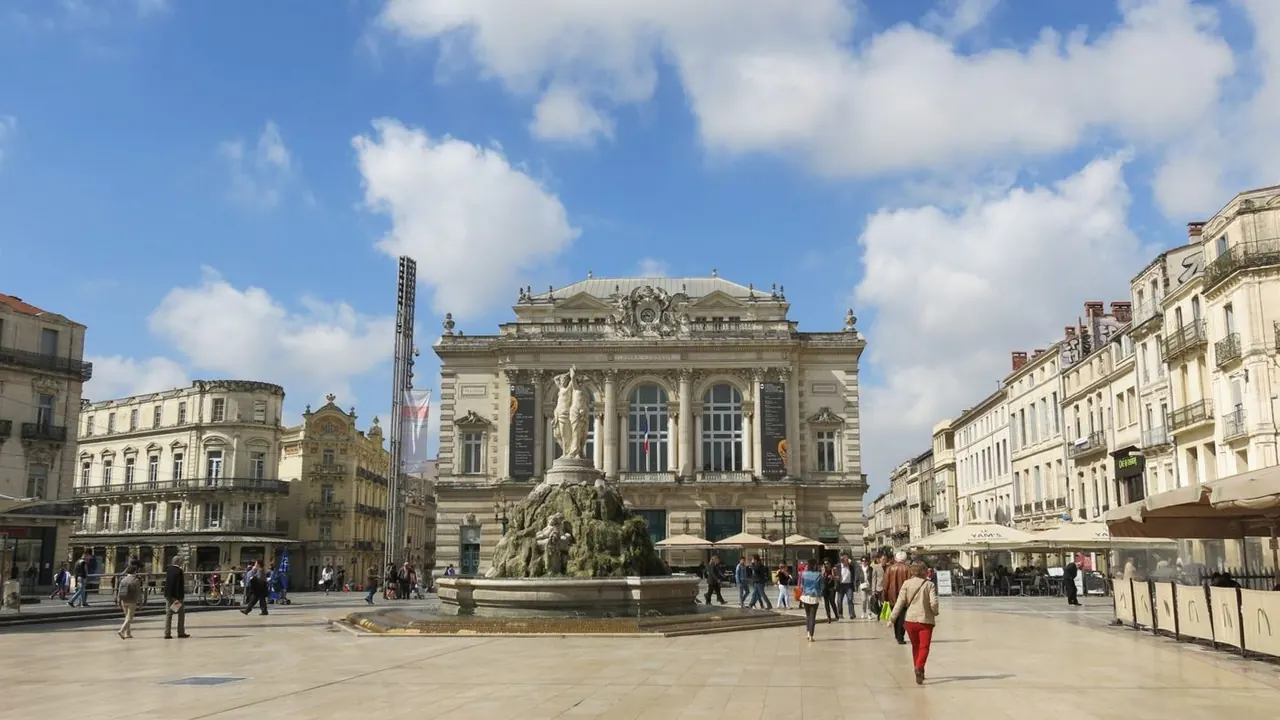
Photos: Avignon by BlueBreezeWiki, CC BY-SA 3.0, cropped; Montpellier by Peter, CC BY 2.0, cropped.
Avignon or Montpellier?
Our verdict in twelve categories, each scored against the same fixed benchmark cities, and the climate month by month, so you can choose for your trip.
Choose Avignon for
- culture and sights
- day trips
- live music and the arts
Avignon is for the traveller who wants history close together and Provence at the door. The papal palace, the ramparts and the broken bridge sit inside one small walled town, and the best Roman sites in France, the Luberon villages and the Châteauneuf vineyards are all an easy hop away. It suits a couple or a culture-minded group with a car, and above all anyone coming in July for the theatre festival.
Choose Montpellier for
- beaches
- nightlife
- families
Montpellier works better as a lived-in base for a longer, more varied stay. It has a sandy coast reached by tram and bus, a student crowd that keeps the bars full on a Tuesday, trams that make it easy with a pushchair, and Languedoc seafood and wine on every terrace. Families, beach lovers and anyone who wants evenings out as well as sights will find it the more rounded choice.
Scoreboard
Twelve categories on one fixed scale from 0 to 100. The shaded stretch is the gap between the two.
Your match
Pick a travel style or drag the sliders, and both match scores follow your weighting.
Wins on culture and sights and day trips with your weighting.
Wins on beaches and nightlife with your weighting.
What matters to you?
Category by category
What the scores mean for a trip.
Beaches & swimming
Avignon has no beach of its own. The summer swim is in the river pools of the Gardon below the Pont du Gard, and the sea at the Camargue or Le Grau-du-Roi is a long day out by car rather than a daily habit.
Montpellier is far better placed. Palavas and Carnon are about 11km away by tram and bus, and the long strip of open sand runs on past La Grande-Motte to the wild dunes of l'Espiguette. It is still a flat, crowded coast in high summer rather than a beach resort, but several beach days fit easily into a city stay.
Food & drink
Both cities cook from the country around them, but Avignon's table is inland Provence, built on slow-braised meat, vegetables and herbs. Its real advantage is the glass beside the plate, since Châteauneuf-du-Pape and the Rhône villages are close enough for bistros to pour them by the glass. Les Halles makes a good market lunch, but away from it the better meals take some looking for, and there is little beyond Provençal cooking.
Montpellier is the easier place to eat well day to day. Oysters and mussels come from the Thau lagoon less than half an hour away, and Sète's spicy octopus tielle adds a taste of the coast that Avignon lacks. The student city also keeps cheap, casual counters and terraces going all over the centre. Neither city offers much fine dining or a wide choice of other cuisines, but in Montpellier ordinary meals are fresher, more varied from the sea and gentler on the budget.
Culture & sights
Avignon has the heavier monuments. The Palais des Papes is the largest Gothic palace in Europe, and it stands in a UNESCO-listed group with the cathedral, the Rocher des Doms and the Pont Saint-Bénezet, all inside nearly 4km of intact ramparts. The Petit Palais, the Musée Calvet and Villeneuve's charterhouse add depth.
Montpellier's appeal is quieter and more spread through the townscape. You find it in the courtyards of the Écusson, the Peyrou terrace with its aqueduct, France's oldest botanical garden and Bofill's Antigone. The Musée Fabre is the one collection that rivals anything in Avignon.
Nightlife
For most of the year Avignon is an aperitif town. There are terraces on Place Pie and a few student bars, and the walled centre is quiet by midnight. July is the exception, when festival crowds keep the squares full until late.
Montpellier has a real night out all year, thanks to its huge student population. Bars and pubs around Place Jean-Jaurès fill even on weeknights, and later the crowd takes taxis to clubs towards Lattes and the coast. It is young and loud rather than polished.
Nature & outdoors
Both cities sit between the uplands and the Camargue, so the difference is in the landscapes. Avignon looks towards high Provence: the bare summit of Mont Ventoux, the Luberon's ochre trails, the Dentelles and the Alpilles, with flat cycling on the Île de la Barthelasse.
Montpellier has hills and water closer together. There are flamingo lagoons right behind the coast, the climb up Pic Saint-Loup, canoeing in the Hérault gorges and the Cirque de Navacelles further out. The windy shore also adds kitesurfing, which inland Avignon cannot offer.
Day trips
Avignon is the better hub. Orange, Nîmes, Arles and the Pont du Gard are all within about half an hour, and so are the wine villages of Châteauneuf and Gigondas. The Luberon hill villages, L'Isle-sur-la-Sorgue and Les Baux are close behind, and Marseille and Aix are quick by TGV.
Montpellier reaches much of the same Roman country, but Arles and Avignon itself are about an hour off. It makes up for that with places of its own in the other direction: Sète, Aigues-Mortes, Saint-Guilhem-le-Désert and Carcassonne by train.
Good for families
Avignon gives children a good morning or two rather than a whole stay. The tablet tour makes the papal palace more fun than they expect, and the broken bridge and the garden on the Rocher des Doms fill an afternoon. After that the outings are out in the country, at the Gardon pools or among the Camargue horses, so the days revolve around the car. Cobbles and the July crowds make the town itself hard going with small children.
Montpellier asks for much less planning. The Jardin des Plantes and the Peyrou terrace give children room to run inside the old town, and the sea is close enough for an unplanned afternoon on the sand rather than a full day's expedition. In summer the beach towns add fairgrounds and seafront promenades. The stone centre gets very hot in high summer and the attractions are not endless here either, but a week with children runs more smoothly here than in Avignon.
Getting around
Avignon is a walking town. Nearly everything lies within twenty minutes of the station by the walls, and regional trains run easily to Arles, Nîmes and Orange. For the villages and Mont Ventoux, though, you need a car or a tour.
Montpellier adds a proper tram network linking the station, the Écusson, Antigone and Odysseum, with bike-share for the flatter districts and a tram-and-bus route to the beaches. A car still helps for the gorges and the Camargue.
Shopping & style
Avignon's shopping is small and Provençal: printed cottons, lavender and olive-wood around Rue des Marchands, chains on Rue de la République, and the antiques dealers a drive away in L'Isle-sur-la-Sorgue.
Montpellier offers somewhat more. There are boutiques and bookshops in the Écusson lanes, plus big-brand choice in the Polygone and Odysseum malls. In both cities, the best things to take home are wine and olive oil from the markets.
Affordability
Montpellier is a little easier on the budget. The student economy keeps plenty of cheap counters and bars going, and rooms stay moderately priced outside July and August.
Avignon's costs depend heavily on the calendar. Rooms inside the walls are steep and scarce during the July festival but much kinder in spring and autumn. Exploring the villages usually means paying for a hire car as well.
Live music & performing arts
The two are about level, but strong in different ways. Avignon's peak is the Festival d'Avignon each July, with major productions in the Cour d'honneur and the vast Off fringe filling every cellar and courtyard. The rest of the year falls back to the Opéra Grand Avignon, a dozen small theatres and a jazz club.
Montpellier spreads its season more evenly. Two opera houses share a national orchestra, contemporary dance is a specialism through Montpellier Danse and the choreographic centre, and the Radio France festival brings classical and jazz concerts, many of them free.
Wellness & relaxation
Neither city has a bathing tradition, but Montpellier has the edge. The thermal centre at Balaruc-les-Bains on the Thau lagoon takes day visitors about half an hour away, alongside the usual hotel spas.
Avignon's form of rest is the farmhouse guesthouse among the vineyards and lavender, with a pool and nothing to do. Inside the walls, the July crowds and days of mistral work against calm.
When should you go?
Pick your month. The climate figures are measured averages, not a forecast.
Avignon in July
Montpellier in July
Daytime high, °C
Rainfall in the month, mm
Where the figures come from
Avignon has no rain gauge within 25 km of the centre, so its rainfall comes from a gridded climate dataset read at the city rather than from a gauge further away.
Avignon's sunshine is measured 65 km from the centre, at Marseille / Marignane.
Temperature and rainfall are climate normals, averaged over the years shown. Avignon: 2005-2020 (sunshine 1991-2020, rainfall 1991-2020) normals, Avignon / Morières-lès-Avignon (8.6 km from centre). Montpellier: 1991-2020 normals, Montpellier (7.8 km from centre).
The two share a Mediterranean pattern, but Avignon runs a little hotter and sunnier at the height of summer. July and August reach about 31°C there, which makes walking the stone streets in the afternoon hard work. Montpellier is a degree or two cooler and has its driest month in July. Its sea only becomes really pleasant for swimming from July to September, peaking around 22°C in August. In both cities, May, June and September give the best balance of warmth and long sunny days for sightseeing.
Autumn is when the rain arrives. October is the wettest month in Avignon at about 109mm, and in both places October and November bring heavy downpours. Winters are mild but grey, with highs around 11°C, which is fine for museums but not for lingering on terraces. Avignon's spring is also exposed to the mistral, so Montpellier is the slightly gentler choice early in the year.
Which traveller are you?
For a beach and sun trip, Montpellier is the clear pick. The fine, gently shelving sands from Palavas to l'Espiguette are a tram and bus ride away. From Avignon, the coast is a drive of well over an hour, so most visitors make do with the pool.
On a culture and arts trip, Avignon edges ahead. The UNESCO-listed papal quarter, its ramparts and its museums fit within a short walk. Nîmes, Arles and Orange are close, and in July the festival turns the whole town into a stage.
On a family trip with children, Montpellier is easier day to day. It has a car-free centre, simple trams for pushchairs, a zoo, an aquarium and calm, shallow beaches. In Avignon, most of the children's days out need a car.
Before you go
| Measure | Avignon | Montpellier |
|---|---|---|
| Official language | French | French |
| Currency | Euro (EUR) | Euro (EUR) |
| Sockets | CE230 V, 50 Hz | CE230 V, 50 Hz |
| Driving side | Right | Right |
| Time zone | UTC+1, UTC+2 in summer | UTC+1, UTC+2 in summer |
| Emergency number | 112 | 112 |
| Elevation | 10 m | 7 m |
| Main airport | Marseille Provence Airport (MRS)65 km from centre126 non-stop destinations | Montpellier-Méditerranée Airport (MPL)8 km from centre41 non-stop destinations |
| Public holidays this year | 11 days | 11 days |
By the numbers
| Measure | Avignon | Montpellier |
|---|---|---|
| City population | 92,188 | 310,240 |
| People per km² | 1,420 | 5,452 |
| Museums within 10 km | 11 | 14 |
| UNESCO World Heritage sites within 50 km | 6 | 2 |
| Swim season, months above 21 °C | - | 2 months |
Where else could you go?
Every comparison below shares a destination with this one, so you can follow Avignon or Montpellier somewhere new.