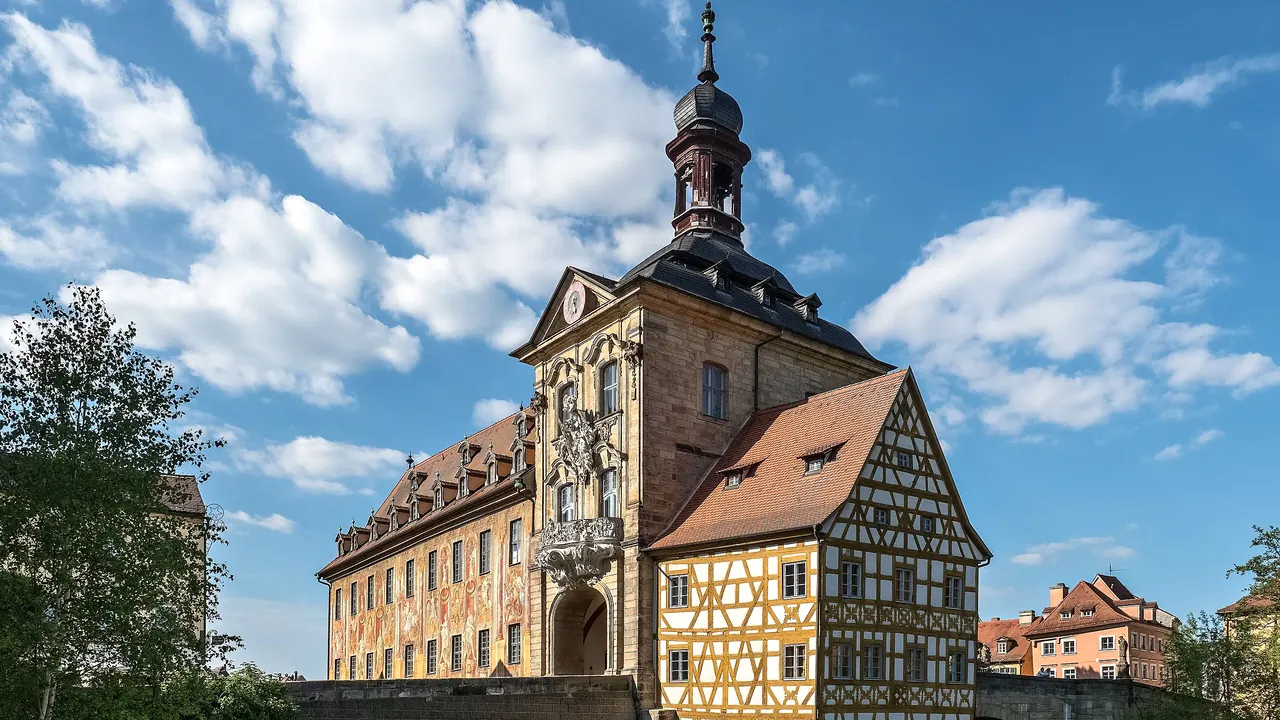
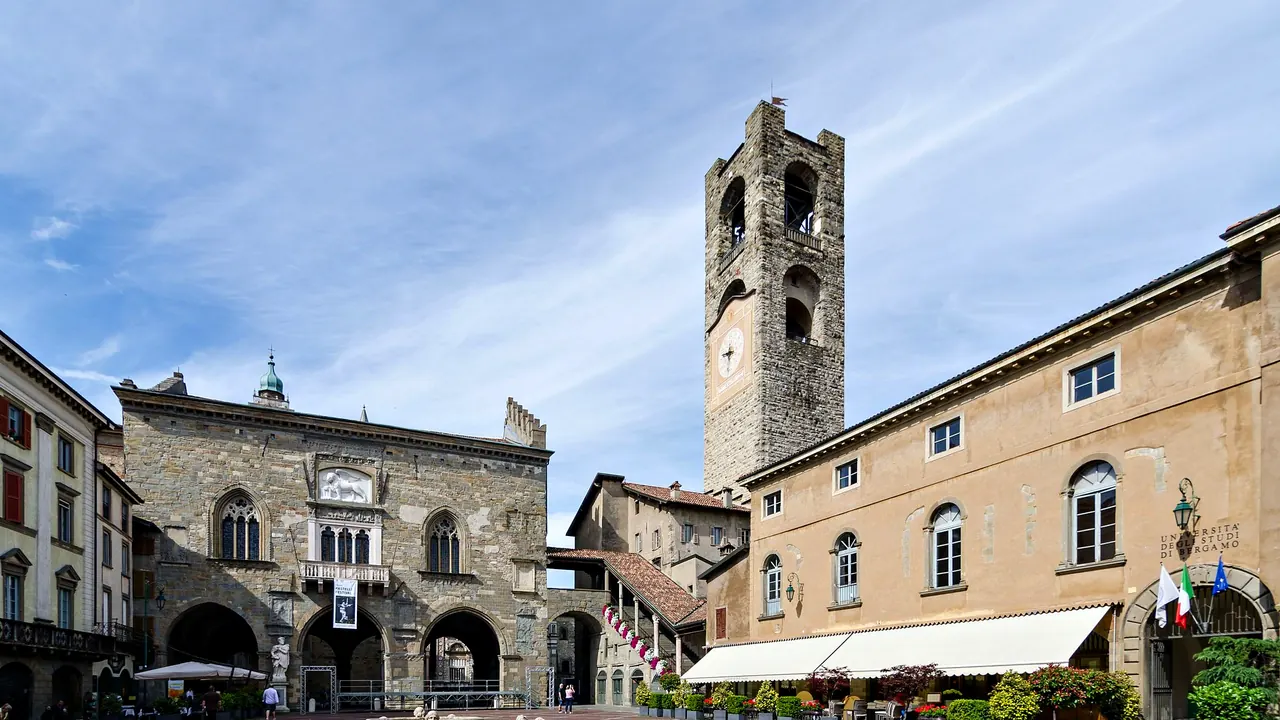
Photos: Bamberg by Ermell, CC BY-SA 4.0, cropped; Bergamo by Steffen Schmitz, CC BY-SA 4.0, cropped.
Bamberg or Bergamo?
Our verdict in twelve categories, each scored against the same fixed benchmark cities, and the climate month by month, so you can choose for your trip.
Choose Bamberg for
- getting around
- prices
- food and drink
Bamberg suits the traveller who wants one intact old town to wander on foot, with evenings in brewery taverns and hillside beer cellars. It is the quieter and more self-contained of the two. The cathedral hill, the island Town Hall and Little Venice lie minutes apart, and the Franconian rail line reaches Nuremberg, Würzburg and Bayreuth without a car.
Choose Bergamo for
- beaches
- nature and the outdoors
- day trips
Choose Bergamo if you want the trip to reach well beyond the town walls. The Città Alta matches Bamberg's townscape and adds a gallery of real stature, but the bigger difference is what lies around it. The Orobie Alps start at the edge of town, and Lake Iseo, Lake Como and Milan are all within an hour. It is the better pick for families, walkers and anyone after a base for lakes and mountains, though the high valleys are easier with a car.
Scoreboard
Twelve categories on one fixed scale from 0 to 100. The shaded stretch is the gap between the two.
Your match
Pick a travel style or drag the sliders, and both match scores follow your weighting.
Wins on getting around and prices with your weighting.
Wins on beaches and nature and the outdoors with your weighting.
What matters to you?
Category by category
What the scores mean for a trip.
Beaches & swimming
Neither town has a beach, but Bergamo has the better swimming. Lake Iseo and the Lecco arm of Lake Como are close enough for a full summer day on pebble, grass or lido platforms. Bamberg has the river bathing spot in the Hain park and the gravel-pit lakes on its edge, which are fine for cooling off but not for a lakeside day out.
Food & drink
The two are evenly matched at the table, but for different reasons. In Bamberg, drink leads. Smoked Rauchbier from the old brewery taverns and long evenings in the hillside beer cellars matter as much as the plate, and the plate is solid Franconian food: Schäufele, dumplings and Bratwurst.
Bergamo eats with more variety and drinks wine. You get casoncelli with butter and sage, polenta with braised meat and game, and cheeses such as Taleggio and Strachitunt from the valleys, with Valcalepio or Franciacorta in the glass. It also has a fine-dining tier that Bamberg mostly lacks. Neither offers much beyond its own regional cooking.
Culture & sights
Both towns offer a historic centre preserved almost whole and listed by UNESCO, and each rises over hills. Bamberg's appeal is spread across a larger townscape: the four-towered cathedral with the Bamberg Horseman, the frescoed Town Hall on its island, Little Venice and the market gardens. Its museums are small.
Bergamo packs its finest buildings into the walled Città Alta, around Piazza Vecchia and the marble front of the Cappella Colleoni. It also has what Bamberg does not: the Accademia Carrara, with Raphael, Bellini and Mantegna. If you love painting, that tips the balance. If you would rather simply walk the streets, Bamberg gives you more of them.
Nightlife
Both are early-to-bed towns where a big night means taking the train, to Nuremberg from Bamberg and to Milan from Bergamo. In Bamberg, evenings centre on beer: brewery taverns after work, the student bars of the Sand quarter in term time, and the beer cellars in summer. Bergamo goes out for a long aperitivo and then wine bars around Borgo Santa Caterina, or drinks in the upper-town squares on summer nights.
Nature & outdoors
Bergamo has much more to offer outdoors. The Colli di Bergamo park climbs straight from the upper town, and beyond it Val Brembana and Val Seriana lead into the Orobie Alps, with rifugi, high lakes, serious hiking and small ski areas in winter. The lakes add sailing and shoreline walks, although the mountains are much easier with a car.
Bamberg's countryside is gentler. The rock towers and caves of Franconian Switzerland, the Steigerwald beech woods and the cycle paths along the Main and Regnitz make for pleasant walking and cycling, but there are no mountains or big views.
Day trips
From Bamberg, the main Franconian rail line takes you from one historic town to the next. Coburg's fortress and ducal palaces are about an hour away. The baroque basilica of Vierzehnheiligen and Banz Abbey face each other across the upper Main valley, closer still. The walled towns of Rothenburg ob der Tauber and Dinkelsbühl make a long day out, with the Franconian wine villages along the way. It is a good list, but the outings tend to look alike: old towns, churches and rolling countryside.
Bergamo has more trips to choose from, and they differ more from one another. Crespi d'Adda, a UNESCO-listed factory village, is half an hour away. Direct trains reach Brescia's Roman and Lombard remains in about an hour. Cremona, with its violin-making tradition, and Verona are both around an hour and a half away, the Franciacorta wine country fills an afternoon, and Mantua is worth the long day. You could go somewhere different every morning for a week.
Good for families
Bergamo keeps children busier. The funiculars up to the Città Alta and San Vigilio are a treat in themselves. Leolandia and the Le Cornelle wildlife park are both short drives away, and the lakes and valleys add easy days out.
Bamberg works best for families who like a slow pace. There are playgrounds and boat hire in the Hain park, a pool with slides for wet days, and beer gardens where children play among the tables. Both towns have steep cobbled climbs that are hard work with a pushchair.
Getting around
Both are easy to manage without much transport, but they are laid out differently. Bamberg is compact and walkable. The island town, the cathedral hill and Little Venice are minutes apart, bikes suit the flat lower town, and the train covers the rest of Franconia, so you never need a car.
Bergamo is a town on two levels, linked by funiculars, with a short bus ride to the airport and direct trains to Milan and Lecco. Walking up between the two levels is steep, and the upper valleys and lake shores are much easier by car.
Shopping & style
Neither is a shopping destination, but Bergamo has a little more to offer. The arcaded Sentierone and Via XX Settembre have Italian mid-range fashion. The main lane of the upper town is lined with cheese shops, delicatessens and wine sellers, and Milan is close for serious fashion. Bamberg's best finds are smaller: bottled smoked beer, produce from the market gardens and the antique dealers near the cathedral.
Affordability
Costs are much the same in both, comfortable rather than cheap. Bamberg saves money on beer and filling tavern meals, but old-town rooms get tighter at weekends and during the Christmas market. In Bergamo, staying in the lower town keeps prices fair, while rooms and restaurants inside the Città Alta cost more.
Live music & performing arts
The two towns have stage scenes of a similar size but a different kind. Bamberg's strength is orchestral: the Bamberg Symphony has an international name, there are choral concerts in the cathedral, and Bayreuth's Wagner festival is an hour away.
Bergamo leans towards opera. It is Donizetti's birthplace, the Teatro Donizetti stages an autumn festival of his works, Bergamo Jazz runs every spring, and La Scala in Milan is within reach for an evening.
Wellness & relaxation
Bergamo has the better spas nearby. San Pellegrino Terme, a grand Belle Époque spa town, is up Val Brembana, and Trescore Balneario's sulphur springs have been used since Roman times. In Bamberg, relaxing mostly means the slow pace by the river and in the beer gardens. For thermal bathing, the brine pools of Bad Staffelstein are about half an hour away by train.
When should you go?
Pick your month. The climate figures are measured averages, not a forecast.
Bamberg in July
Bergamo in July
Daytime high, °C
Rainfall in the month, mm
Where the figures come from
Bergamo has no rain gauge within 25 km of the centre, so its rainfall comes from a gridded climate dataset read at the city rather than from a gauge further away.
Bergamo's sunshine is measured 64 km from the centre, at Lugano.
Temperature and rainfall are climate normals, averaged over the years shown. Bamberg: 1991-2020 normals, Bamberg (2.8 km from centre). Bergamo: 1991-2020 normals, Bergamo / Orio Al Serio (3.9 km from centre).
Bamberg is the cooler of the two and has the drier year overall. Winters are cold and grey, with very little sunshine in the short days, so walking the cobbled lanes from November to February is a chilly business. From May to September it is mild to warm, peaking around 26°C in July. That is the time for beer gardens, cycle paths and a dip in the river. Rain is moderate all year and a little heavier in midsummer, but rarely enough to spoil a day of walking.
Bergamo is several degrees warmer all year, and its winters are noticeably sunnier than Bamberg's. July and August reach about 29°C, which is better for a lake shore than for climbing to the upper town at midday. The catch is rain. From May onwards it is wet for much of the year, and autumn is the wettest stretch, with October bringing around 129mm. For walking the city and the hills, aim for April or late March. It is mild then, around 18°C in April, and the rain has not yet reached its peak. June is warmer and greener but brings frequent showers.
Which traveller are you?
On an outdoors trip, Bergamo is the clear choice. Real Alpine hiking with rifugi and high lakes starts in the valleys just north of town, and there is sailing and cycling on the lakes. Bamberg offers gentle walks through Franconian Switzerland and between village breweries.
On a family trip with young children, Bergamo gives more to do. Children get funicular rides, gelato on the Venetian walls, the Leolandia theme park and the Le Cornelle wildlife park. Bamberg is relaxed and safe, but beyond the Hain park and the leisure pool little is made for children.
For beer lovers, Bamberg has no rival here. Its dense cluster of small breweries, smoky Rauchbier poured from wooden barrels and the summer Bierkeller under chestnut trees are what many visitors come for. In Bergamo the drinking culture is aperitivo and wine.
Before you go
| Measure | Bamberg | Bergamo |
|---|---|---|
| Official language | German | Italian |
| Currency | Euro (EUR) | Euro (EUR) |
| Sockets | CF230 V, 50 Hz | CFL230 V, 50 Hz |
| Driving side | Right | Right |
| Time zone | UTC+1, UTC+2 in summer | UTC+1, UTC+2 in summer |
| Emergency number | 112 | 112 |
| Elevation | 262 m | 249 m |
| Main airport | Nuremberg Airport (NUE)46 km from centre56 non-stop destinations | Il Caravaggio International Airport (BGY)4 km from centre146 non-stop destinations |
| Public holidays this year | 12 days | 13 days |
By the numbers
| Measure | Bamberg | Bergamo |
|---|---|---|
| City population | 77,218 | 119,534 |
| People per km² | 1,414 | 2,973 |
| Museums within 10 km | 11 | 21 |
| UNESCO World Heritage sites within 50 km | 1 | 6 |
Where else could you go?
Every comparison below shares a destination with this one, so you can follow Bamberg or Bergamo somewhere new.
- Milanvs Bergamo
- Comovs Bergamo
- Nurembergvs Bamberg
- Luganovs Bergamo
- Rothenburg ob der Taubervs Bamberg
- Veronavs Bergamo