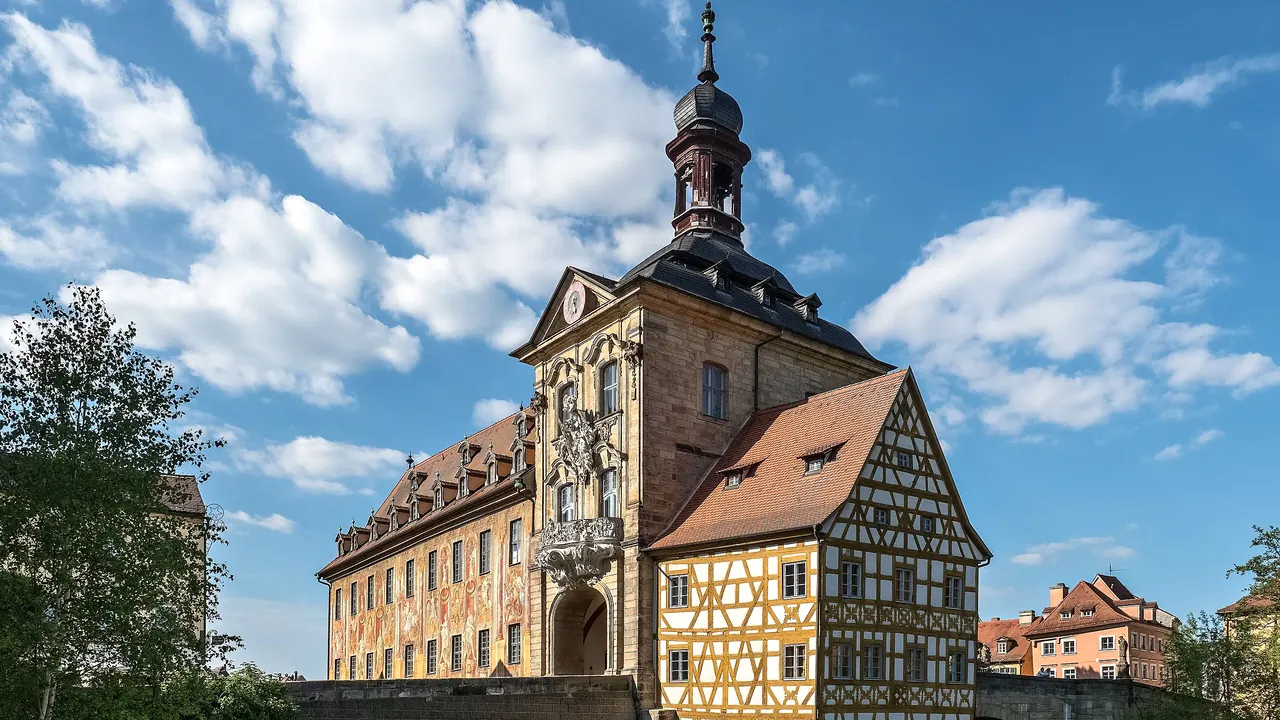
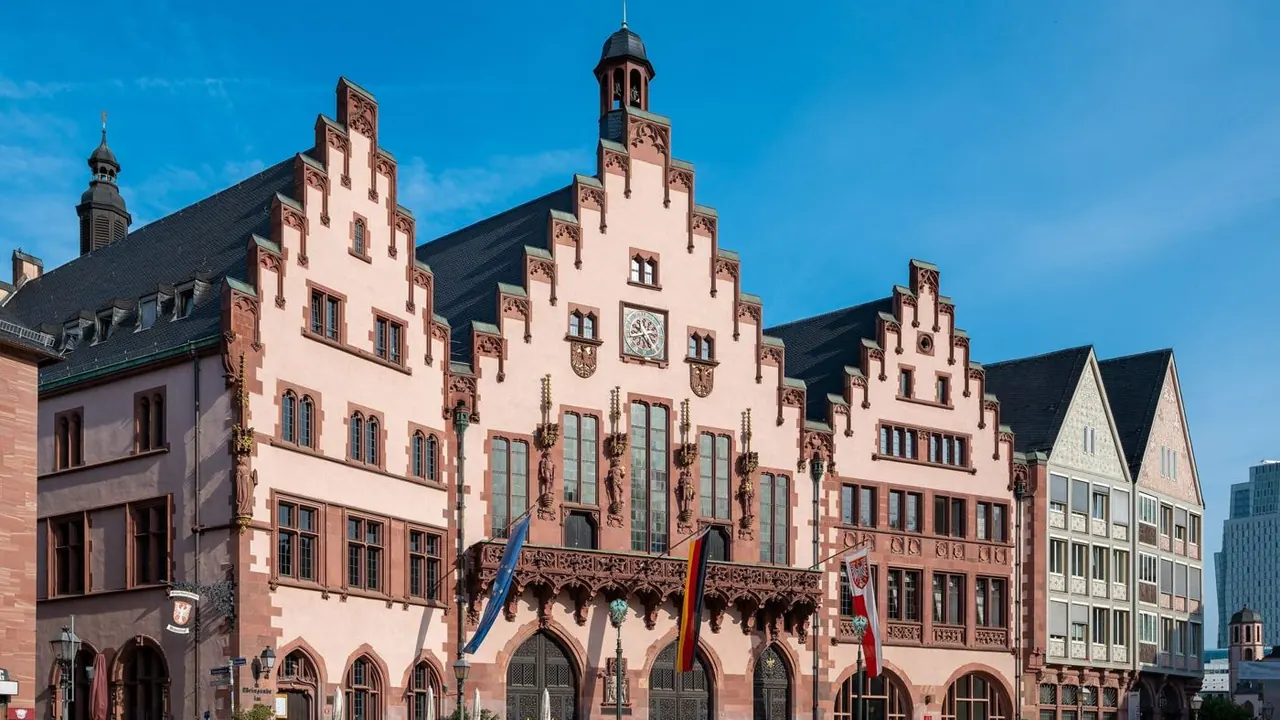
Photos: Bamberg by Ermell, CC BY-SA 4.0, cropped; Frankfurt by Thomas Wolf, CC BY-SA 3.0 DE, cropped.
Bamberg or Frankfurt?
Our verdict in twelve categories, each scored against the same fixed benchmark cities, and the climate month by month, so you can choose for your trip.
Choose Bamberg for
- prices
- food and drink
- culture and sights
Bamberg suits a slow, walking-paced trip. Its old town came through the war intact and is listed by UNESCO as a whole, spread over seven hills with the cathedral above and the Old Town Hall on its island in the Regnitz. Evenings are spent in brewery taverns and hillside beer cellars, and the town is cheaper and quieter than its neighbour. It is a good choice for couples and beer lovers who would rather wander a townscape than work through museums, and who don't need late nights.
Choose Frankfurt for
- shopping
- live music and the arts
- nightlife
Frankfurt is the better base if you want more to do and more ways to get out of town. It has the museums along the Museumsufer, a highly regarded opera company, weekend techno clubs and the shops of the Zeil and Goethestraße. Its rail hub puts Heidelberg, the Rhine Gorge and Cologne within easy reach. Families will find much more for children too, though hotels cost more, especially during trade-fair weeks.
Scoreboard
Twelve categories on one fixed scale from 0 to 100. The shaded stretch is the gap between the two.
Your match
Pick a travel style or drag the sliders, and both match scores follow your weighting.
Wins on prices and food and drink with your weighting.
Wins on shopping and live music and the arts with your weighting.
What matters to you?
Category by category
What the scores mean for a trip.
Beaches & swimming
Neither city is a beach destination. Both are a full day's travel from the sea, and summer swimming means pools and gravel-pit lakes on the edge of town. The difference is in where you swim. Bamberg has a long-established river bathing spot on the Regnitz in the Hain park, while in Frankfurt the Main is for sitting beside, and the best swim is at the Langener Waldsee, a forest lake with sandy shores.
Food & drink
Bamberg has more to eat and drink that you can't get elsewhere. The town and its surrounding district are packed with small breweries, Rauchbier is poured from wooden barrels in old taverns, and in summer people sit under chestnut trees in the Bierkeller on the hillsides. With Schäufele and dumplings alongside, the meal itself is half the reason to come.
Frankfurt's local table is the apple-wine tavern in Sachsenhausen, where you drink tart Apfelwein from stoneware jugs and eat Grüne Soße or Handkäs mit Musik. That repertoire is smaller, but the city makes up for it in range: Turkish, Italian and Asian kitchens, cheap global food in the Bahnhofsviertel and a fine-dining tier that Bamberg largely lacks.
Culture & sights
Bamberg comes out ahead because the town itself is the sight. It is a whole UNESCO-listed old town that survived the war. The Imperial Cathedral with the Bamberg Horseman, the Old Town Hall on its island, Little Venice and Michaelsberg Abbey are all genuinely old, and its museums are small.
Frankfurt is the reverse. Its historic centre was mostly destroyed in 1944, and the Römer and the old-town lanes are largely rebuilt. Its strength is the Museumsufer, with the Städel's old masters, the Schirn's exhibitions and more than a dozen other museums. Go to Bamberg to walk through history and to Frankfurt to see collections.
Nightlife
Frankfurt has much more going on after dark. It has a small, serious techno and house scene with roots in the city's electronic music history, cocktail bars and late kiosks in the Bahnhofsviertel, and neighbourhood bars along Berger Straße. It is mostly a Friday and Saturday city, though.
A night out in Bamberg means beer rather than dancing: brewery taverns after work, student bars in the Sand quarter during term, and long summer evenings in the beer cellars. Clubs are few, and anyone who wants a late night takes the train to Nuremberg.
Nature & outdoors
There is little between them. Both are surrounded by gentle, green country that suits walking and cycling better than anything dramatic. From Bamberg, Franconian Switzerland gives you limestone valleys, rock towers and caves, and hiking routes link one village brewery to the next. Frankfurt has the higher Taunus with the Großer Feldberg, the large Stadtwald forest inside the city, and the vineyard paths of the Rheingau and the Rhine Gorge further out.
Day trips
Both make good bases, but Frankfurt has the longer list and the faster trains. Heidelberg and the castle-lined Rhine Gorge are about an hour away, Cologne is about an hour by high-speed train, and Mainz, Wiesbaden and Darmstadt are close by. You could fill a week without running out.
Bamberg's trips stay within Franconia. Nuremberg is under an hour away, and Coburg, Bayreuth and the facing baroque churches of Vierzehnheiligen and Banz Abbey are close too. Würzburg's Residence is within reach of both cities, a little nearer from Bamberg.
Good for families
Frankfurt has a good deal more for children. There are the Senckenberg's dinosaur skeletons, a central zoo, the Palmengarten glasshouses and boat trips past the skyline, and in the Taunus a wildlife park and a fairy-tale amusement park. Trams and the S-Bahn take pushchairs easily.
Bamberg is safe and relaxed, and its beer gardens are places where children play among the tables. Beyond the Hain park playgrounds, boat hire and the leisure pool, though, little is aimed at young visitors, and the climb to the cathedral is a struggle with a pushchair.
Getting around
Both centres are easy to walk, and neither needs a car. Frankfurt has the edge in transport. The U-Bahn, S-Bahn, trams and buses form one system that reaches out to the Taunus and Mainz, and the airport is about a quarter of an hour from the centre by train. Bamberg is simpler and smaller, mostly walking and cycling across the flat lower town, but the climbs up to the cathedral and Michaelsberg are steep and cobbled.
Shopping & style
Frankfurt is the better place to shop. The Zeil has department stores and malls, the streets around Goethestraße hold luxury fashion and jewellery houses, and Berger Straße and Schweizer Straße have independent boutiques and delis. The Saturday flea market on the Main bank adds some character.
Bamberg has high-street chains around Grüner Markt and Lange Strasse and little fashion beyond them. Its best buys are local: produce from the market gardens, smoked beer from the brewery shops and finds from the antique dealers near the cathedral.
Affordability
Bamberg is the cheaper of the two, mainly because of where you sleep. Its guesthouses are moderately priced for most of the year, and they only get tighter at weekends and during the Christmas market. In Frankfurt, rooms are priced for business travellers and become very dear during the trade fairs, though weekends and summer are often cheaper.
Eating out is good value in both. Bamberg's brewery taverns and Frankfurt's cider taverns and Turkish grills cost little by Western European standards.
Live music & performing arts
Frankfurt has the fuller calendar. Its opera company is known for adventurous productions, the Alte Oper hosts the radio symphony orchestra and touring ensembles, and the Schauspiel, independent dance venues and cellar jazz clubs fill out the season from autumn to early summer.
Bamberg is a smaller scene with one real strength: the Bamberg Symphony, an orchestra with an international reputation, alongside drama at the ETA Hoffmann Theatre and concerts in the cathedral. It has no opera company of its own, but the Bayreuth Festival is an hour away.
Wellness & relaxation
Neither city has a bathing tradition of its own, but Frankfurt has more spa towns within reach. Bad Homburg's thermal baths are at the foot of the Taunus, and Wiesbaden's Art Nouveau Kaiser-Friedrich-Therme is under an hour away. Bamberg has one, the warm brine pools at Bad Staffelstein, about half an hour away by train. In town, though, Bamberg is the calmer of the two, and its riverside mornings and quiet evenings are restful in a way that Frankfurt's working pace is not.
When should you go?
Pick your month. The climate figures are measured averages, not a forecast.
Bamberg in July
Frankfurt in July
Daytime high, °C
Rainfall in the month, mm
Temperature and rainfall are climate normals, averaged over the years shown. Bamberg: 1991-2020 normals, Bamberg (2.8 km from centre). Frankfurt: 1991-2020 normals, Frankfurt Westend (2 km from centre).
The two cities share a central German climate, and both are at their best from May to September. In those months daytime highs climb from about 20°C into the mid-twenties, which is pleasant for walking and warm enough for the local lakes in high summer. Summer is also the wettest part of the year, and July in Bamberg brings around 79mm of rain. Pack for showers even in the best months.
Winter is cold in both, with Bamberg's December and January highs around 4°C, which makes the steep cobbles up the cathedral hill hard going. Frankfurt is a degree or so milder through most of the year and gets noticeably more sun in spring, with about 210 hours in April against Bamberg's 181. That gives it a slight edge for an early-season trip.
Which traveller are you?
On a family trip with young children, Bamberg suits only families who are happy with riverside play and afternoons in the beer gardens, because its sights are made for adults. Frankfurt is the easier choice. It has several days of attractions aimed at children, and pushchairs are no trouble on its public transport.
For a trip on a tight budget, Bamberg makes your money go further. A filling tavern meal with local beer costs little, beds are cheaper and the town is small enough that getting about costs almost nothing. Frankfurt can work too, as long as you keep clear of the trade-fair weeks.
On a shopping trip, Bamberg is a place to pick up souvenirs to eat and drink, but not a reason to travel. Frankfurt is the clear pick. It has the range to fill a whole day, from department stores to luxury labels and small independent design shops.
Before you go
| Measure | Bamberg | Frankfurt |
|---|---|---|
| Official language | German | German |
| Currency | Euro (EUR) | Euro (EUR) |
| Sockets | CF230 V, 50 Hz | CF230 V, 50 Hz |
| Driving side | Right | Right |
| Time zone | UTC+1, UTC+2 in summer | UTC+1, UTC+2 in summer |
| Emergency number | 112 | 112 |
| Elevation | 262 m | 101 m |
| Main airport | Nuremberg Airport (NUE)46 km from centre56 non-stop destinations | Frankfurt Main Airport (FRA)13 km from centre281 non-stop destinations |
| Public holidays this year | 12 days | 10 days |
By the numbers
| Measure | Bamberg | Frankfurt |
|---|---|---|
| City population | 77,218 | 760,656 |
| People per km² | 1,414 | 3,063 |
| Museums within 10 km | 11 | 53 |
| UNESCO World Heritage sites within 50 km | 1 | 4 |
Where else could you go?
Every comparison below shares a destination with this one, so you can follow Bamberg or Frankfurt somewhere new.
- Nurembergvs Bamberg
- Rothenburg ob der Taubervs Bamberg
- Heidelbergvs Frankfurt
- Rothenburg ob der Taubervs Frankfurt
- Karlovy Varyvs Bamberg
- Stuttgartvs Frankfurt