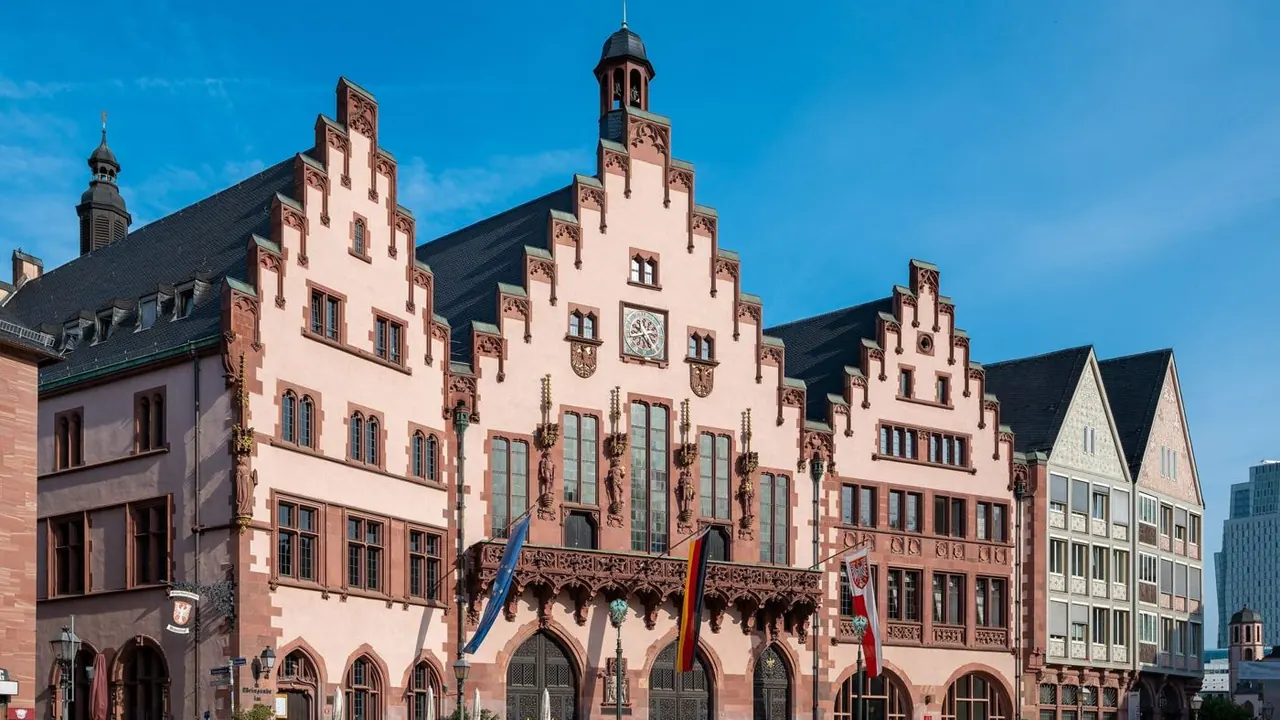
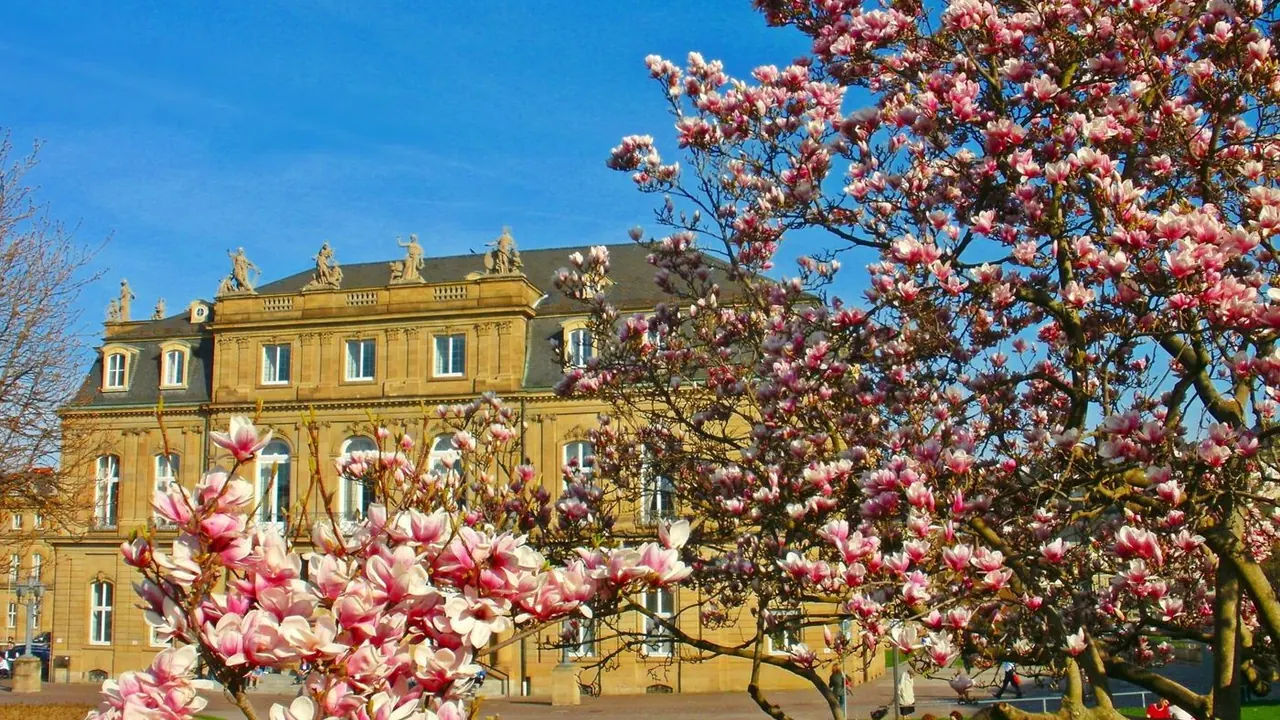
Photos: Frankfurt by Thomas Wolf, CC BY-SA 3.0 DE, cropped; Stuttgart by Baden de, CC BY 3.0, cropped.
Frankfurt or Stuttgart?
Our verdict in twelve categories, each scored against the same fixed benchmark cities, and the climate month by month, so you can choose for your trip.
Choose Frankfurt for
- nightlife
- day trips
- getting around
Frankfurt is the better base for travellers who want to see a lot of Germany in one trip. The airport and main station put the Rhine Gorge, Heidelberg and Cologne within easy reach, and the Museumsufer can fill two or three days of museum-going. Evenings are livelier too, from the cocktail bars of the Bahnhofsviertel to a weekend techno scene with real history behind it.
Choose Stuttgart for
- wellness
- food and drink
- live music and the arts
Stuttgart rewards a slower, more rounded stay. You can soak in warm mineral springs without leaving the city, see one of Europe's great ballet companies in the state theatre, and eat Swabian cooking with wine from vineyards inside the city limits. Wilhelma gives families a full day out. Choose it if a good performance and a long dinner matter more to you than a late night.
Scoreboard
Twelve categories on one fixed scale from 0 to 100. The shaded stretch is the gap between the two.
Your match
Pick a travel style or drag the sliders, and both match scores follow your weighting.
Too close to call, 1 point apart
Wins on nightlife and day trips with your weighting.
Wins on wellness and food and drink with your weighting.
What matters to you?
Category by category
What the scores mean for a trip.
Beaches & swimming
Neither city is a choice for a beach trip, and both are a long way from any coast. The summer swimming is different, though. Frankfurt has gravel-pit lakes such as the Langener Waldsee, with sandy shores in the forest south of the city. Stuttgart's best option is outdoor pools fed by its mineral springs, and the nearest large swimming lake, Lake Constance, is more than two hours away.
Food & drink
Both serve hearty regional cooking, but Stuttgart's is more distinctive and better supported by local wine. Its Maultaschen, Käsespätzle and Zwiebelrostbraten come with Trollinger and Riesling from vineyards on the city's own slopes. In season, growers open Besen taverns in their homes and serve wine with onion tart. Stuttgart also has more fine dining than you would expect for a city its size.
Frankfurt's local food is a shorter list: Grüne Soße and Handkäs mit Musik, eaten with Apfelwein in the Sachsenhausen taverns. It makes up for this with range. Bahnhofsviertel is full of cheap food from around the world, and the Turkish and Asian cooking is easier to find than in Stuttgart.
Culture & sights
These two are fairly even on sights, but their character is very different. Frankfurt has the traditional collections: the Städel's old masters and a dozen more museums along both banks of the Main. Close by are the rebuilt Römer, the Paulskirche and Goethe's birthplace, all beneath the tallest skyline in Germany.
Stuttgart's heritage is industry and modern design. The Mercedes-Benz and Porsche museums are the main draws, and the Weissenhof Estate's Le Corbusier houses are part of a UNESCO listing. The Neues Schloss and the Staatsgalerie add a more classical side.
Nightlife
Frankfurt is the better city for going out. With Offenbach, it played a big part in the history of techno and house, and serious clubs still keep that tradition going at weekends. The Bahnhofsviertel has rough edges and plenty of character, while Berger Straße and the summer riverbanks offer something calmer.
Stuttgart's evenings are friendly but more limited. Most of the action is on the bar strip along Theodor-Heuss-Strasse, and the city settles down early on weeknights. It is at its liveliest during the Cannstatter Volksfest beer tents in autumn and the late-summer wine village.
Nature & outdoors
There is little between them here. Both offer gentle walking and cycling country rather than mountains. Stuttgart's countryside starts closer to the centre: vineyard trails climb its basin walls, and the deer forests of the Rotwildpark are near the city. Within about an hour are the limestone cliffs and caves of the Swabian Jura and the fir woods of the northern Black Forest.
From Frankfurt, the beech forests of the Taunus and the Großer Feldberg are under an hour away by public transport. The huge Stadtwald and the flat cycle paths along the Main are right in the city, and the Rheingau vineyards make for scenic walks a little further out.
Day trips
Both are excellent bases, but Frankfurt has more destinations within easy reach. As a hub of the high-speed rail network, it reaches the castles of the Rhine Gorge, Heidelberg, Cologne Cathedral and Würzburg's Residenz in about an hour or a little more. Mainz, Wiesbaden and Darmstadt are closer still, and you could fill a week without repeating a direction.
Stuttgart has a strong list of its own. Ludwigsburg's palace and Esslingen are a short ride away, Tübingen and Heidelberg take under an hour, and further trips reach Hohenzollern Castle, Ulm Minster and the monastery at Maulbronn. Strasbourg is possible for a long day.
Good for families
These two are close for families, with Stuttgart slightly ahead thanks to Wilhelma, a zoo and botanical garden that easily fills a day. Stuttgart also has extras that children love: the rack railway, the narrow-gauge train on the Killesberg and the fairy-tale garden at Ludwigsburg. The catch is the hills, which make pushing a pushchair hard work.
Frankfurt is flatter and easier on young legs. The Senckenberg's dinosaur hall, the central zoo and the scooter-friendly paths along the Main make several good days out, but none of them matches Wilhelma.
Getting around
Frankfurt is the easier city to get around. Its centre is flat, the river bridges link it to Sachsenhausen, and trains from the airport take about a quarter of an hour. The same ticket network covers Mainz, Wiesbaden and the Taunus.
Stuttgart's flat centre is just as walkable, but the rest of the city climbs the sides of its basin. Beyond Königstrasse and Schlossplatz you will rely on the Stadtbahn and S-Bahn or tackle the long Stäffele stairways. The rack railway and funicular make some of that climbing part of the fun.
Shopping & style
Shopping is evenly matched, and both cities lean towards practical, mainstream shops. Stuttgart is better for brand hunters. Königstrasse is one of Germany's longest shopping streets, Breuninger is the place for designer fashion, and the Metzingen outlet village is about half an hour away.
Frankfurt has a little more for browsers. Alongside the chains of the Zeil and the luxury houses on Goethestraße, it has independent shops on Berger Straße and Schweizer Straße and a Saturday flea market by the river.
Affordability
Both are expensive by German standards, for the same reason: hotels are priced for business travellers and become very expensive during trade fairs. In either city, a weekend or a quiet month cuts the cost noticeably.
Frankfurt is better for cheap meals, thanks to its Turkish grills, market stalls and Bahnhofsviertel food. Stuttgart's taverns give good value through generous portions, but cheap street food is harder to find there.
Live music & performing arts
Stuttgart has the stronger stage scene, mainly because of its ballet. The company has been famous since John Cranko's time and is the hardest ticket in town. It shares the state theatre with an adventurous opera company, and the Liederhalle adds orchestras and a strong Bach tradition. The big musicals at Möhringen and a well-known jazz club give it a lighter side.
Frankfurt is far from weak. Its opera company is one of the most respected in Germany, the Alte Oper hosts the radio symphony orchestra, and jazz cellars and an English-language theatre add variety. Both cities have their main season from autumn to early summer.
Wellness & relaxation
Stuttgart is the better choice for relaxing, because it has a bathing culture of its own inside the city. Mineral springs at Bad Cannstatt and Berg feed public baths where you can soak in warm, naturally carbonated water indoors and outdoors, with saunas in the larger baths.
In Frankfurt itself there are only municipal pools and hotel spas, and the best bathing means a trip out. Wiesbaden's Art Nouveau Kaiser-Friedrich-Therme and the thermal baths at Bad Homburg are both worth the journey. In town, the Palmengarten is the quietest place to slow down.
When should you go?
Pick your month. The climate figures are measured averages, not a forecast.
Frankfurt in July
Stuttgart in July
Daytime high, °C
Rainfall in the month, mm
Temperature and rainfall are climate normals, averaged over the years shown. Frankfurt: 1991-2020 normals, Frankfurt Westend (2 km from centre). Stuttgart: 1991-2020 normals, Stuttgart / Neckartal (2.8 km from centre).
The two cities have almost identical temperatures through the year, so the best months are much the same in both. Late May, June and September are the most comfortable for walking the streets, with daytime highs from about 21°C. July and August reach around 26°C, warm enough for an outdoor pool or one of Frankfurt's lakes but not too hot for sightseeing. From November to February both are cold and grey, with highs in single figures.
The difference is in the rain and sun. Frankfurt's rain is spread fairly evenly across the year. Its summer is a little wetter than its winter, but its winter is clearly wetter than Stuttgart's, with 63mm in December against 50mm. Stuttgart has dry winters and puts most of its rain into late spring and summer, reaching 79mm in July. It also gets noticeably more sunshine from November to February, so a winter visit there feels less gloomy than one in Frankfurt.
Which traveller are you?
For a short city break, Frankfurt is the easier choice. Trains from the airport reach the centre in about a quarter of an hour. The Römer, the cathedral and the Museumsufer are all within a short walk, and the Bahnhofsviertel's bars keep Friday and Saturday nights going.
On a relaxing and wellness trip, Stuttgart is clearly ahead. Its own mineral springs feed the Cannstatt and Leuze baths, where you can soak in warm carbonated water indoors and out. Frankfurt's best thermal baths are in Wiesbaden and Bad Homburg, so you would have to travel out to them.
For a culture and arts trip, Stuttgart has the edge because of what happens on stage. The Stuttgart Ballet and the Staatsoper share a grand theatre beside the palace gardens. Frankfurt's riverside museums, led by the Städel, make it the stronger pick only if you mainly want to look at paintings.
Before you go
| Measure | Frankfurt | Stuttgart |
|---|---|---|
| Official language | German | German |
| Currency | Euro (EUR) | Euro (EUR) |
| Sockets | CF230 V, 50 Hz | CF230 V, 50 Hz |
| Driving side | Right | Right |
| Time zone | UTC+1, UTC+2 in summer | UTC+1, UTC+2 in summer |
| Emergency number | 112 | 112 |
| Elevation | 101 m | 245 m |
| Main airport | Frankfurt Main Airport (FRA)13 km from centre281 non-stop destinations | Stuttgart Airport (STR)10 km from centre124 non-stop destinations |
| Public holidays this year | 10 days | 12 days |
By the numbers
| Measure | Frankfurt | Stuttgart |
|---|---|---|
| City population | 760,656 | 609,365 |
| People per km² | 3,063 | 2,938 |
| Museums within 10 km | 53 | 42 |
| UNESCO World Heritage sites within 50 km | 4 | 3 |
Where else could you go?
Every comparison below shares a destination with this one, so you can follow Frankfurt or Stuttgart somewhere new.