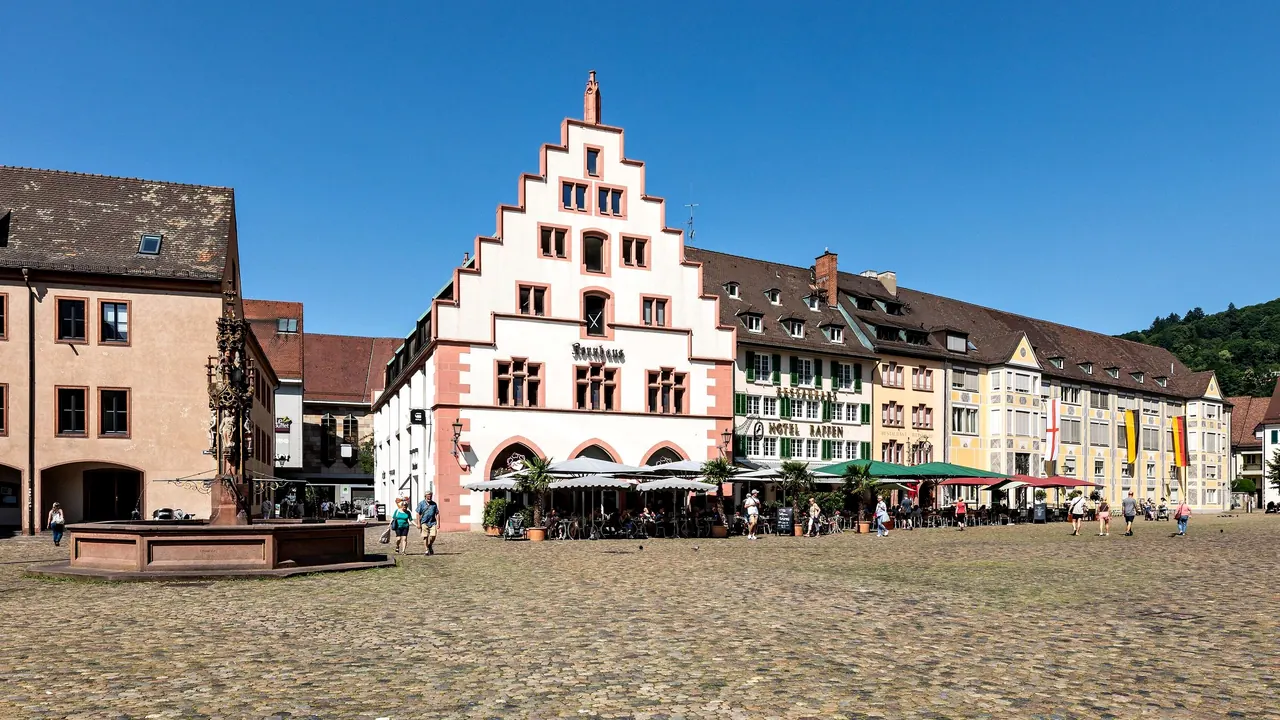
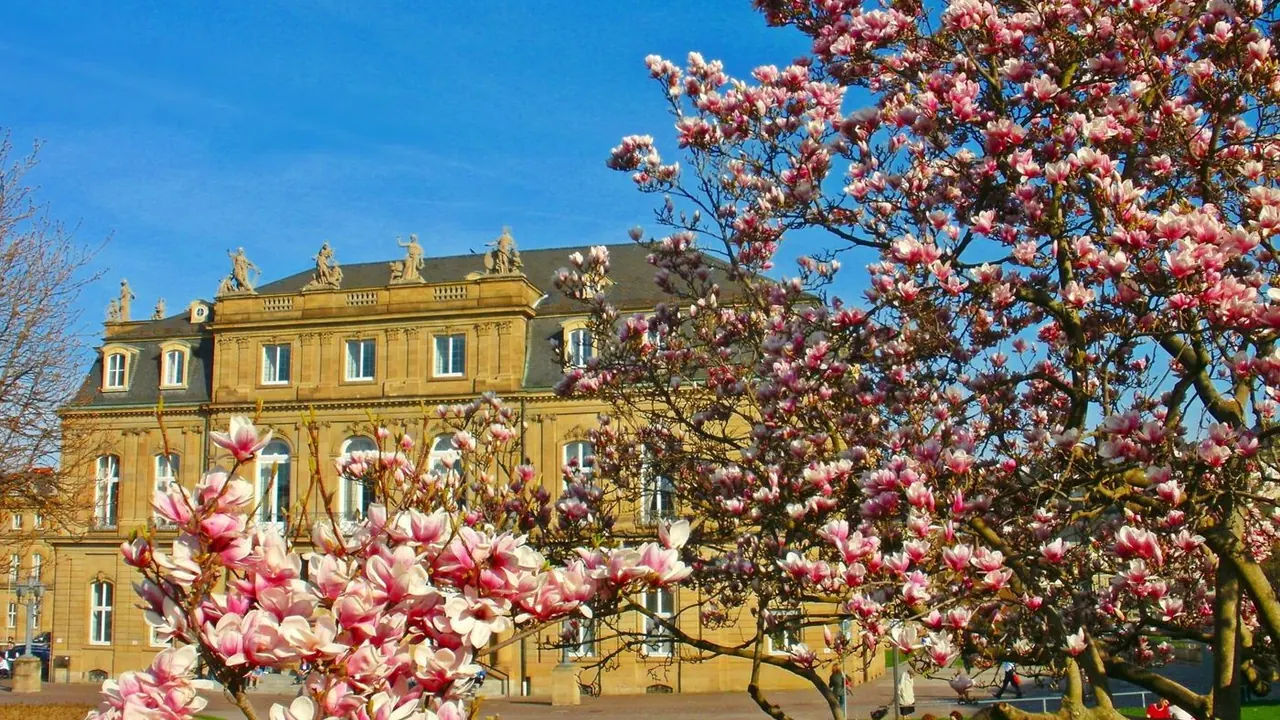
Photos: Freiburg by Dietmar Rabich, CC BY-SA 4.0, cropped; Stuttgart by Baden de, CC BY 3.0, cropped.
Freiburg or Stuttgart?
Our verdict in twelve categories, each scored against the same fixed benchmark cities, and the climate month by month, so you can choose for your trip.
Choose Freiburg for
- nature and the outdoors
- beaches
- families
Freiburg suits travellers who want the outdoors close at hand and a small, walkable town to come back to each evening. The Black Forest rises from its edge, Europa-Park and the Alsace wine villages are within easy reach, and the car-free, cycle-friendly centre makes it the stronger choice for families and for anyone planning hikes, bike rides or spa days in southern Baden.
Choose Stuttgart for
- live music and the arts
- shopping
- culture and sights
Pick Stuttgart if you want a bigger city with more to see and better nights at the theatre. Its ballet and opera are among the most respected in Europe. The car museums and the Staatsgalerie fill days that Freiburg's compact old town cannot, and Königstrasse, with the Metzingen outlets nearby, makes it the place to shop. Expect steeper streets and tamer countryside.
Scoreboard
Twelve categories on one fixed scale from 0 to 100. The shaded stretch is the gap between the two.
Your match
Pick a travel style or drag the sliders, and both match scores follow your weighting.
Too close to call, 1 point apart
Wins on nature and the outdoors and beaches with your weighting.
Wins on live music and the arts and shopping with your weighting.
What matters to you?
Category by category
What the scores mean for a trip.
Beaches & swimming
Neither city is a beach destination, but Freiburg gives a swimmer more to work with. The warm gravel-pit lakes on the Rhine plain are a bike ride away, with grassy shores, and Titisee and Schluchsee in the Black Forest offer a cooler, scenic swim.
Stuttgart has the Neckar, a working river with locks and barges, and Max-Eyth-See, a lake for boating rather than bathing. A summer swim there means an outdoor pool, some of them fed by mineral springs, and the nearest real open water is Lake Constance, more than two hours away.
Food & drink
Both kitchens are regional and built around local wine, but they taste different. Freiburg cooks in the lighter Baden style with a French accent: Flammkuchen, Schäufele and mountain trout with Kaiserstuhl Pinot. Its daily market around the Münster, with the grilled-sausage stalls, is the heart of eating there.
Stuttgart's Swabian food is heavier and more its own: Maultaschen, Käsespätzle and roast beef piled with onions, with Trollinger from vineyards inside the city and seasonal Besen taverns in growers' houses. The Art Nouveau Markthalle takes the place of an open-air market, and Stuttgart has more fine dining in the city itself, whereas Freiburg's best tables are out in the surrounding region.
Culture & sights
Stuttgart has more to see and will hold you longer. The Mercedes-Benz and Porsche museums hold collections of international standing, the Staatsgalerie has a strong run of European painting, and Le Corbusier's houses on the Weissenhof Estate are UNESCO-listed. Allow two or three days.
Freiburg makes the prettier old-town picture: the red sandstone Münster with its climbable lace tower, the oxblood Historisches Kaufhaus, the medieval gates and the Bächle running beside the streets, plus medieval sculpture in the Augustinermuseum. Both centres were rebuilt after wartime bombing, and Freiburg's sights are covered in a day or two.
Nightlife
A night out is much the same size in both, sociable rather than a reason to travel, but the crowds differ. Freiburg belongs to its students, with pubs and wine bars in the lanes around the Martinstor and summer evenings by the Dreisam. It goes noticeably quieter in the semester break.
Stuttgart is more of a weekend city, centred on the bars and lounges of Theodor-Heuss-Strasse, with clubs in basements and old industrial spaces. Its big moments are the beer tents of the Cannstatter Volksfest in autumn and the late-summer wine village.
Nature & outdoors
This is where Freiburg pulls well ahead. The Schlossberg rises right behind the old town, and a cable car climbs to the Schauinsland ridge at about 1,280m, with views to the Alps on clear days. The Feldberg, about an hour away, offers summer hiking and reliable winter snow, and the Kaiserstuhl and the mountain-bike trails add plenty more.
Stuttgart's green is gentler: vineyard paths above the Neckar, deer in the Rotwildpark and Schönbuch forests, and within an hour the cliff-edge trails and caves of the Swabian Jura. It is good walking country, but there are no real heights.
Day trips
Both are excellent bases, and the difference is which way you head. From Freiburg the best trips cross borders: Basel is under an hour by train, and Colmar, Riquewihr and Strasbourg are in Alsace. Staufen and Breisach are close at hand, though the Alsace villages are easier with a car.
Stuttgart's trips are mostly German and historic: Ludwigsburg's baroque palace, half-timbered Esslingen, Tübingen, Heidelberg by fast train, the UNESCO-listed Maulbronn monastery, Hohenzollern Castle and the great spire at Ulm. Most of them are easy by rail.
Good for families
Freiburg has the edge with children, largely because Europa-Park at Rust, Germany's largest theme park, is about 40 minutes north. Close to town there are the free Mundenhof animal park, the cable car ride up the Schauinsland, swimming lakes and the Bächle to splash in. Rainy days are the weak spot.
Stuttgart's highlight is Wilhelma, a zoo and botanical garden set among Moorish-style pavilions that easily fills a day. The car museums suit older children, Killesberg has its little railway, and Ludwigsburg's palace gardens include a fairy-tale garden. The steep hills are harder work with a pushchair, and Germany's biggest theme park is a much longer trip from here than from Freiburg.
Getting around
Freiburg is easier on foot and by bike. The old town is small and largely car-free, nearly everything lies within a twenty-minute walk, and the flat centre has cycle lanes everywhere. Trams reach the suburbs, and regional trains run up the Höllental and along the Rhine, often covered by a guest card from your hotel.
Stuttgart's flat core around Königstrasse and Schlossplatz is walkable too, but the city climbs steeply up its basin, so you rely more on the Stadtbahn and S-Bahn. One ticket covers them along with the rack railway and funicular, and the Stäffele stairways make useful shortcuts.
Shopping & style
Stuttgart is the better place to shop. Königstrasse is one of Germany's longest pedestrian shopping streets, a long-established family department store just off it covers luxury and designer fashion, and the Metzingen outlet village is about half an hour away.
Freiburg's shopping is modest: chain stores on Kaiser-Joseph-Strasse, independent boutiques and bookshops in the Gerberau and Konviktstrasse lanes, and cuckoo clocks and wood carvings for sale all over town. It is better for picking up Kaiserstuhl wine or ham at the Münster market than for designer labels, and locals go to Basel to shop seriously.
Affordability
Neither city is cheap, and overall costs come out much the same. The pressure falls in different places. Freiburg's hotel rooms are scarce and pricey on summer weekends, so some visitors stay in Black Forest villages instead. Stuttgart's business-driven hotels are dear during trade fairs but cheaper at weekends.
Everyday spending is kinder in both, with fairly priced transport and good-value taverns. Freiburg's main sights, the Münster included, cost little or nothing, while in Stuttgart the money goes on smart restaurants and central hotels.
Live music & performing arts
For an evening on stage, Stuttgart is in another league. The Stuttgart Ballet is one of Europe's most respected companies, the Staatsoper is known for bold productions, and the Liederhalle and the long-running musicals at Möhringen add plenty more. Book ballet tickets early.
Freiburg has a respectable programme for its size. Theater Freiburg stages opera and drama, the Freiburger Barockorchester plays at the Konzerthaus, and the Zelt-Musik-Festival runs each summer. It will fill an evening, but it will not shape a trip.
Wellness & relaxation
Both are good for an afternoon in warm mineral water rather than a full retreat, but in different settings. Stuttgart's springs at Bad Cannstatt and Berg feed carbonated baths such as the Mineralbad Leuze right in the city, easy to fit between sights, though the city's pace stays businesslike.
Freiburg has a thermal bath on its eastern edge. Its real strength is the spa towns nearby, Bad Krozingen and Badenweiler with its Roman ruins, along with a slower town where café terraces and the paths along the Dreisam make unwinding easier.
When should you go?
Pick your month. The climate figures are measured averages, not a forecast.
Freiburg in July
Stuttgart in July
Daytime high, °C
Rainfall in the month, mm
Temperature and rainfall are climate normals, averaged over the years shown. Freiburg: 1991-2020 normals, Freiburg (0.6 km from centre). Stuttgart: 1991-2020 normals, Stuttgart / Neckartal (2.8 km from centre).
The two cities follow almost the same temperature curve. December and January are the cold, dull months in both, with highs of about 6°C and little sunshine, while November and February are a few degrees milder. June to August is warm, peaking at about 27°C in Freiburg in July and a degree lower in Stuttgart. That is the only stretch for a lake or outdoor-pool swim. May, June and September are the most comfortable months for walking the streets and the hills, and the mild spring and autumn suit the Black Forest trails above Freiburg especially well.
Rain is where they differ. Freiburg is wetter in every month, with about 103mm in May against Stuttgart's 72mm, and in both cities late spring and summer bring the most rain. Sunshine is very similar, with Freiburg slightly brighter in high summer.
Which traveller are you?
For an outdoors trip, choose Freiburg. The Black Forest begins at the edge of town, with the Schauinsland cable car, Feldberg hikes, winter snow, excellent mountain biking and vineyard cycling in the Kaiserstuhl. Stuttgart's wooded hills and Swabian Jura trails are gentler and lower.
On a family trip with children, Freiburg is the easier base. Europa-Park is a short drive away, the flat, car-free centre and its Bächle channels suit small feet, and the Mundenhof animal park is free. Stuttgart has the excellent Wilhelma, but its hills are slow going with a pushchair.
For a culture and arts trip, Stuttgart wins clearly. The Stuttgart Ballet and the Staatsoper offer evenings Freiburg cannot match. By day the car museums, the Staatsgalerie and the Weissenhof Estate will keep you busy for longer than Freiburg's Münster and old town.
Before you go
| Measure | Freiburg | Stuttgart |
|---|---|---|
| Official language | German | German |
| Currency | Euro (EUR) | Euro (EUR) |
| Sockets | CF230 V, 50 Hz | CF230 V, 50 Hz |
| Driving side | Right | Right |
| Time zone | UTC+1, UTC+2 in summer | UTC+1, UTC+2 in summer |
| Emergency number | 112 | 112 |
| Elevation | 278 m | 245 m |
| Main airport | EuroAirport Basel–Mulhouse–Freiburg (BSL)50 km from centre112 non-stop destinations | Stuttgart Airport (STR)10 km from centre124 non-stop destinations |
| Public holidays this year | 12 days | 12 days |
By the numbers
| Measure | Freiburg | Stuttgart |
|---|---|---|
| City population | 238,299 | 609,365 |
| People per km² | 1,558 | 2,938 |
| Museums within 10 km | 13 | 42 |
| UNESCO World Heritage sites within 50 km | 2 | 3 |
Where else could you go?
Every comparison below shares a destination with this one, so you can follow Freiburg or Stuttgart somewhere new.
- Colmarvs Freiburg
- Baselvs Freiburg
- Strasbourgvs Freiburg
- Baden-Badenvs Stuttgart
- Heidelbergvs Stuttgart
- Zurichvs Freiburg