Photos: Bamberg by Ermell, CC BY-SA 4.0, cropped; Freiburg by Dietmar Rabich, CC BY-SA 4.0, cropped.
Bamberg or Freiburg?
Our verdict in twelve categories, each scored against the same fixed benchmark cities, and the climate month by month, so you can choose for your trip.
Choose Bamberg for
- culture and sights
- prices
- food and drink
Bamberg suits travellers who want an old town that survived intact and a slower, beer-centred rhythm. Its UNESCO-listed centre spreads over seven hills, so the pleasure is in walking it, from the cathedral hill down to the island town hall and Little Venice. Evenings are spent in brewery taverns and hillside beer cellars, and it costs a little less than Freiburg to stay. It works best for adults on a culture-led trip who are happy with small museums and quiet nights.
Choose Freiburg for
- families
- nature and the outdoors
- wellness
Freiburg is the better pick for anyone who wants the outdoors close at hand, or who is travelling with children. The Black Forest begins at the edge of town, Europa-Park is within easy reach, and thermal spas line the road south. Its corner position puts Basel, Alsace and Strasbourg within a day's reach. The old town is partly rebuilt rather than truly old, but the city is greener, livelier after dark and better connected.
Scoreboard
Twelve categories on one fixed scale from 0 to 100. The shaded stretch is the gap between the two.
Your match
Pick a travel style or drag the sliders, and both match scores follow your weighting.
Wins on culture and sights and prices with your weighting.
Wins on families and nature and the outdoors with your weighting.
What matters to you?
Category by category
What the scores mean for a trip.
Beaches & swimming
Neither town is a beach destination, and both are a long way from any coast. Freiburg has somewhat more choice: warm gravel-pit lakes with grassy shores on the Rhine plain, plus Titisee and Schluchsee in the Black Forest for a scenic though chilly swim.
Bamberg has its traditional river bathing spot in the Hain park on the Regnitz, a few lakes on the edge of town and its pools. Both are fine for cooling off on a hot afternoon, and that is all.
Food & drink
The two are about equal for eating well, but they come at it from opposite sides of the glass. Bamberg is a beer town, with smoky Rauchbier poured from wooden barrels, brewery taverns and summer Bierkeller under chestnut trees, alongside heavy Franconian dishes such as Schäufele and dumplings.
Freiburg leans towards wine and a lighter, French-tinged cooking style: Flammkuchen, Black Forest ham, mountain trout and spring asparagus, with Pinot from the Kaiserstuhl. The daily Münster market and the region's top fine dining give it more polish. Neither has much international range.
Culture & sights
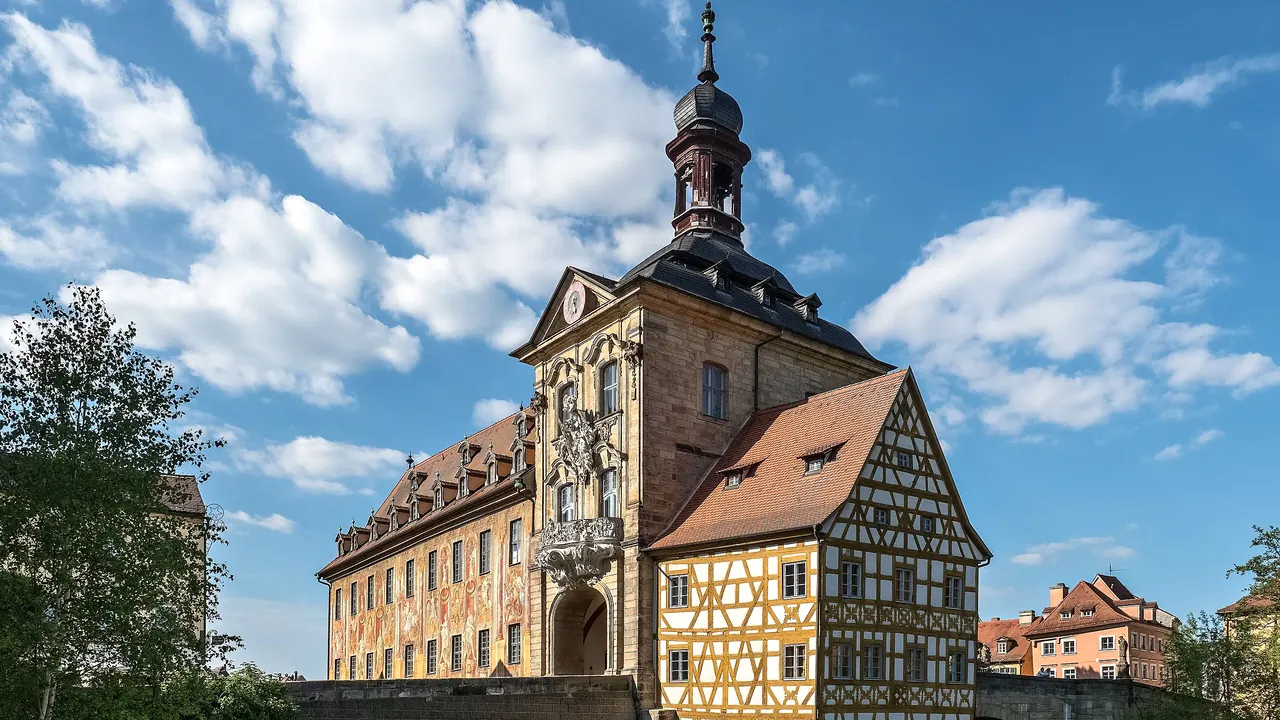
Bamberg has the more remarkable townscape. It escaped serious wartime damage, and the whole centre is UNESCO-listed: the Imperial Cathedral with the Bamberg Horseman, the Neue Residenz, the frescoed town hall standing in the river, and the fishermen's houses of Little Venice. Even the market gardens within the town are part of the heritage.
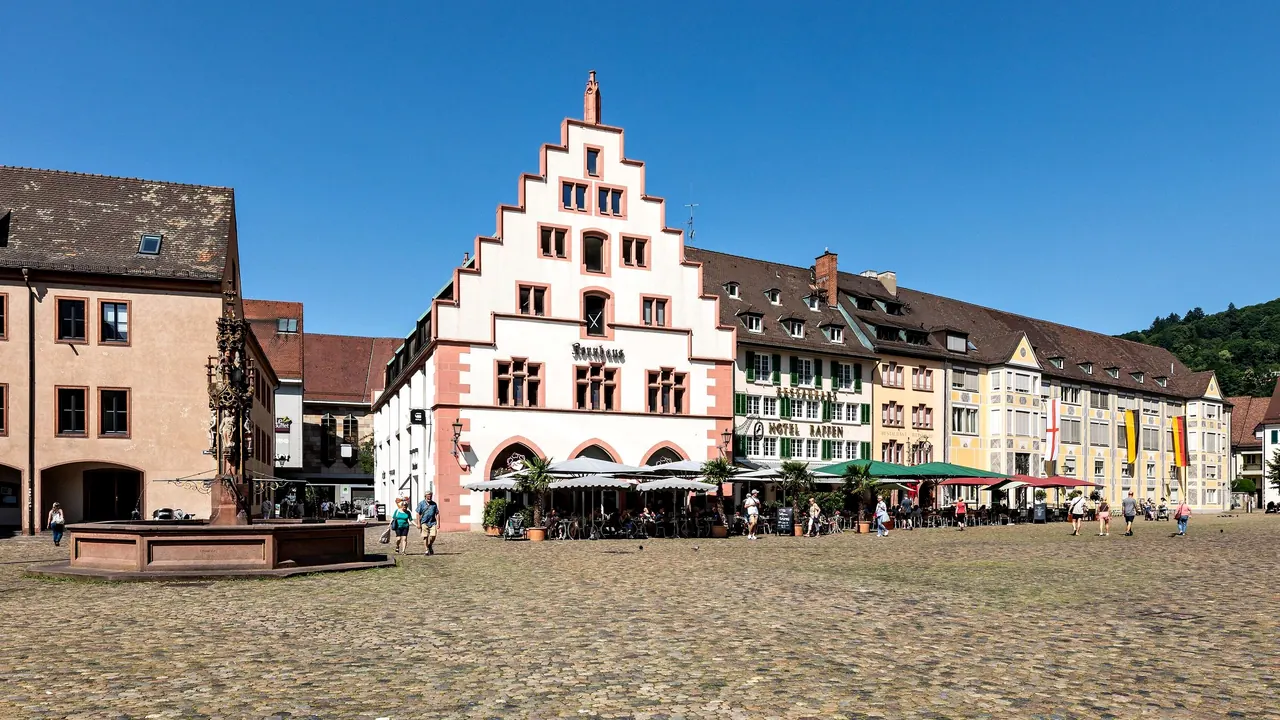
Freiburg's Münster, with its open-lace tower, is a genuine highlight, and the Augustinermuseum has a stronger collection than anything in Bamberg. Around them, though, much of the centre was rebuilt after the bombing. It makes a satisfying day or two rather than a place to wander for longer.
Nightlife
Freiburg makes for the livelier evening. It has a larger student population, pubs and wine bars around the Martinstor, summer crowds on the squares and along the Dreisam, and a few clubs playing techno and indie.
In Bamberg the night belongs to beer: brewery taverns after work, the student bars of the Sand quarter, and long summer evenings in the beer cellars. It goes quiet early, and people head to Nuremberg for a proper night out. Both are noticeably busier during university term.
Nature & outdoors
This is where Freiburg pulls well ahead. The Black Forest rises straight behind the old town, a cable car climbs the Schauinsland to about 1,280m with views towards the Alps, and the Feldberg offers summer hiking and winter snow. Gorge walks, mountain biking and Kaiserstuhl vineyard cycling fill out the choice.
Bamberg's surroundings are softer: the limestone valleys and rock towers of Franconian Switzerland under an hour away, the Steigerwald beech woods, and flat river cycle paths. They are lovely for easy walks between village breweries, but there are no mountains.
Day trips
Both make excellent bases, and Freiburg has the edge in variety. Three countries are within easy reach: Basel by train, Colmar and the Alsace wine villages, Strasbourg, and Baden-Baden to the north.
Bamberg's trips stay within Franconia, but they are strong ones: Nuremberg's castle, the Würzburg Residence, Coburg, Bayreuth's opera house, and the baroque basilica of Vierzehnheiligen. Rothenburg makes a longer day out. All are reached easily by train.
Good for families
Freiburg is far easier with children. They can float toy boats along the Bächle, visit the animals at Mundenhof and ride the cable car up the mountain. Europa-Park, Germany's biggest theme park, is about 40 minutes away, and there are swimming lakes in summer. Rainy days are its weak point.
Bamberg is safe and relaxed, with playgrounds in the Hain, boats to hire on the Regnitz and a leisure pool with slides. Beyond that, the sights are mostly churches, and the steep cobbles make pushchairs hard work.
Getting around
Both centres are compact enough to walk, and neither calls for a car. Freiburg is easier overall. Its old town is largely car-free and flat, trams reach the suburbs and the cable car, the cycle network is excellent, and regional trains run into the Black Forest. Many hotels also give guests a pass for local transport.
Bamberg relies on its feet and its buses. Distances are short, but the climbs to the cathedral and Michaelsberg are steep and cobbled, and the station is a fair walk from the old town.
Shopping & style
What you take home from Bamberg is mostly edible or old: bottled smoked beer from the brewery shops, produce from the town's market gardens, and finds from the antique dealers around the cathedral quarter. Freiburg's Münster market sells Baden wine, schnapps, Black Forest ham and crafts, and cuckoo clocks and wood carvings are on sale all over town.
Beyond the souvenirs, the two are much alike. Each has a pedestrian street of German chains, Lange Strasse in Bamberg and Kaiser-Joseph-Strasse in Freiburg, with a few independent bookshops and boutiques nearby. Freiburg's Gerberau and Konviktstrasse lanes give it slightly more to browse, and Basel is close enough for serious retail.
Affordability
Bamberg is the cheaper stay. Beer and tavern meals cost little, rooms are moderately priced for most of the year, and walking everywhere keeps transport costs down. Weekends and the Christmas market season are tighter.
In Freiburg, the hotels are the main expense, since rooms are scarce for the demand, especially on summer weekends and during trade fairs. Day-to-day spending is gentler, with market snacks, student-quarter restaurants and free entry to the Münster. Excursions into Switzerland add to the bill.
Live music & performing arts
Bamberg's orchestra is the bigger name. The Bamberg Symphony has a real international reputation, and the town adds drama at the ETA Hoffmann Theatre and organ and choral concerts in the cathedral. There is no resident opera, but in festival season the Bayreuth Festival is only an hour away.
Freiburg has more variety on stage. Its municipal theatre runs opera, drama and dance in repertory, the Freiburger Barockorchester is one of Europe's leading period-instrument ensembles, and every summer the Zelt-Musik-Festival puts on concerts in a tent village on the edge of town.
Wellness & relaxation
Freiburg sits in spa country, and it shows. There is a thermal bath on the city's edge, Bad Krozingen and Badenweiler are a short ride south, and Baden-Baden is reachable by train. Café terraces and Dreisam riverside paths set an easy pace.
In Bamberg, the relaxation is mostly about the pace of the town: river mornings, beer-garden afternoons and quiet evenings once the day visitors leave. For proper thermal bathing, the brine pools of Bad Staffelstein are about half an hour away.
When should you go?
Pick your month. The climate figures are measured averages, not a forecast.
Bamberg in July
Freiburg in July
Daytime high, °C
Rainfall in the month, mm
Temperature and rainfall are climate normals, averaged over the years shown. Bamberg: 1991-2020 normals, Bamberg (2.8 km from centre). Freiburg: 1991-2020 normals, Freiburg (0.6 km from centre).
The two towns follow much the same year, with Freiburg a degree or two milder and noticeably sunnier, but also wetter. July is the warmest month in both, around 26°C in Bamberg and 27°C in Freiburg. That is warm enough for the river spot, the gravel-pit lakes and the open-air pools, though the Black Forest lakes stay cool. Winters are grey and cold for walking in both, with Bamberg's January highs only about 4°C.
Rainfall makes the clearest difference. Bamberg is fairly dry all year, and even its wettest month, July, sees under 80mm. Freiburg's rain rises sharply in late spring, peaking at about 103mm in May, and stays heavier through summer and autumn. For Bamberg, May to September is the best time for beer gardens and walking. In Freiburg, the sunny weeks of June and September are the sweet spot for hiking, while the higher slopes hold snow in winter.
Which traveller are you?
On a family trip with children, Freiburg is the clear choice. Kids can splash in the Bächle and ride the Schauinsland cable car, the Mundenhof animal park is free, and Europa-Park is a short drive away. Bamberg's cobbled hills and church-centred sights offer young visitors far less.
For an outdoors trip, Freiburg wins by a long way. Ridge trails, the Feldberg for hiking or skiing, mountain biking and Kaiserstuhl cycling all start close to town. Bamberg's countryside is gentle, with brewery-to-brewery walks and riverside cycle paths, but no mountains or big views.
On a culture and arts trip, Bamberg rewards more. Its whole old town is intact and UNESCO-listed, with the four-towered cathedral, the island town hall and the hilltop abbey. Freiburg has a fine Münster and the Augustinermuseum, but much of its centre is a careful postwar rebuild.
Before you go
| Measure | Bamberg | Freiburg |
|---|---|---|
| Official language | German | German |
| Currency | Euro (EUR) | Euro (EUR) |
| Sockets | CF230 V, 50 Hz | CF230 V, 50 Hz |
| Driving side | Right | Right |
| Time zone | UTC+1, UTC+2 in summer | UTC+1, UTC+2 in summer |
| Emergency number | 112 | 112 |
| Elevation | 262 m | 278 m |
| Main airport | Nuremberg Airport (NUE)46 km from centre56 non-stop destinations | EuroAirport Basel–Mulhouse–Freiburg (BSL)50 km from centre112 non-stop destinations |
| Public holidays this year | 12 days | 12 days |
By the numbers
| Measure | Bamberg | Freiburg |
|---|---|---|
| City population | 77,218 | 238,299 |
| People per km² | 1,414 | 1,558 |
| Museums within 10 km | 11 | 13 |
| UNESCO World Heritage sites within 50 km | 1 | 2 |
Where else could you go?
Every comparison below shares a destination with this one, so you can follow Bamberg or Freiburg somewhere new.
- Colmarvs Freiburg
- Nurembergvs Bamberg
- Baselvs Freiburg
- Strasbourgvs Freiburg
- Rothenburg ob der Taubervs Bamberg
- Zurichvs Freiburg