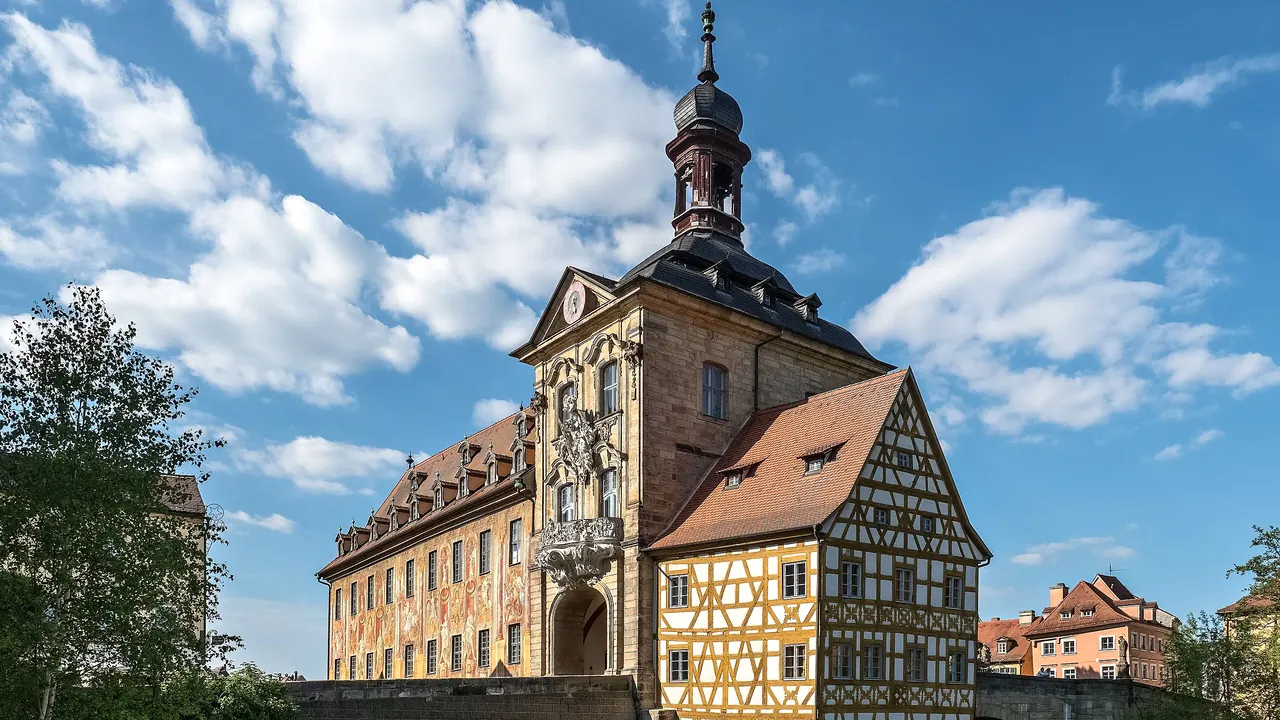
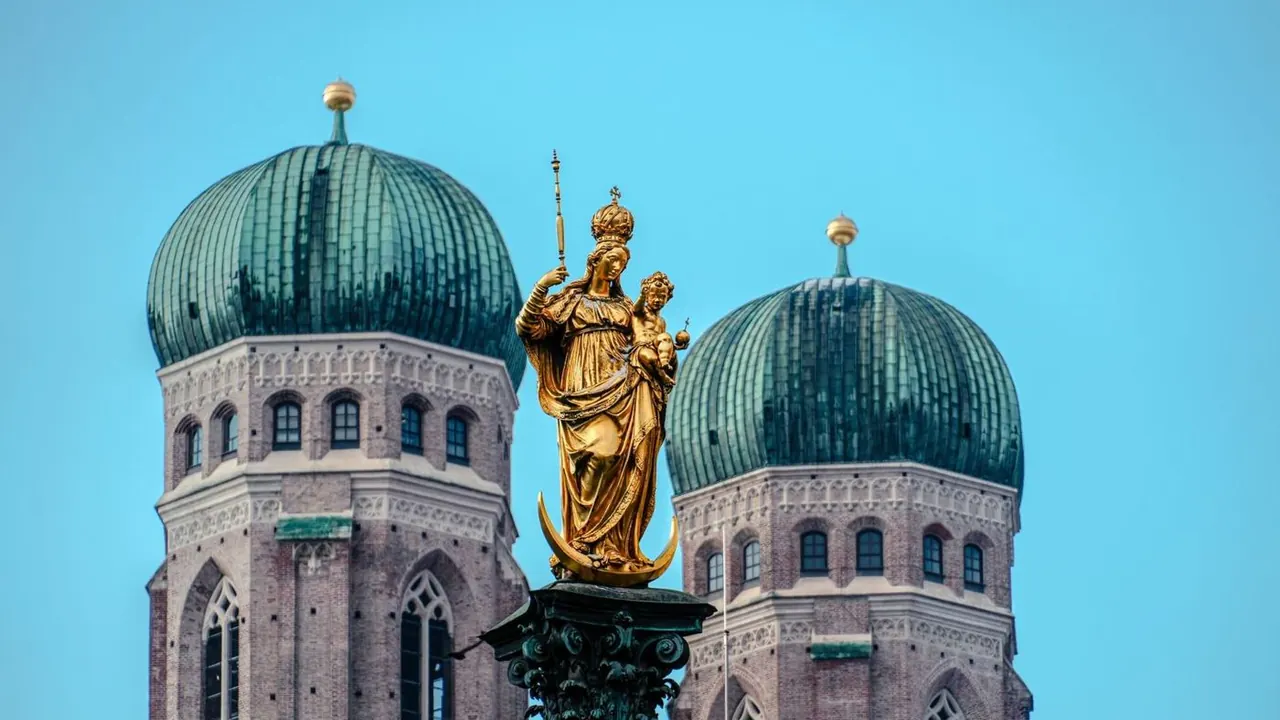
Photos: Bamberg by Ermell, CC BY-SA 4.0, cropped; Munich by 0xd1ma, Pexels License.
Bamberg or Munich?
Our verdict in twelve categories, each scored against the same fixed benchmark cities, and the climate month by month, so you can choose for your trip.
Choose Bamberg for
- prices
Bamberg is the better choice for a slower, smaller trip built around walking and beer. Its whole old town survived the war intact, so the pleasure is in wandering from the island town hall to the cathedral hill and Little Venice, then ending the day in a brewery tavern or a hillside beer cellar. It costs less than Munich, and it makes a sound base for Nuremberg, Würzburg and Bayreuth. Expect quiet evenings and little to shop for.
Choose Munich for
- shopping
- live music and the arts
- families
Munich suits travellers who want more from every day: great art collections, a world-class opera house, the Alps and the lakes within reach, and a city that works easily for children. It has livelier nights, far better shopping and a proper bathing culture, and its trains and trams make all of it simple to reach. The catch is the bill, especially for hotels.
Scoreboard
Twelve categories on one fixed scale from 0 to 100. The shaded stretch is the gap between the two.
Your match
Pick a travel style or drag the sliders, and both match scores follow your weighting.
Wins on prices with your weighting.
Wins on shopping and live music and the arts with your weighting.
What matters to you?
Category by category
What the scores mean for a trip.
Beaches & swimming
Neither city is a beach destination, but Munich gives a summer swimmer more to work with. The gravel banks of the Isar at the Flaucher are a short ride from the centre, and the Starnberger See and the Ammersee, with lawns, jetties and clear, fresh alpine water, are under an hour by S-Bahn.
Bamberg's swimming is more modest: the old river bathing spot in the Hain park, gravel-pit lakes on the edge of town and public pools. Fine for cooling off after a walk, not for a day out.
Food & drink
Beer drives the table in both, and both serve the same kind of hearty roast pork and dumplings, so the difference is one of character. Bamberg is about small breweries and the smoky Rauchbier poured from wooden barrels, with summer evenings at the Bierkeller on the hillsides and village breweries all around.
Munich works on a bigger scale: the great brewery beer halls, litres of Helles, white sausage before noon and the Viktualienmarkt for snacks. It also has the starred restaurants and the Italian, Turkish and Balkan kitchens that Bamberg largely lacks.
Culture & sights
Munich has the greater cultural offer, mainly because of its collections. The Alte Pinakothek and its neighbours in the Kunstareal, the Residenz, Nymphenburg and the Deutsches Museum could fill a week, and the Dachau memorial lies just outside the city.
Bamberg's strength is the townscape itself. Its UNESCO-listed centre survived the war largely untouched, while much of Munich's old town was rebuilt. The four-towered cathedral, the Old Town Hall on its island and the fishermen's houses of Little Venice reward a slow walk more than a museum list.
Nightlife
Munich offers a fuller night out. The cocktail and gay bars of the Glockenbachviertel and Gärtnerplatz, the student pubs of Schwabing and a few serious techno clubs open until morning give it range, and the Oktoberfest tents take over the city each autumn.
In Bamberg the evening means a brewery tavern, a summer beer cellar or the student bars of the Sand quarter in term time, and the town is mostly quiet well before the small hours. Locals who want to dance take the train to Nuremberg.
Nature & outdoors
Munich has the mountains on its doorstep. The Wetterstein and the Zugspitze, Tegernsee and the Isar valley are reachable by train for alpine hiking in summer and skiing in winter, and in town the English Garden even has surfers riding the Eisbach wave.
Bamberg's countryside is softer. Franconian Switzerland, with its limestone valleys, rock towers and castle crags, starts within an hour, and the Steigerwald forests and the cycle paths along the Main make for pleasant walking and riding, often from one village brewery to the next.
Day trips
Both are good bases, and both reach Nuremberg in about an hour, but Munich's list is longer and more varied. Salzburg and Innsbruck sit across the border, Augsburg and Regensburg are close by, and the royal castles of Neuschwanstein and Herrenchiemsee are classic outings.
From Bamberg the trips stay within Franconia: Würzburg's Residence, Coburg's fortress, Bayreuth's opera houses and the baroque basilica of Vierzehnheiligen, with Rothenburg at the end of a long day.
Good for families
Munich is much easier with children. The Hellabrunn zoo, the hands-on sections of the Deutsches Museum, the transport museum, the English Garden and the lake beaches give plenty of easy days, and the transport takes pushchairs without trouble.
Bamberg is safe and relaxed, and the Hain park, rowing boats on the Regnitz and the leisure pool help. But its sights are churches and old streets, and the cobbled climb to the cathedral is hard with a pushchair.
Getting around
Bamberg needs little more than comfortable shoes. The old town is small enough that the island town hall, the cathedral hill and the riverside houses of Little Venice are an easy stroll from one another, and buses or a bicycle cover the trip out to the station and the outer districts. The effort comes on the short, steep cobbled lanes up to the cathedral and Michaelsberg.
Munich is the easier city to get around. It has a compact, largely car-free centre and, on top of that, a full network of U-Bahn, S-Bahn, trams and buses on one system, running out to Nymphenburg, the Olympic Park, the airport and the lakes. The flat streets suit cycling, and regional trains handle the day trips. The weak spot is the shared central S-Bahn line, which is prone to hold-ups.
Shopping & style
Munich is the shopping city of the two. Maximilianstrasse and the Theatinerstrasse arcades hold the luxury houses, Neuhauser Strasse carries the department stores, and Glockenbach and Schwabing add independent design. The distinctive buy is Tracht from specialist tailors.
Bamberg fills an hour rather than a day: chain stores and bookshops around Grüner Markt, and better souvenirs in market garden produce, bottled smoked beer and the antique dealers near the cathedral.
Affordability
Bamberg is noticeably cheaper. Its hotels are moderately priced for most of the year, a tavern meal costs less than in a big German city, and walking replaces transport.
Munich is Germany's most expensive city, and its hotels show it, above all during the Oktoberfest and the big trade fairs. A picnic in a beer garden, the free parks and lakes and the token Sunday entry to several museums ease the bill, but only a little.
Live music & performing arts
Munich is one of Europe's great music cities. The Bavarian State Opera at the National Theatre, three orchestras of real standing, the rococo Cuvilliés Theatre and strong German-language drama at the Residenztheater and Kammerspiele give a full season of evenings.
Bamberg has one real asset in the Bamberg Symphony, an orchestra of international reputation, plus drama at the ETA Hoffmann Theatre and concerts in the cathedral. It has no opera company of its own, though the Bayreuth Festival is an hour away.
Wellness & relaxation
Munich has a true bathing culture. The Art Nouveau Müller'sches Volksbad on the Isar, the textile-free public saunas with infusion rituals, the vast thermal baths at Erding and the spa towns of Bad Tölz and Bad Reichenhall offer plenty of ways to unwind.
Bamberg relaxes you mostly through its pace, with quiet riverside mornings and a town that empties of day visitors by evening. For proper thermal bathing, the warm brine pools at Bad Staffelstein are half an hour away by train.
When should you go?
Pick your month. The climate figures are measured averages, not a forecast.
Bamberg in July
Munich in July
Daytime high, °C
Rainfall in the month, mm
Temperature and rainfall are climate normals, averaged over the years shown. Bamberg: 1991-2020 normals, Bamberg (2.8 km from centre). Munich: 1991-2020 normals, München (1.9 km from centre).
Through the year the two cities have almost the same temperatures. Winters are cold, with daytime highs around 4°C in December and January, and both peak in July and August at about 25°C. May to September is the comfortable stretch for walking the streets, and June to early September is warm enough for a swim in the rivers and lakes. Spring and autumn are mild and good for sightseeing in either city, while winter suits Christmas markets and indoor sights more than long walks.
The real difference is rain. Munich's summer is much wetter, with well over 100mm a month from May to August, against a July peak of 79mm in Bamberg, so a summer trip to Bamberg is more likely to stay dry. Bamberg's April and September are especially good for walking: mild, fairly dry and reasonably sunny. Munich gets a little more sunshine all year, and the gap is widest in the dull winter months.
Which traveller are you?
On a tight budget, Bamberg goes further. Hotels and guesthouses are moderately priced for most of the year, beer and tavern meals are cheap, and the whole old town is walkable, whereas Munich's hotels are among the dearest in Germany.
On a family trip with children, Munich is far easier. It has the Hellabrunn zoo along the Isar, the hands-on Deutsches Museum, playgrounds in every park and transport that takes pushchairs, while Bamberg offers a river park and a leisure pool but steep cobbles.
For an outdoors trip, Munich wins clearly. The Alps around Garmisch and the Zugspitze are reachable by train for hiking or skiing, the Five Lakes suit sailing and cycling, whereas Bamberg's countryside is gentle limestone valleys and beech forest.
Before you go
| Measure | Bamberg | Munich |
|---|---|---|
| Official language | German | German |
| Currency | Euro (EUR) | Euro (EUR) |
| Sockets | CF230 V, 50 Hz | CF230 V, 50 Hz |
| Driving side | Right | Right |
| Time zone | UTC+1, UTC+2 in summer | UTC+1, UTC+2 in summer |
| Emergency number | 112 | 112 |
| Elevation | 262 m | 519 m |
| Main airport | Nuremberg Airport (NUE)46 km from centre56 non-stop destinations | Munich Airport (MUC)29 km from centre211 non-stop destinations |
| Public holidays this year | 12 days | 12 days |
By the numbers
| Measure | Bamberg | Munich |
|---|---|---|
| City population | 77,218 | 1,505,036 |
| People per km² | 1,414 | 4,844 |
| Museums within 10 km | 11 | 75 |
| UNESCO World Heritage sites within 50 km | 1 | 1 |
Where else could you go?
Every comparison below shares a destination with this one, so you can follow Bamberg or Munich somewhere new.
- Nurembergvs Bamberg
- Rothenburg ob der Taubervs Bamberg
- Innsbruckvs Munich
- Salzburgvs Munich
- Karlovy Varyvs Bamberg
- Nurembergvs Munich