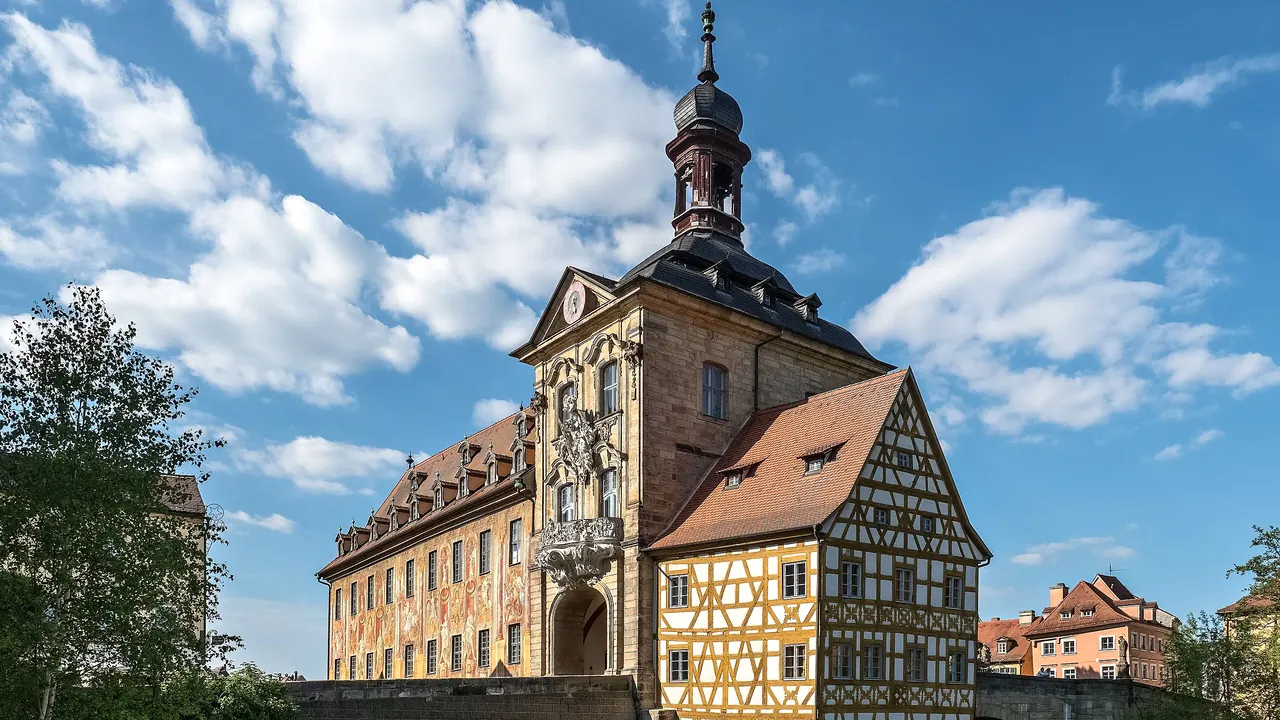
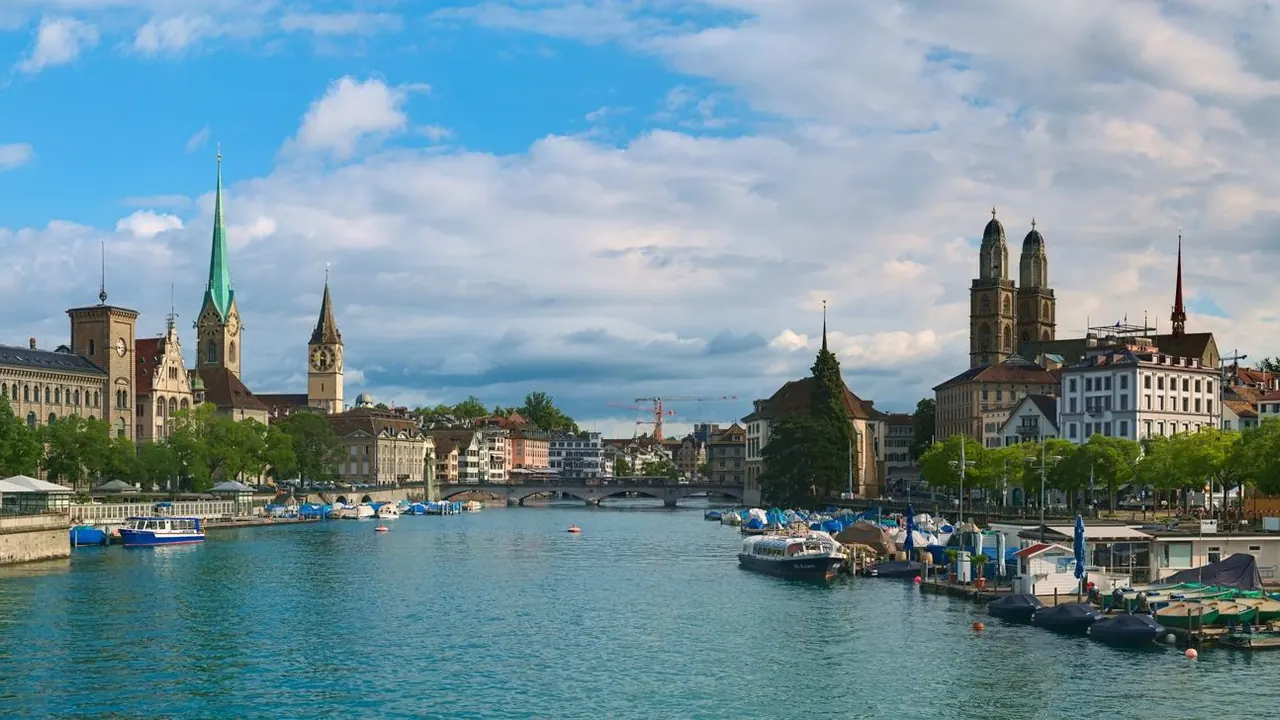
Photos: Bamberg by Ermell, CC BY-SA 4.0, cropped; Zurich by Daniel Kraft, CC BY-SA 3.0, cropped.
Bamberg or Zurich?
Our verdict in twelve categories, each scored against the same fixed benchmark cities, and the climate month by month, so you can choose for your trip.
Choose Bamberg for
- prices
- culture and sights
- food and drink
Bamberg suits travellers who want to walk through a historic German town that has survived almost whole. You get a cathedral hill, a town hall standing in the river and riverside fishermen's houses, then spend the evening in a brewery tavern or a hillside beer cellar. It is a slow, beer-centred stay at ordinary German prices, and a good base for exploring Franconia by train.
Choose Zurich for
- beaches
- families
- shopping
Zurich is the better pick if your budget can take one of the most expensive cities in Europe. In return you can swim in the lake in summer, see the Alps within an hour, go to the opera or a club that runs until morning, and get around on trams that make every trip easy. Families and anyone who wants mountains on the itinerary will find far more here.
Scoreboard
Twelve categories on one fixed scale from 0 to 100. The shaded stretch is the gap between the two.
Your match
Pick a travel style or drag the sliders, and both match scores follow your weighting.
Wins on prices and culture and sights with your weighting.
Wins on beaches and families with your weighting.
What matters to you?
Category by category
What the scores mean for a trip.
Beaches & swimming
Neither city has a sea, but Zurich treats its lake like a coastline in summer. There are wooden bathing houses and lawned lidos along the shore, the clear lake warms up enough for a proper swim, and at the Letten river baths people float downstream on the Limmat's current.
Bamberg has less to offer: the long-standing river bathing spot in the Hain park, gravel-pit lakes on the edge of town and public pools. That is enough to cool off on a hot afternoon. In both cities you swim from grass or decks, not sand.
Food & drink
Bamberg is the stronger place to eat and drink, and the reason is beer. The town is packed with small breweries serving smoky Rauchbier from wooden barrels, and in summer people move up to the Bierkeller beer gardens under the chestnut trees. Meals are hearty, cheap Franconian dishes such as Schäufele and dumplings.
Zurich's food is more polished and has a wider range. There is veal with rösti and fondue in the old guild houses, international and fine dining around Kreis 4 and 5, and excellent chocolate, including the Luxemburgerli from the old tea rooms on Paradeplatz. It lacks Bamberg's strong local character, though, and costs much more at every level.
Culture & sights
Bamberg has the more remarkable townscape. Its whole old town is UNESCO-listed and came through the war almost undamaged, so a walk takes in the four-towered cathedral, the frescoed Old Town Hall on its island in the Regnitz, the Little Venice waterfront and Michaelsberg Abbey above. Its museums are small, though.
Zurich works the other way round. Its Altstadt is pleasant and compact, with the Grossmünster and the Chagall windows of the Fraumünster, but its strength is indoors. The Kunsthaus, the Swiss National Museum and the Museum Rietberg give it collections that Bamberg cannot match.
Nightlife
Zurich is the place for a real night out. Electronic music runs deep here, clubs in Kreis 4 and 5 and Zurich West stay open until morning at weekends, and Langstrasse stays busy late. Each August the Street Parade brings a huge techno crowd to the lake shore. The only brake is the price of a round.
In Bamberg, evenings mean a beer rather than dancing. People fill the brewery taverns and summer beer cellars, and the student bars in the Sand quarter stay lively during term. Most of the town is asleep well before the small hours, and anyone wanting clubs takes the train to Nuremberg.
Nature & outdoors
Zurich has the more dramatic scenery. On clear days the Glarus Alps rise beyond the far end of the lake, and the Uetliberg ridge is a short train ride from the centre. Rigi, Pilatus and real alpine hiking are about an hour away, with day skiing at Flumserberg in winter.
Bamberg's countryside is gentle rather than grand. Franconian Switzerland, with its limestone valleys, caves and rock towers, starts less than an hour east, and there are beech forests in the Steigerwald and cycle paths along the Main and Regnitz. Hiking routes link one village brewery to the next, but there are no big mountain views.
Day trips
Both cities sit on good rail lines, so day trips without a car are easy from either. Zurich's range is wider. Lucerne is under an hour away and Bern and Basel about an hour, and you can also reach the Rhine Falls, Stein am Rhein's painted houses and the abbey library at St Gallen, so lakes and waterfalls go alongside the cities.
From Bamberg, the trips stay within Franconia. Nuremberg's castle, Würzburg's Residence, and Bayreuth's opera houses and Coburg's fortress are all about an hour or less away. The baroque basilica of Vierzehnheiligen is nearer still, and Rothenburg makes a long but worthwhile day.
Good for families
Zurich is much better set up for children. The zoo, with its indoor Madagascar rainforest hall and elephant park, is a full day out on its own. In summer the lake lidos and boat trips fill the afternoons, and the Technorama science centre and Lucerne's Transport Museum are easy to reach by train.
Bamberg is safe and relaxed, with playgrounds and boat hire in the Hain park, a leisure pool with slides, and beer gardens where children play between the tables. Beyond that, the sights are mostly churches, and the cobbled climb to the cathedral is hard going with a pushchair.
Getting around
In both cities you can manage without a car. Bamberg's centre is small enough to walk: the island town, the cathedral hill and Little Venice are minutes apart, though the climbs over uneven cobbles are steep and the station is a fair walk from the old town.
Zurich is easier still. Trams reach every district, and buses, S-Bahn trains, funiculars and even the lake boats all use one ticket. The airport is a short train ride from the main station.
Shopping & style
Zurich is the shopping city. Bahnhofstrasse runs from the station to the lake past watchmakers, jewellers and long-established department stores, and the old railway viaduct arches in Zurich West hold design shops, so luxury and watches are what it does best.
In Bamberg, shopping fills an hour between sights. The best things to bring home are local: vegetables from the market gardens, bottled Rauchbier from the brewery shops and finds from the antique dealers near the cathedral.
Affordability
Here Bamberg wins by a long way. It has ordinary Western European prices, cheap local beer and filling tavern meals, and you will spend almost nothing on transport. Rooms only get scarcer and dearer at weekends and in Christmas market season.
Zurich is among the most expensive cities in the world to visit. Simple hotel rooms, casual lunches and a round of drinks all cost far more than in most European capitals. Supermarket picnics, free lidos and the visitor card help, but only a little.
Live music & performing arts
Zurich has the bigger stage. The Opernhaus on the lake runs a full season of opera and ballet, the Tonhalle Orchestra plays in a restored nineteenth-century hall, and the Schauspielhaus is a leading German-language theatre. For something less formal, the Rote Fabrik and the clubs of Kreis 4 and 5 host jazz, indie and touring bands.
Bamberg's strength is classical music. The Bamberg Symphony has a real international reputation, and the cathedral holds organ and choral concerts. There is no opera company in town, but the Bayreuth Festival is an hour away.
Wellness & relaxation
Zurich has more proper bathing in the city itself. Thermal pools fill the stone vaults of the old Hürlimann brewery, with a rooftop pool above, and in the colder months the wooden lake houses become saunas with cold dips between sessions. Baden's hot springs are about twenty minutes away by train.
Bamberg relaxes you mainly through its pace: mornings by the river and long afternoons in the beer gardens. For thermal water you take the train to Bad Staffelstein's brine pools, about half an hour away.
When should you go?
Pick your month. The climate figures are measured averages, not a forecast.
Bamberg in July
Zurich in July
Daytime high, °C
Rainfall in the month, mm
Temperature and rainfall are climate normals, averaged over the years shown. Bamberg: 1991-2020 normals, Bamberg (2.8 km from centre). Zurich: 1991-2020 normals, Zurich Town / Ville. (2.2 km from centre).
The two cities have similar temperatures through the year. Both are pleasant for walking from May to September, and Bamberg's summer is slightly warmer, peaking around 26°C in July against Zurich's 24°C. The real difference is rain. Bamberg stays fairly dry all year, and even its wettest month, July, brings only about 79mm. Zurich gets much wetter from May to August, with around 126mm in each of those months, so plan for some grey or showery summer days there. Summer is also the only time the lake and river baths are open for swimming.
Winters are cold and dark in both, with daytime highs of about 4°C from December to January and only a few hours of sunshine. Late spring and early autumn are the easiest times for a town stroll in Bamberg. In Zurich, September often brings drier, settled weather after the summer rain, and it is still mild enough for the lake shore and mountain walks.
Which traveller are you?
On a trip on a tight budget, Bamberg is the clear choice. The beer is cheap, a brewery tavern meal costs less than in big German cities, and the whole town is walkable. In Zurich, even picnics and free lidos only take the edge off very high prices.
On a family trip with children, Zurich does far more. The zoo has a Madagascar rainforest hall, the lake lidos have shallow areas for small children, and trams take buggies. The science centre in Winterthur is close by. In Bamberg, children get playgrounds and a leisure pool but steep cobbled lanes.
For an outdoors trip, Zurich wins easily. You can hike the Uetliberg ridge from the city, Rigi and Pilatus are about an hour away, and you can ski at Flumserberg in winter. Bamberg offers gentle walks through Franconian Switzerland's limestone valleys and cycling along the rivers, but no mountains.
Before you go
| Measure | Bamberg | Zurich |
|---|---|---|
| Official language | German | French, German, Italian, Romansh |
| Currency | Euro (EUR) | Swiss Franc (CHF) |
| Sockets | CF230 V, 50 Hz | CJ230 V, 50 Hz |
| Driving side | Right | Right |
| Time zone | UTC+1, UTC+2 in summer | UTC+1, UTC+2 in summer |
| Emergency number | 112 | 112 |
| Elevation | 262 m | 408 m |
| Main airport | Nuremberg Airport (NUE)46 km from centre56 non-stop destinations | Zürich Airport (ZRH)9 km from centre226 non-stop destinations |
| Public holidays this year | 12 days | 10 days |
By the numbers
| Measure | Bamberg | Zurich |
|---|---|---|
| City population | 77,218 | 440,935 |
| People per km² | 1,414 | 5,016 |
| Museums within 10 km | 11 | 63 |
| UNESCO World Heritage sites within 50 km | 1 | 1 |
Where else could you go?
Every comparison below shares a destination with this one, so you can follow Bamberg or Zurich somewhere new.
- Lucernevs Zurich
- Nurembergvs Bamberg
- Baselvs Zurich
- Rothenburg ob der Taubervs Bamberg
- Freiburgvs Zurich
- Interlakenvs Zurich