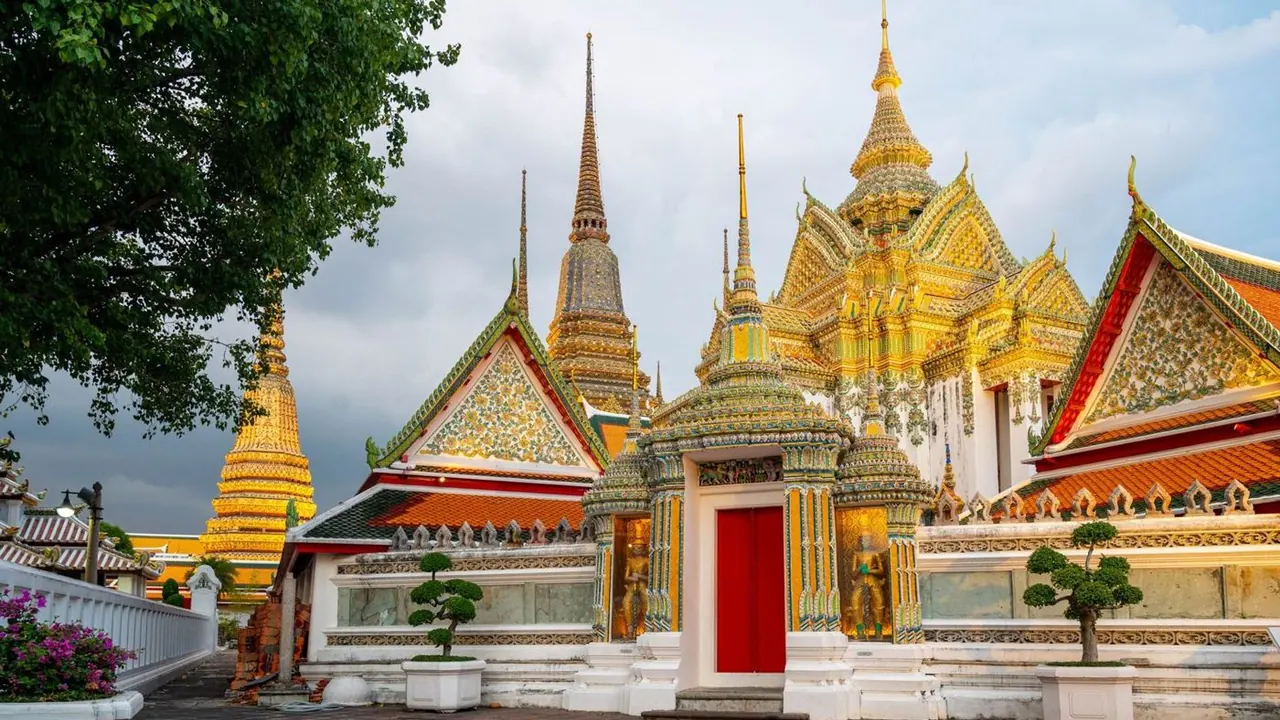
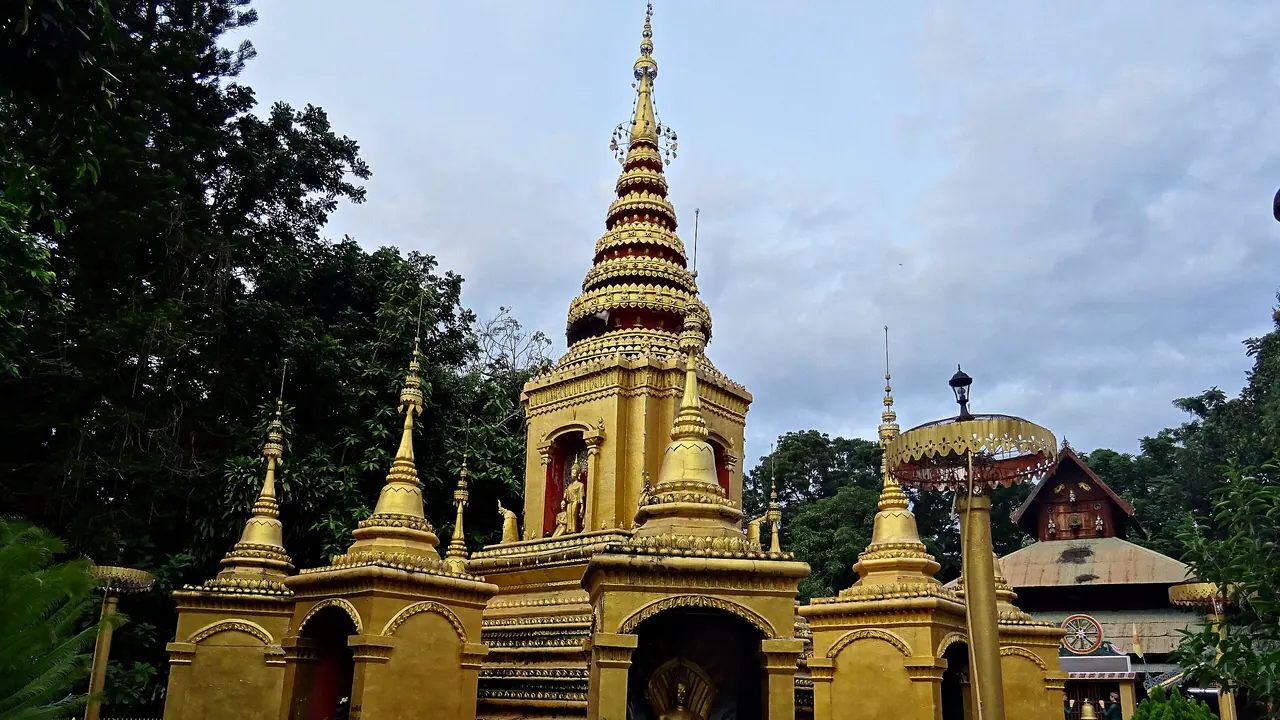
Photos: Bangkok by Lu Zhao, Pexels License; Pai by Christophe95, CC BY-SA 4.0, cropped.
Bangkok or Pai?
Our verdict in twelve categories, each scored against the same fixed benchmark cities, and the climate month by month, so you can choose for your trip.
Choose Bangkok for
- culture and sights
- food and drink
- day trips
Bangkok is the choice for a trip built around eating, sightseeing and late nights. The gilded temples of Rattanakosin, Chinatown's street kitchens, the malls of Siam and the rooftop bars along Sukhumvit give you more to do in a day than Pai offers in a week. Ayutthaya and the canal markets are within easy reach, and the rail lines make moving around simple, as long as you plan each day around one district.
Choose Pai for
- nature and the outdoors
- prices
- wellness
Pai suits travellers who want to slow down in green hill country. Its pleasures are rice fields, the canyon at sunset, waterfalls, hot springs and long, unplanned afternoons, all reached by scooter or a hired truck. There is little to see in town, the food is simple and evenings end early, so come for the valley and the quiet. It works best as a stop on a longer loop through northern Thailand.
Scoreboard
Twelve categories on one fixed scale from 0 to 100. The shaded stretch is the gap between the two.
Your match
Pick a travel style or drag the sliders, and both match scores follow your weighting.
Wins on culture and sights and food and drink with your weighting.
Wins on nature and the outdoors and prices with your weighting.
What matters to you?
Category by category
What the scores mean for a trip.
Beaches & swimming
Neither city is for a beach trip, and in both, swimming is something you fit around other plans. Bangkok's version is the hotel pool, often on a rooftop, and Pattaya or Bang Saen are a long day out by road.
Pai is further still from the sea, a long day's travel, but it has a river instead: tubing down the Pai River and splashing under waterfalls like Mo Paeng. For real sand, add the islands or Hua Hin to either itinerary.
Food & drink
This is one of the widest gaps between the two. Bangkok is a destination for eating in its own right, from boat noodles at plastic tables and Chinatown's street grills to Or Tor Kor's produce halls and restaurants reworking regional Thai cooking, with serious cocktails and Thai-grown coffee on top.
Pai eats well enough but simply. Its night market brings khao soi, skewers and Shan dishes, and its cafés serve vegan plates and smoothie bowls to long-stay travellers. Much of the menu is pitched at foreign tastes, and there is nothing to match Bangkok's depth.
Culture & sights
Bangkok holds some of Southeast Asia's great religious buildings on Rattanakosin Island: the Emerald Buddha, the Reclining Buddha, Wat Arun's porcelain tiers. Around them are the National Museum, the Jim Thompson House and the stilt houses along the Thonburi canals.
Pai offers a half day at most: the white Buddha of Wat Phra That Mae Yen, the wartime iron bridge and the mud-brick Yunnanese village of Santichon. People go there for the valley, not the sights.
Nightlife
Bangkok's nights come in several forms: polished cocktail bars and clubs in Thonglor and Ekkamai, Khao San's loud street drinking, Silom's long-established gay scene and rooftop bars high over the river. They run until around two, and later in a few areas.
Pai has a friendly, scruffy version on a much smaller scale. You get reggae bars, fairy-lit gardens and the odd party out of town, nearly all young backpackers, with no real clubs and most bars quiet soon after midnight.
Nature & outdoors
Pai is the clear winner outdoors. The whole point of going is the valley: rice fields ringed by forested hills, the eroded ridges of Pai Canyon, morning mist from Yun Lai, waterfalls a short ride away, and treks, rafting and Tham Lod cave further out.
Bangkok's green space is limited to parks such as Lumphini, with its monitor lizards, and the cycling paths of Bang Krachao. Khao Yai's forests and elephants are a two to three hour drive, so they need an overnight stay.
Day trips
Bangkok makes a good base for day trips. Ayutthaya's ruined capital is an easy day by train, and the floating markets, the Maeklong railway market and the great stupa at Nakhon Pathom lie in the canal country to the west. Kanchanaburi's Death Railway bridge is a long but workable day.
Pai is the opposite. Apart from the Lahu and Lisu villages around Soppong, the nearby attractions are landscape, and Chiang Mai and Mae Hong Son are three hours away on winding mountain roads, so they make a change of base rather than a day out.
Good for families
Bangkok has far more aimed at children: an aquarium under Siam Paragon, Safari World, Dream World, KidZania and big air-conditioned play areas in the malls, with the Skytrain and river boats as treats in themselves. The catch is the heat, the crowded pavements and slow traffic.
Pai suits older, outdoorsy children best, with farm visits, hot springs, tubing and the night market. The sick-making road up from Chiang Mai, the reliance on scooters and an evening scene geared to backpackers make it harder with small children.
Getting around
Bangkok has a rail network: the air-conditioned BTS and MRT link the main districts and the airport, express boats run along the river to the Grand Palace, and ride-hailing fills the gaps. The old city and the stretches between stations are the weak points, and walking in the heat is hard.
Pai's centre takes minutes on foot, but there is no public transport out to the canyon, waterfalls or springs. You rent a scooter, which is risky on the hill roads if you are new to riding, or hire a songthaew or join a tour.
Shopping & style
For shopping, Bangkok is in a different league. You have the chain of malls around Siam and Ratchaprasong, ICONSIAM on the river, Pratunam's wholesale clothing, and Chatuchak's thousands of weekend stalls, plus Thai silk, celadon and benjarong to take home.
Pai's shopping happens on the evening walking street: cotton trousers, woven bags, hill-tribe textiles and handmade jewellery. Much of it is local and fun to browse, but the stalls repeat one another, and anything bigger waits for Chiang Mai.
Affordability
Both are very cheap by Western standards, and the difference lies in where the money goes. In Bangkok a modest budget buys comfort, such as a rooftop-pool hotel, taxis and tailoring, and only imported drink, rooftop bars and the Grand Palace fee push costs up.
Pai is cheaper still at the simple end. Bungalows, night-market dinners and scooter rental cost very little, and most sights are free, which is why people stay for weeks. Prices are a little higher than in ordinary northern towns, though.
Live music & performing arts
Bangkok has staged performance worth planning an evening around. Khon masked drama at the Sala Chalermkrung and the National Theatre is the highlight, along with classical dance, the symphony orchestra at the Thailand Cultural Centre and the ritual music of Muay Thai at Rajadamnern.
Pai has no stage of any kind. What it does have is live music most nights: acoustic sets and blues or reggae jams in the bars, informal and uneven, something to come across rather than seek out.
Wellness & relaxation
Both are good places to unwind, but in different ways. Bangkok's strength is massage and spas: the traditional school at Wat Pho, late-opening foot-massage shops on every street and refined hotel spas by the river. You take your calm in short doses, though, against the noise and traffic.
Pai offers the slowness Bangkok lacks. You can soak in natural hot springs such as Tha Pai, join a yoga or meditation retreat, or simply lie in a hammock looking out over the rice fields. The treatments are simple rather than luxurious, and the spring haze takes the edge off.
When should you go?
Pick your month. The climate figures are measured averages, not a forecast.
Bangkok in July
Pai in July
Daytime high, °C
Rainfall in the month, mm
Where the figures come from
Pai's temperatures are measured 64 km from the centre, at Mae Hong Son.
Pai's station stands 242 m below the city centre, so the centre is likely a little cooler than the figures say.
Pai has no rain gauge within 25 km of the centre, so its rainfall comes from a gridded climate dataset read at the city rather than from a gauge further away.
Pai's sunshine is measured 86 km from the centre, at Chiang Mai.
Temperature and rainfall are climate normals, averaged over the years shown. Bangkok: 1991-2020 normals, Bangkok (5.7 km from centre). Pai: 1971-2000 (sunshine 1991-2020, rainfall 1991-2020) normals, Mae Hong Son (63.7 km from centre).
Both cities are best from November to February, when rain is scarce and the sun is out most days. Bangkok stays hot all year, with highs rarely below 32°C, so even its best months mean slow sightseeing and long breaks in air-conditioning. Pai is noticeably fresher at the turn of the year, with highs near 29°C in December and cool mornings that suit hot springs and misty viewpoints.
From March to April both heat up, Pai more sharply, and its valley fills with smoke from field burning, so it is the weaker choice in spring. The rains arrive in May in both, but Bangkok's wet season lasts longer and hits harder, peaking at over 300mm in September, while Pai's turns muddy through the summer and eases from October. Bangkok's nearest beaches have warm water all year, but they are a long road trip from the city.
Which traveller are you?
For a culture and arts trip, Bangkok wins easily. The Grand Palace, Wat Pho and Wat Arun, the National Museum and khon masked drama at the royal theatre fill several days, while Pai has one hilltop Buddha and a few small temples.
On a food and nightlife trip, Bangkok again. Yaowarat's night kitchens, market halls and ambitious Thai restaurants are among the best eating anywhere, and the bars run from rooftop cocktails to Khao San Road. Pai's walking street is pleasant but shallow, and closes around midnight.
On an outdoors trip, Pai is the place. Its valley offers canyon walks, waterfalls, hill-tribe treks, rafting and the great cave of Tham Lod, all close by. In Bangkok, outdoor life means parks and a bicycle loop through Bang Krachao.
Before you go
| Measure | Bangkok | Pai |
|---|---|---|
| Official language | Thai | Thai |
| Currency | Baht (THB) | Baht (THB) |
| Sockets | ABCF220 V, 50 Hz | ABCF220 V, 50 Hz |
| Driving side | Left | Left |
| Time zone | UTC+7 | UTC+7 |
| Emergency number | Police 191, ambulance 1669, fire 199 | Police 191, ambulance 1669, fire 199 |
| Elevation | 2 m | 509 m |
| Main airport | Suvarnabhumi Airport (BKK)26 km from centre150 non-stop destinations | Chiang Mai International Airport (CNX)86 km from centre28 non-stop destinations |
By the numbers
| Measure | Bangkok | Pai |
|---|---|---|
| City population | 5,676,648 | 3,598 |
| People per km² | 3,619 | - |
| Museums within 10 km | 61 | 0 |
| UNESCO World Heritage sites within 50 km | 0 | 0 |
| Swim season, months above 21 °C | 12 months | - |
Where else could you go?
Every comparison below shares a destination with this one, so you can follow Bangkok or Pai somewhere new.
- Ayutthayavs Bangkok
- Chiang Maivs Pai
- Pattayavs Bangkok
- Kanchanaburivs Bangkok
- Hua Hinvs Bangkok
- Chiang Raivs Pai