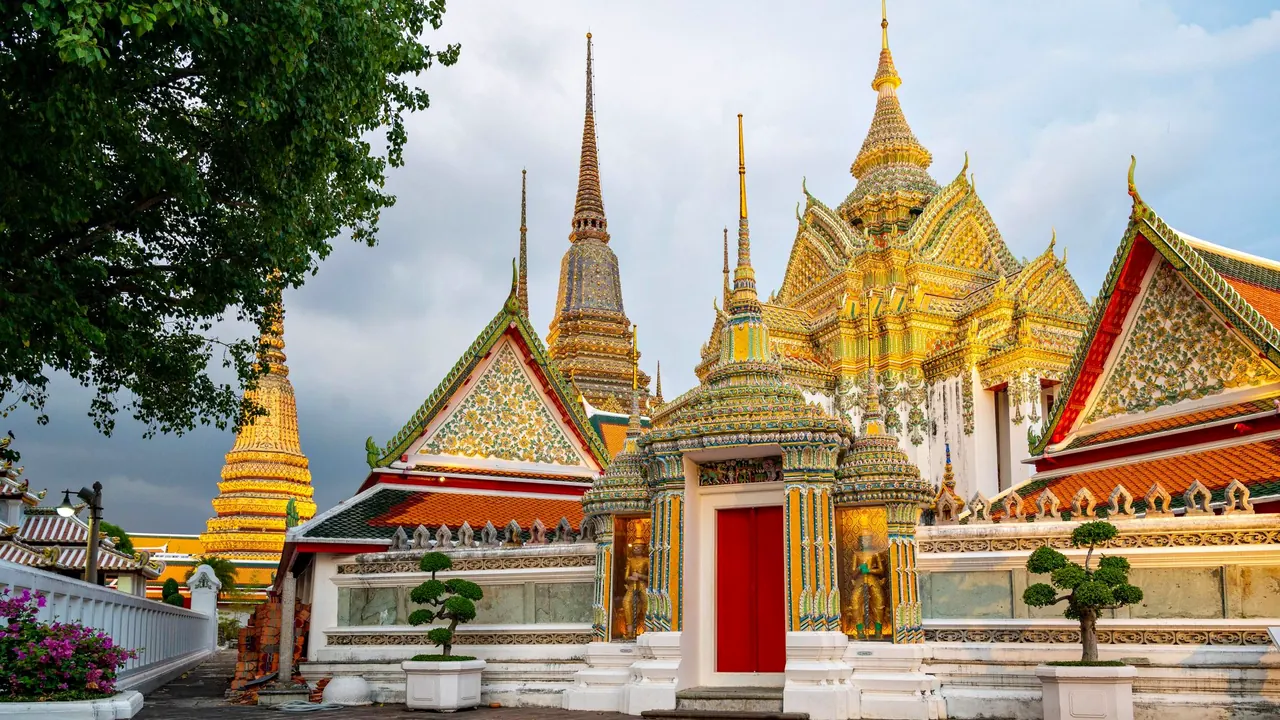
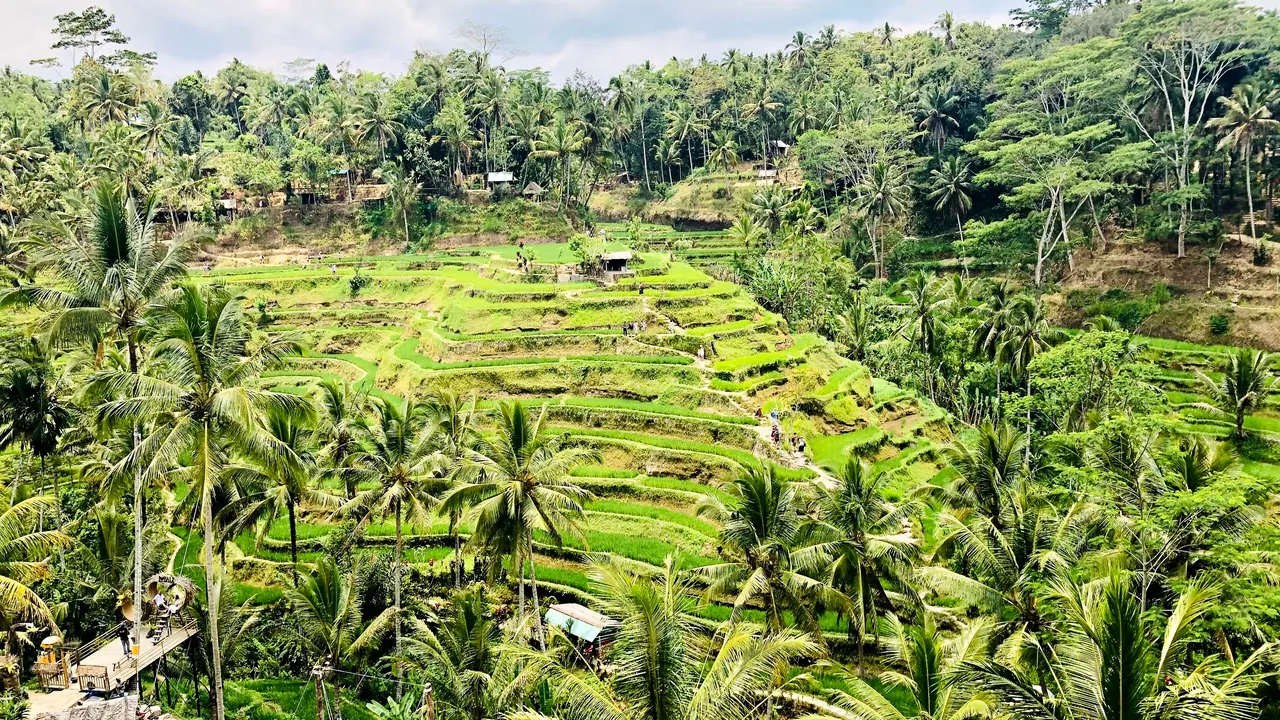
Photos: Bangkok by Lu Zhao, Pexels License; Ubud by Pinterpandai, CC BY-SA 3.0, cropped.
Bangkok or Ubud?
Our verdict in twelve categories, each scored against the same fixed benchmark cities, and the climate month by month, so you can choose for your trip.
Choose Bangkok for
- nightlife
- getting around
- food and drink
Bangkok suits travellers who want a big city with an appetite. You get kitchens on every street from Yaowarat to Banglamphu, the gilded temples of Rattanakosin Island, malls and Chatuchak market, and nights that run until the bars close. The Skytrain, metro and river boats also make it far easier to get around than Ubud, so a short trip can cover a lot.
Choose Ubud for
- nature and the outdoors
- beaches
- wellness
Ubud is the better pick for a slower trip built around landscape and rest. The rice terraces, river gorges and a dawn climb of Mount Batur are close by. Yoga and massage set the pace of the day, and the town is quiet by late evening. You give up great eating, shopping and late nights, and you depend on drivers. In return you get green views and real calm.
Scoreboard
Twelve categories on one fixed scale from 0 to 100. The shaded stretch is the gap between the two.
Your match
Pick a travel style or drag the sliders, and both match scores follow your weighting.
Wins on nightlife and getting around with your weighting.
Wins on nature and the outdoors and beaches with your weighting.
What matters to you?
Category by category
What the scores mean for a trip.
Beaches & swimming
Bangkok's stretch of the Gulf is mudflat, mangrove and fish farms, and a swim at Bang Saen or Pattaya takes up most of a day. Ubud has no beach either, but the sea is closer and better: Sanur's calm water inside the reef is under an hour's drive, depending on traffic. In both places, everyday swimming happens in a pool, on a hotel rooftop in Bangkok or in a villa overlooking the paddies in Ubud.
Food & drink
The gap here is wide, and it favours Bangkok. Yaowarat after dark, the curry counters in shophouses, the produce halls of Or Tor Kor and a deep tier of ambitious Thai restaurants mean you could eat something different at every meal for a week. Serious cocktails and good Japanese and Chinese cooking add to that.
Ubud eats well for a small town. Its babi guling counters and slow-cooked bebek betutu are worth seeking out, and the plant-based cafés draw a following of their own. The choice is much narrower, though, and the main street cooks mostly for visitors.
Culture & sights
Bangkok's monuments work on another scale. The Grand Palace and Wat Phra Kaew, the Reclining Buddha at Wat Pho and the porcelain tiers of Wat Arun across the river are backed by the National Museum, the Jim Thompson House and the canals of Thonburi.
Ubud's culture is smaller and more domestic: offerings on doorsteps, temple processions, the old royal palace and the Balinese painting collections at Neka, ARMA and Puri Lukisan, with Goa Gajah on the edge of town. It rewards a slow pace, but two or three days covers it.
Nightlife
This is the sharpest contrast between the two. Bangkok has cocktail bars of international standing in Thonglor and Ekkamai, the cheap street party of Khao San Road, Silom's long-running gay scene and rooftop bars high above the river, all busy until closing.
Ubud is a town for dinner and a drink, perhaps in a garden bar or with a band, and it is quiet before midnight. Anyone after clubs faces the long drive down to Seminyak or Canggu.
Nature & outdoors
Bangkok's outdoors comes down to parks: early runs in Lumphini past the monitor lizards, and an afternoon cycling the palm-shaded paths of Bang Krachao. Real countryside at Khao Yai or Kanchanaburi means an overnight trip.
Ubud sits inside the scenery people travel to Bali for. You can walk from town to the rice terraces on the Campuhan Ridge, raft the Ayung gorge, swim under jungle waterfalls such as Tibumana, and climb Mount Batur in the dark for sunrise over the crater lake.
Day trips
Both are good bases, but the trips differ in kind. From Bangkok they lead by train or road to history and canal life: the ruined capital at Ayutthaya, the floating markets, the Maeklong railway market and the Death Railway bridge at Kanchanaburi. Beyond these the list thins.
From Ubud nearly every trip goes to a temple or a terrace, and a hired driver takes you there: the holy spring of Tirta Empul, Besakih on the slopes of Mount Agung, Tanah Lot and the Jatiluwih rice terraces. Slow island roads decide how many fit into one day.
Good for families
Children get a warm welcome in both places, and both are tiring for small ones, with heat and poor pavements. What fills the day is different. Bangkok has attractions made for children, such as Sea Life Ocean World, Dream World, KidZania and air-conditioned play areas in the malls, plus the Skytrain to reach them.
Ubud offers rafting on gentle stretches of river, rice-field walks, dance shows and a villa pool instead. Every outing needs a car, and the Monkey Forest macaques grab at bags, so it suits older children who like the outdoors better than toddlers.
Getting around
Bangkok has a real network. The BTS Skytrain and MRT link the main districts and the airport, and the Chao Phraya Express boats stop near the Grand Palace. The old city lies off the rail lines and walking between stations is hot work, but days planned around one station or pier go smoothly.
Ubud has no public transport worth relying on, and steep valley roads, narrow pavements and scooter traffic make even short walks awkward. Most visitors hire a driver by the day or use ride-hailing apps.
Shopping & style
Bangkok is the far bigger shopping destination. It runs from the linked malls of Siam and Ratchaprasong and riverside ICONSIAM to the thousands of stalls at Chatuchak Weekend Market and the wholesale clothing of Pratunam, with Thai silk and celadon to take home.
Ubud has no department store or luxury shopping, but its craft villages each have a clear trade: woodcarving in Mas, silver in Celuk and painting in Batuan, plus the Art Market opposite the palace. Go there for handmade homeware and linen rather than fashion.
Affordability
Money goes a long way in both, with cheap meals, cheap massages and comfortable rooms at a fraction of Western prices. In Bangkok, street food and cheap public transport keep daily costs down, while rooftop bars and international restaurants are where the bill climbs.
Ubud's homestays with breakfast and its warungs are just as easy on a budget. Without public transport, though, a day driver becomes a regular expense, and the jungle resorts above the river valleys are among Bali's priciest stays. Imported drink is heavily taxed in both.
Live music & performing arts
Both are best for traditional dance rather than concerts. Bangkok's highlight is khon masked drama at the Sala Chalermkrung Royal Theatre and the National Theatre. The city also has a symphony orchestra, jazz bars and the ritual music of Muay Thai at Rajadamnern and Lumpinee.
Ubud's range is narrower, but performances happen every night: Legong, Barong and Kecak danced to live gamelan in the palace courtyard and in temple grounds, by village troupes with long traditions. If you come across the same dances at a real temple festival, it is a different experience again.
Wellness & relaxation
Bangkok is excellent for massage. You can be treated at the school inside Wat Pho, find late-opening parlours on every street and book some of Asia's most refined hotel spas. What it lacks is calm, so rest comes in short breaks from the heat and traffic.
In Ubud, rest is the whole point of the trip. Yoga runs from dawn in open pavilions, retreats last from a weekend to several weeks, and flower baths, traditional healers and the purification ritual at Tirta Empul are part of local life. The quiet of the rice fields is only a few steps from the main road.
When should you go?
Pick your month. The climate figures are measured averages, not a forecast.
Bangkok in July
Ubud in July
Daytime high, °C
Rainfall in the month, mm
Where the figures come from
Ubud's temperatures are measured 29 km from the centre, at Denpasar / Ngurah-Rai.
Ubud's station stands 209 m below the city centre, so the centre is likely a little cooler than the figures say.
Ubud has no rain gauge within 25 km of the centre, so its rainfall comes from a gridded climate dataset read at the destination rather than from a gauge further away.
Temperature and rainfall are climate normals, averaged over the years shown. Bangkok: 1991-2020 normals, Bangkok (5.7 km from centre). Ubud: 1991-2020 normals, Denpasar / Ngurah-Rai (29 km from centre).
The two run on almost opposite seasons. Bangkok is at its best from November to February, when the rain nearly stops (7mm in December) and the heat is easiest, though highs still sit in the low thirties. By April the city reaches 36°C, which is hard going for temple walking. Heavy rain arrives in May and lasts until October, at its worst in September. The sea off the eastern seaboard is warm enough for swimming all year.
Ubud is driest and sunniest from May to October, and August is the clearest month of all. December to February is the wet season, with close to 300mm in January, greener terraces and muddier trails. Highs stay around 30°C all year, a few degrees below Bangkok's peak, and the sea at Sanur is warm in every month. A trip in July or August favours Ubud. One in December or January favours Bangkok.
Which traveller are you?
For a food and nightlife trip, choose Bangkok. Days can run from grilled pork skewers at breakfast to grazing through Chinatown at dusk, then a rooftop bar and a late noodle stall. In Ubud the evening usually ends with dinner.
On a relaxing and wellness trip, Ubud is the place. The whole town keeps a slow, early rhythm, so rest fills the trip instead of squeezing into gaps. Bangkok's massages are excellent, but each one ends back in a big, hot city.
On an outdoors trip, pick Ubud. The countryside starts at the edge of town, so walking, rafting and early climbs fit into ordinary days without much planning. From Bangkok, real landscape means giving up a night or two of the trip.
Before you go
| Measure | Bangkok | Ubud |
|---|---|---|
| Official language | Thai | Indonesian |
| Currency | Baht (THB) | Rupiah (IDR) |
| Sockets | ABCF220 V, 50 Hz | CF50 Hz |
| Driving side | Left | Left |
| Time zone | UTC+7 | UTC+8 |
| Emergency number | Police 191, ambulance 1669, fire 199 | 112 |
| Elevation | 2 m | 210 m |
| Main airport | Suvarnabhumi Airport (BKK)26 km from centre150 non-stop destinations | Denpasar I Gusti Ngurah Rai International Airport (DPS)29 km from centre64 non-stop destinations |
By the numbers
| Measure | Bangkok | Ubud |
|---|---|---|
| Population | 5,676,648 | - |
| People per km² | 3,619 | - |
| Museums within 10 km | 61 | 14 |
| UNESCO World Heritage sites within 50 km | 0 | 1 |
| Swim season, months above 21 °C | 12 months | 12 months |
Where else could you go?
Every comparison below shares a destination with this one, so you can follow Bangkok or Ubud somewhere new.
- Ayutthayavs Bangkok
- Pattayavs Bangkok
- Kanchanaburivs Bangkok
- Hua Hinvs Bangkok
- Siem Reapvs Bangkok
- Vientianevs Bangkok