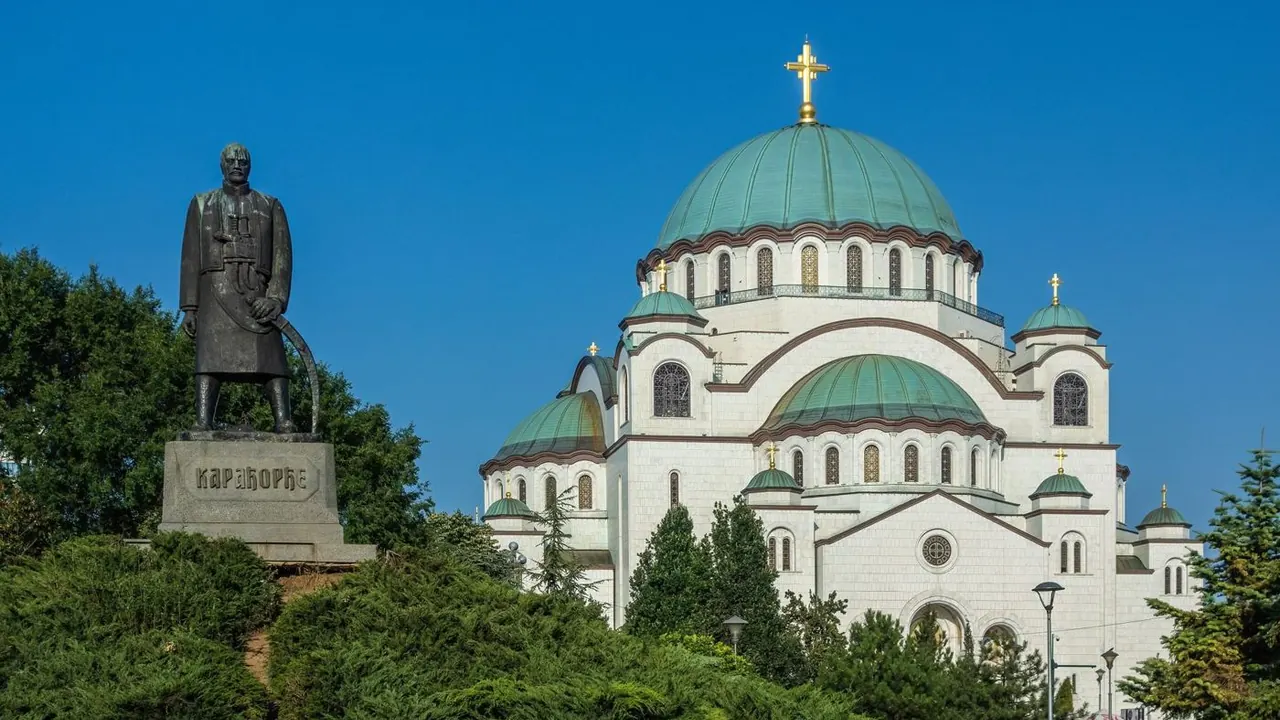
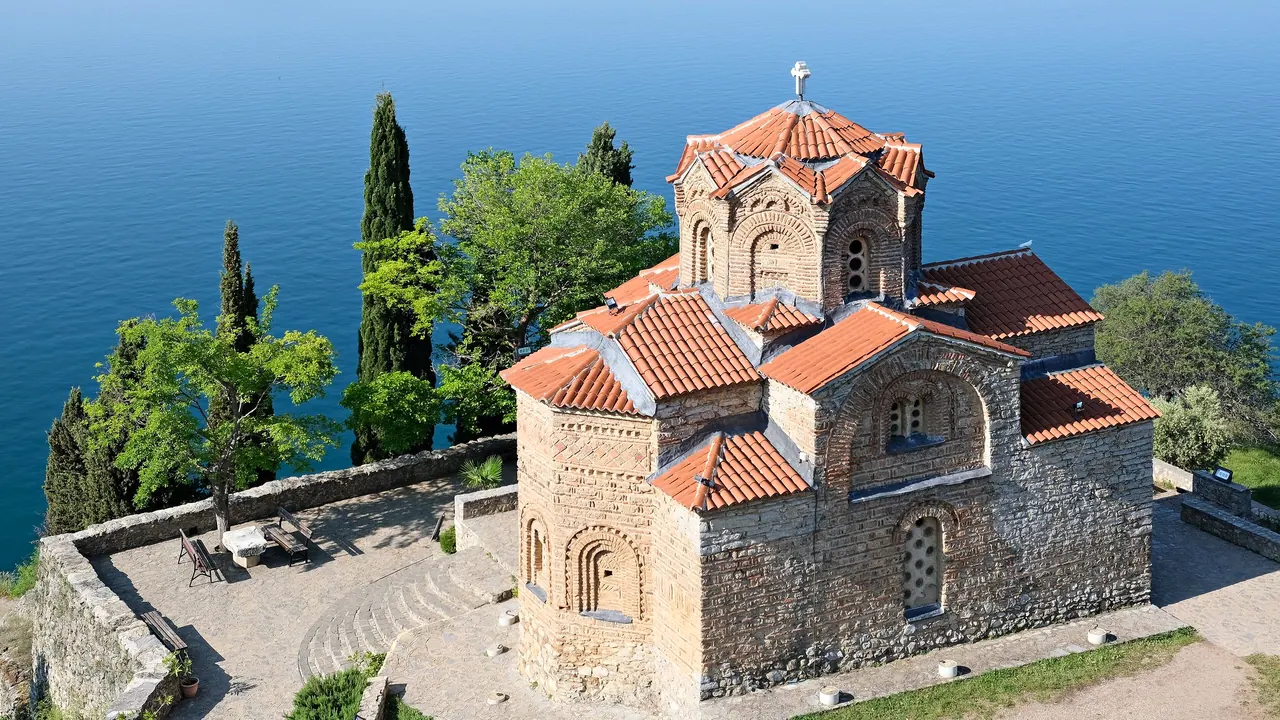
Photos: Belgrade by Petar Milošević, CC BY-SA 4.0, cropped; Ohrid by kallerna, CC BY-SA 4.0, cropped.
Belgrade or Ohrid?
Our verdict in twelve categories, each scored against the same fixed benchmark cities, and the climate month by month, so you can choose for your trip.
Choose Belgrade for
- nightlife
- live music and the arts
- food and drink
Belgrade is the choice for a trip that runs on its evenings. Expect long kafana dinners with rakija, summer clubs on the splavs moored along the rivers, packed cocktail bars in Dorćol, and opera or a concert at the National Theatre or Kolarac. It is a real capital with more to eat and more to browse. It also works in any month, because the nightlife simply moves indoors when the weather turns.
Choose Ohrid for
- nature and the outdoors
- beaches
- culture and sights
Travellers who want a place rather than a scene will be happier in Ohrid. Its UNESCO-listed old town of frescoed churches climbs above one of Europe's clearest lakes, with mountain trails in Galičica behind it and swimming from wooden jetties on hot afternoons. It is smaller, slower and cheaper. It is at its best from late spring to early autumn and much less rewarding in the grey months, when the town goes quiet.
Scoreboard
Twelve categories on one fixed scale from 0 to 100. The shaded stretch is the gap between the two.
Your match
Pick a travel style or drag the sliders, and both match scores follow your weighting.
Wins on nightlife and live music and the arts with your weighting.
Wins on nature and the outdoors and beaches with your weighting.
What matters to you?
Category by category
What the scores mean for a trip.
Beaches & swimming
Neither city is on the sea, but Ohrid's lake is the better swim. It is very clear and calm, with small coves below Kaneo, the town beach at Potpeš, and longer stretches with loungers further south at Lagadin and Gradište. In July and August, swimming is the centre of summer life in the town.
Belgrade's answer is Ada Ciganlija, a lake on the Sava with gravel shores that works like a huge city lido, plus the wilder, sandy Lido on Great War Island. The water is about as warm in both places in high summer. The real difference is the setting: a mountain-ringed lake in Ohrid, an urban sports island in Belgrade.
Food & drink
Both cities share the Balkan grill, ajvar, šopska salad and morning burek, but Belgrade has far more depth. Its taverns in Skadarlija and Zemun, the markets at Zeleni Venac and Kalenić, the fruit brandies and the wines from Fruška Gora give a food-minded visitor several days of eating.
Ohrid serves home cooking in a small town: tavče gravče, stuffed peppers and lake fish such as belvica, with much the same menu repeated along the waterfront. The best meals are in family-run places in the upper old town or in villages along the shore. Neither city is strong on vegetarian or international food.
Culture & sights
Ohrid packs finer heritage into a smaller space. It has the medieval frescoes of St Sophia, St John at Kaneo on its rock above the water, Plaošnik with its links to the Cyrillic tradition, and Samuel's Fortress above the Ottoman-era houses. All of it can be walked slowly in a day or two.
Belgrade's sights are more a history lesson than a showpiece. Kalemegdan's layered walls, the huge Temple of Saint Sava and the Museum of Yugoslavia with Tito's mausoleum are all worth seeing. Repeated destruction, though, has left the old fabric patchy, and much of the interest lies in contrasts such as Habsburg Zemun against the socialist blocks of New Belgrade.
Nightlife
This is where the two cities differ most. Belgrade stays up until dawn all year. In summer the floating splav clubs line the Sava and Danube, and in winter the scene moves to basement clubs and old industrial spaces, with Dorćol's bar streets around Cetinjska and Strahinjića Bana busy in every month. Table bookings and bottle service at the bigger clubs make it a city for groups.
Ohrid has a summer scene of café-bars along the lakefront and beach clubs on the southern shore, but for most people the evening is a walk by the water. Outside high summer it is quiet, and there is no serious club scene.
Nature & outdoors
The landscape is the main reason to go to Ohrid. A deep, ancient lake is ringed by mountains, and Galičica National Park rises behind it with summits above 2,000m and views over both Ohrid and Prespa lakes. Add paragliding from the ridge, kayaks on the water and the spring-fed pool near St Naum.
Belgrade's outdoors is gentler and more urban. It offers long riverside promenades for walking and cycling, the protected wetland of Great War Island with its herons, the wooded hills of Košutnjak and Avala, and easy vineyard walks on Fruška Gora. These are pleasant green spaces rather than scenery worth travelling for.
Day trips
Belgrade's outings head north into Habsburg towns and wine country, while Ohrid's follow the lakeshore to monasteries and cross into Albania. From Belgrade, Novi Sad and the Petrovaradin fortress above the Danube are under an hour by fast train, and the baroque streets and wine cellars of Sremski Karlovci pair well with the Fruška Gora monasteries. To the south-east along the Danube are the medieval fortress at Smederevo and the Roman site of Viminacium.
From Ohrid, you can reach St Naum at the southern tip of the lake by boat in summer. Bitola combines its long Ottoman-era street with the mosaics of Heraclea Lynkestis, and Pogradec and Korçë make easy days over the border. Slow roads and thin bus services mean a car or driver helps for most of these. Belgrade's other trips are also easier by car or on a tour, but its best day out needs only the train.
Good for families
Children are warmly welcomed in both places, and neither has theme parks or aquariums. In Belgrade a family day means climbing the ramparts at Kalemegdan, the tanks outside the military museum and the small old zoo, plus Ada Ciganlija in summer. Heavy traffic and crowded pavements make it tiring with small children.
Ohrid is calmer and small enough to wander. In summer the clear lake, boat rides and the reconstructed pile village at the Bay of Bones fill the days, though the cobbled old town is hard going with a pushchair. Belgrade suits older children who are curious about history, while Ohrid suits families happy to spend their days by the water.
Getting around
Both have walkable centres with hills to climb: the slopes up from the rivers in Belgrade, and the steep cobbles and stairs of Ohrid's old town. The real difference is scale. Belgrade spreads across the Sava to Zemun and New Belgrade, served by trams, trolleybuses and buses that are crowded and slow, with plentiful taxis filling the gaps.
In Ohrid you can walk everywhere in town, but the beaches to the south, St Naum and the mountains depend on infrequent buses and summer boats. In Belgrade a car is a burden, while in Ohrid it is often the easier way to explore.
Shopping & style
Belgrade gives you more to browse. There are chains and bookshops on Knez Mihailova, malls in New Belgrade, young designers in Dorćol and Vračar, and markets for honey, ajvar and rakija to take home. Even so, it is not a city to visit for shopping.
Ohrid's shopping comes down to the Ohrid pearl, made by long-established family workshops in the old bazaar, together with carved wood, icons and filigree silver. Beyond those, it is souvenirs and summer clothes.
Affordability
Both are inexpensive by European standards, but your money goes further in Ohrid. Guesthouse rooms, meals with local wine and entry to the churches all cost little, and late spring and early autumn combine the lowest prices with good weather. The exception is July and August, when lakefront rooms cost more.
In Belgrade, eating, drinking and taxis are cheap. Central rooms in Dorćol or near Knez Mihailova, however, are priced more like Central Europe, and the river clubs charge more.
Live music & performing arts
Belgrade has a stage all year round. Opera and ballet play at the National Theatre, the Belgrade Philharmonic performs at Kolarac, Madlenianum adds musicals, and the BITEF and BEMUS festivals fill the autumn. Tamburica bands in the Skadarlija kafanas offer live music without a ticket.
In Ohrid, the performing arts mean the Ohrid Summer Festival, with concerts and opera in St Sophia and the ancient theatre. Both are memorable settings, but the festival lasts only a short part of the year. The rest of the year offers little beyond folk music in restaurants.
Wellness & relaxation
Neither city has a bathing tradition. Both rely on hotel spas, and the spa towns and thermal springs are hours away. What differs is the pace around you.
In Belgrade, calm comes in pockets, such as long terrace coffees or an afternoon on Ada Ciganlija, between loud streets and late nights. Ohrid in May, June or September is restful in itself, with quiet mornings by the still lake, though the August crowds take some of that away.
When should you go?
Pick your month. The climate figures are measured averages, not a forecast.
Belgrade in July
Ohrid in July
Daytime high, °C
Rainfall in the month, mm
Where the figures come from
Ohrid has no rain gauge within 25 km of the centre, so its rainfall comes from a gridded climate dataset read at the city rather than from a gauge further away.
Temperature and rainfall are climate normals, averaged over the years shown. Belgrade: 1991-2020 normals, Beograd (2.1 km from centre). Ohrid: 1999-2017 (rainfall 1991-2020) normals, Ohrid (0.2 km from centre).
Both cities have hot summers and cold winters, but their rain falls at different times of year. Belgrade is warm enough for swimming at Ada Ciganlija from June to early September, with long sunny days and highs of around 30°C in August, which makes midday sightseeing hard work. June is its wettest month, at about 95mm, often as summer storms. May and September are the most comfortable months for walking the streets. Winters are grey and cold, with highs near 5°C in January.
Ohrid's summer is just as warm but noticeably drier, so July and August are reliable for days on the lake, and the water is pleasant from late June to mid-September. The rain sets in from October, and November and December are the wettest months at around 94mm, cold and damp under snow-capped peaks. Late May, June and September give Ohrid its best mix of warmth for walking and a calm lake.
Which traveller are you?
For a food and nightlife trip, Belgrade wins easily. Long kafana dinners of grilled meats and rakija lead on to the bar streets of Dorćol and the splav clubs on the rivers, and the night runs until dawn. Ohrid's evenings usually end over wine or with a walk by the lake.
On an outdoors trip, Ohrid is the better base. Galičica's trails climb to viewpoints over both Ohrid and Prespa lakes, paragliders launch from the ridge and kayaks set out on very clear water. Belgrade has riverside cycling, a wetland island and wooded parks, which are pleasant but much tamer.
For a culture and arts trip, Ohrid has the finer heritage, with its medieval frescoes, the church of St John at Kaneo and a compact UNESCO-listed old town. Choose Belgrade if your evenings matter as much as the sights, because it has opera, ballet and the Philharmonic all year.
Before you go
| Measure | Belgrade | Ohrid |
|---|---|---|
| Official language | Serbian | Albanian, Macedonian |
| Currency | Serbian Dinar (RSD) | Denar (MKD) |
| Sockets | CF230 V, 50 Hz | CF230 V, 50 Hz |
| Driving side | Right | Right |
| Time zone | UTC+1, UTC+2 in summer | UTC+1, UTC+2 in summer |
| Emergency number | Police 92/192, ambulance 94/194, fire 93/193 | 112 |
| Elevation | 117 m | 695 m |
| Main airport | Belgrade Nikola Tesla Airport (BEG)12 km from centre124 non-stop destinations | Ohrid St. Paul the Apostle Airport (OHD)9 km from centre14 non-stop destinations |
| Public holidays this year | 11 days | 12 days |
By the numbers
| Measure | Belgrade | Ohrid |
|---|---|---|
| City population | 1,197,714 | 38,818 |
| People per km² | 3,327 | 100 |
| Museums within 10 km | 65 | 11 |
| UNESCO World Heritage sites within 50 km | 0 | 2 |
Where else could you go?
Every comparison below shares a destination with this one, so you can follow Belgrade or Ohrid somewhere new.