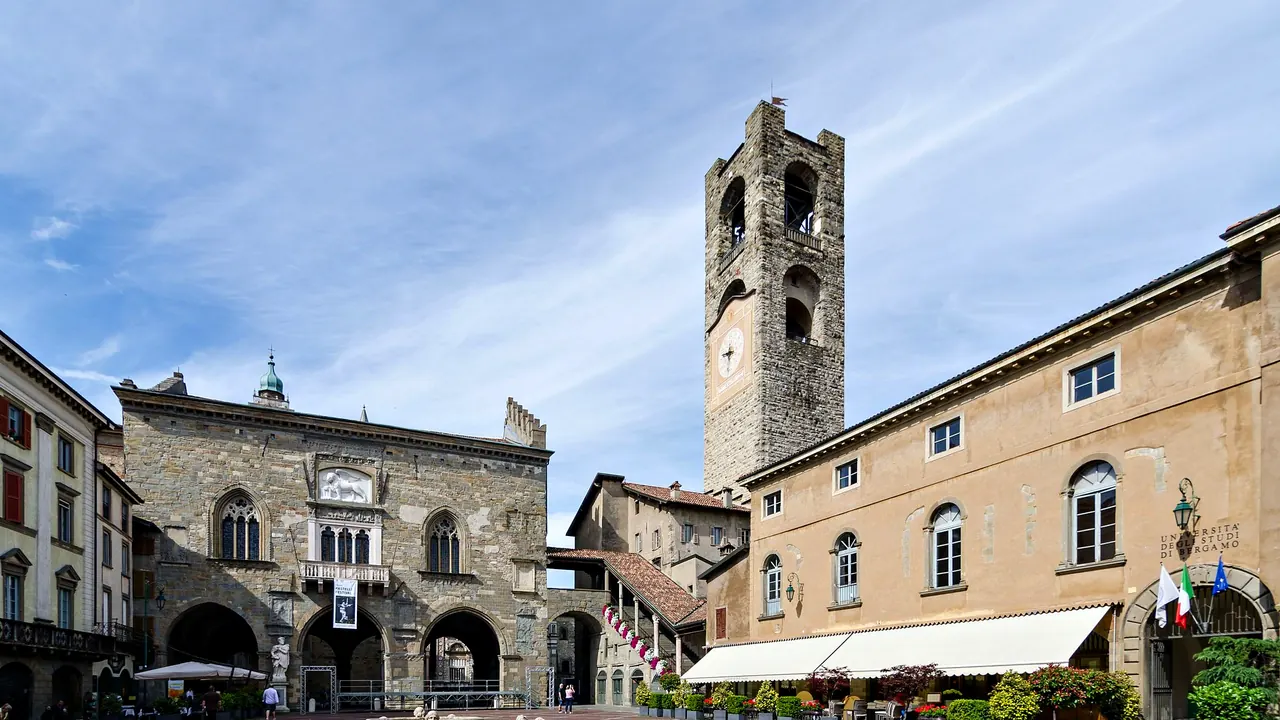
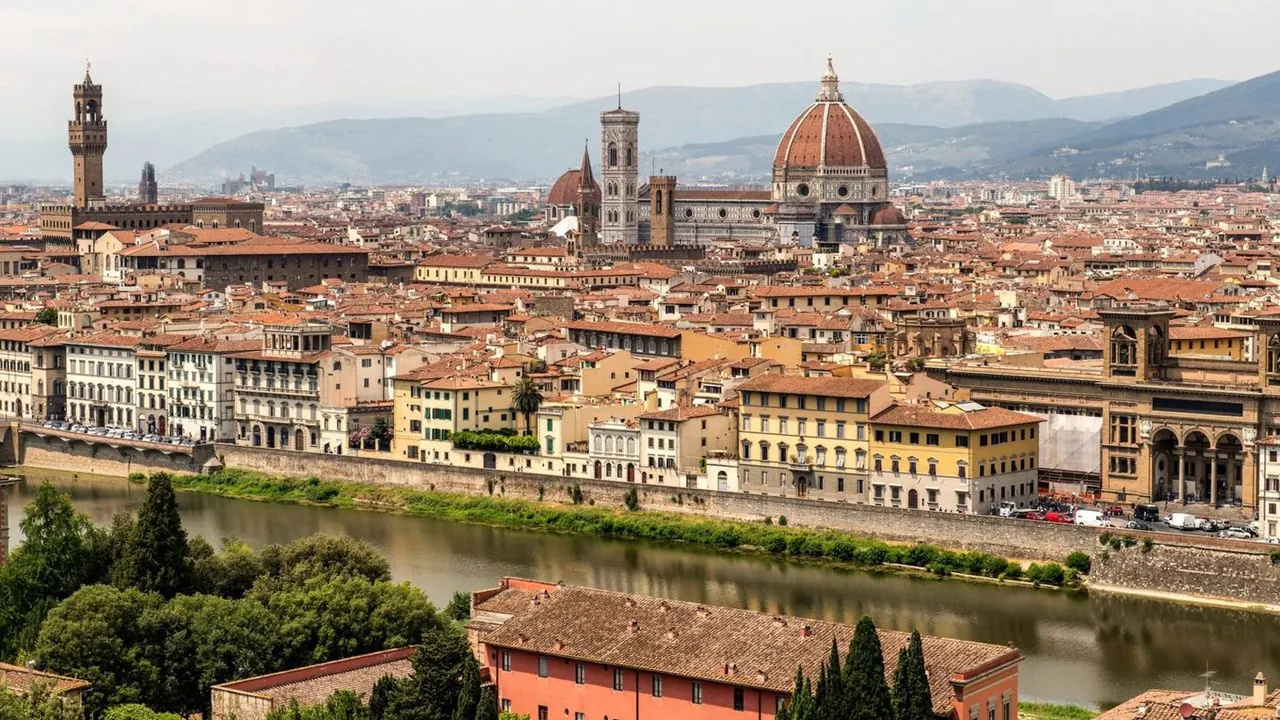
Photos: Bergamo by Steffen Schmitz, CC BY-SA 4.0, cropped; Florence by Wolfgang Weiser, Pexels License.
Bergamo or Florence?
Our verdict in twelve categories, each scored against the same fixed benchmark cities, and the climate month by month, so you can choose for your trip.
Choose Bergamo for
- prices
- beaches
- nature and the outdoors
Bergamo suits a traveller who wants a compact, calmer base with the mountains and lakes on the doorstep. The walled Città Alta fills a day or two, and the rest of the trip can go on walks in the Orobie valleys, swims at Lake Iseo and easy trains to Milan. It costs less to stay, it's gentler with children, and its pace is slower.
Choose Florence for
- shopping
- culture and sights
- food and drink
Florence is the stronger choice for anyone who comes for art, food and the Tuscan countryside around it. The Renaissance collections alone fill a week, the trattoria cooking and markets are richer, and Siena, Lucca, Pisa and the Chianti hills are all within a day's reach. It is pricier and more crowded, but nothing in Lombardy matches its concentration of masterpieces.
Scoreboard
Twelve categories on one fixed scale from 0 to 100. The shaded stretch is the gap between the two.
Your match
Pick a travel style or drag the sliders, and both match scores follow your weighting.
Wins on prices and beaches with your weighting.
Wins on shopping and culture and sights with your weighting.
What matters to you?
Category by category
What the scores mean for a trip.
Beaches & swimming
Neither city is a beach destination, but Bergamo has the easier way to cool off. Lake Iseo's lidos around Sarnico and Lovere and the Lecco arm of Lake Como are close enough for a hot afternoon, though the shores are mostly pebble, grass or concrete.
From Florence, the nearest water is the sandy Versilia coast around Viareggio. That's a full day out by train, so most visitors settle for a hotel or public pool.
Food & drink
Florence eats better and more variedly. There's bistecca alla fiorentina, ribollita and lampredotto from street carts, plus the Mercato Centrale and Sant'Ambrogio markets. Chianti Classico wine is poured by the glass. The best meals are in Oltrarno trattorie rather than near the Duomo.
Bergamo's kitchen is narrower but distinctive. Its Lombard mountain food runs to casoncelli, polenta and game, and the valley cheeses such as Taleggio and Strachitunt are well worth seeking out in the upper town.
Culture & sights
Bergamo offers one superb set piece. The walled Città Alta, ringed by its Venetian fortifications, gathers Piazza Vecchia, Santa Maria Maggiore and the marble front of the Cappella Colleoni into a few unhurried streets. Below the hill, the Accademia Carrara adds Raphael, Bellini and Mantegna. It is rewarding, but it is done in a day or two.
Florence is on another level, because this is where the Renaissance took shape. Brunelleschi's dome, the Uffizi, Michelangelo's David, the Bargello and the Pitti Palace come before you even reach the Fra Angelico cells at San Marco or the Brancacci Chapel. The price is booking ahead and queuing in summer.
Nightlife
Both cities' evenings revolve around aperitivo and wine bars, and neither has much of a club scene. Florence has more going on after dark: crowds with drinks on Piazza Santo Spirito, a more local scene at Sant'Ambrogio, student pubs and summer bars along the Arno.
Bergamo's nights are quieter. People gather around Borgo Santa Caterina or on the upper-town walls, and most evenings end around midnight. Anyone wanting more takes the train to Milan.
Nature & outdoors
Bergamo sits at the foot of real mountains. Val Brembana and Val Seriana lead into the Orobie Alps, which have rifugi, high lakes and small ski areas such as Foppolo. Lake Iseo and Lake Como add sailing and cycling, though a car helps for most of it.
Florence's landscape is softer. There are olive terraces at Fiesole and cypress lanes in Chianti, and the Casentino forests are further out. It's lovely walking country, but not wild.
Day trips
Both are excellent bases. Florence has the deeper list: Siena, Pisa, Lucca, San Gimignano, the Chianti villages and Bologna by fast train are all close, and you could spend a week without repeating a trip.
Bergamo trades Tuscan hill towns for Lombardy's cities and lakes. Milan is under an hour away, and Lake Como, Monte Isola on Lake Iseo, Crespi d'Adda, Brescia and Verona are all within reach.
Good for families
Bergamo works better with children. Funicular rides up to the Città Alta and San Vigilio, gelato on the walls and city playgrounds make the days easy. Leolandia and the Le Cornelle wildlife park are both a short drive away.
Florence's great sights are made for adults. Climbing the dome, the secret passages of Palazzo Vecchio and the Boboli Gardens help, and Collodi's Pinocchio park is a classic outing. Still, summer heat and crowded narrow pavements wear little ones down.
Getting around
Florence is simpler to get around: the Duomo, the Uffizi, Ponte Vecchio and the Pitti are all within a short walk of one another, and Santa Maria Novella station sits right in the centre for day trips.
Bergamo is split across two levels, so you'll ride the funicular or a bus between the lower town and the hilltop, and the climb on foot is steep. Each part is easy to walk once you're there, and the airport is a short bus ride away.
Shopping & style
Florence is far the better place to shop. Leather workshops, marbled paper and the goldsmiths of the Ponte Vecchio sit alongside artisan gilders and framers in the Oltrarno. The great fashion houses line Via de' Tornabuoni, and Via Maggio has antique dealers.
Bergamo's best buys are edible: cheeses, salumi and Valcalepio wine from the Città Alta delis. Fashion shoppers head to Milan.
Affordability
Bergamo is the easier city on the wallet. Lower-town hotels are fairly priced, and many travellers stay there for exactly that reason, exploring Lombardy by train. Only the Città Alta and summer weekends push costs up.
Florence costs a lot for its size. Central rooms are expensive, and museum and dome tickets add up fast. Street lampredotto, market lunches and staying across the river or in winter all soften the bill.
Live music & performing arts
Both cities have opera at their heart, and Florence has the larger stage. The Teatro del Maggio Musicale has its own orchestra and ballet, the spring festival is one of Europe's oldest, and the Pergola stages drama.
Bergamo has Donizetti. His theatre and its autumn festival draw devoted opera lovers, and Bergamo Jazz livens up the spring. Otherwise its calendar is modest, and La Scala is an easy evening trip.
Wellness & relaxation
Bergamo is the more restful stay. Belle Époque San Pellegrino Terme is about forty minutes up the valley, Trescore's sulphur springs date from Roman times, and the Città Alta is quiet early and late.
In Florence, the crowded centre rarely feels calm, and slowing down means the Boboli and Bardini gardens or a trip out. Montecatini Terme is close by train, but Saturnia's hot pools and a farm stay take longer.
When should you go?
Pick your month. The climate figures are measured averages, not a forecast.
Bergamo in July
Florence in July
Daytime high, °C
Rainfall in the month, mm
Where the figures come from
Bergamo has no rain gauge within 25 km of the centre, so its rainfall comes from a gridded climate dataset read at the city rather than from a gauge further away.
Bergamo's sunshine is measured 64 km from the centre, at Lugano.
Florence has no rain gauge within 25 km of the centre, so its rainfall comes from a gridded climate dataset read at the city rather than from a gauge further away.
Florence's sunshine is measured 71 km from the centre, at Pisa / S. Giusto.
Temperature and rainfall are climate normals, averaged over the years shown. Bergamo: 1991-2020 normals, Bergamo / Orio Al Serio (3.9 km from centre). Florence: 1995-2020 (sunshine 1991-2020, rainfall 1991-2020) normals, Firenze / Peretola (5.6 km from centre).
Both cities are best in spring and early autumn, but they get through the year differently. Florence runs hotter and drier in summer. July and August reach about 33°C under long sunny days, which is too hot for the stone streets in the afternoon. Bergamo stays a few degrees cooler, at about 29°C, and July is the month for a lake swim. In Florence, May and June bring warm, bright walking weather with little rain.
Rain works the other way round. Bergamo's wettest stretch runs from May right through to November, with September to November the heaviest at around 125mm a month. Florence is fairly dry until it turns wet in October and November. Winters are cool in both, but Florence is milder, at about 11°C in January against Bergamo's 7°C, so it's the better pick for a winter city break.
Which traveller are you?
On a culture and arts trip, Florence is the clear choice. The Uffizi, the Accademia, the Bargello and the Duomo complex hold some of the world's great Renaissance works. The Maggio Musicale and its opera house add evenings to match.
For a trip on a tight budget, Bergamo goes further. Lower-town hotels are fairly priced, the trattorias and aperitivo bars are reasonable, and the funicular and buses cost little. Florence's centre charges heavily for rooms and museum entry.
On an outdoors trip, Bergamo has the edge. The Colli di Bergamo park climbs straight from the upper town, and the Orobie Alps offer rifugi, high lakes and serious hiking. Florence's hills around Fiesole and Chianti are gentler and more cultivated.
Before you go
| Measure | Bergamo | Florence |
|---|---|---|
| Official language | Italian | Italian |
| Currency | Euro (EUR) | Euro (EUR) |
| Sockets | CFL230 V, 50 Hz | CFL230 V, 50 Hz |
| Driving side | Right | Right |
| Time zone | UTC+1, UTC+2 in summer | UTC+1, UTC+2 in summer |
| Emergency number | 112 | 112 |
| Elevation | 249 m | 50 m |
| Main airport | Il Caravaggio International Airport (BGY)4 km from centre146 non-stop destinations | Florence Airport, Peretola (FLR)6 km from centre46 non-stop destinations |
| Public holidays this year | 13 days | 13 days |
By the numbers
| Measure | Bergamo | Florence |
|---|---|---|
| City population | 119,534 | 360,930 |
| People per km² | 2,973 | 3,528 |
| Museums within 10 km | 21 | 141 |
| UNESCO World Heritage sites within 50 km | 6 | 6 |
Where else could you go?
Every comparison below shares a destination with this one, so you can follow Bergamo or Florence somewhere new.