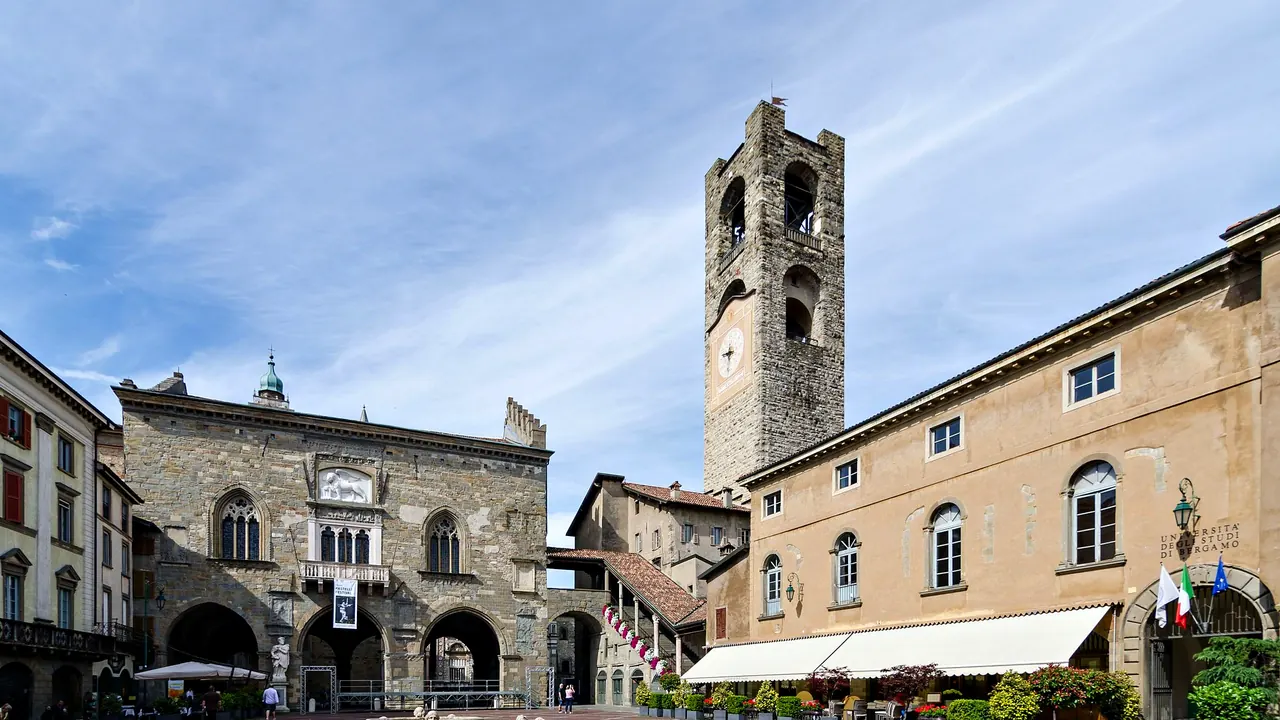
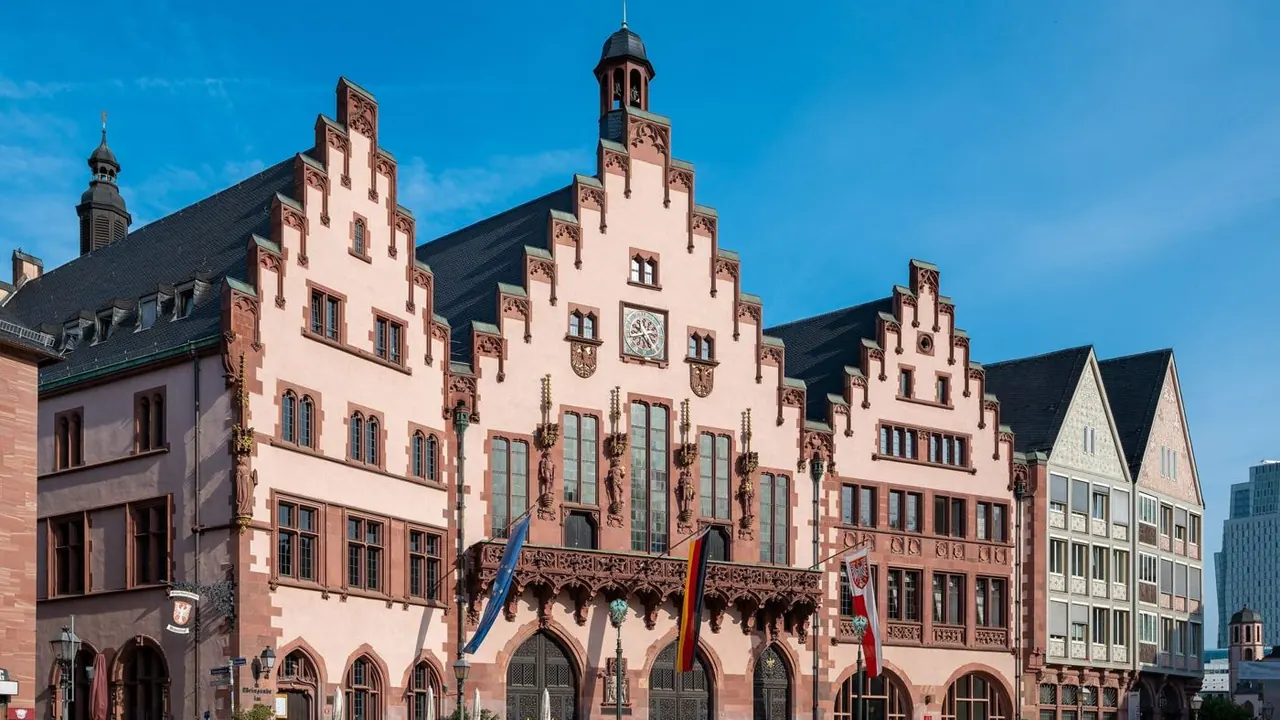
Photos: Bergamo by Steffen Schmitz, CC BY-SA 4.0, cropped; Frankfurt by Thomas Wolf, CC BY-SA 3.0 DE, cropped.
Bergamo or Frankfurt?
Our verdict in twelve categories, each scored against the same fixed benchmark cities, and the climate month by month, so you can choose for your trip.
Choose Bergamo for
- beaches
- nature and the outdoors
- prices
Bergamo suits the traveller who wants a walled hilltop town, mountain food and the Alps almost at the door. The Città Alta gives it the more memorable old centre of the two. The Orobie valleys and Lakes Iseo and Como put real hiking and lake swimming within easy reach, and rooms in the lower town cost less. It is a quiet, slow place in the evening, so it works best for walkers, lake lovers and anyone using it as a calm base for Lombardy.
Choose Frankfurt for
- live music and the arts
- nightlife
- shopping
Frankfurt is the better pick for a city that runs late and runs smoothly. Its opera company, concert halls and techno clubs give it far more to do after dark. The museums along the Main, a transport system that never needs a car, and a stronger shopping street make it easy to fill a few days. Choose it for nightlife and the stage, or to see the Rhine and Heidelberg by fast train, and time the trip away from the trade fairs to keep hotel costs down.
Scoreboard
Twelve categories on one fixed scale from 0 to 100. The shaded stretch is the gap between the two.
Your match
Pick a travel style or drag the sliders, and both match scores follow your weighting.
Too close to call, 1 point apart
Wins on beaches and nature and the outdoors with your weighting.
Wins on live music and the arts and nightlife with your weighting.
What matters to you?
Category by category
What the scores mean for a trip.
Beaches & swimming
Neither city has a coast, but Bergamo has the better summer water. Lake Iseo and the Lecco arm of Lake Como have lidos and grassy shores that reach about 23°C by July, though you swim from pebble or concrete platforms rather than sand.
Frankfurt has only outdoor pools and gravel-pit lakes such as the Langener Waldsee. Its sandy shore is pleasant on a hot day, but it is a local swim, nothing like a day at an Alpine lake.
Food & drink
Bergamo has a slight edge at the table, and its cooking is the more distinctive: casoncelli in butter and sage, polenta with braised game, and valley cheeses like Taleggio and Strachitunt sold from the counters of the upper town. Valcalepio and Franciacorta round it off, though there is little beyond Italian food.
Frankfurt's own repertoire is smaller, apple wine with Grüne Soße at long tables in Sachsenhausen, but the city makes up for it with variety. Turkish, Asian and Italian kitchens and the cheap global food of the Bahnhofsviertel give you far more choice from night to night.
Culture & sights
Bergamo has the stronger sights, because the Città Alta is a real survivor: an almost complete walled town inside its Venetian fortifications, with the Cappella Colleoni and Santa Maria Maggiore around Piazza Vecchia. The Accademia Carrara adds Raphael and Bellini, and the whole visit fits into a day or two.
Frankfurt's appeal is its museums rather than its streets. The Städel and the Senckenberg anchor the Museumsufer, while the Römer and the old-town lanes were rebuilt after 1944. It offers more breadth of collections, but less sense of place.
Nightlife
Frankfurt is clearly the better night out. Together with Offenbach it has a serious techno and house club scene, cocktail bars in the rough-edged Bahnhofsviertel and relaxed bars along Berger Straße. Weekends are when it is busiest.
Bergamo's evening is a long aperitivo, a glass of wine on Via XX Settembre or the walls of the upper town, and bed around midnight. Locals who want clubs go to Milan.
Nature & outdoors
Bergamo is the place for real landscape. Woodland paths climb straight from the upper town into the Colli park, and Val Brembana and Val Seriana lead into the Orobie Alps, with rifugi, high lakes and the Serio falls. The two lakes add sailing and lakeside cycling, though a car helps for the higher valleys.
Frankfurt's countryside is gentler and easier to reach without a car. There is beech forest and Roman frontier trails on the Großer Feldberg, the large Stadtwald, and flat cycle paths along the Main, all by S-Bahn.
Day trips
Both are excellent bases, and the difference is in what lies around them. From Bergamo, the outings are Lombard: Milan's Duomo and Last Supper within an hour, Lake Como and car-free Monte Isola, then Cremona, Verona and Mantua further out.
Frankfurt has the faster rail network and a longer list. Heidelberg, the castle-lined Rhine Gorge, Cologne Cathedral and Würzburg's Residenz are all within about an hour or so. Pick by whether you would rather spend your days among Italian lakes and art cities or along the German Rhine.
Good for families
Frankfurt is the easier city with children. The dinosaur hall at the Senckenberg, a central zoo, the Palmengarten glasshouses and boat trips past the skyline are all close together, and trams take a pushchair without trouble.
Bergamo charms children with its funiculars and gelato on the walls, but the cobbled upper town is hard going with a buggy. Its best family days, Leolandia and the Le Cornelle wildlife park, are outside the city.
Getting around
Frankfurt is simpler to get around. Its U-Bahn, S-Bahn and trams form one network reaching as far as the Taunus and Mainz, and the airport is a quarter of an hour from the centre by train.
Bergamo is small and walkable on each of its two levels, with funiculars linking the lower town, the Città Alta and San Vigilio. Getting between them on foot is a steep climb, though, and the mountain valleys and lake shores are much easier with a car.
Shopping & style
Frankfurt gives shoppers more range: chains and malls on the Zeil, luxury jewellers around Goethestraße, and design shops and delis on Berger Straße and Schweizer Straße. Even so, nothing in it is a reason to make the trip.
Bergamo's lower-town arcades are mainly mid-range chains. The real pleasure is the Città Alta's main lane of cheese shops, bakeries and wine sellers, which is ideal for edible souvenirs. For fashion, people take the train to Milan.
Affordability
Bergamo is the gentler city on the wallet. Lower-town hotels are fair for what you get, and buses and the funicular cost little, although rooms inside the Città Alta and summer weekends cost more.
Frankfurt's hotels are aimed at business travellers and become scarce and very expensive in trade-fair weeks. Eating out in cider taverns and at Turkish grills is cheap, so the dates of your stay decide the bill more than anything else.
Live music & performing arts
Frankfurt has the much fuller stage. A highly respected opera company with adventurous productions, concerts at the Alte Oper, serious drama at the Schauspiel, contemporary dance and jazz in cellar clubs keep the calendar busy from autumn to early summer.
Bergamo's stage life centres on Donizetti, its native composer. The Teatro Donizetti and its autumn festival are a draw for devoted opera lovers, and Bergamo Jazz brightens the spring. Otherwise the programme is that of a provincial city.
Wellness & relaxation
The two are evenly matched, and in both the real bathing is in spa towns outside the city. From Bergamo, it is the Belle Époque grandeur of San Pellegrino Terme up Val Brembana, or the old sulphur springs at Trescore Balneario. The quiet mornings in the Città Alta are relaxing in themselves.
Frankfurt's choice is wider and more German in style, with thermal baths and saunas at Bad Homburg and Wiesbaden's Art Nouveau Kaiser-Friedrich-Therme. In town, the Palmengarten is its calmest corner.
When should you go?
Pick your month. The climate figures are measured averages, not a forecast.
Bergamo in July
Frankfurt in July
Daytime high, °C
Rainfall in the month, mm
Where the figures come from
Bergamo has no rain gauge within 25 km of the centre, so its rainfall comes from a gridded climate dataset read at the city rather than from a gauge further away.
Bergamo's sunshine is measured 64 km from the centre, at Lugano.
Temperature and rainfall are climate normals, averaged over the years shown. Bergamo: 1991-2020 normals, Bergamo / Orio Al Serio (3.9 km from centre). Frankfurt: 1991-2020 normals, Frankfurt Westend (2 km from centre).
Bergamo is the warmer of the two from spring to autumn. July and August reach about 29°C, warm enough for swimming in the lakes but hard going on the cobbled lanes of the upper town at midday. Its driest months are in winter and early spring. From May to November the rain is heavy, and it peaks in autumn at well over 100mm a month. That makes April the best month for walking: it is mild, at about 18°C, and comes before the wet season starts. September is a warm second choice if you can accept that the autumn rain has already begun. Winters are cold but noticeably brighter than Frankfurt's.
Frankfurt stays milder in summer, reaching about 26°C, and its rain is spread thinly through the year, so a wet week is less likely in any month. Its weak point is winter. From November to January the days are short and grey, and December gets roughly a third of Bergamo's sunshine. April to September is its best stretch, with long, bright days for the riverbanks and the Taunus. July and August are also warm enough for the gravel-pit lakes.
Which traveller are you?
On an outdoors trip, Bergamo is the clear choice. Paths climb from the upper town to San Vigilio, and the Orobie Alps have rifugi, high lakes and serious summer hiking. Frankfurt's Taunus and Stadtwald are pleasant, but they are gentle forest rather than mountains.
For a trip on a tight budget, Bergamo goes further. Lower-town hotels are fairly priced and the trattorias and aperitivo bars are reasonable. Frankfurt's rooms are priced for business travellers and soar in trade-fair weeks, though its taverns and Turkish grills are cheap.
On a shopping trip, Frankfurt has more to offer. The Zeil has department stores and malls, Goethestraße has luxury houses, and Berger Straße has independent boutiques. Bergamo's strength is narrower: cheese, salumi and wine from the delicatessens of the Città Alta.
Before you go
| Measure | Bergamo | Frankfurt |
|---|---|---|
| Official language | Italian | German |
| Currency | Euro (EUR) | Euro (EUR) |
| Sockets | CFL230 V, 50 Hz | CF230 V, 50 Hz |
| Driving side | Right | Right |
| Time zone | UTC+1, UTC+2 in summer | UTC+1, UTC+2 in summer |
| Emergency number | 112 | 112 |
| Elevation | 249 m | 101 m |
| Main airport | Il Caravaggio International Airport (BGY)4 km from centre146 non-stop destinations | Frankfurt Main Airport (FRA)13 km from centre281 non-stop destinations |
| Public holidays this year | 13 days | 10 days |
By the numbers
| Measure | Bergamo | Frankfurt |
|---|---|---|
| City population | 119,534 | 760,656 |
| People per km² | 2,973 | 3,063 |
| Museums within 10 km | 21 | 53 |
| UNESCO World Heritage sites within 50 km | 6 | 4 |
Where else could you go?
Every comparison below shares a destination with this one, so you can follow Bergamo or Frankfurt somewhere new.
- Milanvs Bergamo
- Comovs Bergamo
- Luganovs Bergamo
- Heidelbergvs Frankfurt
- Veronavs Bergamo
- Stuttgartvs Frankfurt