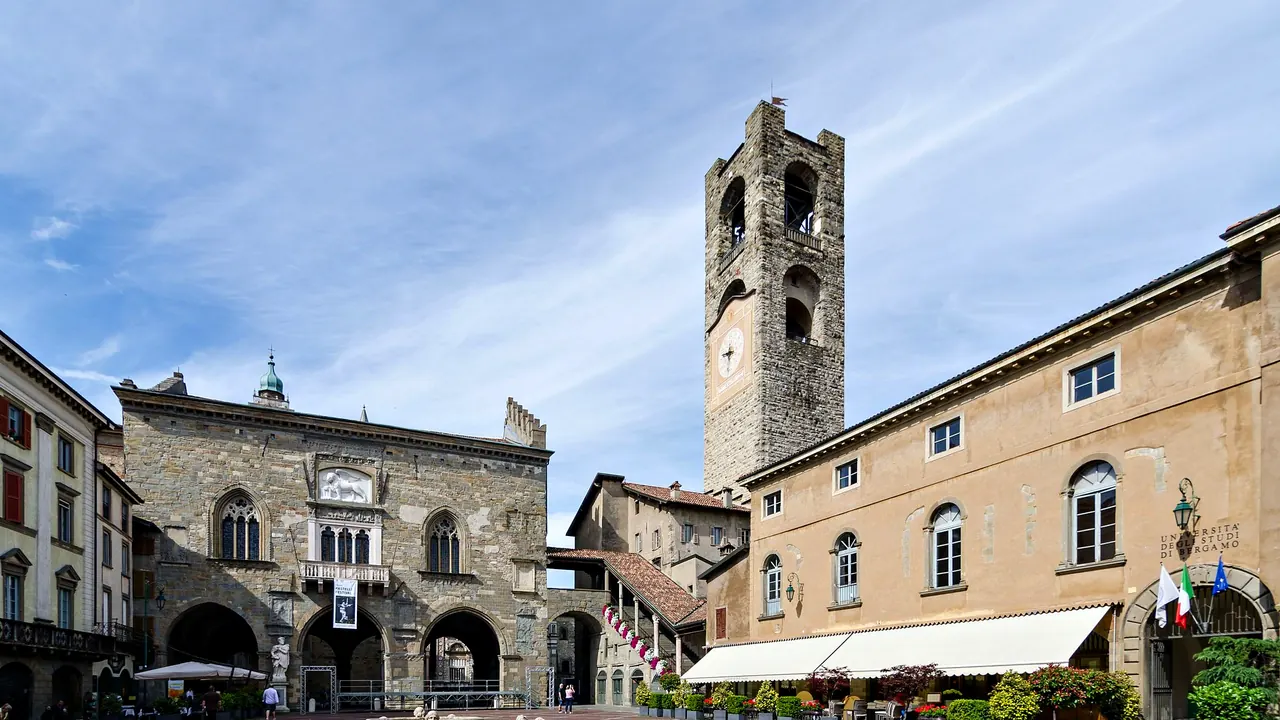
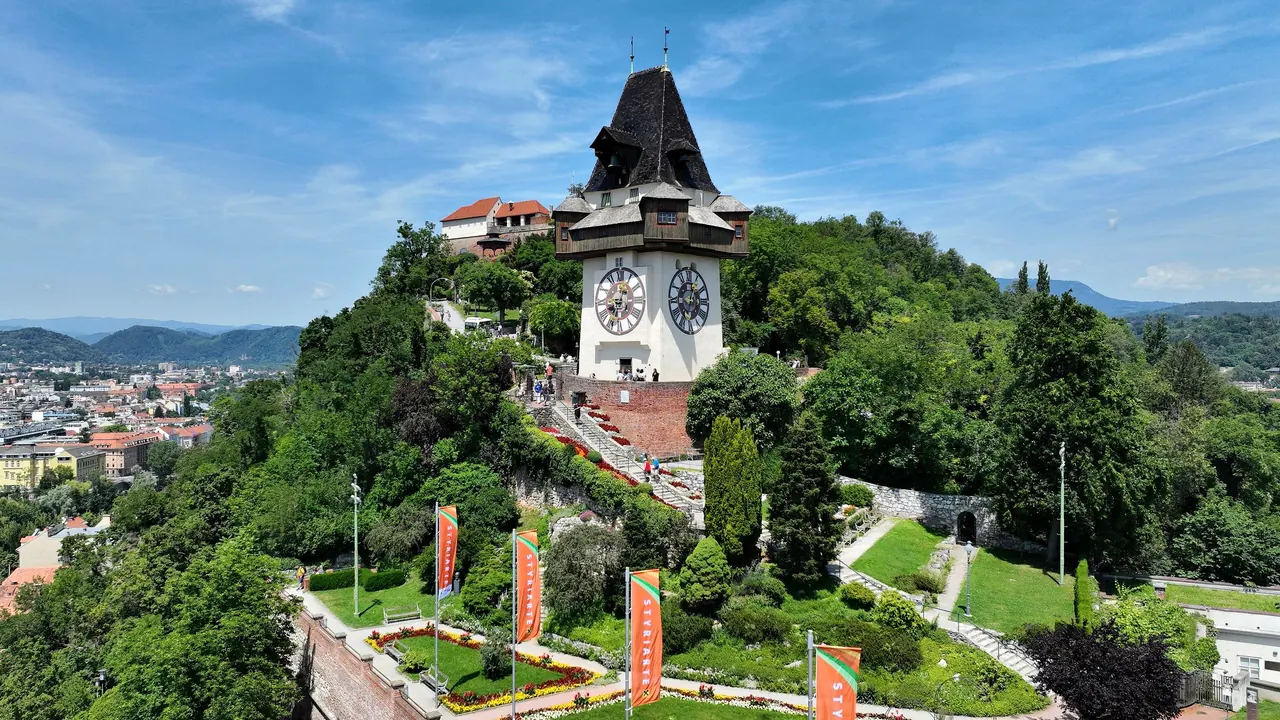
Photos: Bergamo by Steffen Schmitz, CC BY-SA 4.0, cropped; Graz by C.Stadler/Bwag, CC BY-SA 4.0, cropped.
Bergamo or Graz?
Our verdict in twelve categories, each scored against the same fixed benchmark cities, and the climate month by month, so you can choose for your trip.
Choose Bergamo for
- day trips
- beaches
- prices
Bergamo suits the traveller who wants a handsome base rather than a destination to exhaust. The walled Città Alta and the Accademia Carrara fill a day or two. After that, the trains and roads do the work: Milan, Lake Como, Lake Iseo, Brescia and Verona are all easy outings, and a room in the lower town costs a little less than its Austrian equivalent. It is the better pick for a week of touring Lombardy, for lake swimming in summer and for anyone who likes to be in bed by midnight.
Choose Graz for
- live music and the arts
- getting around
- nightlife
Graz is the place to stay put and settle in. Its flat, largely car-free old town and trams make it effortless on foot. The opera house, the festivals and the jazz scene give it far more on stage than Bergamo, and the student bars of the old town and Lend keep evenings going later. It suits a long weekend of walking, music and wine, with the Styrian vineyards and thermal villages as extras if you hire a car.
Scoreboard
Twelve categories on one fixed scale from 0 to 100. The shaded stretch is the gap between the two.
Your match
Pick a travel style or drag the sliders, and both match scores follow your weighting.
Too close to call, 1 point apart
Wins on day trips and beaches with your weighting.
Wins on live music and the arts and getting around with your weighting.
What matters to you?
Category by category
What the scores mean for a trip.
Beaches & swimming
Neither city has a coastline, but Bergamo's lake swimming is in a different league. Lake Iseo's lidos at Sarnico and Lovere and the Lecco arm of Lake Como are true Alpine lakes, with mountains rising from the water.
Graz relies on the Schwarzlsee and similar former gravel pits on the plain to the south, pleasant with their jetties and grassy banks, but flat and suburban. The water warms to about 23°C in high summer in both, and you will find grass and pebble rather than sand either way.
Food & drink
Both are regional kitchens rather than international ones, and neither clearly outdoes the other. The difference is in the larder. Bergamo is a city of stuffed pasta, polenta and serious mountain cheeses such as Taleggio and Strachitunt, with Franciacorta sparkling wine next door and a fine-dining tier for a special night.
Graz revolves around pumpkin seed oil, cold fried-chicken salad and the daily farmers' markets at Kaiser-Josef-Platz and Lendplatz. Its real pleasure is the crisp Sauvignon Blanc poured in rustic Buschenschank taverns in the southern hills.
Culture & sights
These two are closely matched, with Bergamo a touch ahead, but their strengths are different. Bergamo's draw is concentrated: a walled hilltop town inside UNESCO-listed Venetian ramparts, the marble front of the Cappella Colleoni, and Old Master painting by Raphael, Bellini and Mantegna at the Accademia Carrara. It is all seen in a day or two.
Graz spreads further, from a larger arcaded old town to the Baroque Schloss Eggenberg. It adds two things Bergamo has no answer to: the Landeszeughaus armoury, with its thousands of suits of armour, and the blue Kunsthaus beside the Mur.
Nightlife
Graz gives you more of a night out. Its student population fills the bar lanes of the old-town Bermuda Triangle, the artier bars of Lend and the university quarter, and a handful of clubs stay open late at weekends. It goes quieter in summer when the students leave.
Bergamo's evening is a long aperitivo on Via XX Settembre or in Borgo Santa Caterina, then a glass of wine on the walls of the Città Alta. Things wind down around midnight. Clubbers from Bergamo go to Milan.
Nature & outdoors
Both have mountains close by, and there is little between them overall. Bergamo has the higher and wilder country. Paths climb straight from the upper town into the Colli di Bergamo, Val Brembana and Val Seriana lead to rifugi and high lakes in the Orobie Alps, and Lake Iseo and Lake Como add sailing and lakeside cycling.
Graz is softer and closer to hand. You can take the Schöckl cable car or paraglide from its summit, cycle the Mur path or climb the ladders of the Bärenschützklamm gorge. The South Styrian wine hills make gentle walking country. In both, a car opens up the best of it.
Day trips
This is Bergamo's clearest advantage. Direct trains put Milan's Duomo and Last Supper within an hour, and Lake Como, Lake Iseo with Monte Isola, Brescia and the factory village of Crespi d'Adda are all close. Verona and Cremona also make easy days out, so a week here can take in half of northern Italy without moving hotel.
Graz's outings are rural and charming rather than grand: the South Styrian Wine Road, Riegersburg on its volcanic crag, the Lipizzaners at Piber and Admont Abbey's library. Apart from Maribor by train, most of them need a car.
Good for families
Graz is a little easier with children inside the city itself. Trams take buggies, and the Schlossberg alone fills a day, with the lift up, the long underground slide down and the Märchenbahn train through fairytale tunnels. The FRida & freD children's museum adds a rainy-day option.
Bergamo's steep cobbles are hard going with a pushchair, though the funiculars are a treat for children. What Bergamo has and Graz lacks is a proper theme park: Leolandia is twenty minutes away, and the Le Cornelle wildlife park is close by.
Getting around
Graz is the simpler city to move around. Its centre is small, flat and mostly pedestrianised, trams run along the Herrengasse, and one ticket covers everything.
Bergamo is split across two levels. Funiculars and buses bridge the steep climb to the Città Alta, which is tiring on foot. It makes up for this with strong rail links to Milan, Brescia and Lecco and an airport a short bus ride away. In both cities, the countryside is far easier by car.
Shopping & style
Graz has slightly more to browse. A grand nineteenth-century department store anchors the historic Herrengasse, the sloping Sporgasse keeps traditional shops, and Lend adds design and vintage stores that Bergamo lacks.
Bergamo's lower-town arcades are mostly Italian chains, and the real pleasure is the cheese shops and delicatessens along the main lane of the Città Alta. In both cities the best buys are edible: Taleggio and Valcalepio wine in Bergamo, pumpkin seed oil and Schilcher rosé in Graz. Milan is close at hand for serious fashion.
Affordability
Bergamo is the somewhat cheaper stay. Lower-town hotels are fair for what is on offer, and buses and the funicular cost little, though rooms inside the Città Alta and summer weekends push prices up.
Graz runs at full Austrian rates for sit-down dinners and wine, and hotels climb during festivals and trade fairs. Its student lunch menus and walkable centre help keep a trip affordable.
Live music & performing arts
Graz has much more on stage. Its opera house is the second largest in Austria and stages opera, operetta and ballet all season. Styriarte brings early music in summer, steirischer herbst brings avant-garde work in autumn, and the music university feeds a strong jazz scene.
Bergamo's stage life centres on Donizetti, who was born here. Its highlight is the autumn festival of his operas at the Teatro Donizetti, alongside Bergamo Jazz in spring. Otherwise the programme is modest, though La Scala is an evening's train ride away.
Wellness & relaxation
Neither city has bathing traditions within its walls, and both lean on spa country nearby. The difference is in character. From Bergamo, San Pellegrino Terme offers a single grand Belle Époque spa up Val Brembana, and Trescore Balneario has sulphur springs used since Roman times.
From Graz, a whole string of thermal villages lies about an hour east, from Hundertwasser's grass-roofed Bad Blumau to the large warm pools of Loipersdorf. In town, Bergamo's calm comes from walking its walls early, while Graz's comes from its coffee houses and the Stadtpark.
When should you go?
Pick your month. The climate figures are measured averages, not a forecast.
Bergamo in July
Graz in July
Daytime high, °C
Rainfall in the month, mm
Where the figures come from
Bergamo has no rain gauge within 25 km of the centre, so its rainfall comes from a gridded climate dataset read at the city rather than from a gauge further away.
Bergamo's sunshine is measured 64 km from the centre, at Lugano.
Temperature and rainfall are climate normals, averaged over the years shown. Bergamo: 1991-2020 normals, Bergamo / Orio Al Serio (3.9 km from centre). Graz: 1991-2020 normals, Graz Airport (7.9 km from centre).
The two share an Alpine-edge climate, but Bergamo runs a little warmer all year and gets its rain at a different time. Bergamo peaks at about 29°C in July and August, warm enough for the lakes but sticky for climbing the upper town at midday. Graz tops out near 27°C. Lake swimming works in both from late June to August. The wet seasons differ most. In Bergamo the heaviest rain comes in autumn, with October around 129mm. In Graz it falls in summer, with August near 127mm, often as storms, while its winters are dry but cold, around 3°C in January.
For walking the streets, Bergamo is at its best in April, May and early June, before the heat and the autumn rains. Graz shines in May and again in September and October, when the summer storms have passed and the wine hills are in harvest colour. Both get similar summer sunshine. Winter is grey and chilly in both, but brighter and milder in Bergamo.
Which traveller are you?
For a short city break, Graz is the easier choice. Its flat, pedestrianised centre puts the sights a few minutes apart, trams cover the rest, and the evenings bring opera, jazz and lively student bars rather than an early night.
On a trip on a tight budget, Bergamo stretches the money further. Lower-town hotels and trattorias are fairly priced, the funicular and buses cost little, and cheap trains to Milan and the lakes let you see Lombardy without paying for rooms in each place.
On a beach and sun trip, Bergamo wins, though neither city is truly a swimming destination. It is warmer in summer, and it has real Alpine lakes within an hour: the lidos of Lake Iseo and the Lecco shore of Lake Como, rather than Graz's former gravel pits.
Before you go
| Measure | Bergamo | Graz |
|---|---|---|
| Official language | Italian | German, Austrian Sign Language |
| Currency | Euro (EUR) | Euro (EUR) |
| Sockets | CFL230 V, 50 Hz | CF230 V, 50 Hz |
| Driving side | Right | Right |
| Time zone | UTC+1, UTC+2 in summer | UTC+1, UTC+2 in summer |
| Emergency number | 112 | 112 |
| Elevation | 249 m | 353 m |
| Main airport | Il Caravaggio International Airport (BGY)4 km from centre146 non-stop destinations | Graz Airport (GRZ)9 km from centre26 non-stop destinations |
| Public holidays this year | 13 days | 16 days |
By the numbers
| Measure | Bergamo | Graz |
|---|---|---|
| City population | 119,534 | 306,971 |
| People per km² | 2,973 | 2,406 |
| Museums within 10 km | 21 | 29 |
| UNESCO World Heritage sites within 50 km | 6 | 1 |
Where else could you go?
Every comparison below shares a destination with this one, so you can follow Bergamo or Graz somewhere new.