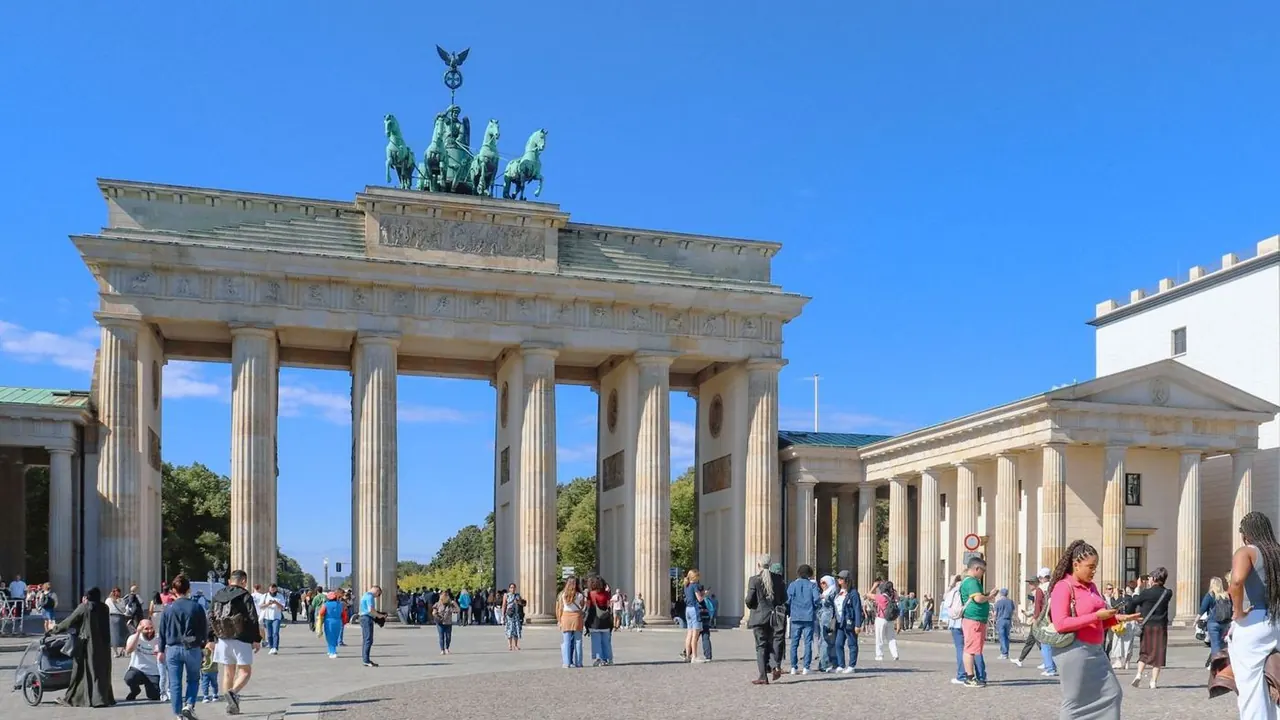
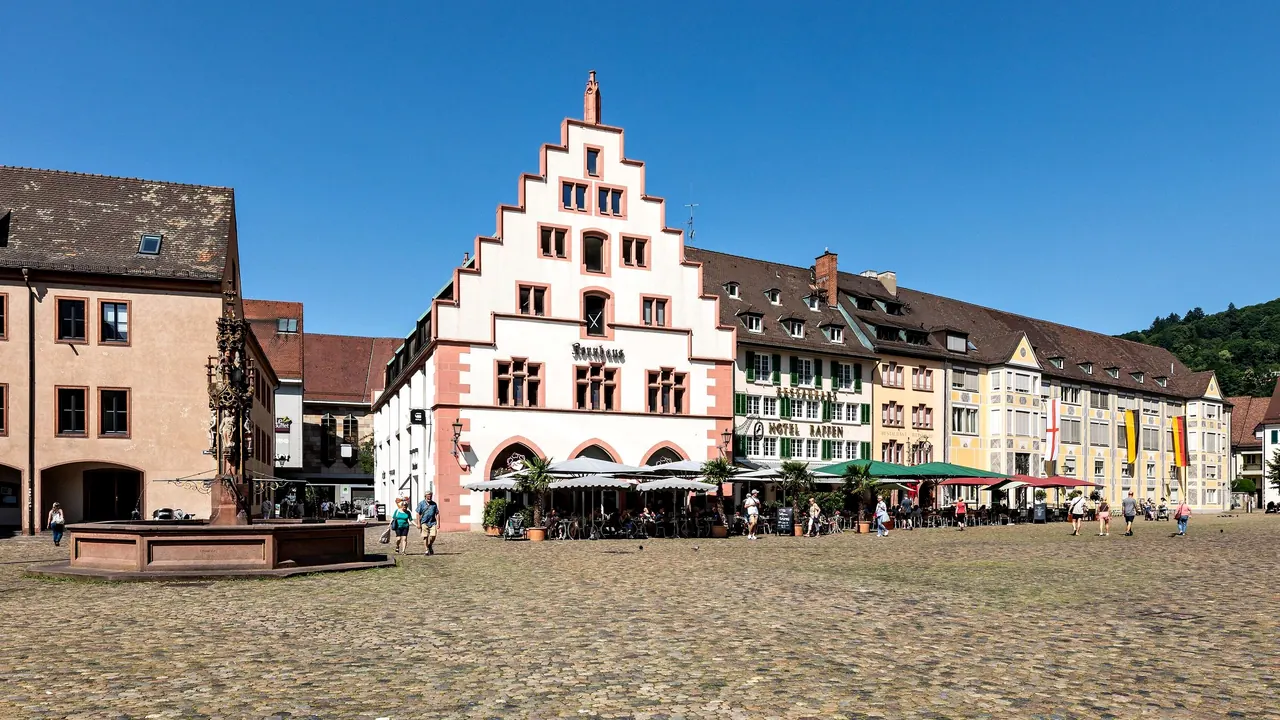
Photos: Berlin by Claudia Solano, Pexels License; Freiburg by Dietmar Rabich, CC BY-SA 4.0, cropped.
Berlin or Freiburg?
Our verdict in twelve categories, each scored against the same fixed benchmark cities, and the climate month by month, so you can choose for your trip.
Choose Berlin for
- nightlife
- live music and the arts
- culture and sights
Berlin suits a trip built around big collections and long evenings. Spend the days on Museum Island and at the Wall sites, go to one of three opera houses or the Philharmonie after dinner, then head to clubs that keep going until Monday. Choose it if you want a large city of distinct districts, cheap food from all over the world and Sunday flea markets, and you don't mind spending a lot of time indoors or on the U-Bahn.
Choose Freiburg for
- nature and the outdoors
- day trips
- wellness
If you want the landscape to do the work, Freiburg is the better base. The Black Forest begins at the edge of town, Basel, Alsace and Strasbourg are within easy reach, and thermal baths are a short ride south. It is smaller and slower, with a compact old town around the Münster and Baden food and wine. Evenings end in a wine tavern rather than a warehouse club.
Scoreboard
Twelve categories on one fixed scale from 0 to 100. The shaded stretch is the gap between the two.
Your match
Pick a travel style or drag the sliders, and both match scores follow your weighting.
Wins on nightlife and live music and the arts with your weighting.
Wins on nature and the outdoors and day trips with your weighting.
What matters to you?
Category by category
What the scores mean for a trip.
Beaches & swimming
Neither city has a coast, so swimming here means lakes in July and August. Berlin does it better. Strandbad Wannsee has a long sandy shore and wicker beach chairs, and forest lakes such as Schlachtensee and Plötzensee are a short train or bus ride from the centre.
In Freiburg you swim in gravel pits with grassy banks on the Rhine plain, in crowded city pools, or in Titisee and Schluchsee in the Black Forest, about an hour away, where the water stays cool. It is fine for a dip, but it is less of a summer day out than a Berlin lido.
Food & drink
Berlin's strength is range. Kreuzberg and Neukölln have Turkish grill houses and bakeries, the city has good Vietnamese, Korean and Levantine cooking, market halls hold street-food evenings, and there is serious fine dining. You could eat something different every night for a week.
Freiburg's food is narrower but more tied to its region. Baden cooking leans French, with Flammkuchen, Schäufele and Black Forest ham, and the dry Pinot from the Kaiserstuhl is poured everywhere. The morning market around the Münster is a pleasure, but after a few days the menus start to look alike.
Culture & sights
For sights, Berlin is in a different league. Museum Island, the Pergamon collections and the Gemäldegalerie would justify a trip on their own. The Reichstag, the Wall Memorial on Bernauer Strasse and the Topography of Terror tell the story of the twentieth century where it happened.
Freiburg has a handsome, compact old town instead. There is the red sandstone Münster with a tower you can climb, the Historisches Kaufhaus, the medieval gates and the Bächle channels running through the streets. With the Augustinermuseum you have seen most of it in a day or two, while Berlin can fill a week.
Nightlife
This is where the two cities differ most. People travel to Berlin just for its techno clubs in former factories and power stations, where parties run from Saturday night into Monday. In Friedrichshain and Kreuzberg there is a bar open at almost any hour.
Freiburg's evenings are pleasant but small. There are student pubs and wine bars around the Martinstor, summer evenings on the squares and along the Dreisam, and a handful of clubs. It is livelier in term-time and makes a friendly night out, but nobody plans a trip around it.
Nature & outdoors
Freiburg wins outright. The Black Forest starts at the edge of town, the Schauinsland cable car climbs to about 1,280m, and the Feldberg offers hiking in summer and snow in winter. The Kaiserstuhl vineyards and the Rhine plain add easy cycling, and the mountain biking is excellent.
Berlin has plenty of green space, but it is all flat. There is the Tiergarten, the old Tempelhof runways, the Grunewald forest and the Havel lakes, and beyond the city Brandenburg's lake country is good for canoeing. It is good for a long walk or a paddle, but there are no hills to climb.
Day trips
Berlin has one superb outing in Potsdam, half an hour away by train, where Sanssouci and the Prussian palace gardens can fill a whole day. Wittenberg, Leipzig and the Bauhaus buildings at Dessau are reachable by fast train, the Spreewald canals are about an hour out, and Dresden makes a long but rewarding day. After that, the list runs short.
Freiburg has more variety within a small radius, because it sits where Germany, France and Switzerland meet. Basel is about 45 minutes by train, Colmar and Alsace wine villages such as Riquewihr are about an hour by car, and Strasbourg is roughly an hour and a half away. Staufen and Breisach are closer still, and Baden-Baden is about an hour north by train. You could take a different trip every day for a week and cross two borders doing it.
Good for families
Both cities work equally well with children, in different ways. Berlin has two large zoos, the Zoologischer Garten in the west and the leafy Tierpark in the east, and either can fill a day outdoors. When it rains there is plenty under a roof: the aquarium, the dinosaur skeleton at the Natural History Museum, the trains and hands-on science at the German Museum of Technology, and dedicated children's museums.
Freiburg depends on the outdoors and on Europa-Park, Germany's largest theme park, about 40 minutes away. Children also enjoy the Schauinsland cable car, the free Mundenhof animal park and sailing toy boats along the Bächle, but there is little to do indoors when it rains.
Getting around
Both are easy to get around without a car, but on a different scale. Berlin is a big city with separate centres in Mitte, Kreuzberg, Prenzlauer Berg and Charlottenburg. The U-Bahn, S-Bahn and trams link them, and trains run through the night at weekends.
In Freiburg almost everything lies within a twenty-minute walk of the car-free old town. Trams and regional trains take you into the Black Forest or along the Rhine to Basel. Both are flat and good for cycling, and only the Alsace villages really need a car.
Shopping & style
Berlin has far more for shoppers. There are big brands on the Kurfürstendamm, KaDeWe's food hall, concept stores around Hackescher Markt, and vintage clothes, vinyl and books in Kreuzberg and Prenzlauer Berg. The Sunday flea markets at Mauerpark and Boxhagener Platz are the highlight.
Freiburg is modest by comparison, with chain stores on Kaiser-Joseph-Strasse and small boutiques in the Gerberau. It does better with regional goods: Kaiserstuhl wine, schnapps and ham from the Münster market, and cuckoo clocks and wood carvings to take home.
Affordability
Neither city is cheap, but Berlin is a little easier on a budget. Its hotels cost less than in most big capitals, and döner stands, Vietnamese canteens and corner Kneipen keep meals inexpensive.
Freiburg's problem is accommodation. Rooms are scarce and cost more than you would expect in a city of its size, so some visitors stay in nearby Black Forest villages instead. Daily costs are lower, with market snacks, reasonably priced taverns and sights that cost little or nothing, but day trips into Switzerland are noticeably more expensive.
Live music & performing arts
Berlin is one of Europe's great cities for the stage. It has three opera houses, the Berlin Philharmonic in Scharoun's Philharmonie, the Konzerthaus, the Friedrichstadt-Palast revue and many jazz cellars and experimental venues. You could book something different every night of a long stay.
Freiburg has a good programme for a city of its size: opera and dance at Theater Freiburg, the Freiburger Barockorchester playing on period instruments, and the Zelt-Musik-Festival in summer. It is enough for an evening out, but not a reason to choose the city.
Wellness & relaxation
Freiburg has the edge, because thermal water is close by. There is a mineral bath on the city's eastern edge and a large complex with warm outdoor pools at Bad Krozingen, twenty minutes south. Badenweiler has a modern bath beside Roman ruins, and Baden-Baden is an hour away by train. The town's slow pace, riverside paths and nearby wine villages help too.
Berlin has no springs, but it has a real German sauna culture. There are large clothes-free sauna complexes, and the old Stadtbad Neukölln lets you swim and sweat in columned halls. It is a good place to recover after a long night, but less suited to a week of unwinding.
When should you go?
Pick your month. The climate figures are measured averages, not a forecast.
Berlin in July
Freiburg in July
Daytime high, °C
Rainfall in the month, mm
Temperature and rainfall are climate normals, averaged over the years shown. Berlin: 1991-2020 normals, Berlin / Alexanderplatz (0.9 km from centre). Freiburg: 1991-2020 normals, Freiburg (0.6 km from centre).
Summer is the warm season in both cities, and July and August are the only months for lake swimming. Berlin peaks at about 25°C. Its spring is notably dry, with only 29mm of rain in April, so April, May and September are the best months for long days walking between districts. Winters are grey and dark, with highs of about 4°C and very little sunshine, which suits museums, concerts and clubs rather than the streets.
Freiburg is a little warmer all year, reaching 27°C in July, and it gets more summer sunshine. It is also much wetter. Rain peaks in May at 103mm and stays heavy through the summer and autumn, so plan outdoor days with showers in mind. Spring and early autumn are the best months for hiking in the Black Forest. In winter the higher slopes around the Feldberg turn to snow, which Berlin's flat surroundings never offer.
Which traveller are you?
For a food and nightlife trip, Berlin wins easily. Its techno clubs in old power stations run all weekend, and Kneipen and canal-side bars fill the gaps. Kreuzberg's Turkish grills and Vietnamese canteens feed you late. Freiburg offers wine taverns and student pubs.
On an outdoors trip, Freiburg is the clear choice. You can walk up the Schlossberg from the old town, ride the cable car to the Schauinsland ridge, hike the Feldberg or cycle through the Kaiserstuhl vineyards. Berlin's lakes and forests are gentle and completely flat by comparison.
On a culture and arts trip, Berlin has far more for both days and evenings. Museum Island, the Gemäldegalerie and the Wall memorials fill the days, and the Berlin Philharmonic or three opera houses fill the evenings. Freiburg's Münster and Augustinermuseum make a pleasant day or two.
Before you go
| Measure | Berlin | Freiburg |
|---|---|---|
| Official language | German | German |
| Currency | Euro (EUR) | Euro (EUR) |
| Sockets | CF230 V, 50 Hz | CF230 V, 50 Hz |
| Driving side | Right | Right |
| Time zone | UTC+1, UTC+2 in summer | UTC+1, UTC+2 in summer |
| Emergency number | 112 | 112 |
| Elevation | 34 m | 278 m |
| Main airport | Berlin Brandenburg Airport (BER)19 km from centre161 non-stop destinations | EuroAirport Basel–Mulhouse–Freiburg (BSL)50 km from centre112 non-stop destinations |
| Public holidays this year | 10 days | 12 days |
By the numbers
| Measure | Berlin | Freiburg |
|---|---|---|
| City population | 3,700,577 | 238,299 |
| People per km² | 4,153 | 1,558 |
| Museums within 10 km | 157 | 13 |
| UNESCO World Heritage sites within 50 km | 4 | 2 |
Where else could you go?
Every comparison below shares a destination with this one, so you can follow Berlin or Freiburg somewhere new.
- Colmarvs Freiburg
- Baselvs Freiburg
- Strasbourgvs Freiburg
- Zurichvs Freiburg
- Baden-Badenvs Freiburg
- Lucernevs Freiburg