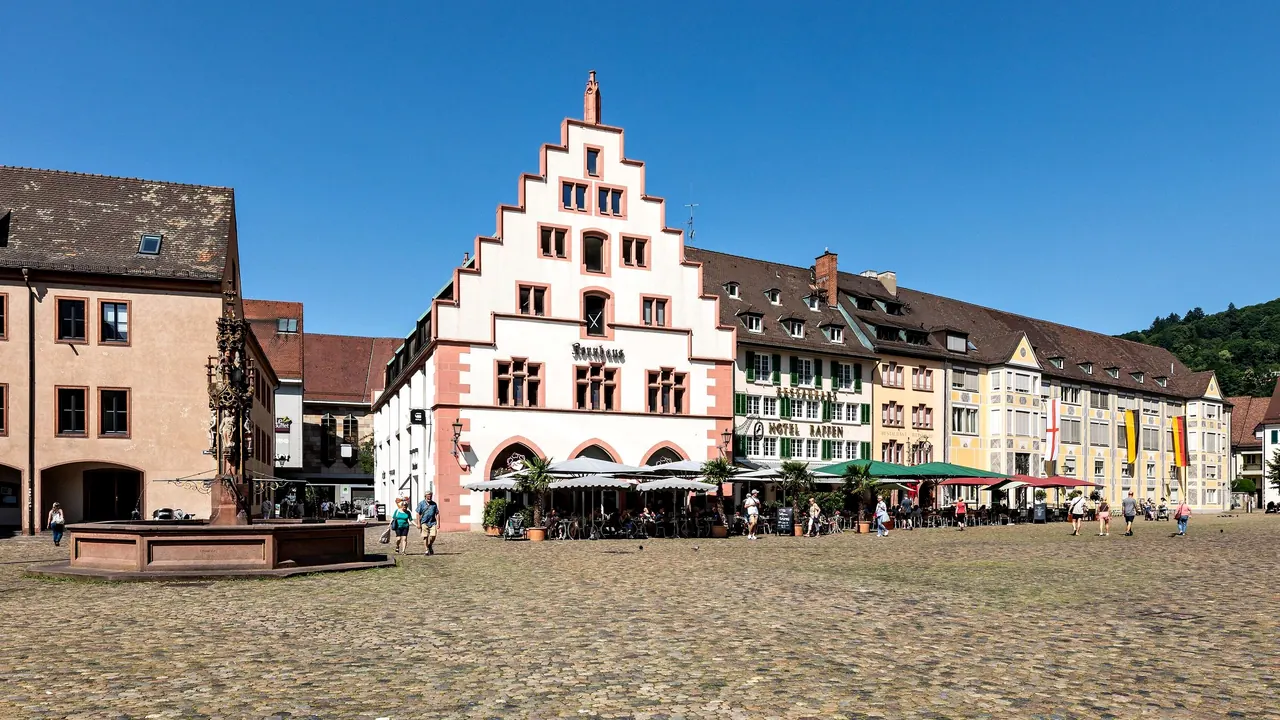
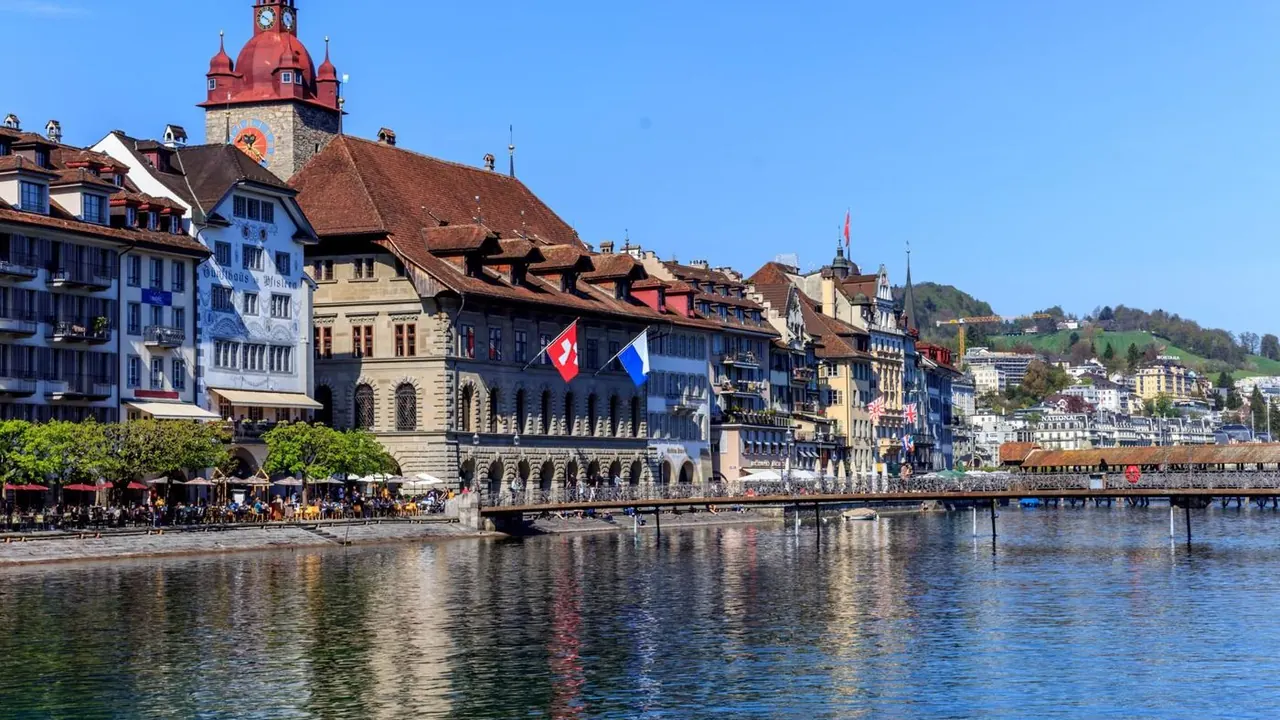
Photos: Freiburg by Dietmar Rabich, CC BY-SA 4.0, cropped; Lucerne by ILOVESwitzerland, Pexels License.
Freiburg or Lucerne?
Our verdict in twelve categories, each scored against the same fixed benchmark cities, and the climate month by month, so you can choose for your trip.
Choose Freiburg for
- prices
- food and drink
- wellness
Freiburg suits travellers who want a relaxed, lived-in base with a good table and money left over. You get Baden cooking with Kaiserstuhl wine, student evenings around the Martinstor, thermal baths just to the south and Europa-Park for the children. It also puts three countries within reach, with Alsace and Basel close by.
Choose Lucerne for
- live music and the arts
- beaches
- nature and the outdoors
Pick Lucerne when the scenery matters most and the budget can stretch. Pilatus and Rigi rising from the lake are grander than anything in the Black Forest, and steamers and cogwheel railways turn every day into an outing. In late summer the world's leading orchestras come to the lakefront concert hall. Expect quieter evenings and a much bigger bill.
Scoreboard
Twelve categories on one fixed scale from 0 to 100. The shaded stretch is the gap between the two.
Your match
Pick a travel style or drag the sliders, and both match scores follow your weighting.
Too close to call, 2 points apart
Wins on prices and food and drink with your weighting.
Wins on live music and the arts and beaches with your weighting.
What matters to you?
Category by category
What the scores mean for a trip.
Beaches & swimming
Neither city has a sea, but Lucerne has the better swimming. Lake Lucerne is clean and reaches a comfortable swimming temperature in high summer. It is a short walk from the Old Town to the Lido, the old wooden lake baths and the lawns at Ufschötti.
In Freiburg a swim means cycling to the gravel-pit lakes on the Rhine plain, going about an hour into the Black Forest for the cooler Titisee and Schluchsee, or queuing for the busy open-air pools. In both places you lie on grass, not sand.
Food & drink
Freiburg eats better and for less. Baden cooking leans towards France, with Flammkuchen, Schäufele and mountain trout, the Pinot comes from the Kaiserstuhl just outside town, and the daily market around the Münster is a meal in itself. The surrounding countryside has some of Germany's best fine dining.
Lucerne serves fondue, rösti, lake perch and its veal-filled Chügelipastete in guild houses and on terraces along the Reuss. It is solid food, but the choice is narrow and many places near the Chapel Bridge cater to coach tours. Neither city offers much international cooking.
Culture & sights
Both have compact old towns that fill a day or two, but they differ in character. Freiburg is centred on one great Gothic building, the red sandstone Münster with its open-lace tower. Around it are the Bächle channels and medieval gates in a carefully rebuilt centre, and the Augustinermuseum holds fine medieval sculpture.
Lucerne's medieval Old Town is well kept and its sights are better known: the Chapel Bridge, the towers of the Musegg Wall and the Lion Monument. It also has the stronger modern art, with Picasso and Klee at the Rosengart Collection.
Nightlife
Freiburg has the livelier evenings. Its large student population keeps the pubs, wine bars and beer gardens around the Martinstor full, people gather along the Dreisam on summer nights, and a few clubs play techno and indie. Things quieten down during the semester break.
Lucerne winds down early. Evenings mean a drink by the river and a small bar and club scene in the Neustadt. The one exception is Fasnacht, when the whole town stays out in costume until dawn.
Nature & outdoors
Both cities have mountains on the doorstep, but Lucerne's are on another scale. Pilatus rises to 2,128m above a branching lake, Rigi and the Stanserhorn are a boat ride away, and Titlis has glacier snow all year. Steamers, cogwheel trains and trails combine easily in a single day, though low cloud can hide it all for days at a time.
Freiburg's Black Forest is gentler and greener. You can take the cable car to the Schauinsland ridge, hike on the Feldberg, walk through gorges like the Ravenna valley and cycle among the Kaiserstuhl vineyards. It suits mountain bikers and walkers who prefer rolling hills to alpine drama.
Day trips
The day trips are equally good, but they lead in different directions. From Freiburg the appeal is crossing borders: Basel by train, then Colmar, the Alsace wine villages and Strasbourg by car. On the German side there are Staufen, Breisach and Baden-Baden.
Lucerne's trips stay within Switzerland and go by rail or boat. Zurich, Bern and Basel are each under an hour away, and lake steamers run to Vitznau, Brunnen and the Rütli meadow of the William Tell story. A car helps for Alsace, but nothing from Lucerne needs one.
Good for families
Freiburg gives children more to do. Europa-Park, Germany's largest theme park, is under an hour north, the Mundenhof animal park is free, and paddling in the Bächle costs nothing. Swimming lakes and the suspension bridge at Steinwasen fill summer days.
Lucerne has one excellent rainy-day answer in the Swiss Museum of Transport, and the steamers and cogwheel trains thrill young children. But those trips depend on clear skies, the costs add up quickly, and a long stay can run out of ideas.
Getting around
Both are easy without a car, and Lucerne slightly more so. Its station, boat piers and Old Town all sit together on the lakefront, and one integrated ticket system takes you on to the steamers, cogwheel railways and cable cars.
Freiburg is made for cycling. It has a walkable, car-free old town, trams out to the suburbs and trains up the Höllental, but the Alsace wine villages are much easier to reach by car.
Shopping & style
Lucerne is the better city for shopping, although neither is a reason to go. Freiburg's offer is modest: chain stores and department stores on Kaiser-Joseph-Strasse, independent bookshops and organic stores in the Gerberau and Konviktstrasse lanes, and Kaiserstuhl wine and Black Forest ham to take home from the Münster market. It has nothing at the luxury end, and locals cross to Basel for serious retail.
Lucerne has a speciality that Freiburg lacks. The big watch and jewellery houses on Schwanenplatz and along the lakefront make it a natural place to buy a good Swiss watch, and chocolate and army knives are sold alongside. Fashion and design shops are scarce, but anyone shopping for something special will find more here. Cuckoo clocks are on sale in both cities.
Affordability
Freiburg is far cheaper. Its hotels are scarce and cost more than you would expect for a city of its size, so many visitors stay in Black Forest villages instead. Market snacks, wine taverns and a free cathedral keep daily costs down.
In Lucerne almost everything is expensive, from a plain dinner to the mountain railways that are the reason for going. A travel pass and supermarket picnics by the lake help, but only a little. Visitors to Freiburg who cross into Switzerland meet the same high prices.
Live music & performing arts
Lucerne is the stronger choice for music, thanks to the Lucerne Festival. Mainly in late summer, it brings the world's leading orchestras and soloists to Jean Nouvel's lakefront hall. The hall is famous for its acoustics and runs a programme all year round.
Freiburg's stage is good for a city of its size. The Theater Freiburg runs opera and drama in repertory, the Freiburger Barockorchester is a leading period-instrument ensemble, and the Zelt-Musik-Festival fills its tent village each summer. The student jazz clubs offer the kind of nightly live music Lucerne largely lacks.
Wellness & relaxation
Freiburg is in spa country. There is a thermal bath on the city's eastern edge, warm outdoor pools at Bad Krozingen about twenty minutes south, a modern thermal bath beside Roman ruins at Badenweiler, and the bathhouses of Baden-Baden an hour away by train.
Lucerne has no bathing tradition of its own. A soak means a hotel spa or Mario Botta's mineral bath high on the Rigi. The city's calm comes from steamer rides and lakeside promenades, though the Old Town gets crowded at midday.
When should you go?
Pick your month. The climate figures are measured averages, not a forecast.
Freiburg in July
Lucerne in July
Daytime high, °C
Rainfall in the month, mm
Where the figures come from
Lucerne has no rain gauge within 25 km of the centre, so its rainfall comes from a gridded climate dataset read at the city rather than from a gauge further away.
Lucerne's sunshine is measured 42 km from the centre, at Zurich Town / Ville..
Temperature and rainfall are climate normals, averaged over the years shown. Freiburg: 1991-2020 normals, Freiburg (0.6 km from centre). Lucerne: 2005-2025 (sunshine 1991-2020, rainfall 1991-2020) normals, Emmen (4.2 km from centre).
Summers are warmer and drier in Freiburg. July reaches about 27°C there against 24°C in Lucerne, and Freiburg gets more sunshine in every month of the year. Lucerne's wettest months fall in high summer, with around 141mm in both July and August. Those are also the only months when the lake is warm enough for most swimmers, so leave some slack in your plans for mountain days. Freiburg's rain peaks in May and stays moderate after that.
For walking the streets and hiking, both cities are at their best from May to September. Freiburg's mild spring and autumn stretch that season at both ends. Winters are cold, grey and short of sun in both, with Lucerne down to about 4°C. That is the season for skiing on the Feldberg and on the slopes above Lake Lucerne rather than for sightseeing.
Which traveller are you?
On a trip on a tight budget, Freiburg is the clear choice. Its hotels are not cheap, but market sausages, student-quarter restaurants and a free cathedral keep the days affordable. In Lucerne, a simple meal and the mountain railways will strain any budget.
For a food and nightlife trip, Freiburg comes out ahead again. Baden cooking with a French accent and wine from vineyards outside town beat Lucerne's narrower menu of fondue and rösti. The student bars around the Martinstor are still busy long after Lucerne's lakefront has emptied.
On an outdoors trip, Lucerne wins. Pilatus, Rigi and Titlis rise straight from the lake, and boats, cogwheel trains and trails link up into full alpine days. Freiburg's Black Forest offers excellent gentle hiking and cycling, but on a smaller, softer scale.
Before you go
| Measure | Freiburg | Lucerne |
|---|---|---|
| Official language | German | French, German, Italian, Romansh |
| Currency | Euro (EUR) | Swiss Franc (CHF) |
| Sockets | CF230 V, 50 Hz | CJ230 V, 50 Hz |
| Driving side | Right | Right |
| Time zone | UTC+1, UTC+2 in summer | UTC+1, UTC+2 in summer |
| Emergency number | 112 | 112 |
| Elevation | 278 m | 436 m |
| Main airport | EuroAirport Basel–Mulhouse–Freiburg (BSL)50 km from centre112 non-stop destinations | Zürich Airport (ZRH)49 km from centre226 non-stop destinations |
| Public holidays this year | 12 days | 12 days |
By the numbers
| Measure | Freiburg | Lucerne |
|---|---|---|
| City population | 238,299 | 86,234 |
| People per km² | 1,558 | 2,963 |
| Museums within 10 km | 13 | 14 |
| UNESCO World Heritage sites within 50 km | 2 | 1 |
Where else could you go?
Every comparison below shares a destination with this one, so you can follow Freiburg or Lucerne somewhere new.
- Colmarvs Freiburg
- Zurichvs Lucerne
- Baselvs Freiburg
- Interlakenvs Lucerne
- Strasbourgvs Freiburg
- Bernvs Lucerne