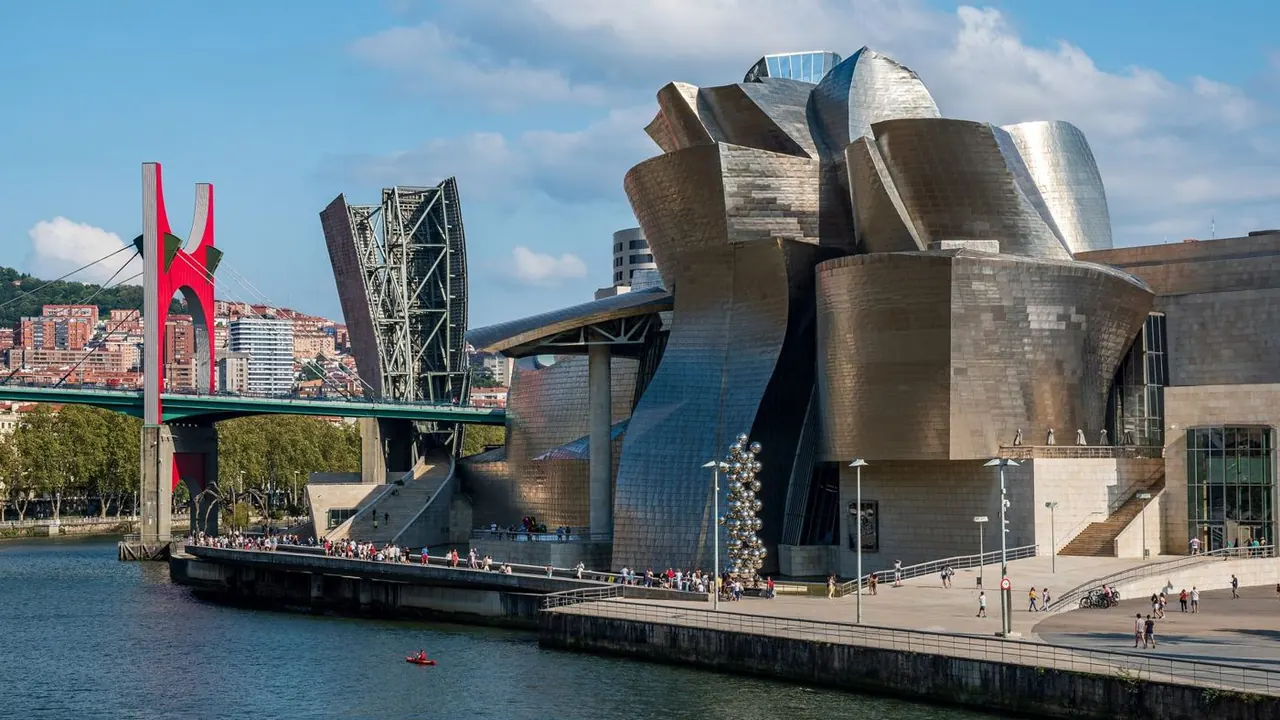
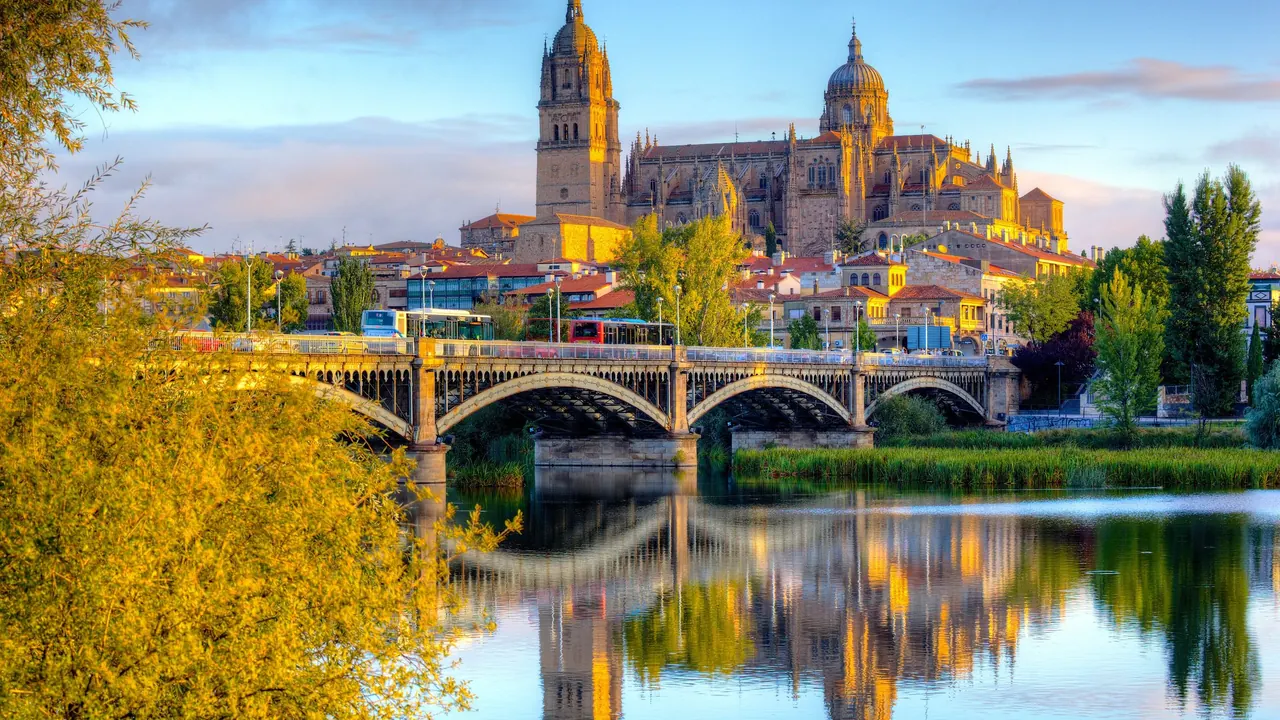
Photos: Bilbao by José Ligero Loarte, CC BY-SA 4.0, cropped; Salamanca by Jiuguang Wang, CC BY-SA 3.0 ES, cropped.
Bilbao or Salamanca?
Our verdict in twelve categories, each scored against the same fixed benchmark cities, and the climate month by month, so you can choose for your trip.
Choose Bilbao for
- beaches
- food and drink
- nature and the outdoors
Bilbao is the better pick if you travel to eat well and want green country and sea within easy reach. The pintxo bars and Basque kitchens are the main attraction, the Guggenheim gives the city a landmark, and the metro carries you out to surf beaches and cliff paths. Mountain walking and San Sebastián are both close enough for a day out. Pack for rain, and expect to pay a little more than elsewhere in Spain.
Choose Salamanca for
- prices
- culture and sights
- nightlife
Salamanca suits the traveller who wants a beautiful historic town on a modest budget. The golden sandstone old town, the university and the twin cathedrals are better sightseeing than anything in Bilbao's medieval core, and they glow when floodlit at night. Tens of thousands of students keep the bars cheap and full late. There is no sea and less greenery close by, but the walled towns of Old Castile make easy day trips.
Scoreboard
Twelve categories on one fixed scale from 0 to 100. The shaded stretch is the gap between the two.
Your match
Pick a travel style or drag the sliders, and both match scores follow your weighting.
Wins on beaches and food and drink with your weighting.
Wins on prices and culture and sights with your weighting.
What matters to you?
Category by category
What the scores mean for a trip.
Beaches & swimming
Bilbao has no beach in the city, but the metro runs to Getxo, Sopelana and the sheltered bay at Plentzia in well under an hour. The Bay of Biscay is warm enough for a proper swim by late summer. The changeable weather makes a beach afternoon something to fit into a city stay, not a reason to come.
Salamanca is on the Castilian plain, a long way from any coast. In summer the only swimming is in municipal pools and river beaches on the Tormes, so if you want sea water at all, Bilbao is the only one of the two that offers it.
Food & drink
Both cities eat at the bar counter, but Bilbao takes it further. The poteo through the Casco Viejo and Plaza Nueva brings elaborate pintxos with txakoli, the Ribera market shows off the fish and produce, and the restaurants go from asadores grilling txuleta up to several Michelin-starred kitchens.
Salamanca's food is simpler, heartier inland cooking: Guijuelo ibérico ham, hornazo, suckling pig and morucha beef, with Toro and Ribera del Duero wines. It is generous and informal but narrower, with little seafood and few ambitious restaurants.
Culture & sights
Salamanca is the finer place for sightseeing. The whole old town is a UNESCO site built in golden sandstone, with one of Spain's great baroque squares, the carved Plateresque university front, two cathedrals side by side and the Casa de las Conchas, all a short walk apart. Its museums are modest apart from the Casa Lis.
Bilbao is the reverse: its strength is art rather than old streets. The Guggenheim and the Bellas Artes collection outshine anything Salamanca has indoors, while the Casco Viejo is pleasant rather than grand. The Vizcaya Bridge adds a piece of industrial heritage a metro ride away.
Nightlife
Salamanca has the livelier nights, with a crowd made up largely of students. From Thursday to Saturday, students and language learners fill the bars around the Plaza Mayor and Calle Bordadores, then move on to dance bars until well past 3am, cheaply and with an international mix. It goes quiet outside term time.
Bilbao's evenings grow out of the pintxo crawl and are more mixed in age, with Licenciado Poza for a younger crowd and alternative bars near the Ribera. Clubs are few, but Aste Nagusia in August takes over the riverbanks for nine days.
Nature & outdoors
Bilbao is the greener base by a distance. The funicular to Artxanda and the Pagasarri hike begin on the city's edge, and Urkiola's limestone peaks, the Urdaibai reserve and San Juan de Gaztelugatxe are all close, much of it reachable without a car. The cost is frequent rain.
Salamanca looks out over the open Meseta, with only riverside paths nearby. Its real landscapes, the chestnut forests of the Sierra de Francia and the granite gorge of the Arribes del Duero, are about an hour away and almost always need a car.
Day trips
Bilbao's outings take in coast, cities and wine country, and that range gives it the edge. San Sebastián is a little over an hour by bus, the fishing ports of Bermeo, Mundaka and Lekeitio line the shore near Gernika's oak tree, and Vitoria and the walled hilltop village of Laguardia in the Rioja Alavesa make a full day inland. To the west, Santillana del Mar and the Altamira museum are within reach in Cantabria.
Salamanca's day trips are nearly all historic towns: walled Ávila, the Romanesque churches of Zamora, the ramparts of Ciudad Rodrigo and the half-timbered streets of La Alberca. Each one is worth the trip, but they are mostly the same kind of day out, and many of the villages are hard to reach without a car.
Good for families
Bilbao gives children more to do, mostly outdoors and on the move. Doña Casilda Park has its pond and playgrounds, the funicular up Artxanda is a small adventure with a park at the top, and Puppy and the Guggenheim's family activities go down well with young visitors. With no zoo or aquarium, wet days still need some planning.
In Salamanca, the fun is mostly hunting for the frog and the astronaut carved into the stonework and climbing the cathedral towers. Little is made for children, summer afternoons are very hot and winters are bitter, so it works best as a day or two within a longer family trip.
Getting around
Both are easy without a car, in different ways. Bilbao spreads along several kilometres of riverbank, so the tram and the Foster-designed metro come into their own, taking you to the Guggenheim, the beaches and the Vizcaya Bridge. Regional trains and buses reach the coast and San Sebastián.
Salamanca is the more compact of the two, an old town you can cross on foot in about twenty minutes with almost no need for transport. Beyond it, the trains to Madrid are good, but the sierras and villages really need a car.
Shopping & style
Bilbao has a little more choice. The Gran Vía has the chains and a department store, and the old family shops of the Casco Viejo sell berets, espadrilles and cookware alongside small design stores.
Salamanca's shopping streets offer chains and university souvenirs. Its distinctive buy is charro silver filigree, and in both cities the best things to take home are edible: anchovies and txakoli in one, ibérico ham in the other.
Affordability
Salamanca is clearly the cheaper stay. The student economy keeps tapas and drinks low, often with a free tapa at the counter, and guesthouses in the old town are moderately priced. The main extra cost is the admission charges at the cathedrals and the university.
Bilbao is on the expensive side for Spain, especially for central hotels. A pintxo crawl is still good value, but the asadores and starred restaurants that draw people here charge for it.
Live music & performing arts
Bilbao has the stronger stage programme. The Euskalduna hosts the ABAO opera season and the Bilbao Symphony Orchestra, the Arriaga and Campos Elíseos theatres stage touring productions, and BBK Live brings international bands each July.
Salamanca has no opera or resident orchestra. Its stages are the Teatro Liceo and the university's concerts in historic halls. Its most memorable music is free: the caped student tunas singing under the arcades of the Plaza Mayor.
Wellness & relaxation
Salamanca is a little more restful. Its quiet cloisters at San Esteban and Las Dueñas, the real siesta and the small Arab-style bath houses make the pace slow. Traditional mineral-spring spas at Ledesma and at Baños de Montemayor, used since Roman times, are within a short drive.
Bilbao offers only hotel and day spas, and the old balnearios are a separate trip. What it has instead is long lunches and riverside walks.
When should you go?
Pick your month. The climate figures are measured averages, not a forecast.
Bilbao in July
Salamanca in July
Daytime high, °C
Rainfall in the month, mm
Temperature and rainfall are climate normals, averaged over the years shown. Bilbao: 1991-2020 normals, Bilbao / Sondica (4.1 km from centre). Salamanca: 1991-2020 normals, Salamanca / Matacan (13.9 km from centre).
Bilbao has a mild, damp climate. Summers are pleasant rather than hot, with afternoons around 26°C, and from June to September the city has its driest and sunniest weather. The sea reaches about 22°C in August, so July to early September is the time for the beaches. From October the rain builds, peaking in November at around 170mm, and winters are grey and wet, though rarely cold.
Salamanca has much sharper seasons and is far drier and sunnier all year. July and August reach 31°C on the plain, which is tiring for long walks in the afternoon. Winter afternoons are cold and clear at around 9°C. The best months for exploring on foot are May, June, September and early October. In high summer, Bilbao's cooler coast is the more comfortable of the two.
Which traveller are you?
For an outdoors trip, Bilbao is the stronger choice. Its hills start at the edge of town, Urkiola and Gorbea offer real mountain walking within an hour, and the coast has cliff paths and good surfing. Salamanca's sierras and canyons mostly need a car.
On a trip on a tight budget, Salamanca makes your money go further. The student crowd keeps tapas and drinks cheap, often with a free tapa alongside, rooms in the old town are moderately priced, and the whole centre is walkable. Bilbao costs more than most Spanish cities.
For a beach and sun trip, neither city is ideal, but Bilbao at least has the sea. The metro reaches the sands at Getxo, Sopelana and Plentzia, which make a good summer afternoon. Salamanca has hotter, sunnier weather but only pools and river beaches.
Before you go
| Measure | Bilbao | Salamanca |
|---|---|---|
| Official language | Spanish | Spanish |
| Currency | Euro (EUR) | Euro (EUR) |
| Sockets | CF230 V, 50 Hz | CF230 V, 50 Hz |
| Driving side | Right | Right |
| Time zone | UTC+1, UTC+2 in summer | UTC+1, UTC+2 in summer |
| Emergency number | 112 | 112 |
| Elevation | 19 m | 798 m |
| Main airport | Bilbao Airport (BIO)5 km from centre73 non-stop destinations | Adolfo Suárez Madrid–Barajas Airport (MAD)184 km from centre239 non-stop destinations |
| Public holidays this year | 13 days | 12 days |
By the numbers
| Measure | Bilbao | Salamanca |
|---|---|---|
| City population | 351,124 | 146,110 |
| People per km² | 8,440 | 3,690 |
| Museums within 10 km | 17 | 13 |
| UNESCO World Heritage sites within 50 km | 3 | 1 |
| Swim season, months above 21 °C | 1 month | - |
Where else could you go?
Every comparison below shares a destination with this one, so you can follow Bilbao or Salamanca somewhere new.
- San Sebastianvs Bilbao
- Biarritzvs Bilbao
- Madridvs Salamanca
- Toledovs Salamanca
- Zaragozavs Bilbao
- Portovs Salamanca