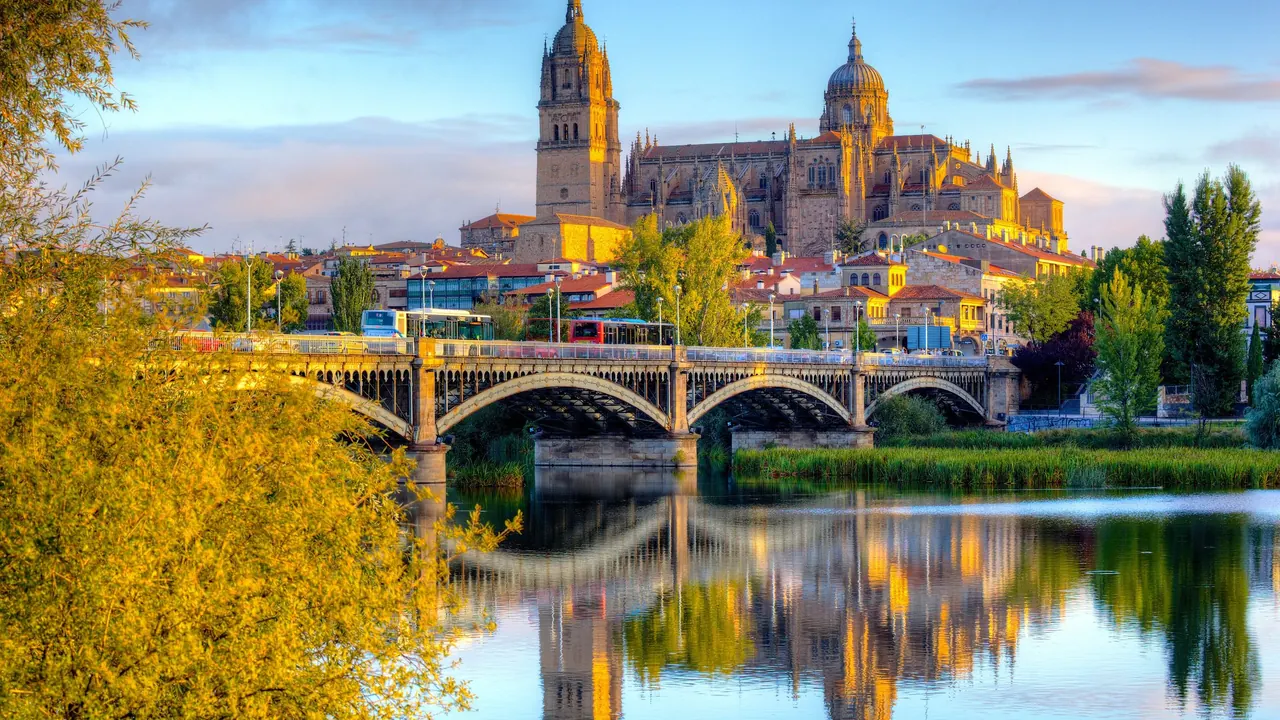
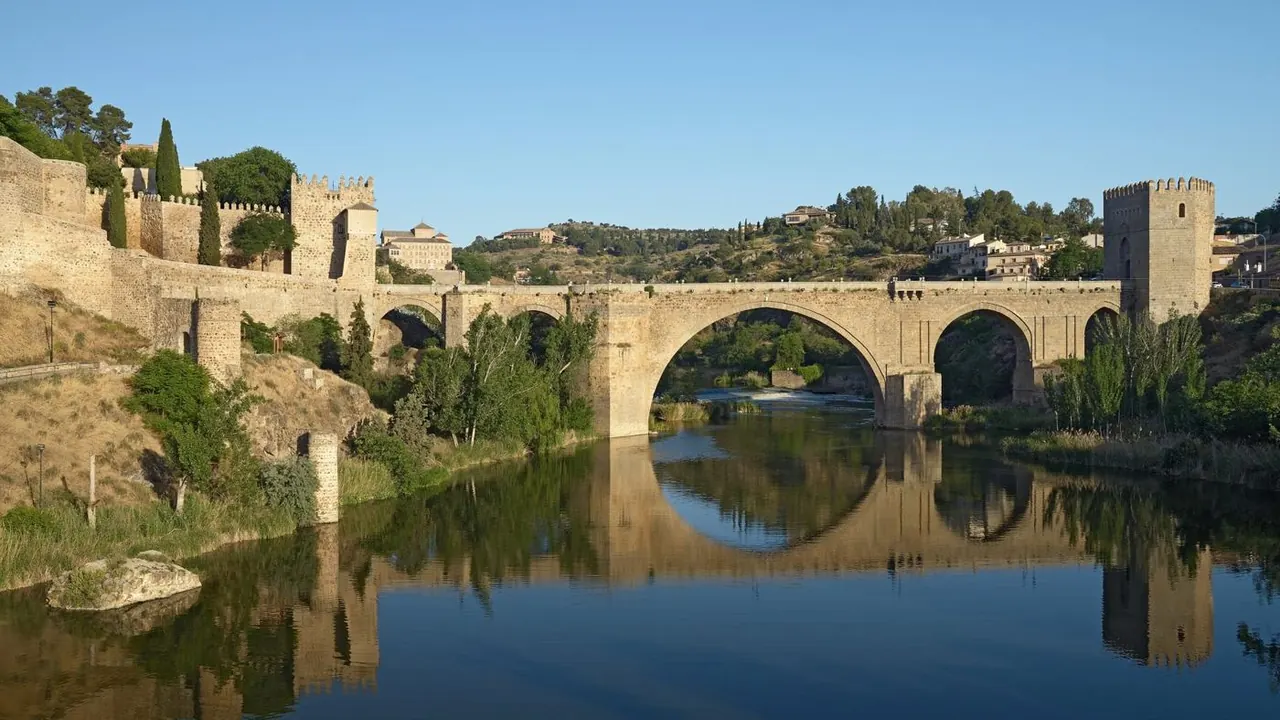
Photos: Salamanca by Jiuguang Wang, CC BY-SA 3.0 ES, cropped; Toledo by Ввласенко, CC BY-SA 3.0, cropped.
Salamanca or Toledo?
Our verdict in twelve categories, each scored against the same fixed benchmark cities, and the climate month by month, so you can choose for your trip.
Choose Salamanca for
- nightlife
- food and drink
- live music and the arts
Salamanca suits travellers who want their sightseeing to come with an evening life. Its golden sandstone centre is easy to walk, the tapas bars are cheap and generous, and from Thursday to Saturday the student crowd keeps the streets full late into the night. It is also the better base for the countryside, with the Sierra de Francia and the Arribes del Duero canyon within an hour's drive, and the better pick for a slower, longer stay on a modest budget.
Choose Toledo for
- day trips
- culture and sights
Choose Toledo if the monuments and paintings are the point of the trip. The layered Roman, Islamic, Jewish and Christian city on its hill above the Tagus, together with El Greco's canvases, gives it the deeper set of sights. Madrid's great museums are also only a short train ride away. The trade-off is quiet evenings, plainer food and steep cobbled lanes, so it works best as two or three focused days rather than a long stay for nights out.
Scoreboard
Twelve categories on one fixed scale from 0 to 100. The shaded stretch is the gap between the two.
Your match
Pick a travel style or drag the sliders, and both match scores follow your weighting.
Wins on nightlife and food and drink with your weighting.
Wins on day trips and culture and sights with your weighting.
What matters to you?
Category by category
What the scores mean for a trip.
Beaches & swimming
Neither city is anywhere near the sea, so this is no reason to pick one over the other. The small difference is in how you cool off. Salamanca has the river beaches along the Tormes and the reservoirs of its province as well as town pools. In Toledo the Tagus runs through a rocky gorge nobody swims in, so it is hotel pools and municipal pools only.
Food & drink
Salamanca eats noticeably better. Guijuelo's ibérico ham, hornazo and farinato sausage come with a bar-hopping culture around the Plaza Mayor and Calle Van Dyck that student custom keeps lively and generous. The Mercado Central and the Toro and Ribera del Duero wines make it easy to eat well without planning.
Toledo has its own good dishes, such as stewed partridge, carcamusas, game from the Montes de Toledo and convent marzipan. But the lanes by the cathedral are given over to set menus for day-trippers, and you need to walk a few streets away to find the honest taverns. It suits a couple of good regional meals more than a trip built around eating.
Culture & sights
Both are UNESCO old towns that take two or three days, but Toledo has more depth. Its hilltop holds the layers of Roman, Visigothic, Islamic, Jewish and Christian Spain: a great Gothic cathedral hung with El Greco and Goya, two synagogues, a small mosque, and El Greco's paintings across Santo Tomé, his museum and the Hospital de Tavera.
Salamanca's strength is harmony rather than range. The baroque Plaza Mayor, the carved University façade and the two cathedrals side by side all share the same golden stone, which glows when floodlit at night. Its museums are thin beyond Casa Lis, though, while Toledo's art collections are a reason to come in themselves.
Nightlife
This is where the two differ most. Salamanca's student and language-school crowd packs the bars around the Plaza Mayor, Calle Bordadores and Gran Vía from Thursday to Saturday, ending in dance bars and small clubs well past 3am. The crowd is young and the range narrow, and it all thins out in high summer.
Toledo's evenings stop at a late dinner and a round of tapas near Zocodover. A few weekend bars stay open later, but for a real night out people take the train to Madrid. The quiet lanes after dark are pleasant, but they are not nightlife.
Nature & outdoors
Salamanca opens onto bigger country. Within about an hour lie the chestnut forests and marked trails of the Sierra de Francia and Las Batuecas, peaks above 2,000m in the Sierra de Béjar, and the granite canyon of the Arribes del Duero with its boat trips.
Toledo's best outdoor moment is right on its doorstep: the riverside path through the Tagus gorge and the views back from the cigarrales hillside. Beyond that, it is the flat plain of La Mancha, the low Montes de Toledo and the deer of Cabañeros, about two hours off. In both cases you need a car to get out into the landscape.
Day trips
Both are good bases, but Toledo's list is stronger because of Madrid. The Prado and the royal palace are about half an hour away by high-speed train, and Aranjuez, El Escorial, the Consuegra windmills and Almagro's Golden Age theatre all fit into a day.
From Salamanca, the trips are quieter and more historic. You can reach walled Ávila, Romanesque Zamora, the ramparts of Ciudad Rodrigo and the timbered villages of La Alberca and Mogarraz. These reward a slower, car-based exploration of Old Castile rather than big-name sights.
Good for families
These two come out even for families, but for different reasons. Toledo has the one big attraction made for children, the history-show theme park on its outskirts, along with the swords, armour and castle-like Alcázar that children love. The trade-off is steep, cobbled lanes that defeat pushchairs.
Salamanca has nothing comparable made for children, but its flatter, pedestrian centre is easier with small legs, and hunting for the frog and the astronaut carved in stone makes a game of sightseeing. Both are very hot in midsummer afternoons.
Getting around
Each old town takes about twenty minutes to cross on foot, but the walking feels very different. Salamanca's centre is largely pedestrianised and only gently sloping, so it is a comfortable stroll from the Plaza Mayor down to the Roman bridge.
Toledo is a steep hill of twisting, cobbled lanes where getting lost is part of the experience and your legs feel it by evening. Public escalators help from the car parks, but the station sits at the foot of the hill across the river, so arriving means a bus or a climb.
Shopping & style
Neither city is a reason to go shopping, and they come out about even. The difference is in what you take home. Salamanca is better for edible souvenirs: a vacuum-packed piece of cured ham or a wedge of local cheese is easy to pick up near the Plaza Mayor. The traditional silverwork of the Salamanca countryside makes a lighter gift, and the city's ordinary run of Spanish chain stores and a department store is handy if you need clothes along the way.
Toledo has little of that everyday shopping, but its metalwork has no equal in Salamanca. Damascene pieces, with fine gold wire hammered into dark steel, and replica swords continue the city's long name for blades, and Talavera pottery adds some colour. The shops packed around the cathedral vary a lot in quality, so buy from a maker rather than a reseller. For fashion you would go to Madrid.
Affordability
Salamanca makes a budget last longer over a stay of several days. Rooms in and around the old town are moderately priced for a historic city, with plenty of simple guesthouses and mid-range hotels a few minutes from the Plaza Mayor. The exceptions are Easter and the festival weekends, when prices climb.
Toledo costs a little more, and where you sleep makes most of the difference. Rooms just outside the walls or in the newer town below the hill are moderate, though staying there means taking the escalators or a bus back up each morning. The set lunches in the taverns away from the cathedral are its best everyday value. Spending a night rather than coming in from Madrid for the day also lets you spread the sightseeing out at a slower pace.
Live music & performing arts
Neither has opera or a resident orchestra, but Salamanca has more going on during an ordinary week. The Teatro Liceo and a municipal arts centre host touring theatre, dance and flamenco, and the university puts on concerts in its historic halls. Tunas in black capes sing under the Plaza Mayor arcades most evenings.
Toledo's Teatro de Rojas runs a regional programme, and church organ music turns up now and then. Its big moment is the Corpus Christi procession. Otherwise serious performances mean an evening trip to Madrid.
Wellness & relaxation
Salamanca is the more restful choice, if not by a wide margin. Real mineral springs are within reach, at the old balneario of Ledesma half an hour away and the Roman-era waters of Baños de Montemayor about an hour south. In town, the cloisters of San Esteban and Las Dueñas and the riverside paths suit a slow day.
Toledo offers only Arab-style bath houses and hotel spas, plus the quiet that settles over its lanes and Tagus viewpoints once the tour groups leave. That is pleasant for a night or two but not enough for a restorative stay.
When should you go?
Pick your month. The climate figures are measured averages, not a forecast.
Salamanca in July
Toledo in July
Daytime high, °C
Rainfall in the month, mm
Temperature and rainfall are climate normals, averaged over the years shown. Salamanca: 1991-2020 normals, Salamanca / Matacan (13.9 km from centre). Toledo: 1991-2020 normals, Toledo (2.3 km from centre).
Both cities sit on the high, dry Spanish plateau and follow the same broad pattern: sunny, almost rainless summers, a wetter October, and cool winters. Spring and autumn are the best seasons for walking either old town, roughly April to early June and late September to October. Neither has a sea, so the summer heat brings no beach time with it, only pools.
The difference is how hot Toledo gets. Its July and August afternoons reach about 35°C, hot enough to make the steep lanes hard going from late morning on, while Salamanca's higher plain peaks around 31°C and cools off better at night. In winter it is the other way round. Salamanca is the colder of the two, with January highs near 9°C against Toledo's 12°C, and Toledo gets a little more sunshine all year. October is the wettest month in both, at around 50mm.
Which traveller are you?
On a food and nightlife trip, Salamanca is the clear choice. Its tapas crawl around the Plaza Mayor and Calle Van Dyck leads straight into one of Spain's best-known student nights, while Toledo goes quiet once the day-trippers leave for Madrid.
For a culture and arts trip, Toledo wins. The cathedral sacristy, the synagogues, the little mosque of Cristo de la Luz and El Greco's paintings in Santo Tomé add up to more than Salamanca's fine but museum-light centre, and the Prado is half an hour away.
On a trip on a tight budget, Salamanca goes further. Student demand keeps bar prices low and a free tapa with each drink is common. Its flat, walkable centre also costs nothing to get around, while Toledo's rooms with river views and separate monument tickets cost more.
Before you go
| Measure | Salamanca | Toledo |
|---|---|---|
| Official language | Spanish | Spanish |
| Currency | Euro (EUR) | Euro (EUR) |
| Sockets | CF230 V, 50 Hz | CF230 V, 50 Hz |
| Driving side | Right | Right |
| Time zone | UTC+1, UTC+2 in summer | UTC+1, UTC+2 in summer |
| Emergency number | 112 | 112 |
| Elevation | 798 m | 523 m |
| Main airport | Adolfo Suárez Madrid–Barajas Airport (MAD)184 km from centre239 non-stop destinations | Adolfo Suárez Madrid–Barajas Airport (MAD)80 km from centre239 non-stop destinations |
| Public holidays this year | 12 days | 13 days |
By the numbers
| Measure | Salamanca | Toledo |
|---|---|---|
| City population | 146,110 | 87,216 |
| People per km² | 3,690 | 376 |
| Museums within 10 km | 13 | 14 |
| UNESCO World Heritage sites within 50 km | 1 | 2 |
Where else could you go?
Every comparison below shares a destination with this one, so you can follow Salamanca or Toledo somewhere new.
- Madridvs Toledo
- Madridvs Salamanca
- Cordobavs Toledo
- Portovs Salamanca
- Coimbravs Salamanca
- Granadavs Toledo