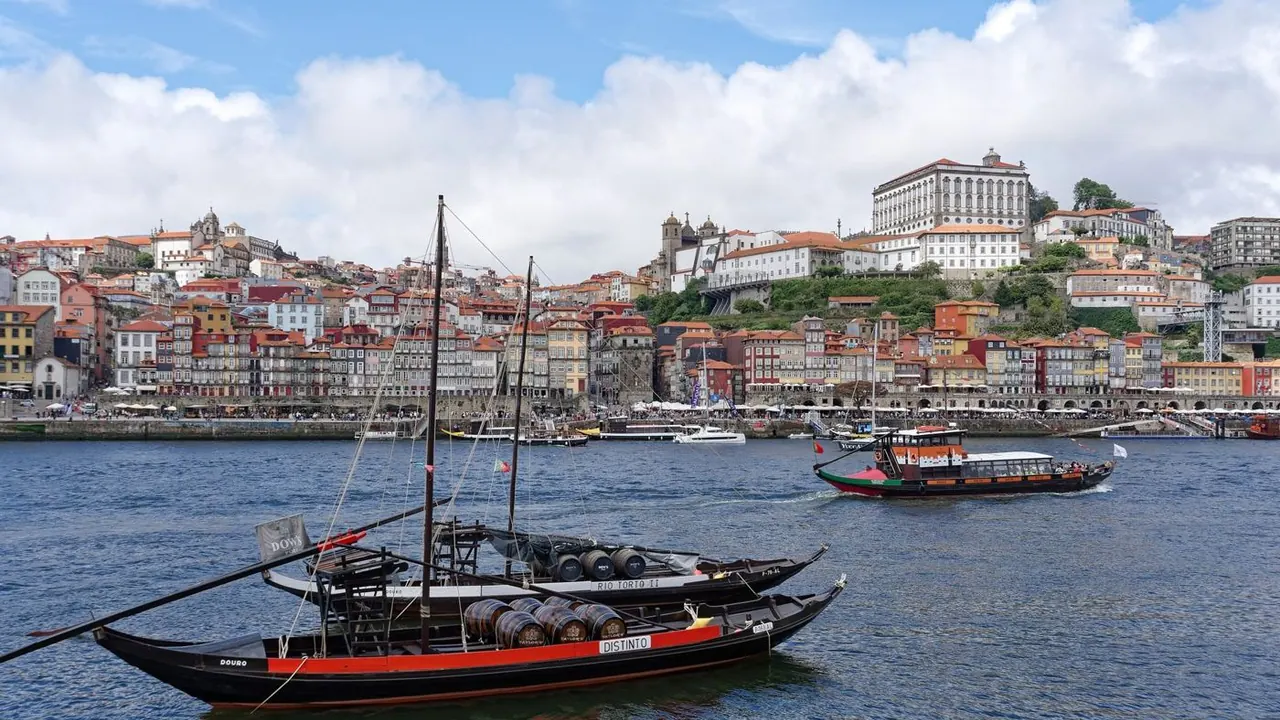
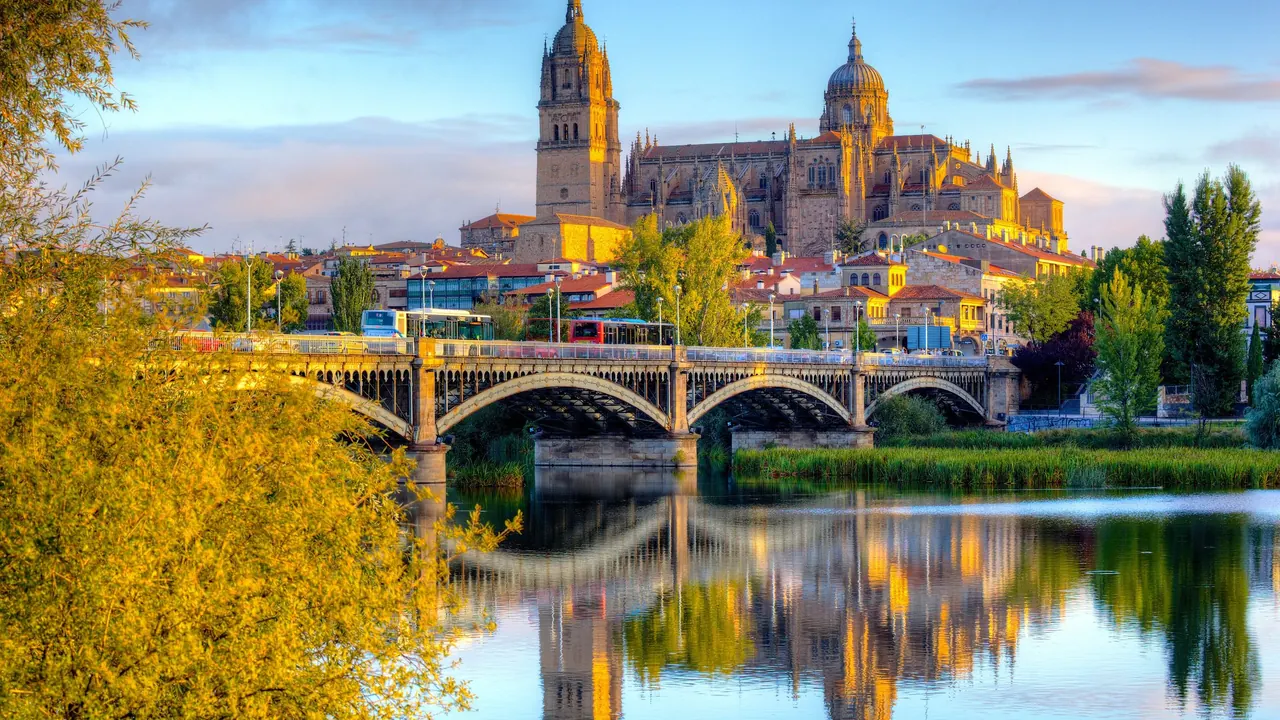
Photos: Porto by Jakub Hałun, CC BY 4.0, cropped; Salamanca by Jiuguang Wang, CC BY-SA 3.0 ES, cropped.
Porto or Salamanca?
Our verdict in twelve categories, each scored against the same fixed benchmark cities, and the climate month by month, so you can choose for your trip.
Choose Porto for
- beaches
- shopping
- live music and the arts
Porto suits travellers who want a city with water on two sides: the Douro gorge running through it and the Atlantic at its edge. It has the stronger table, with charcoal-grilled fish in Matosinhos and port tasted in the Gaia cellars, plus better concerts, more shopping for crafts and design, and a run of towns and vineyards you can reach by train. The price is steep cobbled hills and a wet winter.
Choose Salamanca for
- getting around
- wellness
- culture and sights
Salamanca is the better pick for a slower, more compact stay in one of Spain's great university towns. Its golden sandstone centre can be crossed on foot in minutes, evenings go from tapas counter to student bar, and old spa waters lie within a short drive. There is no sea and the arts programme is thin, but for walking, eating ham at the bar and taking a real siesta, it is hard to beat.
Scoreboard
Twelve categories on one fixed scale from 0 to 100. The shaded stretch is the gap between the two.
Your match
Pick a travel style or drag the sliders, and both match scores follow your weighting.
Wins on beaches and shopping with your weighting.
Wins on getting around and wellness with your weighting.
What matters to you?
Category by category
What the scores mean for a trip.
Beaches & swimming
Porto actually has a coastline. Sandy beaches broken by granite run from Foz north to Matosinhos and south along the boardwalked Gaia shore, and the broad Matosinhos beach is half an hour away by metro. Cold water, fog and rough surf make it more of a sunbathing and walking coast than a swimming one.
Salamanca, high on the Castilian plain, has no sea at all. In summer, swimming means open-air pools or river beaches on the Tormes and in the reservoirs of the province.
Food & drink
Porto has the more varied and satisfying table, mainly because of the sea. Whole streets in Matosinhos grill sardines and octopus over charcoal, the tascas serve bacalhau and tripe, and the francesinha is a meal in itself. The port lodges in Gaia, along with cheap Douro reds and vinho verde, make drinking part of the sightseeing.
Salamanca's cooking is meatier and centres on the bar counter: ibérico ham from nearby Guijuelo, hornazo, suckling pig and morucha beef, with Toro and Ribera del Duero wines. It is excellent for grazing on tapas, but fish and international cooking are thin on the ground.
Culture & sights
The two are broadly level, and both UNESCO-listed centres can be seen in two or three days, but they feel very different. Porto's appeal is texture and contrast: blue-and-white azulejos at São Bento, the gilded interior of São Francisco and the Palácio da Bolsa, then a jump to modern architecture at Serralves and Casa da Música.
Salamanca is more of a single, unified set piece in golden stone. It has the baroque Plaza Mayor, the carved university façade, two cathedrals side by side and the Casa de las Conchas, all floodlit after dark. Its museums are modest beyond Casa Lis, and Porto has none of its scholarly, Castilian grandeur.
Nightlife
Both cities have student-driven nights out that are cheap and informal, and neither has the range of a capital. In Porto the crowd gathers on the streets behind the Clérigos tower, drinks in hand, with a few clubs open until dawn and wine by the river in Ribeira or Gaia as the quieter alternative.
Salamanca's night is more of a progression, from tapas to packed bars around the Plaza Mayor to dance bars after 3am, with a large crowd of foreign language students. Timing matters in both: Porto goes quiet midweek, and Salamanca goes quiet when term ends in high summer.
Nature & outdoors
Porto keeps its scenery close. The Douro gorge and its bridges are part of the city, and a flat promenade and cycle path run out past lighthouses to Matosinhos. The Parque da Cidade reaches down to the sea, and Peneda-Gerês lies further off for proper hiking.
Salamanca's surroundings are open wheat plain, with only the Tormes paths close at hand. The chestnut forests of the Sierra de Francia and the Arribes del Duero canyon, where the same river cuts the Portuguese border, are rewarding but an hour away and need a car.
Day trips
Porto has the better range of outings, and many of them work by train. Guimarães and Braga are about an hour away, as is Coimbra's university on the fast line, Aveiro is closer, and the scenic railway up the Douro to Régua and Pinhão leads into vineyard country.
Salamanca's options are just as historic: the walls of Ávila, Zamora's Romanesque churches, Ciudad Rodrigo's ramparts and the half-timbered villages of La Alberca and Mogarraz. The mountain villages, however, are hard to reach without a car.
Good for families
Porto has more ready-made outings for children: the aquarium at Foz, river cruises, the cable car over Gaia, the Crystal Palace peacocks and zoos just outside town. The trade-off is the hills, as steep stepped cobbles make a buggy hard work.
Salamanca is flatter and largely pedestrian, and children like hunting for the frog and the astronaut carved into the stone. But it has no zoo, aquarium or theme park, and its summer heat and winter cold are harsher.
Getting around
Salamanca is the easier city to get around because nearly everything sits in one pedestrianised old town, a twenty-minute walk end to end on gentle slopes. Buses are hardly needed, though the province beyond is car country.
Porto is also compact, but the walk from Ribeira back up to Aliados is a climb on slippery granite, eased by the Guindais funicular. In return it has a proper light-rail metro to the airport, the beach and Gaia, plus trains to its day-trip towns.
Shopping & style
Porto gives shoppers more to do. Around Rua das Flores and the Miguel Bombarda gallery district, independent shops sell ceramics, cork, linens and design pieces, and you can take home tinned fish from Bolhão and port bought at the lodges.
Salamanca's shopping is mostly high-street chains and university souvenirs. Its best buys are edible ones, ibérico ham and cheese from the Mercado Central, plus the charro silver filigree jewellery of the province.
Affordability
Both are among the cheaper historic cities in Western Europe, and they differ mainly in where the money goes. In Porto, meals, wine and the metro cost little, and the bill climbs with central rooms in summer.
In Salamanca, the free tapa with a drink keeps evenings cheap and rooms are moderate, but admission charges at the cathedrals, the university and the towers add up over a day of sightseeing.
Live music & performing arts
Porto is the clear choice for concertgoers. Casa da Música houses a symphony orchestra and a programme running from classical to electronic, and the São João, Rivoli and Coliseu add drama, dance and touring shows. Fado is present but less rooted than in Lisbon.
Salamanca relies on the Teatro Liceo, university choral concerts and summer events. Its most memorable music is informal: caped student tunas playing under the Plaza Mayor arcades.
Wellness & relaxation
Salamanca does a little better for a restful trip. The old spa hotel at Ledesma is half an hour away, Baños de Montemayor's Roman-era springs lie about an hour south, and the siesta and the cloisters of San Esteban and Las Dueñas slow the day right down.
Porto's calm comes from long lunches, terraces above the Douro and the Serralves gardens. Its spas are mostly in hotels, and the thermal towns of Vizela and Gerês take a full day out.
When should you go?
Pick your month. The climate figures are measured averages, not a forecast.
Porto in July
Salamanca in July
Daytime high, °C
Rainfall in the month, mm
Temperature and rainfall are climate normals, averaged over the years shown. Porto: 1991-2020 normals, Porto / Serra Do Pilar (2.1 km from centre). Salamanca: 1991-2020 normals, Salamanca / Matacan (13.9 km from centre).
Porto is at its best from June to September, when the rain mostly stops, days are long and sunny and highs settle around a mild 25°C. That is good weather for walking the hills, but the Atlantic stays near 17°C even in high summer, so beach days are for sunbathing and short dips. From October to March the rain sets in hard, peaking at about 181mm in November, though it rarely gets truly cold.
Salamanca has a drier, more extreme inland climate. July and August reach about 31°C, too hot for long afternoons in the streets, and winter highs drop to around 9°C under clear, cold skies. May, June, September and early October are the best months for sightseeing there, while Porto's damp winters make it the weaker choice for an off-season trip, even though it is milder.
Which traveller are you?
On a beach and sun trip, Porto is the only real option of the two. Matosinhos and the Gaia shore have proper sand reached by metro, while Salamanca offers municipal pools and river beaches far from any coast. The Atlantic is cold, though.
For a short city break, Salamanca has the edge. Its sights cluster in a flat, pedestrianised old town that you can cross in about twenty minutes, whereas Porto's centre means steep climbs between the river and the hilltop.
On a relaxing and wellness trip, Salamanca is the calmer base. The balneario at Ledesma and the Roman-era springs at Baños de Montemayor are a short drive away, and the siesta and quiet cloisters set the pace. Porto's spas are mainly in hotels.
Before you go
| Measure | Porto | Salamanca |
|---|---|---|
| Official language | Portuguese | Spanish |
| Currency | Euro (EUR) | Euro (EUR) |
| Sockets | CF230 V, 50 Hz | CF230 V, 50 Hz |
| Driving side | Right | Right |
| Time zone | UTC, UTC+1 in summer | UTC+1, UTC+2 in summer |
| Emergency number | 112 | 112 |
| Elevation | 104 m | 798 m |
| Main airport | Francisco de Sá Carneiro Airport (OPO)12 km from centre133 non-stop destinations | Adolfo Suárez Madrid–Barajas Airport (MAD)184 km from centre239 non-stop destinations |
| Public holidays this year | 14 days | 12 days |
By the numbers
| Measure | Porto | Salamanca |
|---|---|---|
| City population | 273,476 | 146,110 |
| People per km² | 6,606 | 3,690 |
| Museums within 10 km | 42 | 13 |
| UNESCO World Heritage sites within 50 km | 3 | 1 |
| Swim season, months above 21 °C | None | - |
Where else could you go?
Every comparison below shares a destination with this one, so you can follow Porto or Salamanca somewhere new.
- Coimbravs Porto
- Madridvs Salamanca
- Toledovs Salamanca
- Santiago de Compostelavs Porto
- Coimbravs Salamanca
- Sintravs Porto