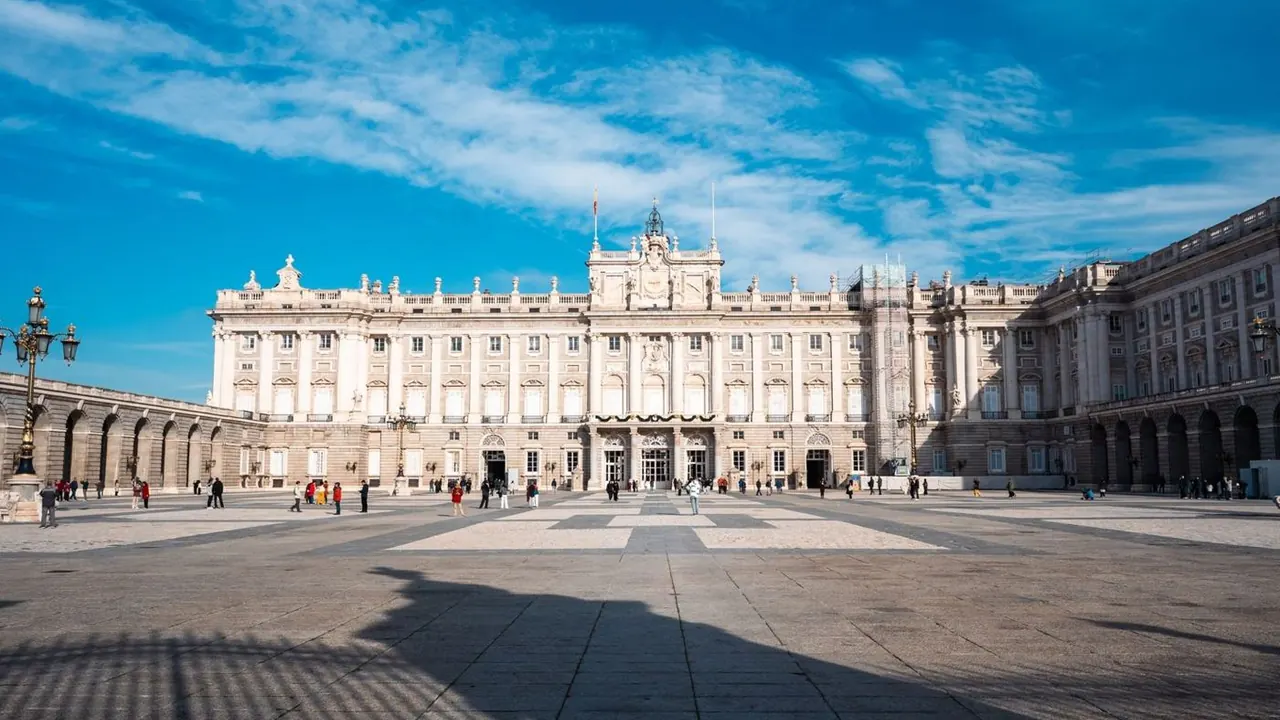
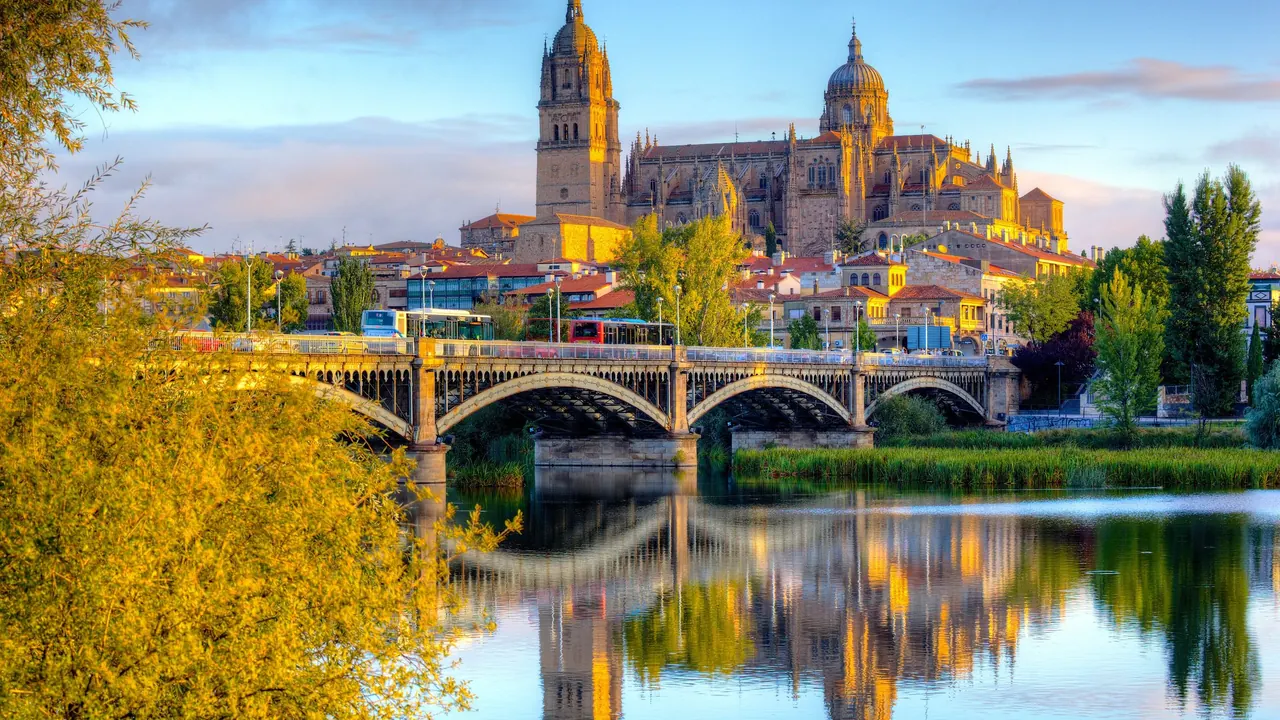
Photos: Madrid by Mert Ocak, Pexels License; Salamanca by Jiuguang Wang, CC BY-SA 3.0 ES, cropped.
Madrid or Salamanca?
Our verdict in twelve categories, each scored against the same fixed benchmark cities, and the climate month by month, so you can choose for your trip.
Choose Madrid for
- shopping
- live music and the arts
- families
Madrid suits travellers who want range and depth from one base. It has the Prado and its neighbours for art, late nights that move through several very different neighbourhoods, proper opera and flamenco, serious shopping, and fast trains out to Toledo, Segovia and beyond. It is also the easier choice with children, and a week there will not run short of things to do.
Choose Salamanca for
- prices
- wellness
- beaches
Salamanca is for a slower, cheaper and more intimate trip built around one beautiful old town. The golden stone, the Plaza Mayor and the floodlit cathedrals reward two or three unhurried days on foot. Student bars keep evenings cheerful and inexpensive, and the quiet cloisters and afternoon siesta suit anyone after calm. With a car, it also opens up the mountain villages and the canyons along the Portuguese border.
Scoreboard
Twelve categories on one fixed scale from 0 to 100. The shaded stretch is the gap between the two.
Your match
Pick a travel style or drag the sliders, and both match scores follow your weighting.
Wins on shopping and live music and the arts with your weighting.
Wins on prices and wellness with your weighting.
What matters to you?
Category by category
What the scores mean for a trip.
Beaches & swimming
Neither city has a beach, and both are a long way from the coast. Where they differ is how locals cool off. Madrid has big open-air municipal pools and the reservoirs at the foot of the Sierra de Guadarrama, while Salamanca has the river beaches on the Tormes and the reservoirs of its province. If you want sea and sand, either trip needs a separate stretch on the coast.
Food & drink
Both cities eat standing at the bar counter, but Madrid has far more on the menu. Its tapas crawl runs through Cava Baja, Plaza de Santa Ana and Lavapiés, and market halls such as San Miguel and Antón Martín double as places to eat. As the capital it gathers Galician seafood, Basque grills and high-end tasting menus alongside its own cocido and calamari sandwiches.
Salamanca is narrower but very good at what it does: ibérico ham from nearby Guijuelo, hornazo, suckling pig and morucha beef, with Toro and Ribera del Duero wines and generous student-priced tapas around Calle Van Dyck. Seafood and international cooking are thin, so a week of meals there would feel more repetitive than in Madrid.
Culture & sights
Madrid's case rests on painting. The Prado, the Reina Sofía and the Thyssen-Bornemisza sit along a single avenue, holding Velázquez, Goya, El Greco and Guernica. The Royal Palace and the Plaza Mayor add grand Habsburg and Bourbon architecture, though there is little that is medieval.
Salamanca is the lovelier place simply to walk around. Its UNESCO-listed old town of golden sandstone has one of Spain's finest baroque squares, the University's carved Plateresque façade and two cathedrals side by side. Its museums are modest apart from the Casa Lis, though, and two or three days covers the town, while an art lover can fill a week in Madrid.
Nightlife
Both are late-night Spanish cities, but Madrid's nightlife is bigger and more varied. Malasaña has rock bars, Chueca the gay scene and La Latina its terraces, and the large clubs around Gran Vía cover everything from mainstream to techno. The night runs past dawn, every night in summer.
Salamanca has a famous student night: cheap, friendly and packed from Thursday to Saturday around the Plaza Mayor and Calle Bordadores, ending in small clubs well after 3am. It is aimed squarely at a young crowd and goes quiet outside term time, especially in high summer, which is just when Madrid's terraces are fullest.
Nature & outdoors
Madrid has the easier way into real mountains. The Sierra de Guadarrama, about an hour north, has granite peaks above 2,400m, the boulder maze of La Pedriza, glacial lakes below Peñalara and modest skiing in winter. Within the city, the Retiro, the woodland of Casa de Campo and Madrid Río are good for runs and bike rides.
Salamanca's landscapes are also about an hour away and quieter in character: the chestnut and oak forests of the Sierra de Francia and Las Batuecas, and the granite canyon of the Arribes del Duero. Close to the city there is little beyond the paths along the Tormes, and nearly all of it needs a car.
Day trips
Madrid is an outstanding base for day trips, because fast trains fan out in every direction. Toledo and Segovia are about half an hour away, Salamanca and Cuenca around an hour to an hour and a half, and Córdoba can be done on a long day. El Escorial, Aranjuez and Alcalá de Henares are closer still.
Salamanca has a good circle of its own. Ávila and Zamora are about an hour away, and there are the ramparts of Ciudad Rodrigo and the untouched mountain villages of La Alberca and Mogarraz. Many of those villages need a car, though, and Segovia is a stretch.
Good for families
Madrid is the easier city for families by some way. The Retiro has rowing boats, puppet shows and playgrounds, and Casa de Campo adds the zoo, aquarium, cable car and funfair, with Faunia and a Warner Bros theme park further out. The flat centre and the lifts in the metro make life easy with a pushchair.
Salamanca is safe, compact and welcoming. Children enjoy hunting for the carved frog and astronaut and climbing the cathedral towers. With no zoo or theme park, sights that are mostly churches and colleges, and cobbled slopes in places, it works best as a day or two within a wider trip.
Getting around
Both centres are walkable, but on very different scales. Madrid's flat core, from the Royal Palace to the Prado, is easy on foot. Beyond it, a huge air-conditioned metro, the Cercanías trains and a direct line to the airport reach everywhere, and Atocha and Chamartín connect straight to the high-speed network.
Salamanca hardly needs transport at all. You can cross the old town on foot in about twenty minutes, though some cobbled slopes are hard work with a pushchair. The catch comes outside town, where the sierras and the Arribes del Duero are far easier to reach by car.
Shopping & style
This is one of the widest gaps between the two. Madrid's shopping is divided by neighbourhood: luxury houses on Calle Serrano in its own Salamanca district, flagships and department stores around Gran Vía and Preciados, independent and vintage shops in Malasaña and Conde Duque, and El Rastro flea market on Sunday mornings.
Salamanca has high-street chains along Calle Toro and Calle Zamora and plenty of university souvenirs. Its best buys are local: ibérico ham and cheese from the Mercado Central, and charro silver filigree jewellery. They make good gifts, but they are not a reason to go.
Affordability
Salamanca is kinder on the wallet. Its large student population keeps bar and tapas prices low, and a drink at the counter often comes with a free tapa. Guesthouses and mid-range hotels are moderately priced, and you walk everywhere. The one cost that adds up is the separate admission to the cathedrals, the university and the towers.
Madrid sits in the middle for a Western European capital. Hotels cost what a big city charges, but the midday menú del día and tapas keep food spending modest, the metro is inexpensive and the great museums have free entry at set times.
Live music & performing arts
Madrid has a full stage calendar. There is opera at the Teatro Real, the national orchestra at the Auditorio Nacional, zarzuela at its own theatre and long-running musicals along Gran Vía. Tablaos in the old centre put on flamenco with serious performers every night, and there are jazz clubs and indie venues in Malasaña.
Salamanca's programme is much thinner: touring theatre, dance and flamenco at the Teatro Liceo and the municipal arts centre, university choral concerts and a summer festival. Its most memorable music is free, the caped student tunas singing under the arcades of the Plaza Mayor in the evening.
Wellness & relaxation
Neither city has a bathing culture of its own, and in town both offer much the same: Arab-style bathhouses and hotel spas. Madrid's rhythm works against rest, though. It is late, social and noisy, and the calm moments come from a long lunch, an afternoon in the Retiro or the shade of the Botanical Garden.
Salamanca is the better place to slow down. Outside weekend nights the old town is quiet, with a real siesta and peaceful cloisters at San Esteban and Las Dueñas. Real spa waters are also within reach: the old balneario over mineral springs at Ledesma, and Baños de Montemayor, whose springs have been used since Roman times, about an hour south.
When should you go?
Pick your month. The climate figures are measured averages, not a forecast.
Madrid in July
Salamanca in July
Daytime high, °C
Rainfall in the month, mm
Temperature and rainfall are climate normals, averaged over the years shown. Madrid: 1991-2020 normals, Madrid (1.7 km from centre). Salamanca: 1991-2020 normals, Salamanca / Matacan (13.9 km from centre).
Both cities sit high on the Castilian plateau, so their years follow the same pattern: cold, bright winters, hot and very dry summers, and the most comfortable sightseeing in May, June and from late September into October. Madrid runs a little hotter, reaching about 33°C in July against Salamanca's 31°C. That makes long summer walks between Madrid's districts hard going in the afternoon, while Salamanca's compact old town is easier to cover in the cooler mornings and evenings. Neither city is a beach destination, but in high summer both are warm enough for open-air pools and, around Salamanca, the river beaches.
Rain is light in both cities and heaviest in autumn, when Madrid gets about 64mm in October and Salamanca a little less. Winter highs stay around 10°C in both. Madrid gets noticeably more winter sunshine, while Salamanca's December and January are the greyer months of the two. In summer both are drenched in sun.
Which traveller are you?
For a culture and arts trip, Madrid is the stronger pick. You can spend your days with some of the world's greatest Spanish painting and your evenings at the opera, an orchestral concert or serious flamenco. Salamanca is a lovelier town to look at, but its museums and stages run out quickly.
Families with children will find a week much easier to fill in Madrid. Parks, animals and rides are a short metro hop from the centre, and the summer heat is the main hardship. Salamanca charms children briefly, so it fits better as a short stop on a longer route through Castile.
On a tight budget, Madrid is manageable, because lunches and the metro are cheap and some museum entry is free, but rooms cost what you would pay in any big city. Salamanca makes the money go further, since student prices set the cost of eating and drinking. The town's sightseeing tickets are the one expense to plan for.
Before you go
| Measure | Madrid | Salamanca |
|---|---|---|
| Official language | Spanish | Spanish |
| Currency | Euro (EUR) | Euro (EUR) |
| Sockets | CF230 V, 50 Hz | CF230 V, 50 Hz |
| Driving side | Right | Right |
| Time zone | UTC+1, UTC+2 in summer | UTC+1, UTC+2 in summer |
| Emergency number | 112 | 112 |
| Elevation | 663 m | 798 m |
| Main airport | Adolfo Suárez Madrid–Barajas Airport (MAD)14 km from centre239 non-stop destinations | Adolfo Suárez Madrid–Barajas Airport (MAD)184 km from centre239 non-stop destinations |
| Public holidays this year | 12 days | 12 days |
By the numbers
| Measure | Madrid | Salamanca |
|---|---|---|
| City population | 3,506,730 | 146,110 |
| People per km² | 5,801 | 3,690 |
| Museums within 10 km | 88 | 13 |
| UNESCO World Heritage sites within 50 km | 4 | 1 |
Where else could you go?
Every comparison below shares a destination with this one, so you can follow Madrid or Salamanca somewhere new.
- Toledovs Madrid
- Toledovs Salamanca
- Portovs Salamanca
- Coimbravs Salamanca
- Zaragozavs Madrid
- Cordobavs Madrid