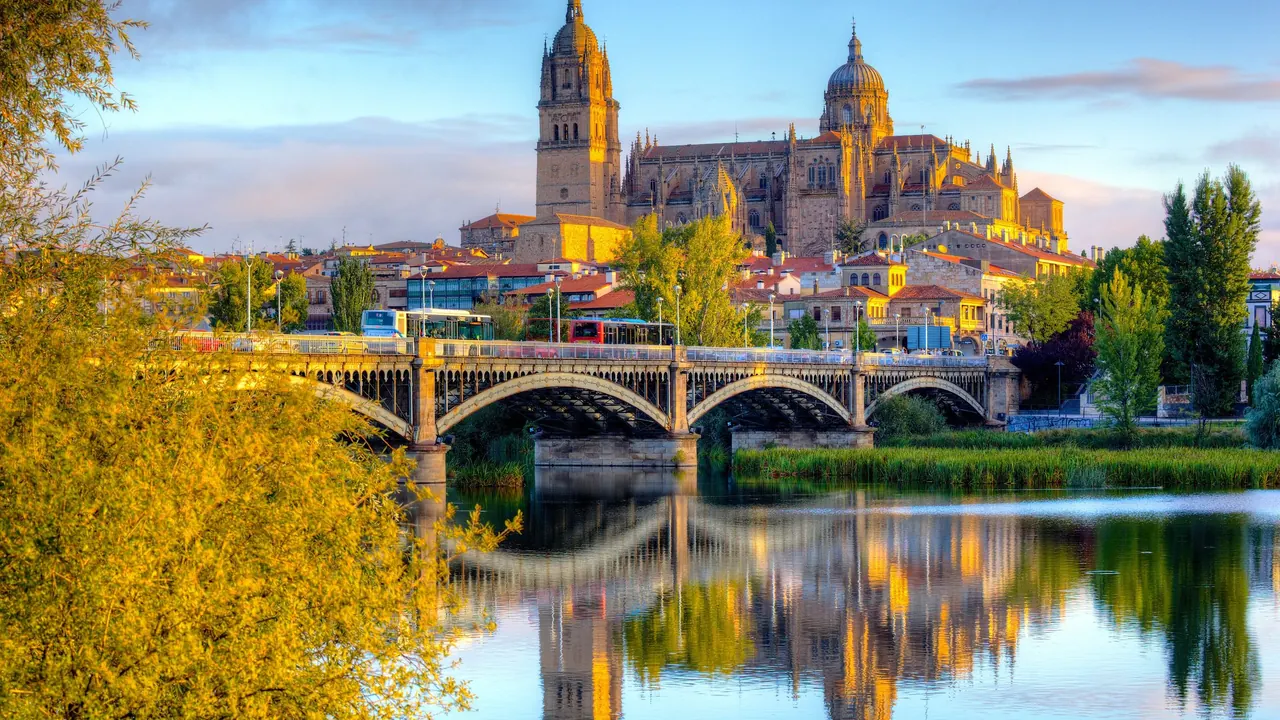
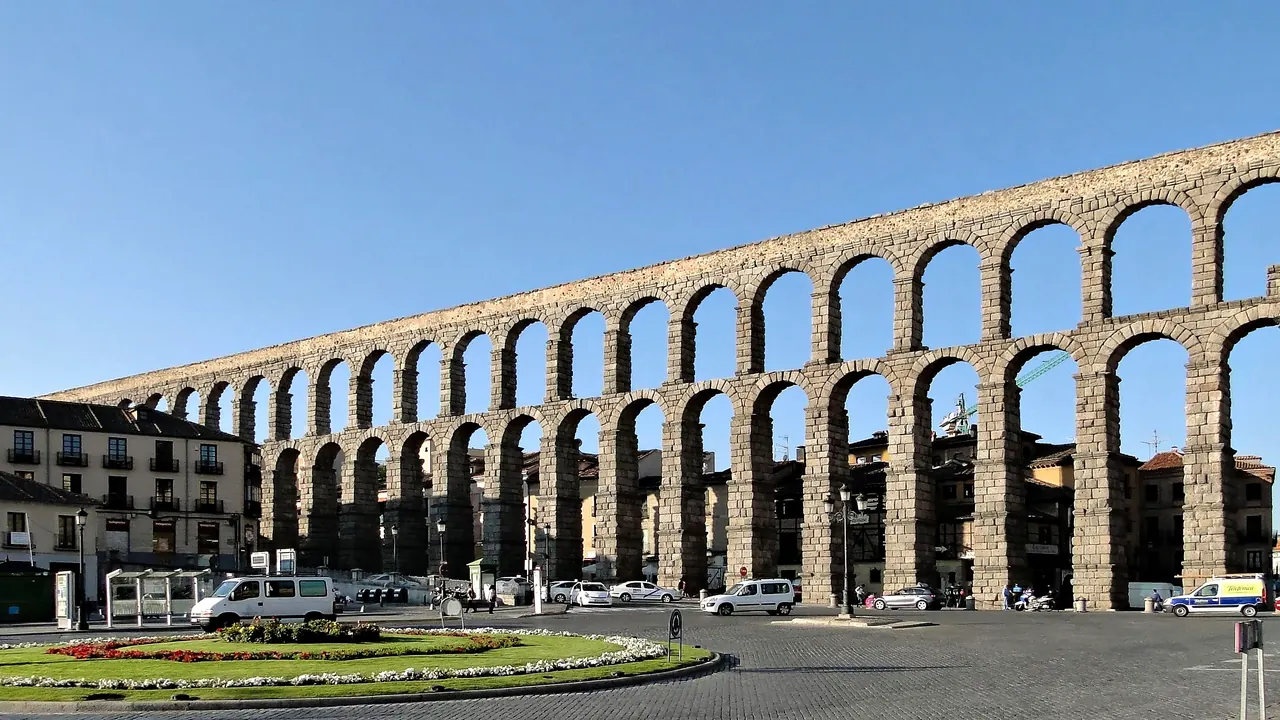
Photos: Salamanca by Jiuguang Wang, CC BY-SA 3.0 ES, cropped; Segovia by Bernard Gagnon, CC BY-SA 3.0, cropped.
Salamanca or Segovia?
Our verdict in twelve categories, each scored against the same fixed benchmark cities, and the climate month by month, so you can choose for your trip.
Choose Salamanca for
- nightlife
- getting around
- wellness
Salamanca is the better choice if your evenings matter as much as your days. It's a university town where the bar counter is the centre of social life, and it has one of Spain's liveliest student nights. The golden old town is compact enough to stroll everywhere, and there is a little more theatre, music and spa bathing within reach. It suits a slow stay of several days with plenty of grazing and a late night or two.
Choose Segovia for
- nature and the outdoors
- day trips
Segovia is for travellers who want mountains next to their monuments. The Sierra de Guadarrama starts at the edge of town, the royal palace of La Granja is close by, and the fast train links it to Madrid, which makes it the stronger base for walking and day trips. Nights are quiet and the cooking centres on one great roast lunch. It rewards people who will be out on the trails or the road by day and in bed at a sensible hour.
Scoreboard
Twelve categories on one fixed scale from 0 to 100. The shaded stretch is the gap between the two.
Your match
Pick a travel style or drag the sliders, and both match scores follow your weighting.
Wins on nightlife and getting around with your weighting.
Wins on nature and the outdoors and day trips with your weighting.
What matters to you?
Category by category
What the scores mean for a trip.
Beaches & swimming
Neither city is a place to swim. Both are a long day's drive from the sea, so on a hot afternoon you are choosing between pools and inland water. Salamanca's river beaches along the Tormes and the reservoirs of its province are the warmer and gentler option. Segovia's reservoirs and river pools in the Guadarrama foothills are fed by mountain water and stay noticeably chilly.
Food & drink
Salamanca offers more variety from one meal to the next. It is ham country, with Guijuelo just to the south, and evenings are spent moving between tapas counters on Calle Van Dyck and around the Plaza Mayor. You can stock up on cheese and charcuterie at the Mercado Central, and there are regional specialities to try along the way, such as hornazo and farinato sausage.
Segovia is the place for one particular meal. Many visitors come for its wood-roasted cochinillo and lechazo, followed by judiones beans from La Granja and ponche segoviano for dessert. Away from the asadores, though, there is less choice than in Salamanca, and the best-known dining rooms by the aqueduct fill up with tour groups at lunchtime.
Culture & sights
These two UNESCO old towns are equally rewarding, but they feel very different. Salamanca is a scholarly city of golden sandstone: the baroque Plaza Mayor, the carved University façade, two cathedrals side by side and the Casa Lis Art Nouveau collection. It takes two or three days to see properly.
Segovia is about Roman engineering and royal power. The aqueduct's mortarless granite arches lead up a narrow ridge, past Romanesque porched churches, to the cathedral and the Alcázar perched above two rivers. Most visitors cover it in one full day and enjoy a second at a slower pace.
Nightlife
This is where the two cities differ most. Salamanca's huge population of university and Spanish-language students fills Calle Bordadores, Gran Vía and the bars around the Plaza Mayor from Thursday to Saturday, and dance bars stay open well past 3am. The scene is cheap, international and aimed at a young crowd, and it goes quiet in high summer.
Segovia's evenings usually end after a tapas round and a drink on a terrace in the Plaza Mayor. A few later bars open at weekends, and there is almost nothing in the way of clubs. Locals who want a big night take the train to Madrid.
Nature & outdoors
Segovia has the mountains on its doorstep. The Sierra de Guadarrama fills the view from the Alcázar. Within half an hour you reach the Valsaín pine forests and the passes at Navacerrada and Cotos, with trails up to Peñalara's glacial lakes. Even without leaving town, the Eresma valley path makes an easy walk below the walls.
Salamanca's open countryside starts further out. The Sierra de Francia, Las Batuecas and the granite canyon of the Arribes del Duero are all impressive, but each is about an hour's drive away, and close to the city there are only the paths along the Tormes.
Day trips
Segovia makes the better base. La Granja's palace and fountain gardens are twenty minutes away, the high-speed train reaches Madrid in under half an hour, and El Escorial, Pedraza and Sepúlveda are all close by car.
Salamanca has a strong list of its own in the west of the region: Zamora's Romanesque churches, the ramparts of Ciudad Rodrigo and the half-timbered villages of La Alberca and Mogarraz. Many of these places are hard to reach without a car. Both cities have Ávila about an hour away, and each counts the other as a possible long day trip.
Good for families
For families, the two cities are much the same: both are safe and compact, welcome children late into the evening and have no zoo or theme park. Salamanca offers a treasure hunt, looking for the frog and the astronaut carved in stone, on gently sloping streets that are easier with a pushchair. Segovia has the more obvious draw for children, a real cliff-top castle with a tower to climb, plus space to run in the gardens at La Granja, but its cobbled lanes climb steeply.
Getting around
Salamanca is the easier city to get around. You can walk across its pedestrianised core, from the Plaza Mayor to the Roman bridge, in about twenty minutes on mostly gentle slopes. Buses link the railway and bus stations with the centre.
Segovia's sights line up along a single ridge, but the climb from the aqueduct to the Alcázar is steep and cobbled. The high-speed station is several kilometres out, about fifteen minutes away by bus. In both cities you'll need a car for the villages and the hills.
Shopping & style
Neither city is worth a trip for shopping, but Salamanca has more to browse. The pedestrian Calle Toro and Calle Zamora have high-street chains and a department store. The best local buys are charro silver filigree and ham from the Mercado Central. In Segovia, shopping mostly means the souvenir shops on Calle Real, with some local ceramics, embroidery and boxed ponche to take home. For anything more, people go to Madrid.
Affordability
Both are reasonably priced for historic cities, and Salamanca is slightly easier on the wallet. Its student crowd keeps bar prices low, a drink at the counter often comes with a free tapa, and everything is within walking distance. The admission charges at the cathedrals, the university and the towers do add up.
In Segovia the cost depends more on timing. Rooms cost more at weekends and in summer when visitors arrive from Madrid, and the famous roasts by the aqueduct are a splurge. Midweek and in winter it is inexpensive.
Live music & performing arts
Salamanca has more going on throughout the year. The Teatro Liceo and a municipal arts centre host touring theatre, flamenco and concerts, the university puts on choral music in its historic halls, and caped student tunas sing under the Plaza Mayor arcades in the evenings.
In Segovia, live performance mostly comes with its festivals: the Titirimundi puppet festival in spring and summer concerts in churches and palace gardens. Teatro Juan Bravo fills some of the gaps between them. Neither city has opera or a resident orchestra.
Wellness & relaxation
Salamanca is the better place for proper spa time. The city has small Arab-style bath houses, and there are old-fashioned spring-fed spas at Ledesma, half an hour away, and at Baños de Montemayor, about an hour south. Quiet cloisters such as San Esteban's add to the slow pace.
Segovia offers rest rather than treatments. It has no bathing tradition and only a few hotel spas. Its appeal is the calm once the day-trippers leave, walks along the walls and the pine-scented air from the sierra.
When should you go?
Pick your month. The climate figures are measured averages, not a forecast.
Salamanca in July
Segovia in July
Daytime high, °C
Rainfall in the month, mm
Temperature and rainfall are climate normals, averaged over the years shown. Salamanca: 1991-2020 normals, Salamanca / Matacan (13.9 km from centre). Segovia: 1991-2020 normals, Segovia (0.3 km from centre).
Both cities sit high on the Castilian plateau and follow much the same pattern through the year. May, June and September are the best months for walking the streets, with warm days and cool evenings. July and August reach about 31°C in Salamanca and 30°C in Segovia, which is too hot for sightseeing in the middle of the afternoon. From December to February daytime highs fall to around 8°C to 10°C. Both cities are cold then, though the days are often clear.
For most of the year Salamanca is the drier of the two, with very little rain in high summer, and from spring to autumn it gets a little more sunshine. Segovia lies under the sierra and gets more rain, especially in May and in October and November, when monthly totals reach about 58mm, so allow for some wet days on a spring visit. In September the two are about even, and Salamanca is in fact slightly the wetter. Neither city has a beach season, but in July and August both have long, sunny evenings for sitting out on a terrace.
Which traveller are you?
On a food and nightlife trip, choose Salamanca. Ibérico ham from Guijuelo, generous tapas and a big student population keep the bars around the Plaza Mayor busy late from Thursday to Saturday. Segovia offers one excellent roast lunch and then quiet streets by night.
For an outdoors trip, Segovia is the clear pick. The Valsaín pine forests and the passes leading up to Peñalara are within half an hour, and there is snow in winter. Salamanca's best hill country is an hour away and needs a car for almost everything.
On a relaxing and wellness trip, Salamanca has the edge. It has Arab-style bath houses in town, the old spa at Ledesma half an hour away and the Roman-era springs at Baños de Montemayor. Segovia offers calm evenings and mountain air, but no bathing.
Before you go
| Measure | Salamanca | Segovia |
|---|---|---|
| Official language | Spanish | Spanish |
| Currency | Euro (EUR) | Euro (EUR) |
| Sockets | CF230 V, 50 Hz | CF230 V, 50 Hz |
| Driving side | Right | Right |
| Time zone | UTC+1, UTC+2 in summer | UTC+1, UTC+2 in summer |
| Emergency number | 112 | 112 |
| Elevation | 798 m | 1,002 m |
| Main airport | Adolfo Suárez Madrid–Barajas Airport (MAD)184 km from centre241 non-stop destinations | Adolfo Suárez Madrid–Barajas Airport (MAD)68 km from centre241 non-stop destinations |
| Public holidays this year | 12 days | 12 days |
By the numbers
| Measure | Salamanca | Segovia |
|---|---|---|
| City population | 146,110 | 52,375 |
| People per km² | 3,690 | 320 |
| Museums within 10 km | 13 | 11 |
| UNESCO World Heritage sites within 50 km | 1 | 2 |
Where else could you go?
Every comparison below shares a destination with this one, so you can follow Salamanca or Segovia somewhere new.
- Madridvs Segovia
- Toledovs Segovia
- Madridvs Salamanca
- Toledovs Salamanca
- Portovs Salamanca
- Coimbravs Salamanca