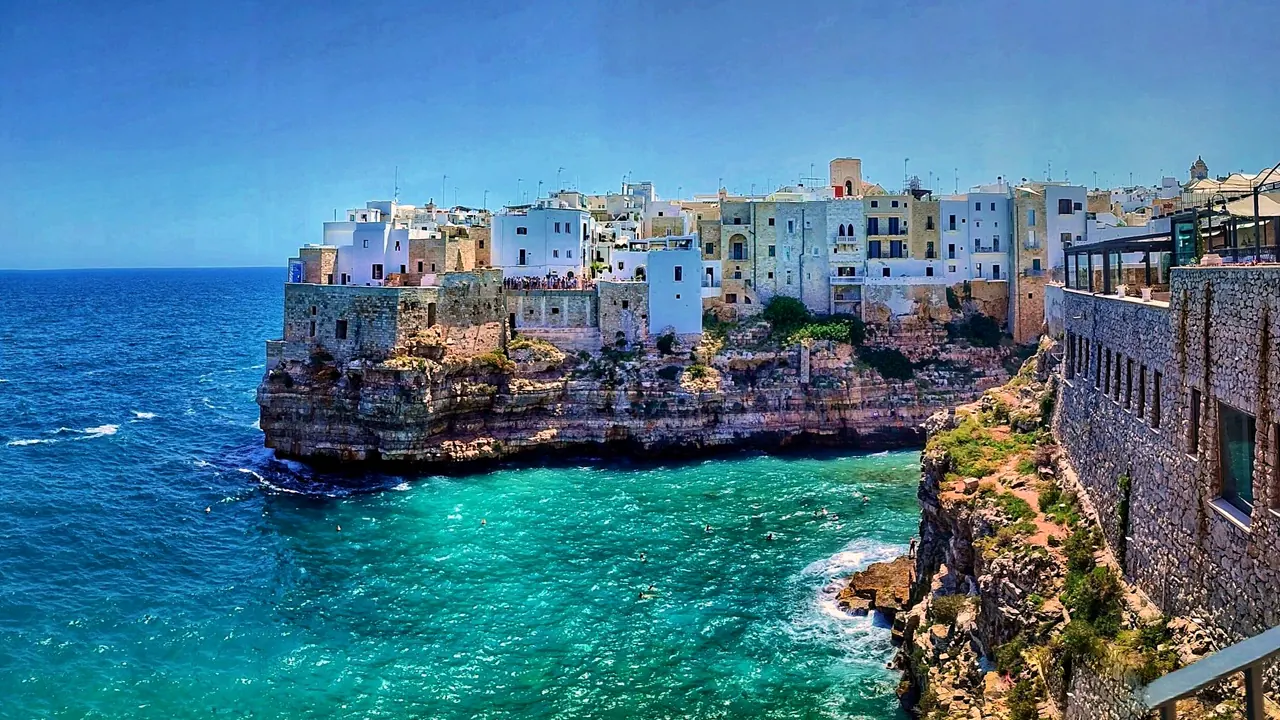
Photos: Puglia by Acquario51, CC BY-SA 4.0, cropped.
Brač or Puglia?
Our verdict in twelve categories, each scored against the same fixed benchmark cities, and the climate month by month, so you can choose for your trip.
Choose Brač for
Brač does not lead in any category we score.
Brač suits a slower, smaller trip: one island, an apartment by a pebble bay, and days spent between Zlatni Rat, a morning climb up Vidova Gora and a drink on the harbour. It is a good fit for windsurfers drawn to the channel off Bol. It also works for anyone happy to give up memorable dinners and a long list of sights in return for clear water and stone villages, with Split a ferry ride away when you want a city.
Choose Puglia for
- culture and sights
- food and drink
- live music and the arts
Travellers who want more from each day should pick Puglia. Its coast is as good, and the Ionian side has real sand. It adds baroque Lecce, the trulli of Alberobello and far better eating, and with a car you can reach a string of small towns, with Matera beyond them. Puglia also has livelier nights and is generally kinder to the budget, though it asks for more driving.
Scoreboard
Twelve categories on one fixed scale from 0 to 100. The shaded stretch is the gap between the two.
Your match
Pick a travel style or drag the sliders, and both match scores follow your weighting.
Has no clear advantage with the weighting you have chosen.
Wins on culture and sights and food and drink with your weighting.
What matters to you?
Category by category
What the scores mean for a trip.
Beaches & swimming
Both are serious beach destinations, and the real difference is what lies underfoot. Brač is almost all pebble and rock, from the shifting point of Zlatni Rat at Bol to the shallow town bays of Supetar and Sutivan. Lovrečina is one of its few sandy exceptions, so water shoes are worth packing.
Puglia offers a choice that Brač does not. The Ionian side of the Salento has long pale sands and shallow turquoise water, while Polignano a Mare has rock platforms and the Gargano has white cliffs and coves. The price is paid lidos and the August crowds of Italian families, whereas on Brač the crowds gather mainly at Zlatni Rat.
Food & drink
Brač has honest konoba cooking: octopus under the iron lid, spit-roasted vitalac and Dol's walnut cake, along with fine olive oil and the red wine from Bol. But the range is narrow, the waterfronts of Bol and Supetar cook for visitors, and the better tables are in inland villages.
Puglia is a far stronger place to eat. Everyday food there is worth planning a day around, from orecchiette with turnip tops and fresh burrata to raw sea urchins on the Bari waterfront and pasticciotto in Lecce. The butcher-grills of the Valle d'Itria and the masseria kitchens add a variety that Brač cannot match.
Culture & sights
Brač's heritage is small in scale and charming: the Blaca hermitage built into its cliff, Škrip's Illyrian walls and Venetian tower, the stonemasonry school at Pučišća and a Tintoretto in the Dominican monastery at Bol. It gives you a few gentle outings rather than a reason for the trip.
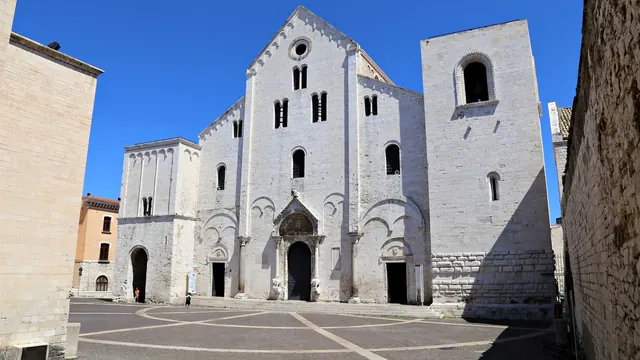
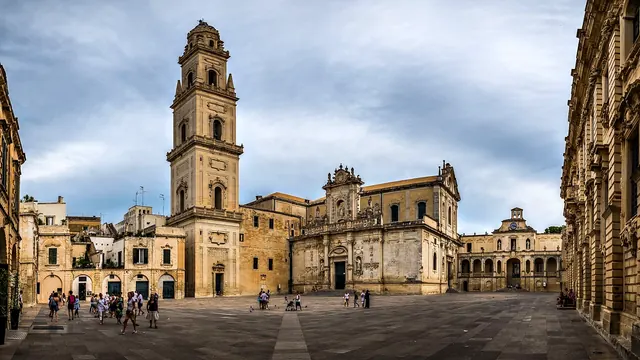
Puglia's sights are of another order. It has Lecce's honey-coloured baroque, the conical trulli of Alberobello, Frederick II's octagonal Castel del Monte and a line of Romanesque cathedrals running from Trani to Otranto, with its mosaic floor. Neither place has big museums, and in Puglia seeing the best of it means driving from town to town.
Nightlife
Evenings on Brač mean a long dinner and a drink on the harbour. In July and August, Bol's beach bars and a few open-air dance venues keep things going, and for the rest of the year the island is quiet.
Puglia has much more on offer. In summer, Gallipoli's beach clubs run into the small hours and Lecce's lanes fill with people drinking, while Bari keeps its old-town bars open all year. Both coasts go quiet out of season, but Bari gives Puglia somewhere to go that Brač lacks.
Nature & outdoors
Brač fits its landscape into a small space. A bare karst plateau rises to Vidova Gora, at 778m the highest point on any Adriatic island, and cliff paths lead to Blaca, while the windsurfing channel lies off Bol. Its terrain is steeper and more concentrated than most of Puglia's.
Puglia is broader and more varied. It has gentle olive country for cycling in the Valle d'Itria, the beech woods of the Foresta Umbra, sea caves and the Tremiti islands in the Gargano, and cliff paths and the Alimini lakes in the Salento. In both places, spring and autumn are the seasons for walking.
Day trips
From Brač, a day out means a ferry. Split and Diocletian's Palace are under an hour from Supetar, Trogir lies beyond them, and in summer catamarans reach Hvar. Once the season ends the timetable thins and the choice shrinks.
Puglia is made for day trips. From a base in the Valle d'Itria, Ostuni, Locorotondo, Cisternino and Polignano a Mare are short drives away, Trani and other harbour towns line the coast north of Bari, and the cave city of Matera is about an hour off. All of them are reached by road, with no timetable to watch.
Good for families
Brač works for a calm week at the beach. The north coast towns have shallow, sheltered bays, apartments with kitchens and harbour fronts where children can stay up late. Beyond that there is little made for children, and the water at Zlatni Rat gets deep quickly.
Puglia gives families more. The sandy Ionian shallows suit toddlers, and masserie and villas with pools are an easy way to stay. The safari park and amusement park at Fasano and the trulli of Alberobello break up the beach days. Both have fierce midsummer heat, and in Puglia you need a car.
Getting around
Both are places to explore by car. On Brač the distances are short, but the road over the plateau to Bol is slow and winding, buses are infrequent, and every trip off the island depends on the ferries, with long queues on summer weekends.
Puglia covers far more ground, with four to five hours between the Gargano and Leuca, but its roads are good. A main-line railway through Bari, Polignano a Mare, Monopoli and Lecce means you can manage without a car along that stretch, which no part of Brač allows.
Shopping & style
Shopping on Brač is a short list: stone carvings from the workshops of Pučišća, olive oil, honey, lavender and the harbour souvenir stalls. For anything more, people go to Split.
Puglia goes further. It has the ceramic quarter at Grottaglie, Lecce's papier-mache studios, linen from the Valle d'Itria, and the chain stores and boutiques around Via Sparano in Bari. Even so, neither is a destination for fashion.
Affordability
Neither is a bargain in high summer. In July and August, Brač costs about what Western Europe does: hotels in Bol, waterfront meals and ferry fares for a car add up. Private rooms in the north coast villages and simple village konobas are the way to save.
Puglia is easier on a budget, mainly because eating out is cheap by Italian standards and the local wine is good value. Its costs are in high-season rooms near the Salento beaches, lido sunbeds and car hire. In both places, June and September cost noticeably less.
Live music & performing arts
Brač has no theatre or concert hall. In summer there are open-air concerts on the squares of Bol and Supetar, and klapa singing on festival nights. For a proper programme you have to cross to Split.
Puglia has real stages. Bari's Teatro Petruzzelli is one of Italy's largest opera houses, and Martina Franca holds a summer opera festival in the courtyard of its ducal palace. There is also pizzica, the trance-like folk dance of the Salento, which comes together each August at the Notte della Taranta in Melpignano.
Wellness & relaxation
Neither place has a bathing culture. On Brač the spas are inside the larger hotels at Bol and Supetar, and the island's calm comes from quiet harbours such as Milna and Povlja and from long evenings over the water, best of all in June and September.
Puglia offers a little more on both counts. Its masserie among the olive groves often have pools and their own spas, and there are small thermal sites at the sulphur caves of Santa Cesarea Terme and at Torre Canne. Even so, the countryside matters more there than the treatments.
When should you go?
Pick your month. The climate figures are measured averages, not a forecast.
Brač in July
Puglia in July
Daytime high, °C
Rainfall in the month, mm
Where the figures come from
Brač's temperatures are measured 34 km from the centre, at Split / Marjan.
Brač has no rain gauge within 25 km of the centre, so its rainfall comes from a gridded climate dataset read at the destination rather than from a gauge further away.
Brač's sunshine is measured 34 km from the centre, at Split / Marjan.
Puglia's temperatures are measured 64 km from the centre, at Brindisi.
Puglia has no rain gauge within 25 km of the centre, so its rainfall comes from a gridded climate dataset read at the destination rather than from a gauge further away.
Temperature and rainfall are climate normals, averaged over the years shown. Brač: 1991-2020 (sunshine 1971-2000) normals, Split / Marjan (33.5 km from centre). Puglia: 1991-2020 (sunshine 1981-2010) normals, Brindisi (64.4 km from centre).
Both follow the same Mediterranean pattern of hot, dry summers and wet late autumns, and in both the sea is warm enough for swimming from June into early October. On Brač's coast, daytime air temperatures reach about 31°C in July and August, slightly hotter than Puglia, and the island gets a little more summer sunshine. The sea there peaks at 25°C in August, while around Puglia's main coast it is a touch warmer at 26°C. In both places midsummer is too hot for long walks or a full day of sightseeing, so May and late September suit that better.
Autumn is where they part. Rain on Brač builds from September and peaks in November at 125mm, against 83mm in Puglia, which also stays a little milder through winter. That makes April, May and October good months for touring Puglia's towns, while Brač is best kept for summer and its edges in June and September.
Which traveller are you?
For a culture and arts trip, Puglia is the clear choice. Lecce's baroque centre, the trulli of Alberobello, Castel del Monte and the seafront cathedral at Trani fill days of touring, and Bari's opera house adds evenings. Brač offers stone villages, the Blaca hermitage and little more.
On a food and nightlife trip, Puglia wins again, with burrata, orecchiette and Primitivo, followed by summer nights in Gallipoli's beach clubs or Lecce's crowded squares. Brač's konobas grill good fish and lamb, but evenings end early, and a real party means taking the catamaran to Hvar.
For windsurfers and kitesurfers, Brač has the stronger draw. The channel off Bol gets a reliable afternoon westerly through summer, with Zlatni Rat beside it and Vidova Gora above. In Puglia, time on the water is more about swimming, sea caves and snorkelling off the Tremiti islands.
Before you go
| Measure | Brač | Puglia |
|---|---|---|
| Official language | Croatian | Italian |
| Currency | Euro (EUR) | Euro (EUR) |
| Sockets | CF230 V, 50 Hz | CFL230 V, 50 Hz |
| Driving side | Right | Right |
| Time zone | UTC+1, UTC+2 in summer | UTC+1, UTC+2 in summer |
| Emergency number | 112 | 112 |
| Main airport | Split Saint Jerome Airport (SPU)69 non-stop destinations | Bari Karol Wojtyła International Airport (BRI)104 non-stop destinations |
| Public holidays this year | 14 days | 13 days |
By the numbers
| Measure | Brač | Puglia |
|---|---|---|
| Population | 14,434 | 3,866,174 |
| People per km² | 36 | 198 |
| Swim season, months above 21 °C | 4 months | 4 months |
Where else could you go?
Every comparison below shares a destination with this one, so you can follow Brač or Puglia somewhere new.