Brittany or Cotswolds?
Our verdict in twelve categories, each scored against the same fixed benchmark cities, and the climate month by month, so you can choose for your trip.
Choose Brittany for
- beaches
- nightlife
- prices
Brittany suits travellers who want the sea at the centre of the trip: sandy bays and rock pools for children, oysters and galettes at the table, the coast path and island ferries for the active, and Celtic music festivals in summer. It covers far more ground than the Cotswolds, so it works best from one well-chosen base on the north coast, the Gulf of Morbihan or the far west. It is also the easier of the two on the budget.
Choose Cotswolds for
- shopping
- day trips
Choose the Cotswolds for a slower, more compact trip among honey-stone villages, wool churches and country pubs, where walking from one village to the next is the main event. You give up the beach and most of the evening life, and you pay more. In return, few rural bases put Oxford, Bath, Stratford-upon-Avon and Warwick so close at hand, and the antique towns reward anyone who likes to browse.
Scoreboard
Twelve categories on one fixed scale from 0 to 100. The shaded stretch is the gap between the two.
Your match
Pick a travel style or drag the sliders, and both match scores follow your weighting.
Wins on beaches and nightlife with your weighting.
Wins on shopping and day trips with your weighting.
What matters to you?
Category by category
What the scores mean for a trip.
Beaches & swimming
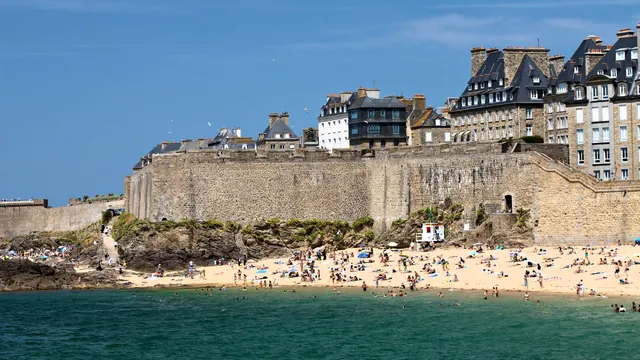
Brittany offers a genuine seaside vacation: wide sandy bays at Carnac, Quiberon and Bénodet, pink granite coves at Ploumanac'h, and huge tidal flats at Saint-Malo and Dinard. The water is fresh rather than warm, and the swimming season is essentially July to early September.
The Cotswolds sit inland, and the nearby Severn is all mudflats and currents, a place for walking rather than swimming. The lake beach at the Cotswold Water Park near Cirencester is the only real substitute. Proper sandy coast is too far away for a comfortable day out.
Food & drink
Brittany has a cuisine of its own: oysters from Cancale, scallops, shellfish platters in the harbour towns, buckwheat galettes with cider, and salted butter in almost everything. Markets such as Rennes' Place des Lices add to it.
The Cotswolds have no regional cooking. Instead, the best meals come from stone country pubs serving lamb, game and local cheeses, along with farm shops and cream teas. Cheltenham has the widest range, and in the busiest villages a good dinner often means driving to a pub a few miles away.
Culture & sights
The two are broadly level, but their heritage differs in kind. Brittany reaches back to prehistory with the menhir rows of Carnac and the dolmens of the Gulf of Morbihan. It adds walled towns such as Saint-Malo, Dinan and Concarneau's Ville Close, and the parish closes of Finistère, all spread over long distances.
The Cotswolds pack their sights into a smaller area: golden wool villages such as Chipping Campden and Burford, some of England's finest parish churches, and the World Heritage palace at Blenheim, with gardens such as Hidcote close by. Neither region has large museums.
Nightlife
Neither is a destination for nightlife, but Brittany has more going on. Rennes' student bars on Rue Saint-Michel fill from Thursday, the summer resorts stay lively into the evening, and a village fest-noz makes a memorable night.
In the Cotswolds, an evening usually ends with a pint by a pub fire, and only Cheltenham has bars and late venues.
Nature & outdoors
Brittany's outdoors is wilder and more varied. The GR34 path follows cliffs at Cap Fréhel and Pointe du Raz, and ferries reach islands such as Ouessant and Belle-Île. The Sept-Îles hold gannets and puffins, the Gulf of Morbihan is ideal for kayaking, and Finistère has reliable surf.
The Cotswolds offer gentler country of dry-stone walls, beech woods and small river valleys. The best views come from the western escarpment along the Cotswold Way, and short footpaths link one village to the next. The walking is pleasant rather than dramatic, with no coast or wild country.
Day trips
The Cotswolds have the stronger list of day trips, and it is more concentrated. Oxford, Bath, Stratford-upon-Avon, Warwick and Gloucester Cathedral are all within about an hour, and some can be reached by train.
Brittany's outings depend more on where you stay. From Saint-Malo you can reach Mont-Saint-Michel, Dinan and Cancale, while the south and west have island ferries into the Gulf of Morbihan and out to Belle-Île or Ouessant. Many of these trips go by boat rather than to another city.
Good for families
Brittany is the better choice for children. It has sandy beaches with rock pools, sailing and kayak schools everywhere, crêpes, and easy campsites and gîtes. Océanopolis in Brest and the Saint-Malo aquarium cover wet days, though the cool water and strong tides need watching.
The Cotswolds suit a gentler trip built around the Cotswold Wildlife Park, the model village at Bourton-on-the-Water, farm parks and the Winchcombe steam railway, with Warwick Castle nearby. Expect more time in the car and no seaside.
Getting around
Brittany is easier to reach and get around without a car. Fast trains from Paris reach Rennes, and regional lines continue to Saint-Malo, Vannes, Quimper and Brest, each with a walkable old centre. The coast and megalith sites still call for a car, but the dual carriageways are toll-free.
In the Cotswolds a car is close to essential. Narrow lanes, thin rural buses and summer parking in Bourton or Bibury are the frustrations. The compensation is that neighbouring villages are close enough to walk between on footpaths.
Shopping & style
The Cotswolds are better for shopping. Tetbury and Stow-on-the-Wold are known for antique furniture, silver and prints, and Burford and Broadway have galleries and homeware. Cheltenham's Promenade and Montpellier add a proper high street and boutiques.
Brittany's shopping centres on regional goods: Quimper faience, striped sailor tops, salted caramels, cider and Guérande salt. The weekly markets are its highlight.
Affordability
Brittany is noticeably cheaper. Campsites, gîtes, inland villages, crêperies and markets keep everyday costs moderate, and June and September ease the bill further. Seafood platters and the smart coastal restaurants are where it climbs.
The Cotswolds are expensive by any rural standard, with characterful inns, manor hotels and better pubs all priced high, and full admission charged at each house and garden. Sharing a cottage with a group and picnicking from farm shops help.
Live music & performing arts
Brittany has the richer live scene, rooted in Celtic tradition: bagad pipe bands, fest-noz dances, and big summer festivals such as the Festival Interceltique in Lorient and Les Vieilles Charrues at Carhaix. Rennes has an opera house and a national theatre.
The Cotswolds centre on Cheltenham's Everyman Theatre and its jazz, classical and literature festivals, plus barn opera at Longborough. The Royal Shakespeare Company in Stratford is also an easy evening out from the northern villages.
Wellness & relaxation
Both are good places to slow down, but in different ways. Brittany is a home of thalassotherapy, with seawater spas on the seafront at Quiberon, Carnac, Dinard and Perros-Guirec. The fresh, windy Atlantic air suits spring and autumn.
In the Cotswolds, rest means country-house hotel spas, long lunches and evenings by the fire. Bath's natural thermal springs, the only ones in Britain, are an easy trip from the southern wolds.
When should you go?
Pick your month. The climate figures are measured averages, not a forecast.
Brittany in July
Cotswolds in July
Daytime high, °C
Rainfall in the month, mm
Where the figures come from
Brittany has no rain gauge within 25 km of the centre, so its rainfall comes from a gridded climate dataset read at the destination rather than from a gauge further away.
Brittany's sunshine is measured 89 km from the centre, at Rennes.
Cotswolds has no rain gauge within 25 km of the centre, so its rainfall comes from a gridded climate dataset read at the destination rather than from a gauge further away.
Cotswolds's sunshine is measured 46 km from the centre, at Lyneham.
Temperature and rainfall are climate normals, averaged over the years shown. Brittany: 2004-2020 (sunshine 1991-2020, rainfall 1991-2020) normals, Vannes-Meucon (8.1 km from centre). Cotswolds: 1961-1990 (sunshine 1991-2020, rainfall 1991-2020) normals, Fairford Royal Air Force Base (22.5 km from centre).
Brittany is the warmer of the two, and the sunnier in summer. Around the coast where most visitors stay, July and August reach about 24°C and the sea peaks at around 18°C. That gives real beach days, though swimming stays brisk. June and September are nearly as good, especially for walking the coast path. Summer is also Brittany's driest stretch. The rain arrives in earnest from October and peaks at around 121mm in November.
The Cotswolds are a few degrees cooler all year. July highs reach about 22°C, and winter days hover near 5°C, which makes January and February raw for village walks. Rain is spread more evenly than in Brittany, so summer is not much drier than spring, and August is among the wetter months. The comfortable window runs from May to September, with bluebells in spring and the autumn beeches as reasons to come at either end.
Which traveller are you?
On a beach and sun trip, Brittany is the only real option of the two. Summer days can be planned around the tide, with sandcastles, sailing lessons and brisk swims in water near 18°C. Choosing the Cotswolds means giving up the sea entirely.
For a trip on a tight budget, Brittany stretches the money further. The coast path, the beaches and the menhir fields cost nothing, and a tent and a crêpe supper keep the days cheap. In the Cotswolds the villages are free, but beds and meals cost dear.
On a shopping trip, the Cotswolds suit anyone who likes to browse, spending a day among the antique dealers and galleries of several market towns, with a car boot ready for a find. In Brittany, most of what you bring home is edible, bought at market.
Before you go
| Measure | Brittany | Cotswolds |
|---|---|---|
| Official language | French | English |
| Currency | Euro (EUR) | Pound Sterling (GBP) |
| Sockets | CE230 V, 50 Hz | G230 V, 50 Hz |
| Driving side | Right | Left |
| Time zone | UTC+1, UTC+2 in summer | UTC, UTC+1 in summer |
| Emergency number | 112 | 112 or 999 |
| Main airport | Nantes Atlantique Airport (NTE)97 non-stop destinations | Bristol Airport (BRS)117 non-stop destinations |
| Public holidays this year | 11 days | 8 days |
By the numbers
| Measure | Brittany | Cotswolds |
|---|---|---|
| Population | 4,687,381 | - |
| Swim season, months above 21 °C | None | - |
Where else could you go?
Every comparison below shares a destination with this one, so you can follow Brittany or Cotswolds somewhere new.
- Peak Districtvs Cotswolds
- Devonvs Cotswolds
- Normandyvs Brittany
- Yorkshire Dalesvs Cotswolds
- Loire Valleyvs Brittany
- Cornwallvs Cotswolds