Brittany or Loire Valley?
Our verdict in twelve categories, each scored against the same fixed benchmark cities, and the climate month by month, so you can choose for your trip.
Choose Brittany for
- beaches
- wellness
- nature and the outdoors
Brittany is the pick for a trip built around the sea. It has sandy bays and rock pools, the coastal path past cliffs and pink granite, ferries to car-free islands, seawater spas, and summer nights of fest-noz and Celtic festivals. It suits families, walkers and anyone happy with one coastal base and a car, as long as they don't mind brisk water and skies that change quickly.
Choose Loire Valley for
- culture and sights
- day trips
- prices
Travellers who come for history and wine will be happier in the Loire Valley. Chambord, Chenonceau, Fontevraud and the Apocalypse Tapestry in Angers are all within reach of a base around Tours, with tasting cellars in the tufa cliffs and a flat riverside cycle route between them. The summers are warmer and drier, but this is a sightseeing trip, not a beach one.
Scoreboard
Twelve categories on one fixed scale from 0 to 100. The shaded stretch is the gap between the two.
Your match
Pick a travel style or drag the sliders, and both match scores follow your weighting.
Wins on beaches and wellness with your weighting.
Wins on culture and sights and day trips with your weighting.
What matters to you?
Category by category
What the scores mean for a trip.
Beaches & swimming
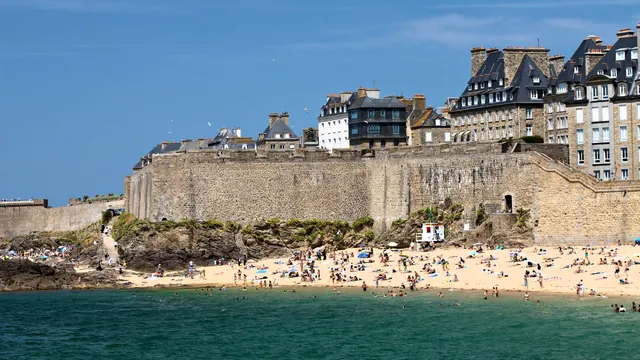
Brittany has the coast that the Loire Valley lacks: sandy bays around Carnac and Bénodet, the pink granite coves of Ploumanac'h and wide tidal flats at Saint-Malo and Dinard. The water is cool even in August and you need to check the tides, but it is a proper seaside vacation.
In the Loire Valley, swimming means a supervised lake such as the Lac de Maine at Angers or, more often, the pool at your rental house. The river itself is dangerous, and the Atlantic beaches lie well beyond Nantes.
Food & drink
Both regions eat very well, but they eat different things. Brittany's table is shellfish and dairy: Cancale oysters, scallops, galettes with bowls of cider and salted butter in almost everything. It is at its best in the harbour towns and at the Place des Lices market in Rennes.
In the Loire, wine leads, from Vouvray and Chinon to sparkling Saumur tasted in tufa caves, with rillettes, goat cheeses, river fish in beurre blanc and tarte Tatin to go with it. Wine lovers will lean towards the Loire, seafood lovers towards Brittany.
Culture & sights
The Loire Valley has the stronger and more concentrated heritage. Chambord, Chenonceau, Blois and Amboise, Leonardo's last home at Clos Lucé, the abbey of Fontevraud and the Apocalypse Tapestry in Angers are of world importance, and most of them can be reached from a single base.
Brittany's heritage is older in places and more spread out: the long rows of Carnac stones, the ramparts of Saint-Malo and Dinan, and the parish closes of Finistère. It rewards a slow tour of small towns more than a run of great monuments.
Nightlife
Neither region is the place for a big night out, but Brittany has a little more going on. Rennes is a large student city with the bars of Rue Saint-Michel and a few late clubs, the summer resorts stay busy into the evening, and a village fest-noz is a kind of night out the Loire has no equivalent for.
In the Loire, evenings mostly mean a long dinner with local wine. The terraces of Place Plumereau in Tours and the student bars of Angers are the exceptions, and the countryside goes quiet early.
Nature & outdoors
Brittany's outdoors is wilder and more varied. The GR34 coastal path passes Cap Fréhel, Pointe du Raz and the Crozon cliffs. There is kayaking in the Gulf of Morbihan and surf in Finistère, and puffins and gannets nest on the Sept-Îles.
The Loire is gentler country of willow-lined river, vineyards and the ponds of the Sologne. Its strength is the flat Loire à Vélo cycle route, ideal for unhurried riders, but there are no real hills and no wild country.
Day trips
Both regions work well as bases for day outings, the Loire slightly better because its towns sit so close together. From Tours you can easily reach Amboise, Chinon, Loches, Saumur and the wine villages, the troglodyte caves near Saumur are unique, and Paris is about an hour away by fast train.
Brittany's outings lean towards the sea: Mont-Saint-Michel from Saint-Malo, boats into the Gulf of Morbihan, and ferries to Belle-Île, Ouessant and car-free Bréhat. There is plenty of choice, but your base decides which part of the coast you see.
Good for families
A family week in Brittany is spent on the sand: rock pools at low tide, sailing and kayak lessons, crêpes on the harbour, and a campsite or gîte a short walk from the beach. Océanopolis in Brest and the Saint-Malo aquarium cover the grey days. The cool water and big tides mean young swimmers need a close eye.\n\nIn the Loire Valley the days are built around outings instead. There is a full day at the ZooParc de Beauval, Leonardo's full-size machines in the park at Clos Lucé, the Maison de la Magie facing the château of Blois, and flat stretches of riverside cycling for young riders. Swimming happens in the gîte pool, and children soon tire of formal rooms, so ration the château interiors.
Getting around
Getting around is much the same in both: compact, walkable town centres, a rail line linking the main towns and a car for everything else. Brittany has fast trains to Rennes and toll-free dual carriageways, but its coast means summer traffic jams and its islands mean ferry timetables.
The Loire adds the bicycle as a real alternative, with bike hire and luggage transfer along the river route. Chambord, the villages and the wineries are still hard to reach without a car.
Shopping & style
Neither region is a shopping destination, and both sell mainly regional produce. Brittany has more to take home that isn't food: Quimper faience, striped sailor tops and woollens, alongside salted caramels and Guérande salt, with Rennes for the high street. The Loire's buys are mostly edible or drinkable, such as cellar-door wine, goat cheese and quince paste, with Gien faience and Saumur leather as the main crafts.
Affordability
Costs are similar in the two regions, moderate for France, and both are easier on the budget outside July and August. In Brittany the money goes on summer rooms in Saint-Malo and the Morbihan resorts and on seafood platters, while campsites and crêperies keep the costs down.
In the Loire the extra costs are château entrance fees, which add up quickly over several visits, and a car. Set lunches and cellar-door wine are good value.
Live music & performing arts
Brittany has the stronger music scene, rooted in a living Celtic tradition. Bagad pipe bands and fest-noz dances belong to village life. Summer brings the Festival Interceltique in Lorient and Les Vieilles Charrues at Carhaix, and Rennes has the Transmusicales in December as well as an opera house and a national theatre.
The Loire's offer is more occasional: sound-and-light shows at Blois and Amboise, summer chamber music at the Grange de Meslay and the Angers street-arts festival, with opera in Tours and Angers through the year.
Wellness & relaxation
Brittany has a genuine spa tradition. Thalassotherapy began at Roscoff, and seawater spas line the seafronts at Quiberon, Carnac, Dinard and Perros-Guirec, with quiet islands and harbour walks for the rest of the day. They are best visited outside the summer peak.
The Loire has no bathing culture. Its spas are those of hotels in converted châteaux and manors, some with wine-based treatments, and the calm comes instead from slow cycling, long lunches and gardens such as Villandry.
When should you go?
Pick your month. The climate figures are measured averages, not a forecast.
Brittany in July
Loire Valley in July
Daytime high, °C
Rainfall in the month, mm
Where the figures come from
Brittany has no rain gauge within 25 km of the centre, so its rainfall comes from a gridded climate dataset read at the destination rather than from a gauge further away.
Brittany's sunshine is measured 89 km from the centre, at Rennes.
Temperature and rainfall are climate normals, averaged over the years shown. Brittany: 2004-2020 (sunshine 1991-2020, rainfall 1991-2020) normals, Vannes-Meucon (8.1 km from centre). Loire Valley: 1991-2020 normals, Tours (20.4 km from centre).
Brittany is a summer destination by the sea. On the coast where most visitors stay, July and August reach the low twenties and the sea peaks at only 18°C, so the beach season runs from July to early September and swimming is bracing. May, June and September are drier and bright enough for the coastal path. From October the Atlantic rain arrives in earnest, above 100mm a month until December, and the winter is grey but mild.
The Loire Valley is a few degrees warmer in summer, around 26°C in July and August, and a little sunnier than the coast. That suits cycling and garden visits, though a midsummer afternoon of driving between châteaux can feel warm. Its rain is spread more evenly through the year, and its winters are never as wet as Brittany's, but they are colder, around 8°C in January. Late spring and September are the best times for touring the châteaux.
Which traveller are you?
On a beach and sun trip, Brittany is the only real choice of the two. It has sandy bays around Carnac and Quiberon, rock pools, sailing schools and surf. In the Loire the river is unsafe for swimming and the Atlantic is a long drive away.
For a culture and arts trip, the Loire Valley comes out ahead. Its Renaissance châteaux, Fontevraud Abbey and the Apocalypse Tapestry make a grander and more concentrated set than Brittany's walled towns and standing stones, and nearly all of it is within reach of Tours.
On a relaxing and wellness trip, Brittany offers more. Its seafront thalassotherapy centres at Quiberon, Dinard and Perros-Guirec are a tradition in their own right, and car-free islands make for quiet days. The Loire relies on château-hotel spas and slow cycling.
Before you go
| Measure | Brittany | Loire Valley |
|---|---|---|
| Official language | French | French |
| Currency | Euro (EUR) | Euro (EUR) |
| Sockets | CE230 V, 50 Hz | CE230 V, 50 Hz |
| Driving side | Right | Right |
| Time zone | UTC+1, UTC+2 in summer | UTC+1, UTC+2 in summer |
| Emergency number | 112 | 112 |
| Main airport | Nantes Atlantique Airport (NTE)97 non-stop destinations | Tours Val de Loire Airport (TUF)5 non-stop destinations |
| Public holidays this year | 11 days | 11 days |
By the numbers
| Measure | Brittany | Loire Valley |
|---|---|---|
| Population | 4,687,381 | - |
| Swim season, months above 21 °C | None | - |
Where else could you go?
Every comparison below shares a destination with this one, so you can follow Brittany or Loire Valley somewhere new.
- Normandyvs Brittany
- Normandyvs Loire Valley
- Dordognevs Loire Valley
- Devonvs Brittany
- Cornwallvs Brittany
- Dordognevs Brittany