Brittany or Cornwall?
Our verdict in twelve categories, each scored against the same fixed benchmark cities, and the climate month by month, so you can choose for your trip.
Choose Brittany for
- getting around
- live music and the arts
- day trips
Brittany is the stronger all-round choice, especially if you want more than beaches from a coastal trip. Its walled towns, the Carnac stones and the islands of the Gulf of Morbihan give you something new to see each day. Oysters, galettes and Celtic music festivals fill the evenings, the seawater spas suit a slower stay, and it is cheaper, warmer and easier to get around. Pick it if you like moving between old towns and islands and want your money to go further.
Choose Cornwall for
- nature and the outdoors
Cornwall suits travellers who want the surf coast and the art colony above everything else. That means bodyboarding on lifeguarded north-coast beaches, walking the cliffs of Penwith, and the galleries of St Ives. A play at the Minack Theatre above the sea is an evening you won't find anywhere else. Go knowing that you will pay more, the lanes are hard work in summer, and the outings around the county are quite alike. A car-free stay in one of the railway towns makes the most of it.
Scoreboard
Twelve categories on one fixed scale from 0 to 100. The shaded stretch is the gap between the two.
Your match
Pick a travel style or drag the sliders, and both match scores follow your weighting.
Wins on getting around and live music and the arts with your weighting.
Wins on nature and the outdoors with your weighting.
What matters to you?
Category by category
What the scores mean for a trip.
Beaches & swimming
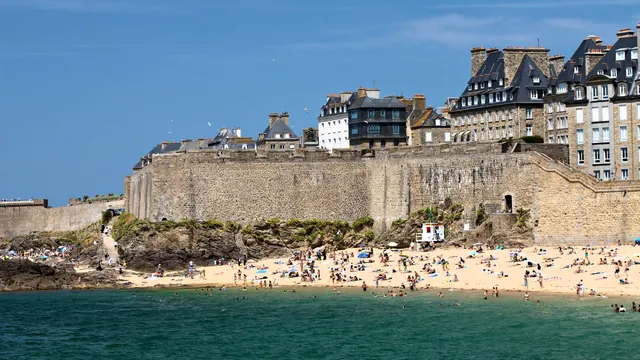
The two coasts are equally good for a beach trip, but the beaches are different. Brittany has wide sandy bays on the south coast around Carnac and Quiberon, pink granite coves at Ploumanac'h, and enormous tidal flats at Saint-Malo and Dinard. The sheltered Gulf of Morbihan gives the slightly warmer swims.
Cornwall is the place for surf beaches, such as Fistral and the long sweep at Gwithian. The turquoise coves of Porthcurno and Kynance Cove are among its best-known views. Wetsuits are more common there, and the big beaches fill during the school summer break.
Food & drink
Brittany eats better. Oysters from Cancale and the Gulf of Morbihan, scallops, buckwheat galettes with dry cider, salted butter in everything and a weekly market in every town give its food real depth. Rennes adds the region's broadest restaurant scene.
Cornwall's best food is fish from Newlyn and the seafood dining rooms of Padstow and St Ives, plus pasties and cream teas. Beyond the harbour towns the choice falls away quickly, and resort menus often cater to the passing summer trade.
Culture & sights
Brittany has the denser heritage. The rows of menhirs at Carnac rank among Europe's major prehistoric sites. Add the corsair walls of Saint-Malo, the half-timbered streets of Dinan and Vitré, and the parish closes of Finistère, and you can see historic towns every day for a week.
Cornwall offers single landmarks rather than whole old towns: St Michael's Mount, Tintagel, and the mining engine houses near Botallack. Its own strength is modern art. Tate St Ives and the Hepworth garden have no real equivalent in Brittany, where the museums are modest.
Nightlife
Both regions are quiet at night, and most villages wind down before midnight. Brittany's late nights happen in Rennes, where students fill the bars of Rue Saint-Michel, and in the village fest-noz dances. Cornwall's busiest nights are in Newquay in summer, a surf town with clubs and stag and hen groups, while Falmouth's university gives it a smaller scene.
Nature & outdoors
These are two closely matched Atlantic coasts, each followed end to end by a long-distance path: the GR34 in Brittany and the South West Coast Path in Cornwall. Brittany's extra is its offshore islands, such as Belle-Île, Ouessant and the Glénan archipelago, along with puffins at Sept-Îles and kayaking among the islands of the Gulf of Morbihan.
Cornwall is the place to go for surfing, at Newquay, Bude and Sennen. Seals are common and basking sharks pass offshore in summer, and Bodmin Moor gives it higher, wilder ground inland than Brittany's low moors.
Day trips
Brittany has far more variety within reach. Mont-Saint-Michel is about an hour from Saint-Malo, boats run out to islands from Quiberon, Vannes and Brest, and Nantes, Quimper and Concarneau make very different outings from each other.
In Cornwall, a day out usually means another harbour town, whether that is Mousehole, Port Isaac or Fowey. They are lovely but quite alike. The Isles of Scilly are the standout trip, though they take a full day.
Good for families
Both are classic seaside regions for families, built on rock pools, sandcastles and self-catering stays. Brittany's sailing schools, campsites and gîtes suit longer stays, and Océanopolis in Brest covers wet days. Cornwall has lifeguarded beaches for bodyboarding and the Eden Project for when it rains, but its summer traffic is harder on children in the back seat.
Getting around
Brittany is easier. Fast trains reach Rennes from Paris, regional lines continue to Quimper and Brest, and the toll-free dual carriageways make driving between bases simple.
Cornwall's high-hedged single-track lanes and the scarce summer parking in St Ives and Port Isaac make a car tiring to use. Its branch railway lines are the way round this: staying in St Ives, Falmouth or Looe without a car works well.
Shopping & style
Neither region is for fashion shopping. What you bring home is different. Brittany sells Quimper faience, striped sailor tops, salted caramels and Guérande salt, and the Saturday market at Place des Lices in Rennes is the highlight. Cornwall's best buys are pottery and paintings from the St Ives studios, plus surf gear from Newquay.
Affordability
Brittany is the cheaper of the two, and it stays that way in high summer. Its prices go up in July and August, when rooms around Saint-Malo and the Gulf of Morbihan are in demand. Even so, campsites, gîtes, crêperies and toll-free roads keep a Breton stay moderate when the same weeks in Cornwall get expensive.
Cornwall's costs are higher and add up from more directions. Coastal cottages for the school summer break book out early at high prices, and parking and attraction tickets add to a family's bill day after day. Prices ease in both regions outside the peak, so June or September saves money whichever coast you choose.
Live music & performing arts
The difference here is a living musical tradition against one unforgettable stage. In Brittany, Celtic music is part of village life, with bagad pipe bands and fest-noz dances. Summer brings large festivals, from the Festival Interceltique in Lorient to Les Vieilles Charrues at Carhaix, and Rennes keeps an opera house and a national theatre going all year.
Cornwall's standout is the Minack Theatre, an open-air stage cut into the cliffs above Porthcurno. Beyond that, the county has male voice choirs, pub folk sessions, Padstow's May Day celebration and touring shows at Truro's Hall for Cornwall, but little regular classical music.
Wellness & relaxation
Brittany has a real spa tradition. Thalassotherapy began in Roscoff, and seawater spas line the seafronts from Quiberon to Perros-Guirec, so a calm spring or autumn stay can revolve around them.
Cornwall relies more on its slow pace than on treatments. There are spa hotels above Watergate Bay and Carbis Bay, and wood-fired beach saunas paired with cold sea swims. In summer, though, the crowds make it hard to unwind.
When should you go?
Pick your month. The climate figures are measured averages, not a forecast.
Brittany in July
Cornwall in July
Daytime high, °C
Rainfall in the month, mm
Where the figures come from
Brittany has no rain gauge within 25 km of the centre, so its rainfall comes from a gridded climate dataset read at the destination rather than from a gauge further away.
Brittany's sunshine is measured 89 km from the centre, at Rennes.
Cornwall has no rain gauge within 25 km of the centre, so its rainfall comes from a gridded climate dataset read at the destination rather than from a gauge further away.
Cornwall's sunshine is measured 28 km from the centre, at Camborne.
Temperature and rainfall are climate normals, averaged over the years shown. Brittany: 2004-2020 (sunshine 1991-2020, rainfall 1991-2020) normals, Vannes-Meucon (8.1 km from centre). Cornwall: 1991-2020 normals, Saint Mawgan (5.7 km from centre).
Brittany has the warmer, sunnier summer. Around its main resort areas, afternoons reach about 24°C in July, against 19°C in Cornwall. Brittany's June and July are also the driest months of its year, while Cornwall gets wetter again through August and September. The sea is cold off both coasts. It peaks at about 18°C off Brittany and 17°C off Cornwall, so July and August are the main swimming months in each, and Cornwall's beach days start in June for those who don't mind cold water.
From April to October, Cornwall's daytime highs stay a few degrees below Brittany's. That makes Brittany's May and September pleasantly warm for walking the old towns and the coast path, and Cornwall's spring and autumn fresher. In winter the two are about level. From October to December, both get more than 100mm of rain a month and have short, grey days, which makes the cold months a time for indoor sights and spas rather than the beach.
Which traveller are you?
On a relaxing and wellness trip, Brittany suits a stay built around seawater treatments, with a seafront spa as your base and car-free Bréhat for a quiet day. Cornwall's version is wilder: a cliff walk, a beach sauna and a cold swim.
For a trip on a tight budget, Brittany goes further, especially in June or September. Galettes, market picnics and an inland base cost little. Cornwall rarely comes cheap in its season. Pasties and pub suppers help, but staying near its famous coast costs more.
On a culture and arts trip, Brittany works best as a tour, with a few nights in Vannes and then Quimper, spending each day walking ramparts and half-timbered streets. In Cornwall, stay among the St Ives studios and drive out to one landmark at a time.
Before you go
| Measure | Brittany | Cornwall |
|---|---|---|
| Official language | French | English |
| Currency | Euro (EUR) | Pound Sterling (GBP) |
| Sockets | CE230 V, 50 Hz | G230 V, 50 Hz |
| Driving side | Right | Left |
| Time zone | UTC+1, UTC+2 in summer | UTC, UTC+1 in summer |
| Emergency number | 112 | 112 or 999 |
| Main airport | Nantes Atlantique Airport (NTE)97 non-stop destinations | Cornwall Airport Newquay (NQY)14 non-stop destinations |
| Public holidays this year | 11 days | 8 days |
By the numbers
| Measure | Brittany | Cornwall |
|---|---|---|
| Population | 4,687,381 | 575,525 |
| People per km² | - | 162 |
| Swim season, months above 21 °C | None | None |
Where else could you go?
Every comparison below shares a destination with this one, so you can follow Brittany or Cornwall somewhere new.
- Devonvs Cornwall
- Normandyvs Brittany
- Loire Valleyvs Brittany
- Cotswoldsvs Cornwall
- Devonvs Brittany
- Normandyvs Cornwall