France
Saint-Malo
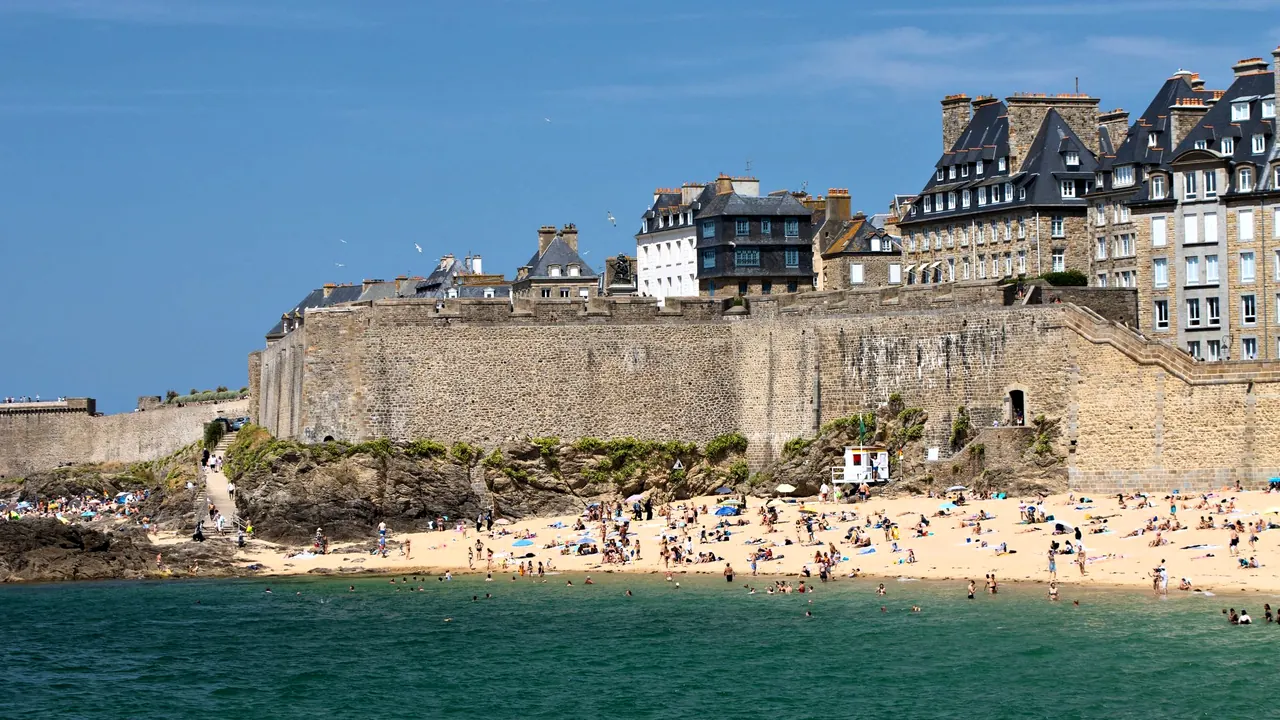
The walled old town above the beach
- Day trips76
- Nature & outdoors68
- Families64
Photo: Efrem Efre, Pexels License
Match
49
Every category weighted equally
- Beach & sun51
- Culture & arts47
- Food & nightlife44
- Family trip55
- Outdoors57
- Relax & unwind53
- Shopping & style46
- On a budget48
Saint-Malo in twelve categories
Our verdict on each, scored 0 to 100 against the same fixed benchmark cities, so a score means the same thing on every page.
Beaches & swimming. Scores 52 out of 100.
Food & drink. Scores 48 out of 100.
Culture & sights. Scores 42 out of 100.
Nightlife. Scores 25 out of 100.
Nature & outdoors. Scores 68 out of 100.
Day trips. Scores 76 out of 100.
Good for families. Scores 64 out of 100.
Getting around. Scores 62 out of 100.
Shopping & style. Scores 35 out of 100.
Affordability. Scores 40 out of 100.
Live music & performing arts. Scores 25 out of 100.
Wellness & relaxation. Scores 56 out of 100.
Saint-Malo category by category
Beaches & swimming
52The beaches start right at the walls. The Grand Plage du Sillon runs for about 3km towards Paramé and Rothéneuf, and smaller coves such as Bon-Secours and l'Éventail sit below the ramparts. At Bon-Secours a walled seawater pool with a diving board fills at every tide, so you can still swim when the sea has gone out. The tides here are huge, and at low water the beaches double in size and you can walk out to the island forts.
The water is the drawback. It is the Channel, and even in August it rarely gets much above 18°C, so most visitors swim briefly and spend more time on the sand. Across the estuary, the beaches at Dinard and along the Emerald Coast are prettier and more sheltered. Beach life matters in July and August and fades outside the summer.
Food & drink
48Eating here means Breton cooking and the sea. Buckwheat galettes with a bowl of dry cider are the everyday meal, kouign-amann and salted-butter caramel are the sweets, and the oysters come from the beds at Cancale, a short drive along the bay, where you can eat them at stalls by the harbour wall. Mussels, scallops in season and plateaux de fruits de mer fill the menus along the ramparts.
The walled town is packed with crêperies and brasseries aimed at day visitors, and the quality varies a lot. Better meals tend to be found in Saint-Servan and on the coast towards Cancale, which also has a serious fine-dining tradition. Apart from that the range is narrow, and there is little international food.
Culture & sights
42The walled town is the main sight. Tall granite houses stand inside a complete circuit of ramparts, and you can walk all the way around the top, looking down on the beaches, the harbour and the islands in the bay. Much of the town was destroyed in 1944 and rebuilt stone by stone afterwards, so it looks older than it really is. The Cathedral of Saint-Vincent, with its stained glass, and the castle with its great keep at the corner of the walls are the main buildings. The history is about corsairs, explorers and rich shipowners, and you see it in the street names and statues more than in museums.
At low tide you can walk out to Fort National and to the Grand Bé, where Chateaubriand is buried facing the sea. In Saint-Servan, the Solidor Tower guards the mouth of the Rance, and the countryside around the town has malouinières, the elegant country houses built by the old shipowners. It makes a good day of sightseeing, but there isn't a long list of sights, and anyone who wants serious museums will be disappointed.
Nightlife
25Evenings are about a drink after dinner. Inside the walls there is a cluster of pubs, wine bars and Irish-style bars, and a few places stay open late on summer weekends. Sailors and young visitors keep the streets around the ramparts busy in July and August. The rest of the year the town goes quiet early, and anyone looking for clubs has to go to Rennes.
Nature & outdoors
68This is a coast for walking and for watching the tides, which are among the largest in Europe at up to about 13m. The GR34 coastal path runs both ways from the town: east past Rothéneuf to the headland of Pointe du Grouin, and west across the Rance to the pink and grey cliffs of the Emerald Coast and Cap Fréhel. The Rance estuary is good for kayaking and cycling, and the bay is a sailing centre. Kitesurfers use the long beaches when the wind blows, which is often.
Inland the country is flat farmland, with no hills or big forests. Wildlife means seabirds, seals off the islands and the vast tidal flats of the bay of Mont-Saint-Michel.
Day trips
76The big one is Mont-Saint-Michel, the abbey on its tidal island, about an hour's drive east. Closer to home, Dinan is a half-timbered medieval town on the Rance, about half an hour away, and Dinard is a short boat crossing over the estuary, with Belle Époque villas and a seafront promenade. Cancale has its oyster port, and Rennes, the Breton capital, is under an hour by train, with its old half-timbered centre and Parliament of Brittany.
Further out you have the castle town of Fougères, Combourg with Chateaubriand's family castle, and the walled Cap Fréhel fort of La Latte. In summer, ferries go to Jersey and the Chausey islands. Most of these trips are easiest by car.
Good for families
64This is an easy, safe seaside town for children. Older children like the ramparts and the pirate stories, building sandcastles on wide beaches, jumping into the sea pool at Bon-Secours and walking out to the island forts at low tide. The Grand Aquarium, on the edge of town, is a reliable rainy-day trip, and boats across to Dinard make a short outing.
The tides need watching, though. The sea comes in fast over the causeways and sandbanks, and the tide tables are posted for a reason. The water is cold for small swimmers, and the walled town gets very crowded with pushchairs in August. There are no theme parks or big zoos close by.
Getting around
62The walled town is compact and pedestrian, and the seafront promenade connects it on foot to Paramé and the long beach. Saint-Servan is a pleasant walk or short bus ride away. Local buses cover the whole town, a passenger boat crosses to Dinard, and the station has direct high-speed trains to Rennes and Paris.
Beyond the town it gets harder. Mont-Saint-Michel, Cancale and the coastal villages have some buses, but service is thin, and most visitors drive or join a tour. Parking near the walls is hard in summer, so it is best to leave the car outside.
Shopping & style
35Shopping inside the walls is mostly Breton specialities. You will find striped sailor tops and oilskins, salted-butter caramels, biscuits and cider, Quimper-style faience and marine prints, with a few art galleries and decent clothes shops on the main streets. Food lovers come for the famous salted butter and the cheesemongers. There are covered and open markets in the town and in Saint-Servan for produce. Beyond that, the choice is limited. For fashion or department stores you go to Rennes.
Affordability
40Saint-Malo is a popular French seaside resort, and it is priced like one. In July and August, rooms inside the walls and along the beach are expensive and sell out early. Eating out is more reasonable. A galette and cider costs little, and the set lunch menus are fair, but seafood platters and harbourside tables add up quickly. Prices drop noticeably in spring and autumn, which is when the town is best value. Local buses and walking keep transport costs low.
Live music & performing arts
25The town theatre runs a modest season of touring plays, concerts and dance, and there are occasional organ and chamber concerts in the cathedral. Most of the cultural life is concentrated in a few festivals. La Route du Rock is a well-known indie music festival, Étonnants Voyageurs is a literary festival, and Quai des Bulles is about comics. Outside those dates there is little on most nights. For opera or a full concert season, you need to go to Rennes.
Wellness & relaxation
56Saint-Malo is one of the classic places for French thalassotherapy, the seawater cure. A large thalasso centre stands on the seafront of the Sillon beach, with heated seawater pools, hydrotherapy and treatments that draw people for weekends of doing nothing much. Across the estuary, Dinard has the same tradition. The sea pools and cold morning swims are part of the local habit.
The pace depends on the season. In August the walls and beaches are crowded and noisy. In spring, autumn and winter the town calms down, and long walks on the empty sand at low tide, followed by an afternoon in seawater pools, make it a good restful break.
When should you go?
Pick a month to see what it is like. The climate figures are measured averages, not a forecast.
Saint-Malo in July
Daytime high, °C
Rainfall in the month, mm
The whole year
Shaded against this city’s own year: the deepest cell is its best month for that figure and the palest its weakest.
Where the figures come from
Saint-Malo has no rain gauge within 25 km of the centre, so its rainfall comes from a gridded climate dataset read at the city rather than from a gauge further away.
Saint-Malo's sunshine is measured 68 km from the centre, at Rennes.
Temperature and rainfall are climate normals, averaged over the years shown. Saint-Malo: 2002-2020 (sunshine 1991-2020, rainfall 1991-2020) normals, Dinard (7.9 km from centre).
Before you go
| Measure | Saint-Malo |
|---|---|
| Official language | French |
| Currency | Euro (EUR) |
| Sockets | CE230 V, 50 Hz |
| Driving side | Right |
| Time zone | UTC+1, UTC+2 in summer |
| Emergency number | 112 |
| Elevation | 0 m |
| Main airport | Rennes-Saint-Jacques Airport (RNS)68 km from centre15 non-stop destinations |
| Public holidays this year | 11 days |
By the numbers
| Measure | Saint-Malo |
|---|---|
| City population | 47,439 |
| People per km² | 1,296 |
| Museums within 10 km | 3 |
| UNESCO World Heritage sites within 50 km | 2 |
| Swim season, months above 21 °C | None |
Compare Saint-Malo with
Every comparison with a written verdict behind it.
- Aix-en-Provence
- Annecy
- Antibes
- Arles
- Avignon
- Bath
- Biarritz
- Bordeaux
- Brighton
- Bristol
- Bruges
- Cambridge
- Cannes
- Carcassonne
- Cardiff
- Chamonix
- Colmar
- Dijon
- Ghent
- Lille
- London
- Lyon
- Marseille
- Montpellier
- Nantes
- Nice
- Oxford
- Paris
- Saint-Tropez
- Strasbourg
- Toulouse