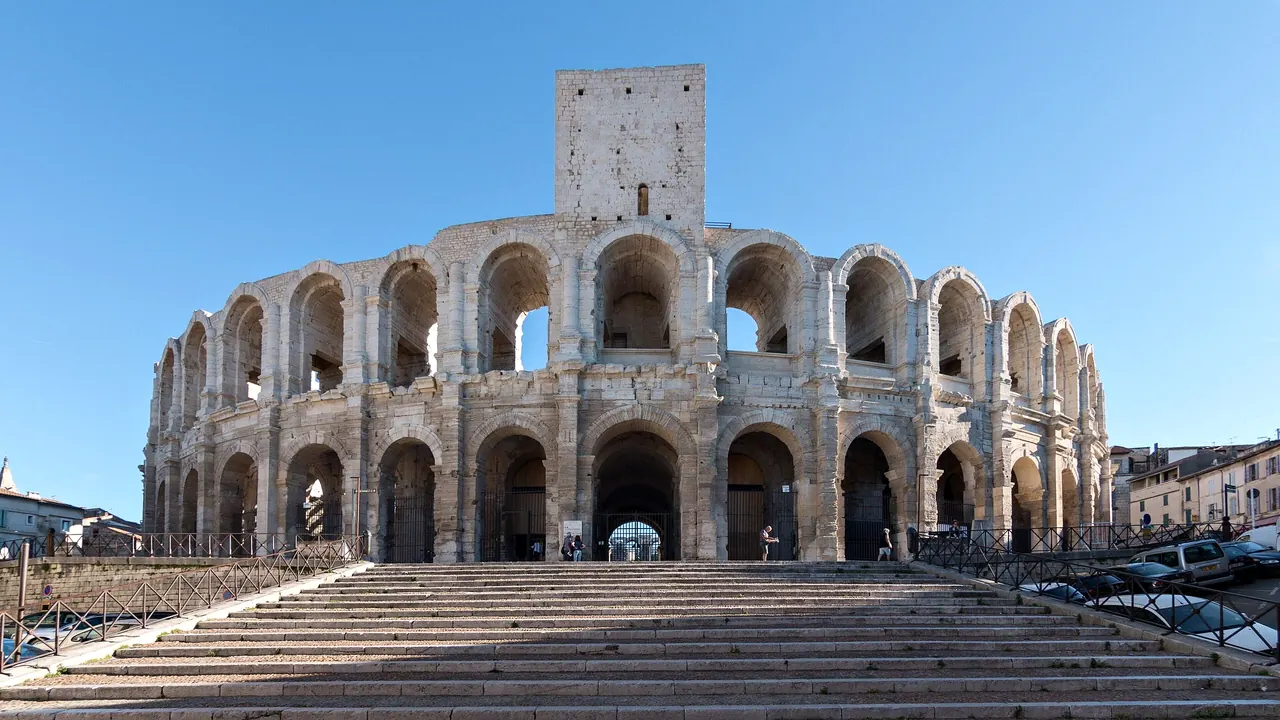
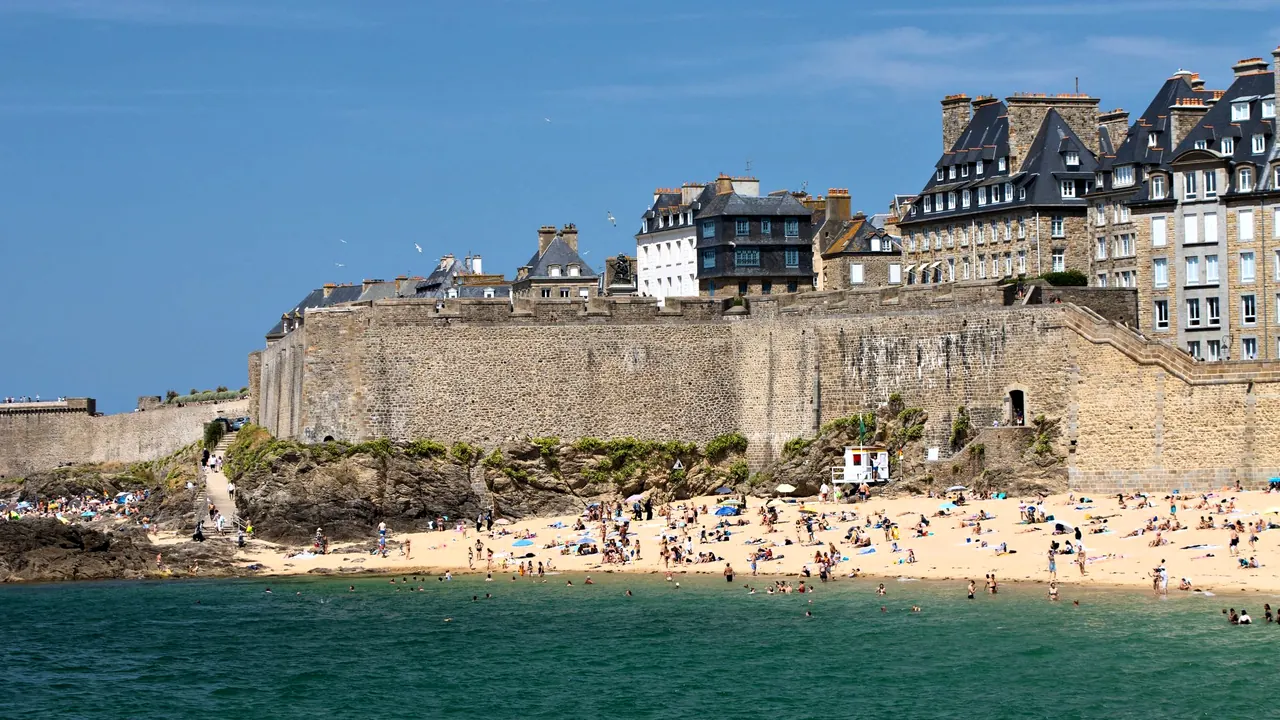
Photos: Arles by Martin Kraft, CC BY-SA 3.0, cropped; Saint-Malo by Efrem Efre, Pexels License.
Arles or Saint-Malo?
Our verdict in twelve categories, each scored against the same fixed benchmark cities, and the climate month by month, so you can choose for your trip.
Choose Arles for
- culture and sights
- day trips
- live music and the arts
Arles is the choice for travellers who want history and a base for exploring. Roman monuments, Romanesque carving and Van Gogh's landscapes are all within a short walk, and Avignon, Nîmes, the Pont du Gard and the Alpilles villages are close enough for a different outing every day. It suits couples and curious adults who are happy with quiet evenings, and it is a little kinder on the budget.
Choose Saint-Malo for
- wellness
- families
- getting around
Saint-Malo makes more sense for a seaside break where the town itself is the pleasure: walking the ramparts, watching the huge tides and spending afternoons in seawater pools. Children have more to do, it is easier to get around without a car, and the thalassotherapy tradition makes it a good choice for a restful weekend out of season. Just don't expect warm water or many museums.
Scoreboard
Twelve categories on one fixed scale from 0 to 100. The shaded stretch is the gap between the two.
Your match
Pick a travel style or drag the sliders, and both match scores follow your weighting.
Too close to call, level with your weighting
Wins on culture and sights and day trips with your weighting.
Wins on wellness and families with your weighting.
What matters to you?
Category by category
What the scores mean for a trip.
Beaches & swimming
Neither town is really a beach destination, but the sea works very differently in each. Arles has no beach of its own. You drive across the Camargue to the wild, open sands of Piémanson, Beauduc or Saintes-Maries, where the Mediterranean is warm and shallow but there is little shade and you have to put up with the mistral and mosquitoes.
In Saint-Malo the sand starts right at the ramparts, and the Sillon runs for about 3km, with a tidal sea pool at Bon-Secours. The catch is the Channel, which stays cold even in high summer, so people spend more time on the sand than in the water.
Food & drink
Bull stew and red Camargue rice in Arles, buckwheat galettes and oysters in Saint-Malo: the two kitchens share almost nothing. Arles eats from the land and the delta, with tellines, saucisson d'Arles and Alpilles olive oil. Its best food moment is the Saturday market along the Boulevard des Lices, followed by a long lunch with local rosé on the Place du Forum.
Saint-Malo eats from the sea and the dairy, with dry cider, salted butter and oysters from Cancale, eaten by the harbour wall. The better tables are found in Saint-Servan and along the coast towards Cancale, rather than at the crêperies inside the walls. Neither town has a wide restaurant scene, and many places in Arles close in winter.
Culture & sights
Arles is far richer here. A UNESCO-listed group of Roman monuments sits within walking distance: the arena, the theatre, the cryptoporticus and the Baths of Constantine. Add the carved portal and cloister of Saint-Trophime, the Roman barge in the Museum of Ancient Arles, the Van Gogh connection and Gehry's tower at Luma, and two full days are well spent.
Saint-Malo's appeal lies in the scene as a whole rather than in individual sights: granite houses inside a full circuit of ramparts, largely rebuilt after 1944, plus the cathedral, the castle keep and Chateaubriand's tomb on the Grand Bé. It fills a pleasant day, but museum lovers will run out of things to see quickly.
Nightlife
Both towns go quiet early, so neither suits a night-out trip. Arles is about late dinners and café tables on the Place du Forum, except during the Easter and September ferias, when bodegas take over the streets for a few days. Saint-Malo has more of a pub culture, with Irish-style and wine bars inside the walls that stay lively with sailors and young visitors through July and August. For clubs, you go to Marseille or Montpellier from one and to Rennes from the other.
Nature & outdoors
Arles looks inland over a delta and limestone hills, and Saint-Malo looks out over a tidal coast. From Arles you head into the Camargue's lagoons, salt flats and rice fields, where flamingos, white horses and black bulls graze and herons and waders pass through in spring and autumn. You explore on horseback or by bike along the dykes, and the Alpilles add proper hill walking among the olives and pines.
Saint-Malo's outdoors is about the sea's edge: cliff walking on the GR34 towards Pointe du Grouin and Cap Fréhel, kayaking on the Rance, sailing, and kitesurfing when the wind blows, with tides of up to about 13m. Inland it is flat farmland, so there is nothing to match the Alpilles, but summer brings no mosquitoes or mistral to deal with.
Day trips
Both are fine bases, but Arles has the edge, mainly because so much is reachable by train. Avignon and Nîmes are each under half an hour away, the Pont du Gard, Les Baux and Saint-Rémy are a short drive, and Aigues-Mortes, Aix and Marseille can be done in a day.
Saint-Malo has one great excursion, Mont-Saint-Michel, about an hour away, plus Dinan, Dinard by boat, Cancale and Rennes by train. The summer ferries to Jersey and the Chausey islands are an option that Arles cannot offer.
Good for families
Saint-Malo is the easier family choice. Children get sandcastles below the ramparts, jumps into the Bon-Secours sea pool, low-tide walks to the forts and the Grand Aquarium when it rains. Parents need to watch the fast incoming tide and the cold water.
Arles works mainly for older children who like history and animals. The arena towers and the cryptoporticus are fun, and the Camargue has pony rides and flamingos, but almost everything outside town needs a car, and the summer heat and cobbled streets wear out small legs and buggies.
Getting around
Saint-Malo is a little easier to manage without a car. Local buses cover the whole town, a passenger boat crosses to Dinard, the seafront promenade connects the walls to Paramé on foot, and high-speed trains run direct to Paris.
Arles is even more compact, with everything within about fifteen minutes' walk and a free shuttle around the centre, and trains to Avignon and Nîmes are frequent. However, the Camargue and the hill villages almost require a hire car, so many visitors end up driving.
Shopping & style
Neither town is a place for fashion. Both sell regional crafts, and you go to the nearest city for anything bigger. Arles offers Provençal printed cottons, santons, gardian shirts, Camargue salt and an unusual number of bookshops and photography prints. In Saint-Malo the things to buy are striped sailor tops, oilskins, faience, salted-butter caramels and cheese.
Affordability
Arles is slightly kinder to the wallet. It costs about the same as any French provincial town, it is cheaper than the smart Luberon villages, and a combined pass covers most of the sights. The extra costs are a hire car and higher room prices around the ferias and the photography festival.
Saint-Malo is priced as a popular seaside resort. Summer rooms inside the walls are expensive and book up early, and seafood platters add up quickly, although galettes are cheap. Spring and autumn are when it is good value.
Live music & performing arts
Arles has more to offer, especially in summer, when concerts take place in the Roman theatre and the arena, Les Suds fills the courtyards with world music, and the course camarguaise runs through the warm months.
Saint-Malo's calendar depends on a few festivals: La Route du Rock for indie music, Étonnants Voyageurs for books and Quai des Bulles for comics, plus occasional organ recitals in the cathedral. Outside those, both towns leave serious opera and orchestras to the nearest city.
Wellness & relaxation
Saint-Malo is the clear choice for being looked after. Thalassotherapy is part of its identity, with a large seafront centre of heated seawater pools and hydrotherapy on the Sillon, and Dinard across the estuary shares the same tradition. In the quiet months, a low-tide walk followed by an afternoon in the pools makes a proper restful break.
Arles offers a slower pace rather than treatments: siestas, shaded squares, evenings by the Rhône and a few farmhouse retreats with pools in the Camargue and the Alpilles.
When should you go?
Pick your month. The climate figures are measured averages, not a forecast.
Arles in July
Saint-Malo in July
Daytime high, °C
Rainfall in the month, mm
Where the figures come from
Arles's temperatures are measured 28 km from the centre, at Nimes / Courbessac.
Arles has no rain gauge within 25 km of the centre, so its rainfall comes from a gridded climate dataset read at the city rather than from a gauge further away.
Saint-Malo has no rain gauge within 25 km of the centre, so its rainfall comes from a gridded climate dataset read at the city rather than from a gauge further away.
Saint-Malo's sunshine is measured 68 km from the centre, at Rennes.
Temperature and rainfall are climate normals, averaged over the years shown. Arles: 1991-2020 (sunshine 1981-2010) normals, Nimes / Courbessac (28 km from centre). Saint-Malo: 2002-2020 (sunshine 1991-2020, rainfall 1991-2020) normals, Dinard (7.9 km from centre).
Arles has a hot Provençal summer. July and August reach about 31°C with long, sunny days, which makes for heavy sightseeing at midday but good conditions for the Camargue beaches, where the sea warms to about 22°C. May, June and September are the best months for walking the town and the marshes. The rain arrives in autumn and peaks in October at around 105mm, and winters are cool but bright for the season.
Saint-Malo's climate is much milder and cloudier. Summer days reach only about 22°C, comfortable for walking the walls and the coastal path at any hour, and the Channel peaks at around 18°C in August and September, so swims are brisk. From late autumn into winter the town is noticeably wetter and greyer than Arles, which makes it better suited to bracing walks and the thalasso pools than to sitting outdoors.
Which traveller are you?
On a culture and arts trip, Arles is the clear pick. Its Roman and Romanesque heritage is dense enough to fill two full days on foot, and more great historic towns are a short train ride away. Saint-Malo is one handsome walled town rather than many sights.
On a family trip with children, Saint-Malo is the easier choice. The sea is on the doorstep, there is a fallback for wet days, and the mild summers suit small children better than Provençal heat. Arles works best with older children and a car.
For a relaxing and wellness trip, Saint-Malo wins because seawater treatment is a real local tradition there, and the town grows calm out of season. Arles slows you down with long lunches and siestas, but offers little in the way of treatments.
Before you go
| Measure | Arles | Saint-Malo |
|---|---|---|
| Official language | French | French |
| Currency | Euro (EUR) | Euro (EUR) |
| Sockets | CE230 V, 50 Hz | CE230 V, 50 Hz |
| Driving side | Right | Right |
| Time zone | UTC+1, UTC+2 in summer | UTC+1, UTC+2 in summer |
| Emergency number | 112 | 112 |
| Elevation | 0 m | 0 m |
| Main airport | Marseille Provence Airport (MRS)54 km from centre126 non-stop destinations | Rennes-Saint-Jacques Airport (RNS)68 km from centre15 non-stop destinations |
| Public holidays this year | 11 days | 11 days |
By the numbers
| Measure | Arles | Saint-Malo |
|---|---|---|
| City population | 51,811 | 47,439 |
| People per km² | 68 | 1,296 |
| Museums within 10 km | 3 | 3 |
| UNESCO World Heritage sites within 50 km | 5 | 2 |
| Swim season, months above 21 °C | 2 months | None |
Where else could you go?
Every comparison below shares a destination with this one, so you can follow Arles or Saint-Malo somewhere new.
- Avignonvs Arles
- Montpelliervs Arles
- Aix-en-Provencevs Arles
- Marseillevs Arles
- Nantesvs Saint-Malo
- Saint-Tropezvs Arles