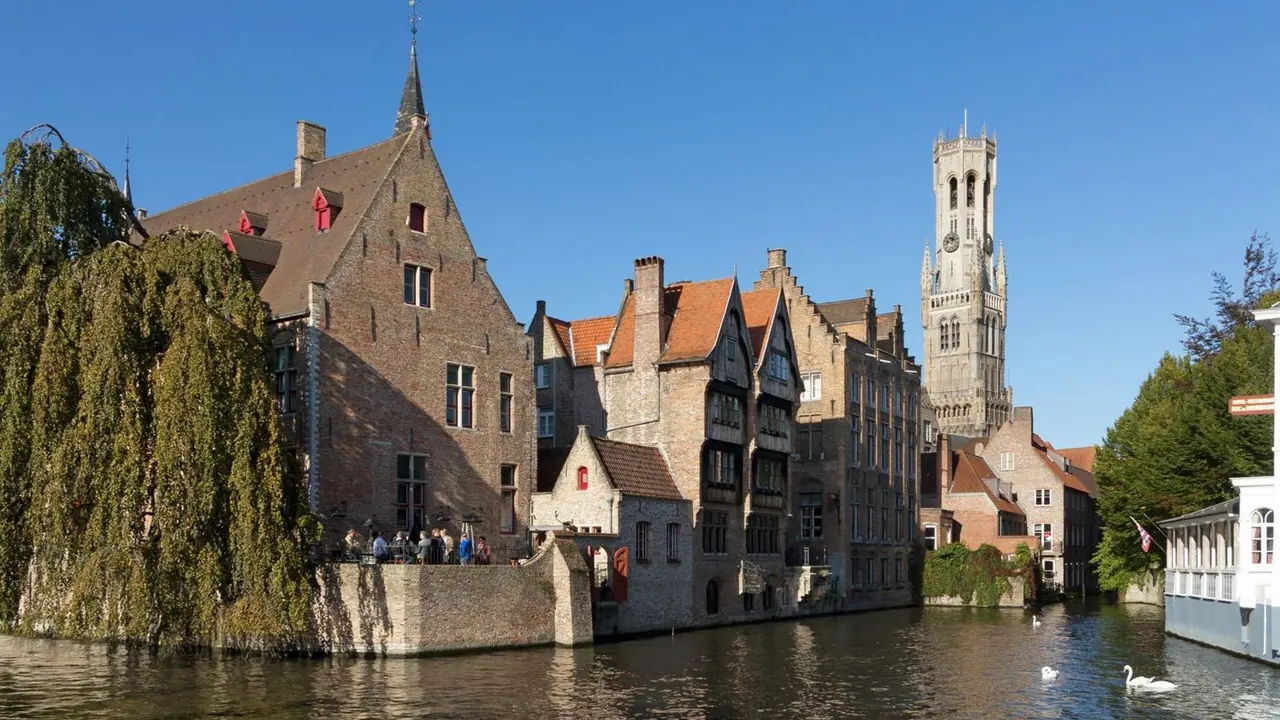
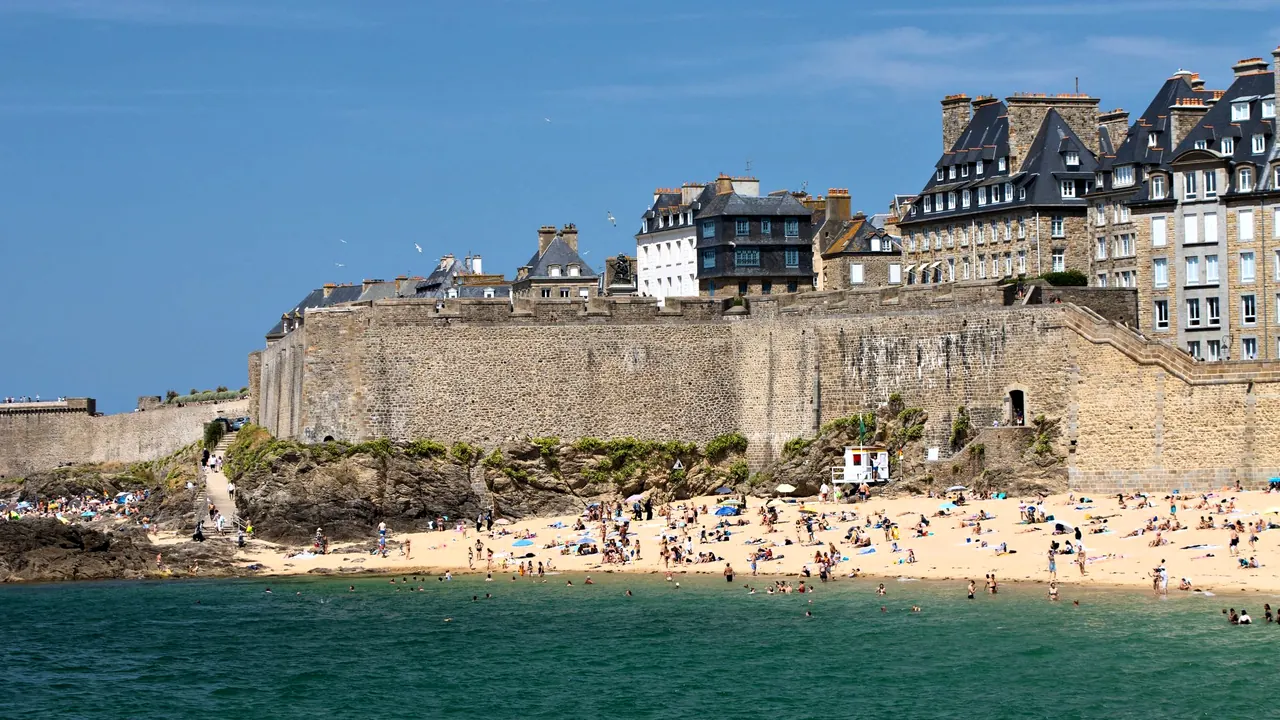
Photos: Bruges by Michielverbeek, CC BY-SA 4.0, cropped; Saint-Malo by Efrem Efre, Pexels License.
Bruges or Saint-Malo?
Our verdict in twelve categories, each scored against the same fixed benchmark cities, and the climate month by month, so you can choose for your trip.
Choose Bruges for
- culture and sights
- getting around
- live music and the arts
Bruges suits a trip built around art, architecture and getting about by train. Its intact medieval centre, the Flemish Primitives at the Groeninge and the Memling paintings give a short stay real depth. Ghent, Brussels and Antwerp are close enough to add a day each without a car. It is also the better choice for anyone who travels for beer and is happy with quiet canalside evenings.
Choose Saint-Malo for
- nature and the outdoors
- beaches
- wellness
Pick Saint-Malo if you want the sea to be part of the trip rather than a side trip. The beaches start at the ramparts, low tide opens the way to the island forts, and the GR34 coastal path runs out along the cliffs in both directions. Add the thalassotherapy tradition and you have a town for walkers, families and anyone wanting a restful break. The catch is that its sightseeing fills a good day rather than a week.
Scoreboard
Twelve categories on one fixed scale from 0 to 100. The shaded stretch is the gap between the two.
Your match
Pick a travel style or drag the sliders, and both match scores follow your weighting.
Too close to call, 1 point apart
Wins on culture and sights and getting around with your weighting.
Wins on nature and the outdoors and beaches with your weighting.
What matters to you?
Category by category
What the scores mean for a trip.
Beaches & swimming
Neither has warm water. Both face cold northern seas that reach only the high teens in late summer, so what separates them is how close the sand is. From Bruges the beach is an outing: a short train to Blankenberge, then the coast tram along wide, flat sands. It is worth an afternoon in a sunny spell.
In Saint-Malo the Sillon beach and the coves below the ramparts are part of the town itself. The Bon-Secours tidal pool lets you swim at any state of the tide, and low water doubles the sand and opens walks out to the island forts. Dinard's more sheltered beaches are a short boat ride across the estuary.
Food & drink
Bruges has the edge, mostly thanks to Belgian beer: long lists of Trappist and abbey ales poured in wood-panelled cafés. Alongside come mussels with frites, beef stewed in beer and waterzooi, and there is chocolate in every other window.
Saint-Malo's cooking is simpler and more coastal. It is built on buckwheat galettes and dry cider, with Cancale oysters eaten by the harbour wall and seafood platters along the ramparts. Both share the same trap, a tourist core that feeds day visitors poorly. Head for the side streets in Bruges, or out to Saint-Servan and Cancale from Saint-Malo.
Culture & sights
This is where the two differ most. Bruges is a medieval city that survived largely intact: a whole UNESCO-listed centre of canals, guildhalls, the Belfry and the Begijnhof. Its art matches the setting, with van Eyck at the Groeninge, Memling in St John's Hospital and Michelangelo's marble Madonna in the Church of Our Lady.
Saint-Malo's walled town looks fine from the walk around its ramparts, but much of it was rebuilt after 1944, and its corsair history shows in street names more than in museums. The cathedral, the castle and a low-tide walk to Chateaubriand's grave on the Grand Bé make a good day, and after that there is not much left to see.
Nightlife
Both go quiet early and neither is a place for clubbing. What differs is the drink and the season. Bruges evenings revolve around strong Trappist ales in brown cafés and vaulted cellar bars, and students keep a few of them busy around the Eiermarkt and 't Zand all year round.
In Saint-Malo it means a drink in a pub, wine bar or Irish-style bar inside the walls. These are lively in July and August with sailors and young visitors and sleepy the rest of the year, and the nearest clubs are in Rennes.
Nature & outdoors
Around Bruges the land is Flemish polder: wide skies, grazing meadows, old dykes and poplar-lined canals. The towpath to Damme makes a lovely easy ride, and the Zwin salt marsh near Knokke is good for birdwatching, with blustery dune walks close by. It is gentle country for an afternoon, with no hills or forests to fill several active days.
Inland, Saint-Malo is no more dramatic, just flat farmland without hills or big woods, so everything that sets it apart happens at the shoreline. Tides of up to about 13m drain the bay of Mont-Saint-Michel into vast flats of sand and mud, and the coast looks completely different twice a day. Separately, seals live off the islands and seabirds work the rocks and the flats. Here the sea is the landscape, and it is far wilder than anything on the Flemish side.
Day trips
Both make good bases, but Bruges is the easier and richer one. Belgium's frequent trains put Ghent under half an hour away and Brussels and Antwerp around an hour, each a major city of art. Ypres and the First World War memorials of the Westhoek, and Lille across the border, widen the choice further.
Saint-Malo's big draw is Mont-Saint-Michel, with Dinan, Cancale and Rennes all close by and Dinard just across the water. Apart from the train to Rennes and the Dinard boat, though, most of these trips are much easier with a car.
Good for families
Saint-Malo gives children more to do: wide beaches for sandcastles, the sea pool at Bon-Secours to jump into, forts to walk out to at low tide, pirate stories on the ramparts and the Grand Aquarium for a wet day. Parents do need to keep an eye on the fast incoming tides.
Bruges works best for short treats: a canal boat, the Belfry climb, feeding the swans at the Minnewater, with Boudewijn Seapark for a longer day out. Beyond those, its real attractions are paintings and churches, and pushchairs struggle on the cobbles.
Getting around
Bruges is the easier place to be without a car. The whole old town inside the canal ring is flat and can be crossed on foot in about half an hour. Bikes are the local way to get about, and trains run often to the coast and the big Flemish cities. The cobbles are the only real complaint.
Within the town Saint-Malo is simple too, with a walled centre for pedestrians, the seafront promenade to Paramé, buses to Saint-Servan and fast trains to Rennes and Paris. Further out the buses thin out, and most visitors end up driving.
Shopping & style
Neither is a fashion destination, and in both the best buys are things to eat. Bruges has more depth there: chocolate makers on every street and specialist beer shops selling bottles and glasses from across Belgium. The Saturday market on 't Zand and the flea market along the Dijver are good for browsing.
Saint-Malo's shops lean towards the sea, with striped sailor tops, oilskins, faience, salted butter and caramels, plus produce markets in the town and in Saint-Servan. For anything bigger, you go to Rennes.
Affordability
Neither is cheap, and a similar trip costs about the same in each. Where they differ is when the prices bite. Bruges is priced for a steady flow of visitors all year, with weekends the dearest. You save by staying midweek or near the station and eating away from the Markt.
In Saint-Malo the pressure is seasonal. Rooms inside the walls and along the beach climb and sell out in July and August, then ease in spring and autumn. A galette and cider also makes a cheap meal, which is hard to find on Bruges's main squares.
Live music & performing arts
Bruges has a real year-round programme for a small city. The Concertgebouw specialises in early music, chamber music and contemporary dance, the ornate Stadsschouwburg puts on theatre, the Belfry carillon plays over the rooftops, and a long-running early-music festival takes over in summer.
Saint-Malo's cultural life comes in bursts: La Route du Rock, the Étonnants Voyageurs literary festival and Quai des Bulles for comics. Outside those dates there is a modest theatre season and the odd concert in the cathedral, and on most evenings nothing is on.
Wellness & relaxation
Saint-Malo has a real tradition here in thalassotherapy, the French seawater cure. Its large centre on the Sillon beach has heated seawater pools and hydrotherapy, and Dinard across the estuary has the same tradition. Out of season, a weekend of treatments and long walks on the empty sand at low tide makes a genuinely restful break.
Bruges has only hotel and day spas, so its calm depends on timing. The canals, the Begijnhof and the Minnewater are peaceful early and late, and the Sint-Anna quarter stays quiet even at midday.
When should you go?
Pick your month. The climate figures are measured averages, not a forecast.
Bruges in July
Saint-Malo in July
Daytime high, °C
Rainfall in the month, mm
Where the figures come from
Bruges has no rain gauge within 25 km of the centre, so its rainfall comes from a gridded climate dataset read at the city rather than from a gauge further away.
Bruges's sunshine is measured 37 km from the centre, at Vlissingen.
Saint-Malo has no rain gauge within 25 km of the centre, so its rainfall comes from a gridded climate dataset read at the city rather than from a gauge further away.
Saint-Malo's sunshine is measured 68 km from the centre, at Rennes.
Temperature and rainfall are climate normals, averaged over the years shown. Bruges: 2009-2025 (sunshine 1991-2020, rainfall 1991-2020) normals, Zeebrugge / Zeemanshaard (15.8 km from centre). Saint-Malo: 2002-2020 (sunshine 1991-2020, rainfall 1991-2020) normals, Dinard (7.9 km from centre).
Neither city ever gets too hot for walking, so summer is the natural season for both. Saint-Malo has the better summer: highs of about 22°C in July and August, and these are also its driest months, at about 46mm. The Channel peaks near 18°C, which is warm enough for a brisk swim and not much more. Bruges reaches about 21°C, but its rain builds through the summer to around 87mm in August, so beach days on the Belgian coast are hit and miss.
For walking around Bruges, late April to June is the best stretch, with drier weather and the most sunshine of the year. Both cities turn wet and grey from October. Winter is damp rather than harsh, and slightly milder on the Breton coast than in Flanders.
Which traveller are you?
For a culture and arts trip, Bruges is the far stronger choice. A complete medieval centre, van Eyck and Memling in its museums and a serious concert hall for early music fill two full days, and Ghent and Brussels add more by train.
On an outdoors trip, Saint-Malo wins clearly. The GR34 coastal path runs to Pointe du Grouin and Cap Fréhel, the Rance estuary suits kayaks and bikes, and big tides and steady wind bring sailing and kitesurfing. Around Bruges there is only flat cycling.
For a relaxing and wellness trip, Saint-Malo is the better bet, especially outside summer. Its thalassotherapy centre on the Sillon beach has heated seawater pools and treatments, and empty low-tide sand for long walks. Bruges has only hotel spas and quiet early-morning canals.
Before you go
| Measure | Bruges | Saint-Malo |
|---|---|---|
| Official language | French, German, Dutch | French |
| Currency | Euro (EUR) | Euro (EUR) |
| Sockets | CE230 V, 50 Hz | CE230 V, 50 Hz |
| Driving side | Right | Right |
| Time zone | UTC+1, UTC+2 in summer | UTC+1, UTC+2 in summer |
| Emergency number | 112 | 112 |
| Elevation | 2 m | 0 m |
| Main airport | Brussels Airport (BRU)94 km from centre191 non-stop destinations | Rennes-Saint-Jacques Airport (RNS)68 km from centre15 non-stop destinations |
| Public holidays this year | 14 days | 11 days |
By the numbers
| Measure | Bruges | Saint-Malo |
|---|---|---|
| City population | 118,509 | 47,439 |
| People per km² | 840 | 1,296 |
| Museums within 10 km | 38 | 3 |
| UNESCO World Heritage sites within 50 km | 4 | 2 |
| Swim season, months above 21 °C | None | None |
Where else could you go?
Every comparison below shares a destination with this one, so you can follow Bruges or Saint-Malo somewhere new.