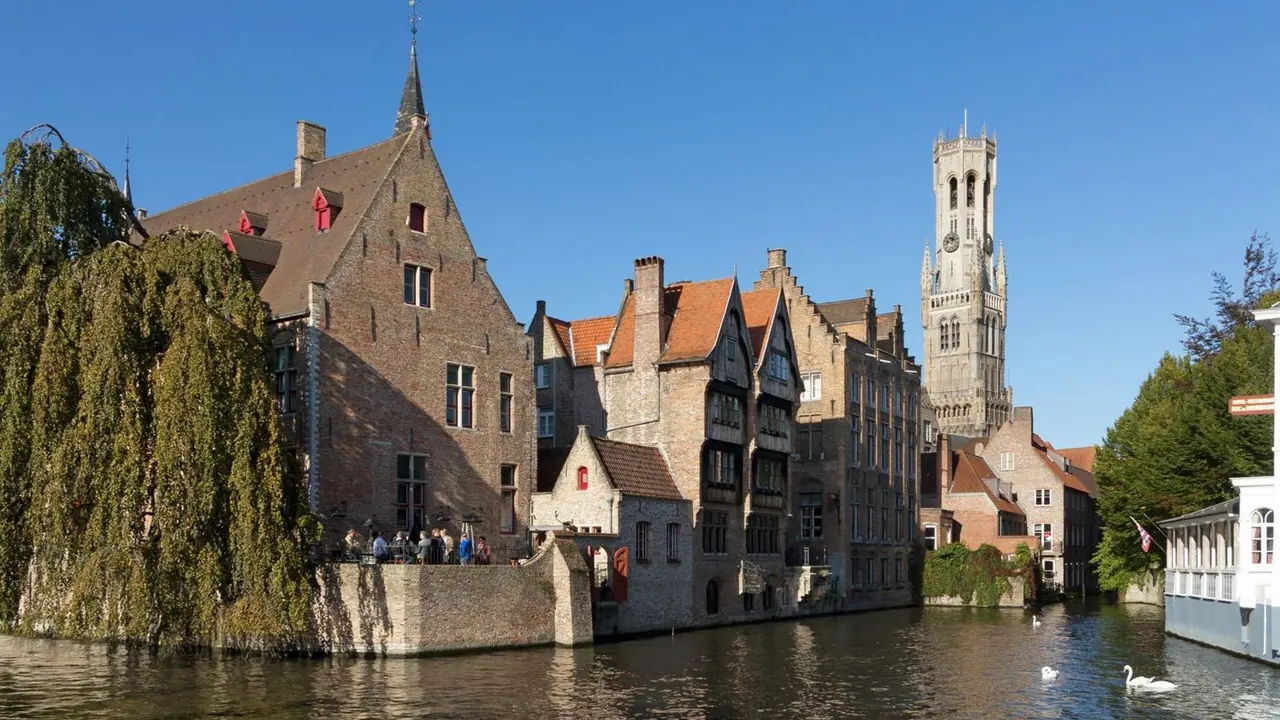
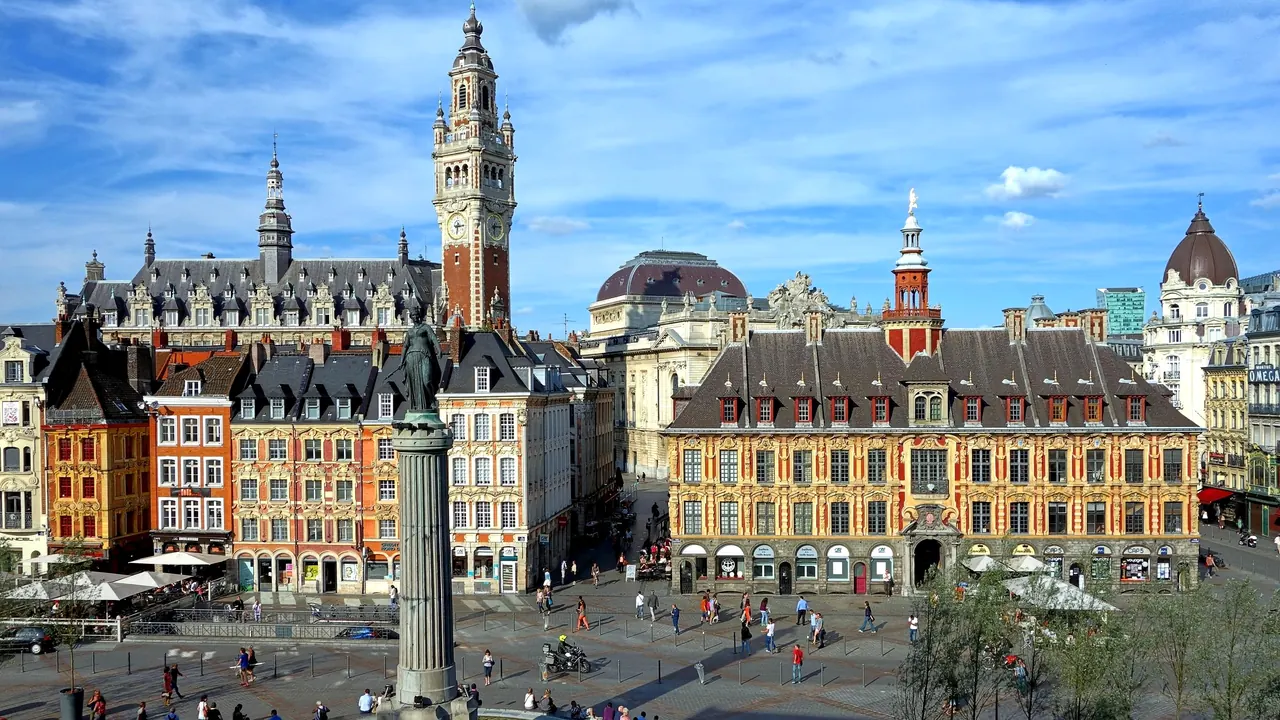
Photos: Bruges by Michielverbeek, CC BY-SA 4.0, cropped; Lille by Velvet, CC BY-SA 3.0, cropped.
Bruges or Lille?
Our verdict in twelve categories, each scored against the same fixed benchmark cities, and the climate month by month, so you can choose for your trip.
Choose Bruges for
- wellness
- beaches
- culture and sights
Bruges suits a traveller who wants the medieval city itself to be the point: canals, guildhalls, the Begijnhof and the Flemish Primitives, all in a centre small enough to know in two days. It is the better pick for a slow, romantic stay. Walk early before the day-trippers arrive, spend evenings over Trappist ale, and fit in a bike ride to Damme or an afternoon on the coast.
Choose Lille for
- nightlife
- shopping
- live music and the arts
Lille is the livelier and more practical choice. A large student population keeps its bars full, and the Opéra and the Théâtre du Nord give evenings more range. Vieux-Lille and the Braderie make for better shopping, and rooms cost less. Two stations sit beside the old town, with fast trains to Brussels, Paris and London. That makes Lille best for travellers who want a working French city as a base rather than a postcard to stay in.
Scoreboard
Twelve categories on one fixed scale from 0 to 100. The shaded stretch is the gap between the two.
Your match
Pick a travel style or drag the sliders, and both match scores follow your weighting.
Wins on wellness and beaches with your weighting.
Wins on nightlife and shopping with your weighting.
What matters to you?
Category by category
What the scores mean for a trip.
Beaches & swimming
Neither city is a beach destination, but Bruges is much better placed for a seaside afternoon. Blankenberge is a quarter of an hour away by train, and from there the coast tram runs along Belgium's flat, sandy shore, with promenades all the way.
From Lille the nearest sand is Malo-les-Bains at Dunkirk, about an hour away, and the dune beaches of the Opal Coast are further still. In both cases the water is the same chilly North Sea, so expect paddling and windy walks rather than swimming.
Food & drink
Both cities cook from the same Flemish recipe book, with waterzooi and beef stewed in beer on menus in each, so the difference lies in where and how you eat. Bruges is the place for beer itself, with long Trappist and abbey lists in brown cafés and chocolate in shop window after shop window. Its main squares cater to day-trippers, though, and the good everyday food is on the side streets. Its finest cooking is in farmhouses just outside town.
Lille's strength is the estaminets of Vieux-Lille, which serve potjevleesch, the welsh and Maroilles tarts to a more local crowd. The multi-ethnic Sunday market at Wazemmes widens the range a little beyond regional cooking.
Culture & sights
Bruges is the more remarkable place to look at. Its entire medieval centre is listed by UNESCO, a ring of canals, guildhalls and almshouses, with the Belfry, the Burg and the Begijnhof minutes apart. Indoors there are Van Eyck, Memling and a Michelangelo Madonna. The price is crowded narrow streets by late morning in summer.
Lille has the bigger single museum in the Palais des Beaux-Arts, and the Flemish baroque streets of Vieux-Lille are handsome. Its sights are more spread out, though, with La Piscine and LaM out in Roubaix and Villeneuve-d'Ascq. It rewards a gallery lover more than someone who wants the whole town to feel like history.
Nightlife
Lille is clearly the better night out. Its huge student population fills the bars of Rue Masséna and Rue Solférino, especially on Thursdays. The brick cellar bars of Vieux-Lille suit a calmer evening, and Belgian clubs are close for a later night.
Bruges goes to bed early. An evening there means a long session over strong ale in a brown café or vaulted cellar around the Eiermarkt, then a walk along the lit canals. Dancing is limited to a couple of small weekend clubs.
Nature & outdoors
Both cities sit in flat Flemish country, but Bruges has the easier and prettier outdoor afternoon. The poplar-lined towpath to Damme starts at the edge of the old town. The Zwin salt marsh and the coastal dunes are close for birdwatching and blustery walks.
Lille has the green loop of the Citadel park along the Deûle and short walks on low hills such as Mont des Cats. Its most dramatic scenery, the chalk cliffs of Cap Blanc-Nez and Cap Gris-Nez, is a long day away.
Day trips
Both cities make excellent bases. Bruges offers Flanders in depth, while Lille offers wider reach. From Bruges, Ghent is under half an hour away and Brussels and Antwerp are on regular trains. Damme is a bike ride away, and the coast and the Ypres memorials are close at hand.
From Lille's two stations, Brussels is about half an hour away, Paris about an hour by TGV, and London possible by Eurostar. It also adds French trips of its own: Arras, the cathedral at Amiens, the Louvre-Lens, and the battlefields of Vimy and the Somme.
Good for families
Bruges gives younger children more to enjoy inside the town itself. There are canal boats and horse-drawn carriages, swans to feed on the Minnewater and the climb up the Belfry. Boudewijn Seapark is on the southern edge of town, and sandcastle beaches are a short train ride away. The catch is the cobbles and the crowded summer streets, which make hard going with a pushchair.
In Lille, family time centres on the Citadel park, with its small zoo, playgrounds and flat paths for scooters. The natural history museum and the Forum des Sciences cover wet days. The bigger outings, Pairi Daiza and the Nausicaá aquarium, each take a full day out of the city, and the cobbles of Vieux-Lille are no kinder to wheels.
Getting around
Bruges is a city for feet and bikes. The old town inside its oval of canals takes only about thirty minutes to walk from one side to the other, and locals ride rather than drive, so hiring a bike for your stay makes sense. The awkward part is arriving: the station is outside the canal ring, so with luggage you face a longish walk or a bus into the Markt.
Lille is the other way round. Lille Flandres and Lille Europe sit next to each other at the edge of the old town, so trains leave you almost at the door and each day trip is quick to start. Further out, the driverless VAL metro and the tram do the job a bike does in Bruges, taking you to places such as La Piscine in Roubaix. Both cities have a flat centre, neither needs a car, and in both the old streets are cobbled, which is hard on suitcase wheels.
Shopping & style
Lille is the better place to shop. Beyond the chains of Rue Neuve and the Euralille mall, Vieux-Lille has independent fashion, design shops, delicatessens and a few luxury labels. The Braderie at the start of September turns the whole city into a vast flea market.
Shopping in Bruges is mostly things to take home and eat or drink: pralines, Belgian beer and glasses, and lace, though much of the lace is imported. The high street is largely chains, and the Saturday market on 't Zand and the Dijver flea market are pleasant for browsing.
Affordability
Lille is the easier city on a budget. Rooms are reasonable for most of the year, apart from Braderie and trade-fair weeks. Estaminet meals, the metro and the museums are fairly priced, so a stay is comfortable, if never cheap.
Bruges charges for its beauty. Hotels inside the canal ring are dear, especially at weekends and in summer, and the restaurants on the squares charge a lot. Midweek stays, rooms near the station and meals away from the Markt all help, and the beer is fair value for its quality.
Live music & performing arts
Lille has the fuller evening programme. There is opera and dance at the Opéra on the Place du Théâtre, a full symphonic season from the Orchestre National de Lille, drama at the Théâtre du Nord, and touring rock and pop at the Zénith.
Bruges has a narrower but distinctive programme. It is strong on early music, chamber music and contemporary dance at its Concertgebouw and during its summer early-music festival, and the Belfry carillon and church concerts add to it. There is no opera, so a big night out means a train to Ghent or Brussels.
Wellness & relaxation
Neither city has a spa tradition, so here wellness means calm rather than treatments, and Bruges has far more of it. Early in the morning and after the day-trippers leave, the canals, the Begijnhof and Minnewater park are very peaceful. The Sint-Anna and Langestraat quarters stay quiet even at midday.
In Lille, relaxing means hotel spas, tea rooms and café terraces in Vieux-Lille. Real thermal baths are a short train ride away at Saint-Amand-les-Eaux. The city's pace is easygoing, but it is not a place you go for rest.
When should you go?
Pick your month. The climate figures are measured averages, not a forecast.
Bruges in July
Lille in July
Daytime high, °C
Rainfall in the month, mm
Where the figures come from
Bruges has no rain gauge within 25 km of the centre, so its rainfall comes from a gridded climate dataset read at the city rather than from a gauge further away.
Bruges's sunshine is measured 37 km from the centre, at Vlissingen.
Temperature and rainfall are climate normals, averaged over the years shown. Bruges: 2009-2025 (sunshine 1991-2020, rainfall 1991-2020) normals, Zeebrugge / Zeemanshaard (15.8 km from centre). Lille: 1991-2020 normals, Lille (7.8 km from centre).
Both cities share the same grey northern winter, with highs around 7°C from December to February, so the cold months are for museums and beer cafés rather than long walks. Lille warms faster from April and reaches about 24°C in July and August, against 21°C in Bruges, which makes its summer slightly better for terraces and street wandering. Neither is ever too hot for sightseeing. Bruges has clearly more sunshine through late spring and summer.
Only Bruges has the sea close by, and the North Sea there peaks at about 19°C in August, enough for a dip on a sunny day but not for real swimming. Rain falls steadily in both all year. Bruges turns noticeably wetter from late summer, with close to 89mm a month from October to December, while Lille's rainfall stays more even. May, June and September are the best months in both.
Which traveller are you?
For a food and nightlife trip, Lille is the stronger choice. Its estaminets serve hearty Flemish cooking, and its large student scene keeps bars full through the week, from loud Rue Masséna to the cellars of Vieux-Lille. Bruges mostly goes quiet by midnight.
On a relaxing and wellness trip, Bruges suits better. Its canals, the Begijnhof and the Sint-Anna quarter are very peaceful in the early mornings and evenings. Lille is an easygoing but busy working city, where calm mostly means a café terrace.
For a shopping trip, Lille wins comfortably. Vieux-Lille has independent fashion, design shops and delicatessens, there is a big mall by the stations, and the September Braderie is a famous flea market. Bruges offers mainly chocolate, beer and lace.
Before you go
| Measure | Bruges | Lille |
|---|---|---|
| Official language | French, German, Dutch | French |
| Currency | Euro (EUR) | Euro (EUR) |
| Sockets | CE230 V, 50 Hz | CE230 V, 50 Hz |
| Driving side | Right | Right |
| Time zone | UTC+1, UTC+2 in summer | UTC+1, UTC+2 in summer |
| Emergency number | 112 | 112 |
| Elevation | 2 m | 17 m |
| Main airport | Brussels Airport (BRU)94 km from centre191 non-stop destinations | Lille Airport (LIL)8 km from centre61 non-stop destinations |
| Public holidays this year | 14 days | 11 days |
By the numbers
| Measure | Bruges | Lille |
|---|---|---|
| City population | 118,509 | 238,246 |
| People per km² | 840 | 6,846 |
| Museums within 10 km | 38 | 23 |
| UNESCO World Heritage sites within 50 km | 4 | 6 |
| Swim season, months above 21 °C | None | - |
Where else could you go?
Every comparison below shares a destination with this one, so you can follow Bruges or Lille somewhere new.