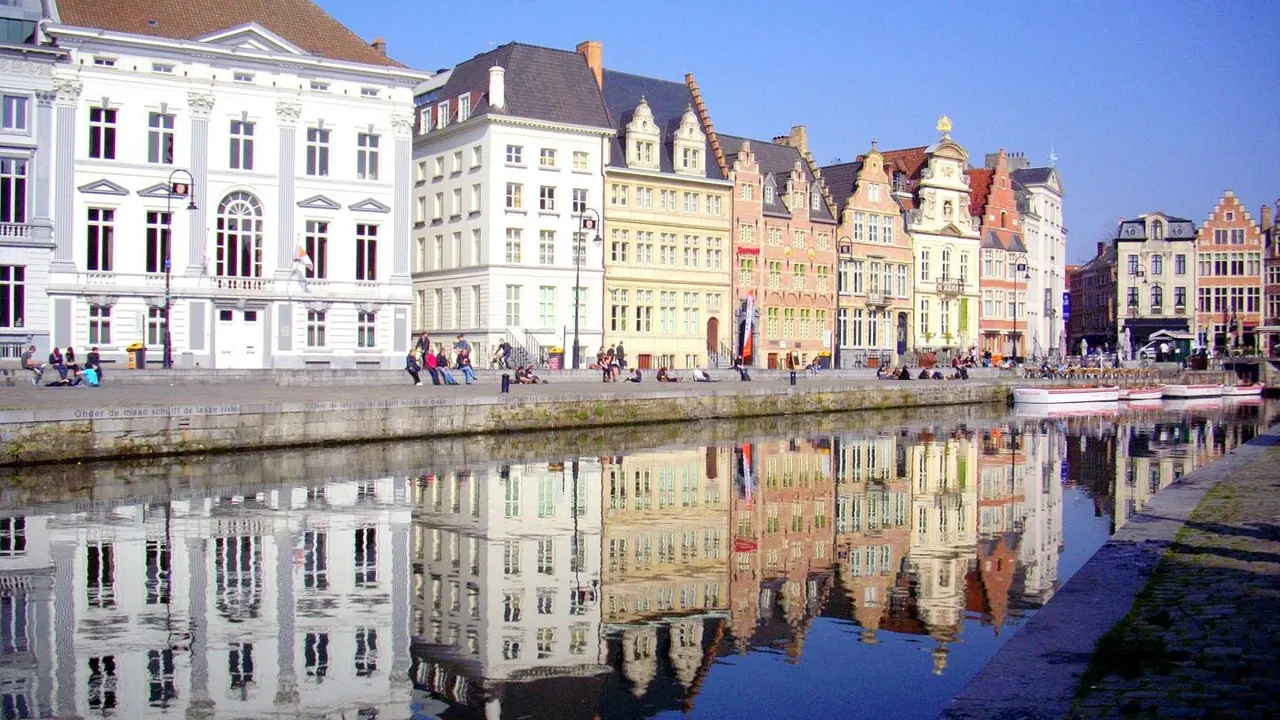
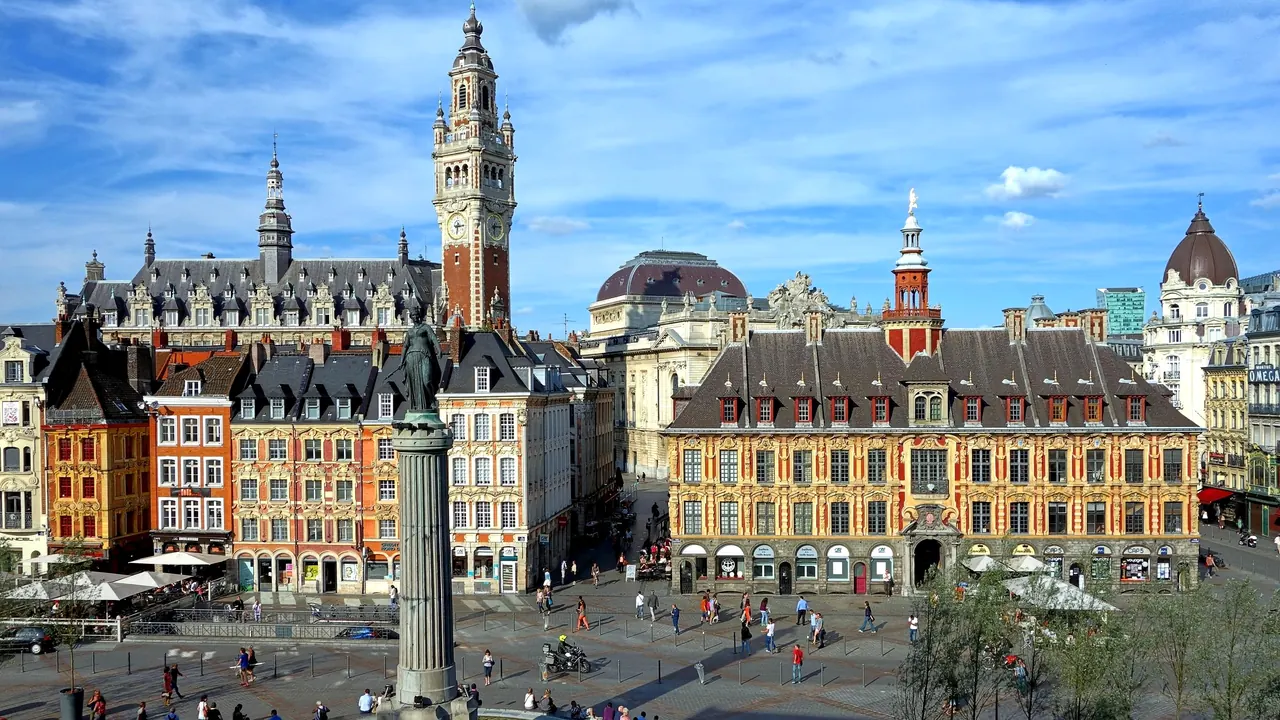
Photos: Ghent by ykeiko, CC BY-SA 3.0, cropped; Lille by Velvet, CC BY-SA 3.0, cropped.
Ghent or Lille?
Our verdict in twelve categories, each scored against the same fixed benchmark cities, and the climate month by month, so you can choose for your trip.
Choose Ghent for
- beaches
- culture and sights
- live music and the arts
Ghent suits the traveller who wants the finer old centre and the stronger art. It has the van Eyck altarpiece, the guildhalls along the Leie, a moated castle in the middle of town, and bolder theatre and concerts in the evening. It is the better choice for a first trip to Flanders where the city itself is the point, with Bruges and Brussels a short train ride away.
Choose Lille for
- prices
- shopping
- day trips
Lille is the cheaper and more practical base, and the better one for shopping. Its two stations stand beside the old town, Paris and Brussels are both within an hour, and London is possible for a long day. Pick it for a French-flavoured weekend of estaminets and the Palais des Beaux-Arts, or for a trip that ranges across northern France and Belgium.
Scoreboard
Twelve categories on one fixed scale from 0 to 100. The shaded stretch is the gap between the two.
Your match
Pick a travel style or drag the sliders, and both match scores follow your weighting.
Too close to call, 1 point apart
Wins on beaches and culture and sights with your weighting.
Wins on prices and shopping with your weighting.
What matters to you?
Category by category
What the scores mean for a trip.
Beaches & swimming
Neither city is a beach destination, but Ghent comes closer. Ostend is about an hour away by train, and the coastal tram links the Belgian resorts. On hot days the Blaarmeersen lake on the city's western edge has supervised swimming without leaving town.
Lille has nothing like that lake. Its nearest sand is Malo-les-Bains at Dunkirk, a windy North Sea beach that suits a bracing walk better than a swim.
Food & drink
Both cities cook from the same Flemish tradition, beer stews and waterzooi included, so the difference is in style. Ghent adds mussels, grey shrimp croquettes and frites in paper cones. It is also unusually good for vegetarians, and its old brown cafés pour long lists of Trappist and lambic beers.
Lille's estaminets are heavier and more French, with potjevleesch, the cheese-drenched welsh and pungent Maroilles in almost everything. Vanilla waffles and the multi-ethnic Sunday market at Wazemmes add a sweeter and more varied side.
Culture & sights
Ghent has the edge here. Its centre is a medieval city still in everyday use, with a moated castle and three great towers lined up in one view from St Michael's Bridge. In St Bavo's Cathedral hangs the van Eyck altarpiece, a painting people cross Europe to see.
Lille's main draw is one great museum, the Palais des Beaux-Arts, set in a handsome Flemish baroque old town. La Piscine and the LaM are well worth the metro or tram ride, but they lie out in the suburbs, while Ghent's highlights are all a few minutes' walk apart.
Nightlife
These are two university cities with much the same kind of night out, but each has its own flavour. In Ghent the student bars are packed into the Overpoort, the old cafés around the Vrijdagmarkt serve strong Belgian beer, and in July the Gentse Feesten turns the centre into a ten-day street party.
In Lille, students fill Rue Masséna and Rue Solférino on Thursdays, and Vieux-Lille adds wine and cocktail bars in brick cellars. For a serious club night, people have traditionally crossed the border into Belgium.
Nature & outdoors
Both cities sit in flat, farmed Flanders, so the outdoors means cycling and easy walking in either. Ghent offers riverside meadows along the Leie and birdwatching at a wetland reserve on its edge. Lille has the large Citadel park on the Deûle, the low Monts de Flandre for a little height, and the Opal Coast cliffs as a long day out.
Day trips
Both are excellent bases, and the difference is the direction they face. Ghent sits in the middle of the Flemish cities. Bruges is under half an hour away, Brussels and Antwerp are close behind, and Ypres and the cobbled Flemish Ardennes are easy to reach.
Lille reaches across two countries. Brussels is about half an hour away by fast train and Paris around an hour, and London works for an ambitious day. On the French side there are Arras, Amiens Cathedral and the Louvre-Lens.
Good for families
Ghent's best offer for children is a real castle: the Gravensteen, with battlements and armour, in the middle of town. Canal boat trips, old toys and games at the House of Alijn and a lake beach at the Blaarmeersen for hot days add to it. In Lille the centre of family life is the Citadel park, with its small zoo, playgrounds and fairground rides, and the hands-on Forum des Sciences is a metro ride away.
Beyond those, neither city is built for children, and the bigger draws are out of town: the zoo in Antwerp from Ghent, and Pairi Daiza and the Nausicaá aquarium from Lille. Cobbles make pushchairs hard work in both old centres.
Getting around
Both centres are flat and walkable, and a car is a nuisance in either. Ghent is a cycling city, with bike streets and rental bikes everywhere, but its main station is a twenty-minute walk from the centre. Lille has an automated metro instead, and its two stations stand right by the old town, which makes day trips quicker to start.
Shopping & style
Lille gives a shopper more to do. Beyond the chains on Rue Neuve and the mall by the stations, Vieux-Lille has independent fashion, delicatessens and the city's few luxury labels. Every September the Braderie turns the streets into a flea market on an enormous scale.
Ghent is pleasant for shopping rather than a reason to go. It has independent design on the Serpentstraat, vintage in the student quarter and flowers on the Kouter on Sundays. Chocolate, cuberdons and the local mustard are the best things to take home.
Affordability
Lille keeps day-to-day costs down. The metro is inexpensive and the main museums take little out of a budget, so a full day of sightseeing stays affordable. Over a whole stay it is comfortable rather than cheap, at about the level of urban France.
Ghent is the dearer of the two, though its walkable centre and cheap trams keep transport costs low. Several churches, St Bavo's Cathedral among them, are free to enter, while the Gravensteen and the museums charge admission. Both cities get pricier in their big festival weeks, when rooms fill for the Gentse Feesten in Ghent in July and for the Braderie in Lille in early September.
Live music & performing arts
Ghent has the more adventurous stages. NTGent's bold, often political productions are known well beyond Belgium, although most are in Dutch. De Bijloke brings early music into a medieval hospital, and the opera house is one half of the Flemish national company.
Lille's season is solid and more conventional. It has the Opéra, a full symphonic season from the Orchestre National de Lille and the Théâtre du Nord, while touring rock and pop acts fill its larger concert venues.
Wellness & relaxation
Neither city is a place to come for spas, but Ghent is the more restful stay, with its enclosed beguinage gardens, slow walks along the Coupure and quiet Sundays. Lille offers tea rooms and terraces in Vieux-Lille. Its one real thermal bath is out of town at Saint-Amand-les-Eaux, a short train ride away.
When should you go?
Pick your month. The climate figures are measured averages, not a forecast.
Ghent in July
Lille in July
Daytime high, °C
Rainfall in the month, mm
Where the figures come from
Ghent has no rain gauge within 25 km of the centre, so its rainfall comes from a gridded climate dataset read at the city rather than from a gauge further away.
Ghent's sunshine is measured 45 km from the centre, at Vlissingen.
Temperature and rainfall are climate normals, averaged over the years shown. Ghent: 2009-2025 (sunshine 1991-2020, rainfall 1991-2020) normals, Melle / Kalverhaag (10.1 km from centre). Lille: 1991-2020 normals, Lille (7.8 km from centre).
The two cities share the same mild, damp north-western climate. May to September are the comfortable months for walking the streets in either, with summer highs of about 23°C in Ghent and 24°C in Lille, so it is warm but rarely hot. Winter in both is grey and cool, and the short days are better spent in museums and cafés than outdoors.
Ghent gets more sunshine than Lille in every month, and its long, bright days in May and June make late spring its best time. It is also the wetter city for most of the year, with rain building through autumn to about 87mm in December. The North Sea off the Flemish coast is warmest in August at about 19°C, so a beach day only makes sense in high summer, and even then it is a gamble. Lille is drier than Ghent from June right through the winter, though wetter in May. Its sunniest months are June and July, and April, its driest month, suits a spring visit well.
Which traveller are you?
On a culture and arts trip, Ghent is the stronger choice. It has the Ghent Altarpiece, the Gravensteen and the Graslei guildhalls within a short walk, and NTGent, the opera house and De Bijloke give its evenings more character than Lille's dependable programme.
On a trip on a tight budget, Lille makes the money go further. Hotel rooms are reasonable outside the Braderie and the trade fairs, and estaminet meals and beer are fairly priced. Ghent's Belgian prices make sit-down dinners with a few beers add up quickly.
For a shopping trip, Lille has more range. There are chains on Rue Neuve, independent design and delicatessens in Vieux-Lille, the Wazemmes market on Sundays and the vast Braderie in September. Ghent's side streets and markets are pleasant, but are best for edible souvenirs.
Before you go
| Measure | Ghent | Lille |
|---|---|---|
| Official language | French, German, Dutch | French |
| Currency | Euro (EUR) | Euro (EUR) |
| Sockets | CE230 V, 50 Hz | CE230 V, 50 Hz |
| Driving side | Right | Right |
| Time zone | UTC+1, UTC+2 in summer | UTC+1, UTC+2 in summer |
| Emergency number | 112 | 112 |
| Elevation | 12 m | 17 m |
| Main airport | Brussels Airport (BRU)56 km from centre191 non-stop destinations | Lille Airport (LIL)8 km from centre61 non-stop destinations |
| Public holidays this year | 14 days | 11 days |
By the numbers
| Measure | Ghent | Lille |
|---|---|---|
| City population | 272,657 | 238,246 |
| People per km² | 1,728 | 6,846 |
| Museums within 10 km | 30 | 23 |
| UNESCO World Heritage sites within 50 km | 5 | 6 |
| Swim season, months above 21 °C | None | - |
Where else could you go?
Every comparison below shares a destination with this one, so you can follow Ghent or Lille somewhere new.