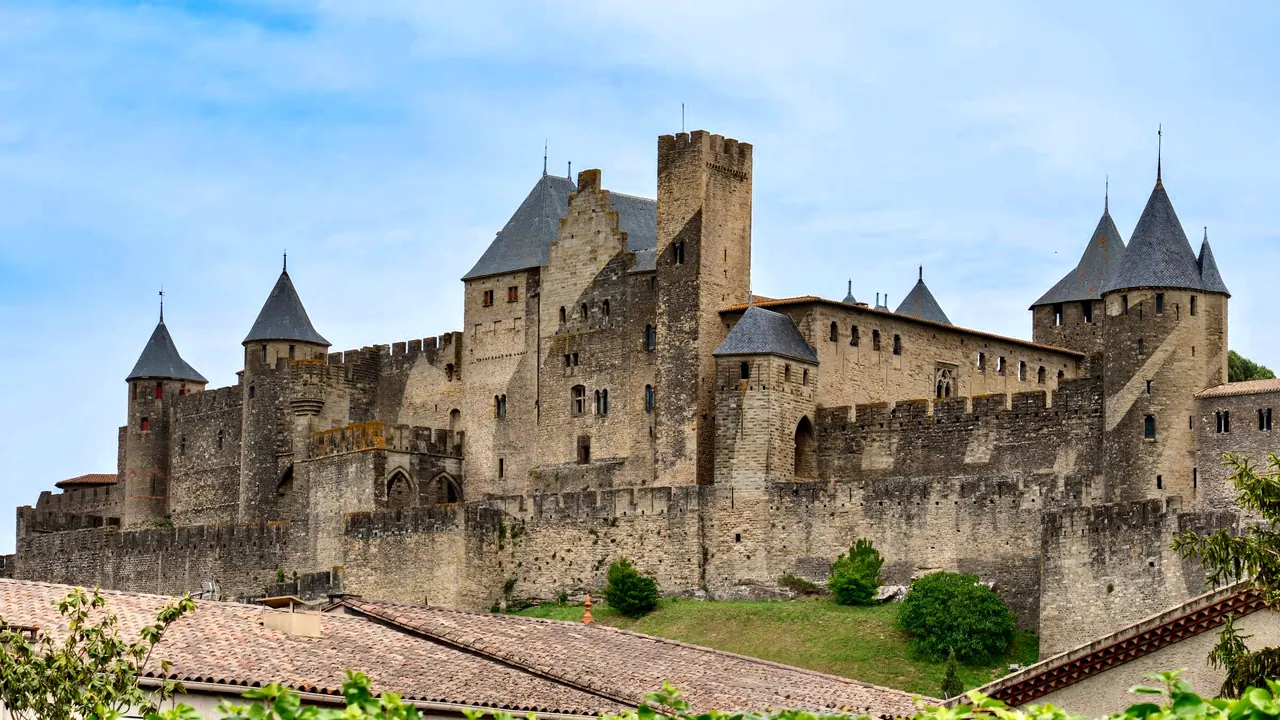
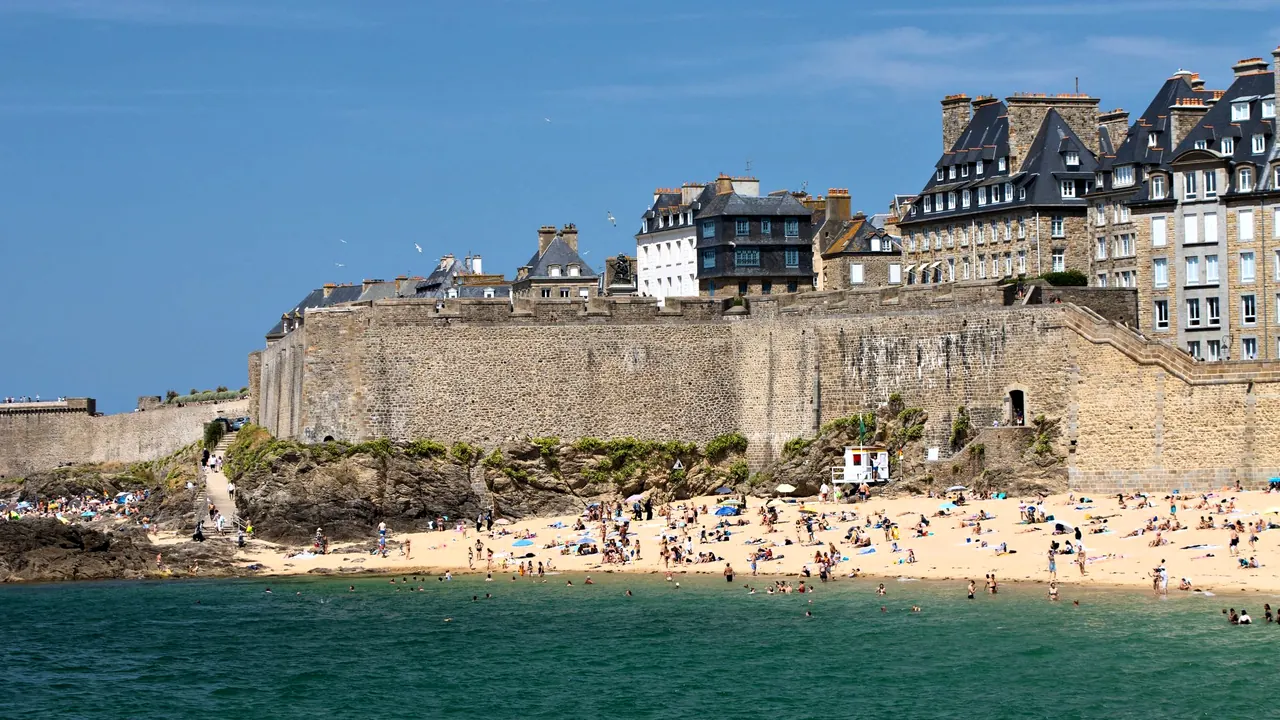
Photos: Carcassonne by Susanne Jutzeler, suju-foto, Pexels License; Saint-Malo by Efrem Efre, Pexels License.
Carcassonne or Saint-Malo?
Our verdict in twelve categories, each scored against the same fixed benchmark cities, and the climate month by month, so you can choose for your trip.
Choose Carcassonne for
- culture and sights
- prices
- live music and the arts
Carcassonne suits travellers who want history first. La Cité's double ring of walls, the Basilica of Saint-Nazaire and the Cathar castles on the ridges to the south make for richer sightseeing than anything on this stretch of the Breton coast. It is also the gentler of the two on the wallet. It works best as a base with a hire car for a sunny southern trip of wine country and cassoulet, as long as you accept that the sea is an hour away and the evenings are quiet.
Choose Saint-Malo for
- wellness
- beaches
- getting around
Saint-Malo is the choice for a seaside vacation with a walled town attached. The beaches begin at the foot of the ramparts, and the coastal path and the huge tides give walkers more to do. The seawater pools of its thalasso tradition make it the more restful stay. Families also find it easier, with sand, sea pools and island forts to explore on foot, though the Channel stays cool and rooms cost more in high summer.
Scoreboard
Twelve categories on one fixed scale from 0 to 100. The shaded stretch is the gap between the two.
Your match
Pick a travel style or drag the sliders, and both match scores follow your weighting.
Wins on culture and sights and prices with your weighting.
Wins on wellness and beaches with your weighting.
What matters to you?
Category by category
What the scores mean for a trip.
Beaches & swimming
Carcassonne is inland. Swimming means the lifeguarded lake at Cavayère, or a drive of about an hour to the long Mediterranean sands at Gruissan and Narbonne-Plage, where the sea is warmer but the beach is a day out rather than part of daily life.
Saint-Malo has the beach on its doorstep, which is why it comes out ahead. The Sillon runs for about 3km from the walls, the tidal pool at Bon-Secours lets you swim even at low water, and Dinard's sheltered coves are a short boat ride away. The catch is the Channel, which is cool enough that most people swim only briefly.
Food & drink
The two eat about as well as each other, but in very different ways. Carcassonne is inland and its cooking is hearty and meaty, built around cassoulet of beans, duck and sausage. Its real strength is the wine from the surrounding vineyards: Corbières, Minervois and sparkling blanquette from Limoux.
Saint-Malo means buckwheat galettes, dry cider, salted butter and seafood, with Cancale's oysters a short drive along the bay. In both towns the walled centre is the place to avoid for a good meal. Eat in the Bastide around Place Carnot in Carcassonne, and in Saint-Servan or towards Cancale in Saint-Malo.
Culture & sights
Carcassonne has the greater monument. La Cité, with its fifty-two towers, the Château Comtal and the Gothic stained glass of Saint-Nazaire, is a sight of European rank. The Bastide Saint-Louis and the Canal du Midi add a second layer of history below the hill.
Saint-Malo's ramparts make a fine circuit, but most of the town inside was rebuilt after 1944, and its corsair history lives more in statues and street names than in old buildings. The low-tide walks out to Fort National and to Chateaubriand's grave on the Grand Bé are the memorable part. Neither town has much in the way of museums.
Nightlife
Neither town is for a big night out, but Saint-Malo has a little more going on. In summer its pubs and Irish-style bars inside the walls fill with sailors and young visitors, and a few stay open late at weekends.
Carcassonne's evenings are calmer still: a walk on the floodlit walls, a glass of wine on a terrace, or the bars around Place Carnot. For clubs, people go from Carcassonne to Toulouse or Montpellier, and from Saint-Malo to Rennes.
Nature & outdoors
Carcassonne has more varied country around it: beech forest in the Montagne Noire, garrigue and castle ridges in the Corbières, and rafting in the Aude gorges. Almost all of it needs a car, and the flat, shaded towpath of the Canal du Midi is the only easy option from town.
Saint-Malo puts the outdoors within easier reach and offers more of it. The GR34 coastal path runs from the town towards Pointe du Grouin and the cliffs of the Emerald Coast. The Rance suits kayaks and bikes, the bay draws sailors and kitesurfers, and tides of up to about 13m uncover the vast flats towards Mont-Saint-Michel. Inland, though, it is flat farmland.
Day trips
Both are excellent bases, with a different flavour. From Carcassonne the trips head south and east: Peyrepertuse and Quéribus on their ridges, Lastours, Lagrasse and Minerve, Toulouse by train, and wine estates offering tastings in the Corbières and Minervois.
From Saint-Malo the trips are Breton and Norman: Mont-Saint-Michel, half-timbered Dinan, Dinard by boat, Rennes by train and, in summer, ferries to Jersey. In both, a car opens up far more than public transport does.
Good for families
Carcassonne gives children a real castle, with drawbridges, plus jousting and falconry in summer, and adds the lake beach and a water park. But the Cité is steep, cobbled and hot at midday in July and August, and hard going with a pushchair.
Saint-Malo is the easier town for families. Sandcastles, the sea pool at Bon-Secours, walks out to the island forts and the Grand Aquarium for wet days can fill a week without a car. Parents need to watch the fast tides, though, and the water is chilly for small swimmers.
Getting around
Carcassonne's Bastide is flat and easy, but reaching the Cité means a walk of about twenty-five minutes across the Pont Vieux and uphill, with a shuttle bus only in season. Trains to Toulouse and Narbonne are good, but buses to the castles and villages are not much use.
Saint-Malo is simpler to manage without a car. The seafront promenade links the walls to Paramé on foot, local buses cover the town, a passenger boat crosses to Dinard and high-speed trains run direct to Rennes and Paris. Beyond the town, buses are thin here as well.
Shopping & style
Neither is a shopping destination. In Carcassonne the lanes of the Cité lean heavily on plastic swords and Cathar trinkets, and the best buys are edible: tinned cassoulet, blanquette from Limoux and Corbières wine.
Saint-Malo has more worth taking home: striped sailor tops, faience, marine prints and a few galleries, plus its famous salted butter and the cheesemongers. For fashion, people still go to Rennes.
Affordability
Carcassonne is the cheaper stay. It is priced like a provincial town in the south, with cheap local wine and good set lunches. The extra costs are hotels and restaurants inside the Cité walls, and the hire car most visitors need.
Saint-Malo is priced like a popular resort, and rooms near the walls and the beach are expensive and book up early in summer. Galettes and set lunches keep meals reasonable, but seafood platters do not. Both towns are much better value in spring and autumn.
Live music & performing arts
Both are quiet for most of the year and come alive around their festivals. Carcassonne's July festival has the more striking stage, an open-air theatre inside the Cité walls, and Bastille Day brings fireworks over the ramparts.
Saint-Malo spreads its events more widely: La Route du Rock for indie music, Étonnants Voyageurs for books, Quai des Bulles for comics, and organ concerts in the cathedral. For opera, Carcassonne looks to Toulouse and Saint-Malo to Rennes.
Wellness & relaxation
Saint-Malo is clearly the better place for rest, and the two towns offer quite different kinds of it. Carcassonne has no baths or bathing culture. The old spa villages up the Aude valley serve local people rather than visitors. Rest here is informal: a long lunch in the Bastide, an unhurried stretch of canal and the walls once the day visitors have gone, and it works best in spring and autumn.
In Saint-Malo, rest can be the whole point of the trip. It is one of the classic French towns for thalassotherapy, so a stay can be planned around seawater treatments and hydrotherapy. Dinard, across the estuary, keeps the same tradition, and locals take a cold morning dip in the sea pools. As in Carcassonne, August is crowded, but from autumn through winter the town slows right down.
When should you go?
Pick your month. The climate figures are measured averages, not a forecast.
Carcassonne in July
Saint-Malo in July
Daytime high, °C
Rainfall in the month, mm
Where the figures come from
Carcassonne has no rain gauge within 25 km of the centre, so its rainfall comes from a gridded climate dataset read at the city rather than from a gauge further away.
Carcassonne's sunshine is measured 68 km from the centre, at Perpignan.
Saint-Malo has no rain gauge within 25 km of the centre, so its rainfall comes from a gridded climate dataset read at the city rather than from a gauge further away.
Saint-Malo's sunshine is measured 68 km from the centre, at Rennes.
Temperature and rainfall are climate normals, averaged over the years shown. Carcassonne: 1999-2020 (sunshine 1991-2020, rainfall 1991-2020) normals, Carcassonne (2.8 km from centre). Saint-Malo: 2002-2020 (sunshine 1991-2020, rainfall 1991-2020) normals, Dinard (7.9 km from centre).
Carcassonne has a southern summer. July and August reach about 29°C with long sunny days and little rain. That suits the lake and trips to the Mediterranean but makes climbing the ramparts at midday hard work. May, June and September are the most comfortable months for walking the Cité and the hills. October to December bring the wettest weather and cool, grey days.
Saint-Malo stays mild all summer, with highs of around 22°C, and gets noticeably less sunshine than Carcassonne in every month. The sea is coldest in spring and warmest in August and September at about 18°C, so swims are brisk even then. Late spring is dry and bright enough for the coastal path, while autumn and winter turn wet, with December the rainiest month at around 97mm.
Which traveller are you?
For a culture and arts trip, Carcassonne is the stronger pick. La Cité, the walk along the ramparts of the Château Comtal and the stained glass of Saint-Nazaire, with the Bastide's Gothic churches below, give more to see than Saint-Malo's rebuilt walled town.
On a relaxing and wellness trip, Saint-Malo wins clearly. Its thalasso centre on the seafront, heated seawater pools and long low-tide walks on empty sand make a restful break. Carcassonne has only hotel spas and small thermal villages an hour away.
On a tight budget, Carcassonne goes further. Provincial prices, cheap local wine and good set lunches in the Bastide beat Saint-Malo's resort pricing, as long as you sleep outside the Cité walls and avoid July and August in either town.
Before you go
| Measure | Carcassonne | Saint-Malo |
|---|---|---|
| Official language | French | French |
| Currency | Euro (EUR) | Euro (EUR) |
| Sockets | CE230 V, 50 Hz | CE230 V, 50 Hz |
| Driving side | Right | Right |
| Time zone | UTC+1, UTC+2 in summer | UTC+1, UTC+2 in summer |
| Emergency number | 112 | 112 |
| Elevation | 81 m | 0 m |
| Main airport | Carcassonne Salvaza Airport (CCF)4 km from centre10 non-stop destinations | Rennes-Saint-Jacques Airport (RNS)68 km from centre15 non-stop destinations |
| Public holidays this year | 11 days | 11 days |
By the numbers
| Measure | Carcassonne | Saint-Malo |
|---|---|---|
| City population | 46,080 | 47,439 |
| People per km² | 708 | 1,296 |
| Museums within 10 km | 6 | 3 |
| UNESCO World Heritage sites within 50 km | 2 | 2 |
| Swim season, months above 21 °C | - | None |
Where else could you go?
Every comparison below shares a destination with this one, so you can follow Carcassonne or Saint-Malo somewhere new.
- Toulousevs Carcassonne
- Andorra la Vellavs Carcassonne
- Montpelliervs Carcassonne
- Gironavs Carcassonne
- Nantesvs Saint-Malo
- Arlesvs Carcassonne