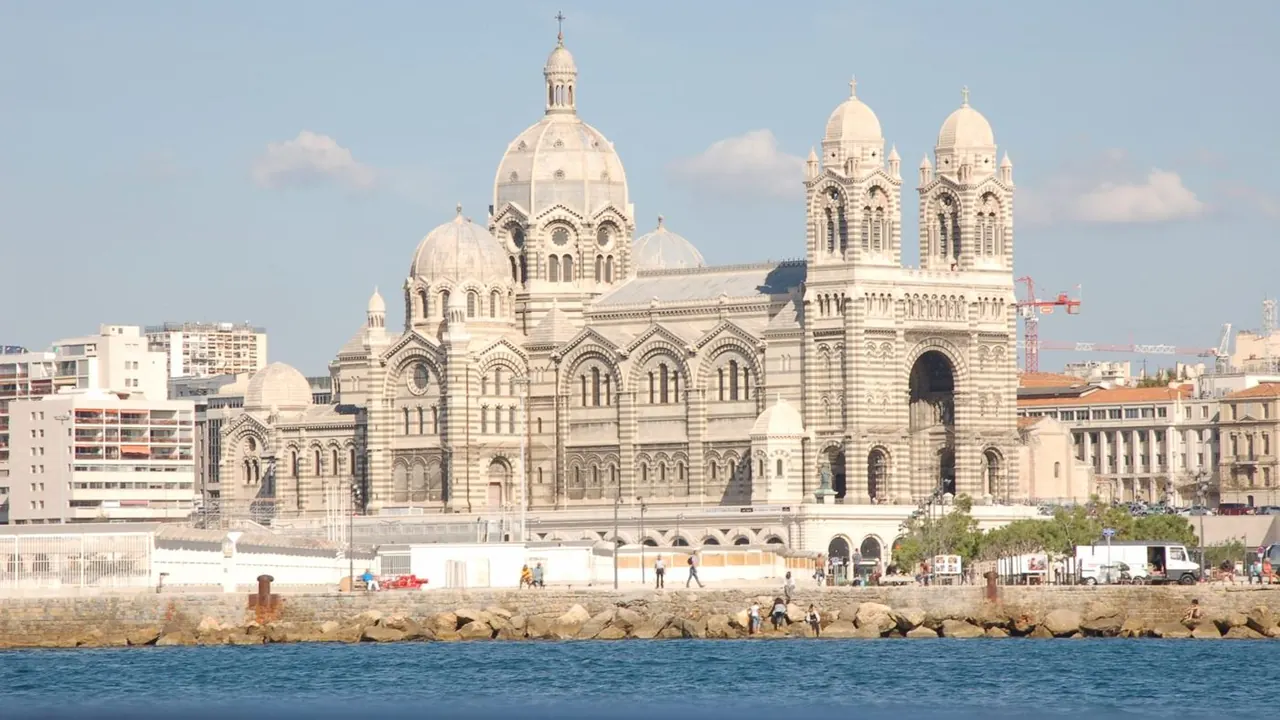
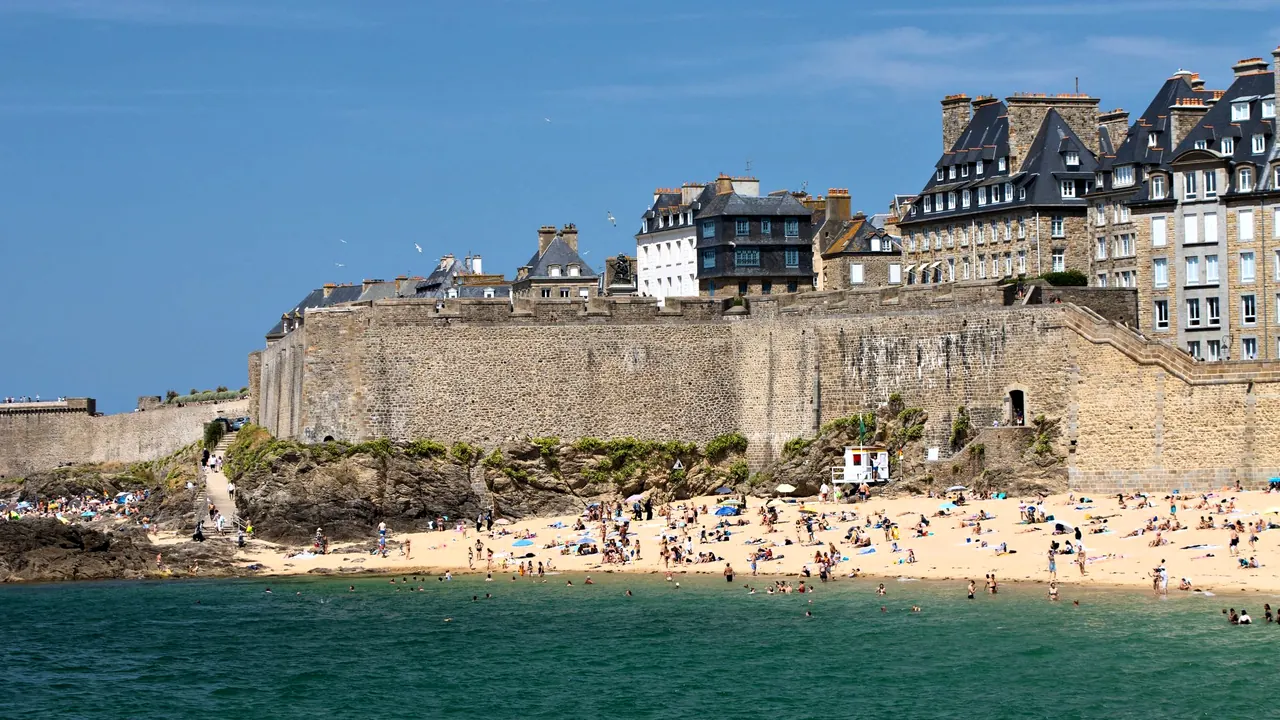
Photos: Marseille by Charlotte Noblet, CC BY-SA 3.0, cropped; Saint-Malo by Efrem Efre, Pexels License.
Marseille or Saint-Malo?
Our verdict in twelve categories, each scored against the same fixed benchmark cities, and the climate month by month, so you can choose for your trip.
Choose Marseille for
- nightlife
- live music and the arts
- culture and sights
Marseille is the choice for travellers who want a big, rough-edged Mediterranean port with wild coast on its doorstep. You get warmer water, the Calanques for walking and swimming, a food scene that runs from Noailles market stalls to bouillabaisse on the Corniche, late terraces around Cours Julien, and Aix, Arles and Avignon an easy train ride away. It rewards energy and curiosity more than calm.
Choose Saint-Malo for
- wellness
- families
- getting around
For a gentler seaside break, especially with children or with rest in mind, Saint-Malo is easier going. The walled town is compact and safe, the tides turn the beaches into a playground, and the seafront thalasso gives you a proper reason to slow down. In return you accept cold Channel water, quiet evenings and a narrower list of sights and restaurants.
Scoreboard
Twelve categories on one fixed scale from 0 to 100. The shaded stretch is the gap between the two.
Your match
Pick a travel style or drag the sliders, and both match scores follow your weighting.
Wins on nightlife and live music and the arts with your weighting.
Wins on wellness and families with your weighting.
What matters to you?
Category by category
What the scores mean for a trip.
Beaches & swimming
Marseille offers warmer water and much more variety. There are the broad Prado beaches of shingle and imported sand for an easy family day, the rocky Corniche inlets such as the Vallon des Auffes for a quick dip, and the turquoise Calanques, which take half a day to reach on foot or by boat. The catches are the mistral, which can chill the sea overnight, and the occasional beach closure after heavy rain.
Saint-Malo's beaches are wide sand right under the walls. The tides double their size at low water, and the walled pool at Bon-Secours lets you swim even when the sea is out. Channel water keeps swims brief, though, and the more sheltered, prettier beaches are across the estuary at Dinard.
Food & drink
Marseille has the richer and more varied table. It eats like the Mediterranean crossroads it is, with Comorian, Armenian and North African grocers in Noailles, chickpea panisses and wood-fired pizza on the street, fish sold on the Vieux-Port quay each morning, and a serious high-end tier built around the sea. The weak spot is the tired set menus around the old port.
Saint-Malo does one thing well: Breton cooking and shellfish. Galettes with cider, kouign-amann, and oysters at the harbour wall in Cancale are real pleasures. Beyond that the range is narrow, the crêperies inside the walls vary a lot, and there is little foreign food.
Culture & sights
Marseille has far more to see, and it goes back much further. Over 2,600 years of history are scattered through a working city: Notre-Dame de la Garde on its hill, the forts and the MuCEM at the harbour mouth, the Vieille Charité in Le Panier, the crypts of Saint-Victor and Le Corbusier's Cité Radieuse. You can fill several days.
Saint-Malo's appeal is one complete picture rather than a long list. You walk the ramparts round the rebuilt granite town and cross the sand at low tide to Chateaubriand's grave on the Grand Bé. It makes a lovely day, but there are no serious museums.
Nightlife
This is one of the widest gaps between the two. Marseille goes out late and informally, on the streets and terraces of Cours Julien, La Plaine and the Vieux-Port, with warehouse electronic nights and rooftop or seaside parties in summer. Some central streets feel edgy late at night, so a taxi home is wise.
Saint-Malo has a handful of pubs and wine bars inside the walls. They liven up with sailors and young visitors in July and August, and outside summer the town goes quiet early. For clubs you would have to go to Rennes.
Nature & outdoors
Both are coastal walking country, but Marseille's is wilder. The Calanques national park starts in its southern suburbs, with white limestone ridges, pine gullies and deep blue inlets like Sugiton and En-Vau. It is also known for sport climbing, kayaking and diving, and Sainte-Victoire and the Sainte-Baume are within an hour. Summer heat and fire closures make spring and autumn the seasons for it.
Saint-Malo is about tides and open coast. You can follow the GR34 to Pointe du Grouin or Cap Fréhel, kayak the Rance, kitesurf the long beaches and watch seals and seabirds. Inland it is flat farmland, so there is nothing like Provence's hills.
Day trips
Provence opens up in every direction from Marseille. Cassis and its cliffs are very close, Nîmes and the Pont du Gard make a long day, and a car brings in the hilltop villages of the Luberon, Les Baux and Saint-Rémy, the Bandol wine estates and the little harbours of the Côte Bleue. The main towns are on the regional railway as well, so even without a car you have more choices than Saint-Malo offers.
From Saint-Malo the headline trip is Mont-Saint-Michel, about an hour's drive away. Medieval Dinan, Dinard across the estuary by boat, Cancale's oyster port and Rennes are all nearby, and in summer there are ferries to Jersey. It is a good list but a shorter one, and most of it is easier by car.
Good for families
Saint-Malo is clearly the easier place for children. Sandcastles on wide beaches, jumping into the Bon-Secours pool, pirate stories on the ramparts and the Grand Aquarium keep a family busy without much effort. You do need to watch the fast incoming tides and the cold water.
Marseille can work if you base yourself near the Prado beaches and Parc Borély and add boat trips to the Frioul islands. Away from there, traffic, narrow pavements, steep streets and summer heat make a day with a buggy hard going, and the museums are aimed at adults.
Getting around
Neither is hard to manage, but they work differently. Marseille is a sprawling city with a metro, trams and small ferries. The centre is walkable if steep, but the beaches and Calanques trailheads mean slow buses through traffic.
Saint-Malo is small enough to walk. A promenade runs from the walls to the long beach, there is a boat to Dinard, and high-speed trains go to Paris. Rural buses are thin, so the countryside around it is car territory.
Shopping & style
Marseille gives you more to browse. Noailles packs fabrics, spices and North African goods into its narrow streets, Le Panier has santon workshops and independent boutiques, and Rue Paradis and La Joliette add department stores and chains. Designer shopping is still thin.
In Saint-Malo, shopping means Breton specialities: striped sailor tops, salted-butter caramels, cider, faience and good cheese and butter. For anything more you go to Rennes.
Affordability
Costs come out broadly similar, but the savings are in different places. In Marseille, cheap everyday eating like pizza, market food and North African snacks, free walks in the Calanques and low museum fees keep the bill down, while rooms near the port and beaches climb in summer.
Saint-Malo is priced as a resort, and rooms inside the walls are dear in July and August. Galettes and set lunches are fair, though, and the town is much better value in spring and autumn.
Live music & performing arts
On an ordinary evening, Marseille gives you a real choice. There is opera at the art deco Opéra, drama at the Théâtre de la Criée and contemporary dance and concerts at the Friche la Belle de Mai, and the city is known for hip-hop and world music. The Festival de Marseille in summer and the Fiesta des Suds in autumn add to that.
Saint-Malo's cultural life comes mostly through its festivals: La Route du Rock, Étonnants Voyageurs and Quai des Bulles. Outside those dates there is little beyond the town theatre and the odd concert in the cathedral.
Wellness & relaxation
Saint-Malo is the place to unwind. It is one of France's classic thalassotherapy towns, with heated seawater pools and treatments on the Sillon seafront, and out of season a walk on the empty sand at low tide followed by an afternoon of pools is about as restful as it gets.
Marseille has a few local hammams and some hotel spas, but the city is loud and dense. Rest there means a long harbour lunch on the Corniche, or staying in Cassis and coming into the city for the day.
When should you go?
Pick your month. The climate figures are measured averages, not a forecast.
Marseille in July
Saint-Malo in July
Daytime high, °C
Rainfall in the month, mm
Where the figures come from
Saint-Malo has no rain gauge within 25 km of the centre, so its rainfall comes from a gridded climate dataset read at the city rather than from a gauge further away.
Saint-Malo's sunshine is measured 68 km from the centre, at Rennes.
Temperature and rainfall are climate normals, averaged over the years shown. Marseille: 1991-2020 normals, Marseille / Marignane (20.6 km from centre). Saint-Malo: 2002-2020 (sunshine 1991-2020, rainfall 1991-2020) normals, Dinard (7.9 km from centre).
Marseille has a long, hot, dry summer. From June to September the sea is warm enough for real swimming, reaching about 22°C in August. In July, though, highs near 31°C make walking the streets at midday hard work, so the city and the Calanques paths are at their best in April, May and late September into October. Rain arrives with the autumn, and September to November are the wettest months. Winters are mild and still get a fair amount of sun.
Saint-Malo never gets hot. Summer highs sit around 22°C, which is comfortable for walking the ramparts, but the sea only reaches about 18°C at its warmest, so July and August are the only beach months and most swims are short. From October the weather turns grey and wet, with about 97mm of rain in December, and Saint-Malo gets far less sunshine than Marseille in every month of the year.
Which traveller are you?
For a food and nightlife trip, Marseille wins easily. You can eat your way through Noailles, spend an afternoon on bouillabaisse by a Corniche harbour, then move on to the graffiti-covered bars of Cours Julien. Saint-Malo's evenings end with a drink after dinner.
On a family trip with children, Saint-Malo is the easier choice. Wide sandy beaches, the sea pool at Bon-Secours, walks out to the island forts at low tide and the Grand Aquarium for wet days all sit close together, while Marseille's traffic, steep streets and heat wear families out.
For a relaxing and wellness trip, choose Saint-Malo. Its seafront thalasso centre and long tradition of seawater cures make a restful weekend, best in spring or autumn. Marseille has no real spa culture, and the city is loud and intense.
Before you go
| Measure | Marseille | Saint-Malo |
|---|---|---|
| Official language | French | French |
| Currency | Euro (EUR) | Euro (EUR) |
| Sockets | CE230 V, 50 Hz | CE230 V, 50 Hz |
| Driving side | Right | Right |
| Time zone | UTC+1, UTC+2 in summer | UTC+1, UTC+2 in summer |
| Emergency number | 112 | 112 |
| Elevation | 0 m | 0 m |
| Main airport | Marseille Provence Airport (MRS)21 km from centre126 non-stop destinations | Rennes-Saint-Jacques Airport (RNS)68 km from centre15 non-stop destinations |
| Public holidays this year | 11 days | 11 days |
By the numbers
| Measure | Marseille | Saint-Malo |
|---|---|---|
| City population | 886,040 | 47,439 |
| People per km² | 3,683 | 1,296 |
| Museums within 10 km | 27 | 3 |
| UNESCO World Heritage sites within 50 km | 1 | 2 |
| Swim season, months above 21 °C | 2 months | None |
Where else could you go?
Every comparison below shares a destination with this one, so you can follow Marseille or Saint-Malo somewhere new.
- Aix-en-Provencevs Marseille
- Arlesvs Marseille
- Avignonvs Marseille
- Saint-Tropezvs Marseille
- Montpelliervs Marseille
- Cannesvs Marseille