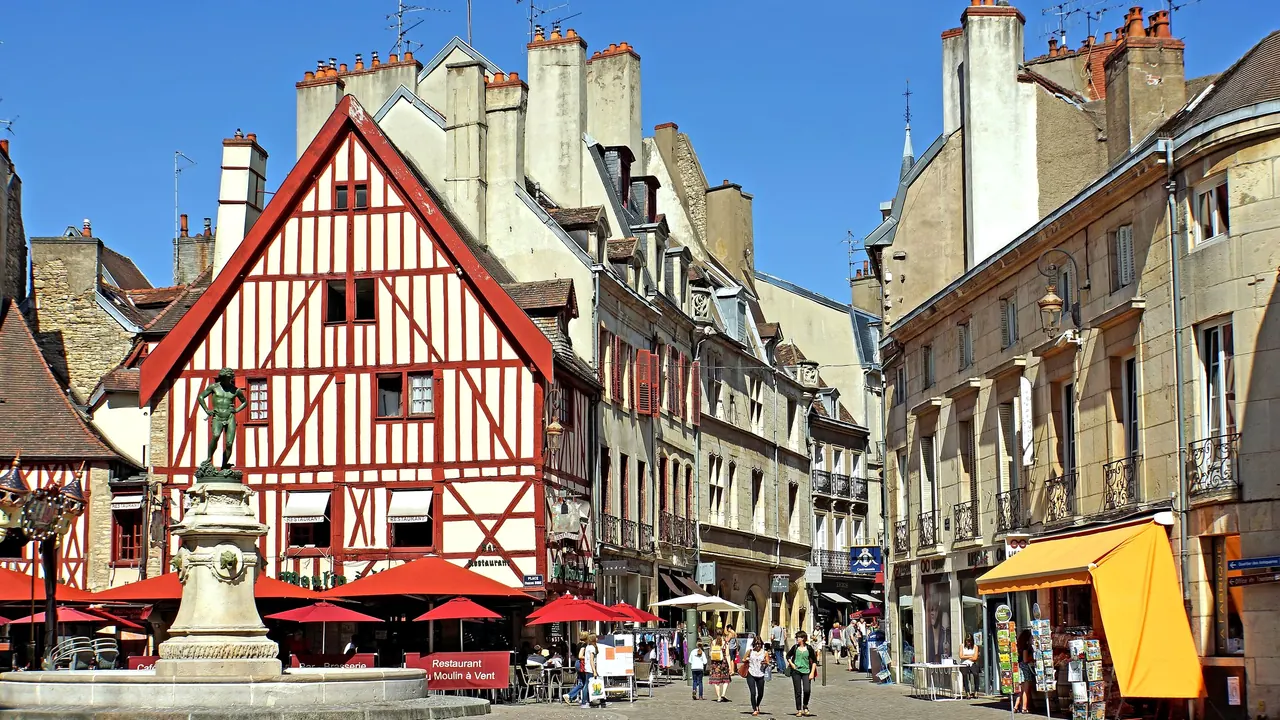
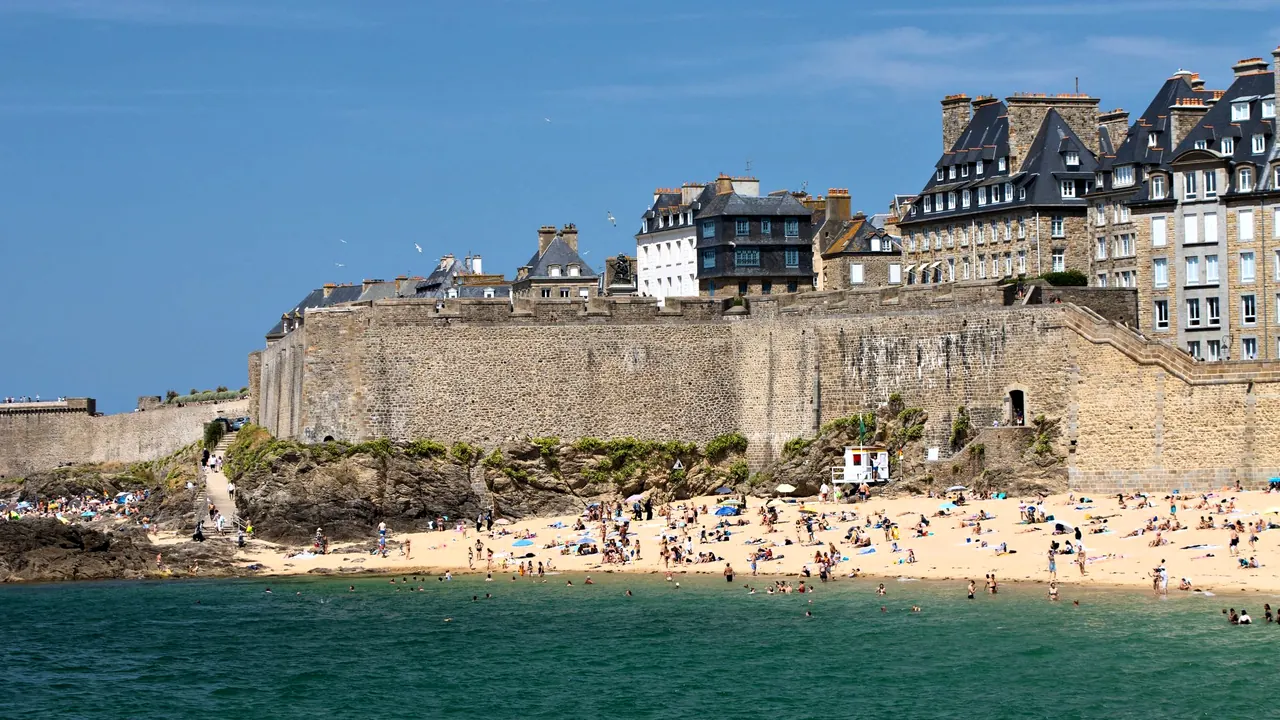
Photos: Dijon by Dennis G. Jarvis, CC BY-SA 2.0, cropped; Saint-Malo by Efrem Efre, Pexels License.
Dijon or Saint-Malo?
Our verdict in twelve categories, each scored against the same fixed benchmark cities, and the climate month by month, so you can choose for your trip.
Choose Dijon for
- culture and sights
- food and drink
- live music and the arts
Dijon suits travellers who plan a trip around the table and the cellar. It has the deeper food and wine culture, the dukes' palace and its museum, a proper opera season and the Burgundy vineyards starting at the edge of town. The compact centre is easy to cross on foot, the fast train from Paris makes it easy to reach, and it is the cheaper of the two places to stay.
Choose Saint-Malo for
- beaches
- wellness
- families
Choose Saint-Malo if you want the sea in front of you. The walled town opens straight onto long beaches with enormous tides, and the coastal path runs off in both directions. Its seawater thalasso tradition also makes it the better place to unwind. Children get sandcastles, island forts and pirate stories, which Dijon cannot match, though the Channel stays cool even in high summer.
Scoreboard
Twelve categories on one fixed scale from 0 to 100. The shaded stretch is the gap between the two.
Your match
Pick a travel style or drag the sliders, and both match scores follow your weighting.
Too close to call, 1 point apart
Wins on culture and sights and food and drink with your weighting.
Wins on beaches and wellness with your weighting.
What matters to you?
Category by category
What the scores mean for a trip.
Beaches & swimming
Here there is no real contest. Dijon is hours from any coast. Swimming there means the supervised lawn-and-sand area at Lac Kir or a municipal pool, which is fine on a hot afternoon but no reason to travel.
Saint-Malo has the Grand Plage du Sillon running for about 3km from the walls, coves under the ramparts and the tidal pool at Bon-Secours. The catch is the Channel water, which stays cool even in August, so expect more time on the sand than in the sea.
Food & drink
Dijon is the stronger food city, set at the head of Burgundy's wine country. Boeuf bourguignon, jambon persillé, Époisses from Les Halles and village Burgundies by the glass give its meals real depth. The Cité de la Gastronomie in the old hospital adds tastings and cookery.
Saint-Malo eats from the sea instead: galettes with cider, Cancale oysters at the harbour stalls and seafood platters. It can be very good, especially in Saint-Servan and towards Cancale, but the walled town is full of crêperies aimed at day visitors and quality is uneven. Neither city offers much international cooking.
Culture & sights
Dijon has more to see and more history behind it. As the old capital of the dukes of Burgundy, it has their palace with one of France's oldest museums and the Valois tombs. Add Notre-Dame's gargoyles and lucky owl, Sluter's Well of Moses and streets of half-timbered and Renaissance houses.
In Saint-Malo the walled town itself is the attraction: the circuit of the ramparts, the corsair history and the low-tide crossing to Chateaubriand's grave on the Grand Bé. It fills a good day, but much of the town was rebuilt after 1944 and there are few museums worth seeking out.
Nightlife
Neither is a night-out city, but Dijon's university gives it a little more life after dark. The small bars on Rue Berbisey and the terraces around Place Émile Zola stay busy in term time, and there are a few clubs. In Saint-Malo an evening means a pub or wine bar inside the walls, lively on summer weekends and quiet early the rest of the year, and clubbing means going to Rennes.
Nature & outdoors
Saint-Malo has the more striking outdoors. The GR34 coastal path leads to Pointe du Grouin and the cliffs of the Emerald Coast, and the tides rise as high as about 13m. The bay is good for sailing and kitesurfing, and for watching seals and seabirds.
Dijon's countryside is gentler. There is walking and climbing in the combes just west of town, flat cycling along the Burgundy Canal towpath and the vineyard route to Beaune. The Morvan's lakes and granite hills are the wildest country within reach.
Day trips
Both make excellent bases, and the difference is in the kind of trip. From Dijon the trips are about wine and abbeys: the Route des Grands Crus to Beaune, Fontenay Abbey, Semur-en-Auxois and Vézelay, with Beaune and Besançon easy to reach by train.
From Saint-Malo they mix sea and stone: Mont-Saint-Michel, medieval Dinan, Dinard by boat, Cancale's oyster port and Rennes by train, plus ferries to Jersey in summer. From either base, a car opens up most of the list.
Good for families
Saint-Malo is far easier to fill with children. Beaches, the Bon-Secours sea pool, forts you can walk out to at low tide, pirate stories on the ramparts and the Grand Aquarium for rainy days give plenty to do, as long as you watch the fast tides.
Dijon is safe and calm, with a planetarium in the Jardin de l'Arquebuse, play areas in the Parc de la Colombière and paddling at Lac Kir. Beyond those, though, most of what there is to do revolves around wine and fine art.
Getting around
Both have direct high-speed trains to Paris and historic cores you can cross on foot in minutes, so the difference lies in what happens once you leave the centre. That is where Dijon pulls ahead. Its trams and buses reach the outskirts and Lac Kir, and trains running south along the wine route put Beaune about twenty minutes away, so much of a vineyard trip works without a car. Only the villages off the line need wheels.
Saint-Malo is easy enough within the town, with the promenade out to Paramé, buses to Saint-Servan and the boat to Dinard. Its best excursions are harder to reach. Mont-Saint-Michel, Cancale and the coastal villages have only sparse buses, so most visitors drive or join a tour, and finding a parking space near the walls in summer is a struggle.
Shopping & style
Neither is a fashion destination, and both are best for food and drink to take home. In Dijon that means mustard in many flavours, pain d'épices, cassis and Burgundy from the cellars, plus a department store on Rue de la Liberté and antiques in the side lanes. Saint-Malo sells the Breton seaside version: striped sailor tops, salted-butter caramels, cider and faience, with a few galleries inside the walls and Rennes for anything bigger.
Affordability
Dijon is easier on the wallet. Prices are typical of a French regional city, rooms are moderate and wine by the glass is good value, though tastings, tours and serious restaurants soon raise the bill. Saint-Malo is a seaside resort with resort prices, and rooms by the walls and the beach are dear in July and August. Its galettes and set lunches are fair, and spring or autumn bring costs down noticeably.
Live music & performing arts
Dijon has a real season. The Opéra de Dijon stages opera, concerts and dance in the Grand Théâtre and the acoustically fine Auditorium. There is also a national drama centre and a venue for contemporary music, though the programme thins out in summer.
Saint-Malo's cultural life comes in bursts: La Route du Rock, the Étonnants Voyageurs literary festival and Quai des Bulles for comics, plus organ concerts in the cathedral. Outside the festivals there is little on most nights, and for opera you go to Rennes.
Wellness & relaxation
Saint-Malo is the place to unwind. It is one of France's classic thalassotherapy towns, with a seafront centre of heated seawater pools on the Sillon. Outside August, its empty beaches at low tide are made for slow walks.
Dijon has no bathing tradition and only a few hotel spas, some with grape-based treatments. It offers rest of a different sort: long lunches, quiet squares and unhurried afternoons in the vineyards.
When should you go?
Pick your month. The climate figures are measured averages, not a forecast.
Dijon in July
Saint-Malo in July
Daytime high, °C
Rainfall in the month, mm
Where the figures come from
Saint-Malo has no rain gauge within 25 km of the centre, so its rainfall comes from a gridded climate dataset read at the city rather than from a gauge further away.
Saint-Malo's sunshine is measured 68 km from the centre, at Rennes.
Temperature and rainfall are climate normals, averaged over the years shown. Dijon: 1991-2020 normals, Dijon (7 km from centre). Saint-Malo: 2002-2020 (sunshine 1991-2020, rainfall 1991-2020) normals, Dinard (7.9 km from centre).
Dijon has the warmer, sunnier summer, with highs around 27°C in July and long sunny days from June to August, which is good weather for cycling through the vineyards and eating lunch on terraces. Winters are cold and grey, around 6°C in December and January. The wettest spells come in May and again in October and November. Late spring and September are the most comfortable months for walking the old centre and the wine villages.
Saint-Malo is milder all year: cooler in summer at about 22°C, less chilly in winter, and a little sunnier than Dijon in the darkest months. July and August are the beach months, and the sea peaks at around 18°C in August and September, so swims are brisk. June is the driest month. From October the rain builds to a peak of 97mm in December, when the coastal walks turn wet and windy.
Which traveller are you?
For a culture and arts trip, Dijon goes deeper. It is a former ducal capital with one of France's oldest art museums and an opera season to fill the evenings. Saint-Malo's ramparts, cathedral and castle make one good day, but there are few museums behind them.
On a family trip with children, Saint-Malo is the easier choice. A seaside town keeps children busy outdoors most days, and its corsair past reads like an adventure story. In Dijon, most of what fills a day is aimed at adults.
For a relaxing and wellness trip, Saint-Malo has the real tradition. It is one of France's classic towns for the seawater cure, and it is at its calmest outside the August crowds. Dijon is restful in its own unhurried way, but treatments there are an afterthought.
Before you go
| Measure | Dijon | Saint-Malo |
|---|---|---|
| Official language | French | French |
| Currency | Euro (EUR) | Euro (EUR) |
| Sockets | CE230 V, 50 Hz | CE230 V, 50 Hz |
| Driving side | Right | Right |
| Time zone | UTC+1, UTC+2 in summer | UTC+1, UTC+2 in summer |
| Emergency number | 112 | 112 |
| Elevation | 220 m | 0 m |
| Main airport | Lyon Saint-Exupéry Airport (LYS)178 km from centre141 non-stop destinations | Rennes-Saint-Jacques Airport (RNS)68 km from centre15 non-stop destinations |
| Public holidays this year | 11 days | 11 days |
By the numbers
| Measure | Dijon | Saint-Malo |
|---|---|---|
| City population | 161,830 | 47,439 |
| People per km² | 3,890 | 1,296 |
| Museums within 10 km | 8 | 3 |
| UNESCO World Heritage sites within 50 km | 1 | 2 |
| Swim season, months above 21 °C | - | None |
Where else could you go?
Every comparison below shares a destination with this one, so you can follow Dijon or Saint-Malo somewhere new.