Photos: Bern by Beat Bieri, Pexels License; Dijon by Dennis G. Jarvis, CC BY-SA 2.0, cropped.
Bern or Dijon?
Our verdict in twelve categories, each scored against the same fixed benchmark cities, and the climate month by month, so you can choose for your trip.
Choose Bern for
- beaches
- nature and the outdoors
- families
Bern suits travellers who want the Alps within reach and a railway that does the planning for them. The Jungfrau peaks are about an hour away, Lake Thun is nearer still, and from the station at the top of the old town, Lucerne, Basel and Fribourg are easy days out. It is also the better choice with children and for summer river swimming, as long as you accept from the start that everything costs a lot.
Choose Dijon for
- prices
- food and drink
Choose Dijon if the trip is really about eating and drinking. Burgundian cooking, the stalls of Les Halles and village wines poured by the glass give it a table Bern cannot match, and the Côte de Nuits starts at the edge of town. Staying and eating there costs far less. The trade-off is that the wine villages need a car, a bike or a tour, and the landscape is gentle vineyard and plateau rather than mountain.
Scoreboard
Twelve categories on one fixed scale from 0 to 100. The shaded stretch is the gap between the two.
Your match
Pick a travel style or drag the sliders, and both match scores follow your weighting.
Wins on beaches and nature and the outdoors with your weighting.
Wins on prices and food and drink with your weighting.
What matters to you?
Category by category
What the scores mean for a trip.
Beaches & swimming
Neither city has a coast, but Bern has a real summer swimming culture. Strong swimmers walk upstream and let the fast, cold Aare carry them back past the Federal Palace. The lidos at Marzili, Lorraine and Eichholz have lawns and pools, and Lake Thun is twenty minutes away by train for calmer water.
Dijon has only Lac Kir, a supervised reservoir beach on the western edge. It is fine for a hot afternoon with children, and otherwise swimming means a pool.
Food & drink
Dijon is the better place to eat, by some distance. It is the gateway to Burgundy, with boeuf bourguignon, snails, jambon persillé, mustard and cassis, the iron market hall of Les Halles, and village wines by the glass from vineyards that begin at the city's edge.
Bern's food is heartier and narrower: the Berner Platte, rösti and fondue in guildhall rooms and arcade cellars, Emmental cheese at the Bundesplatz market and excellent chocolate. It is satisfying, but few people travel for it, and it costs more.
Culture & sights
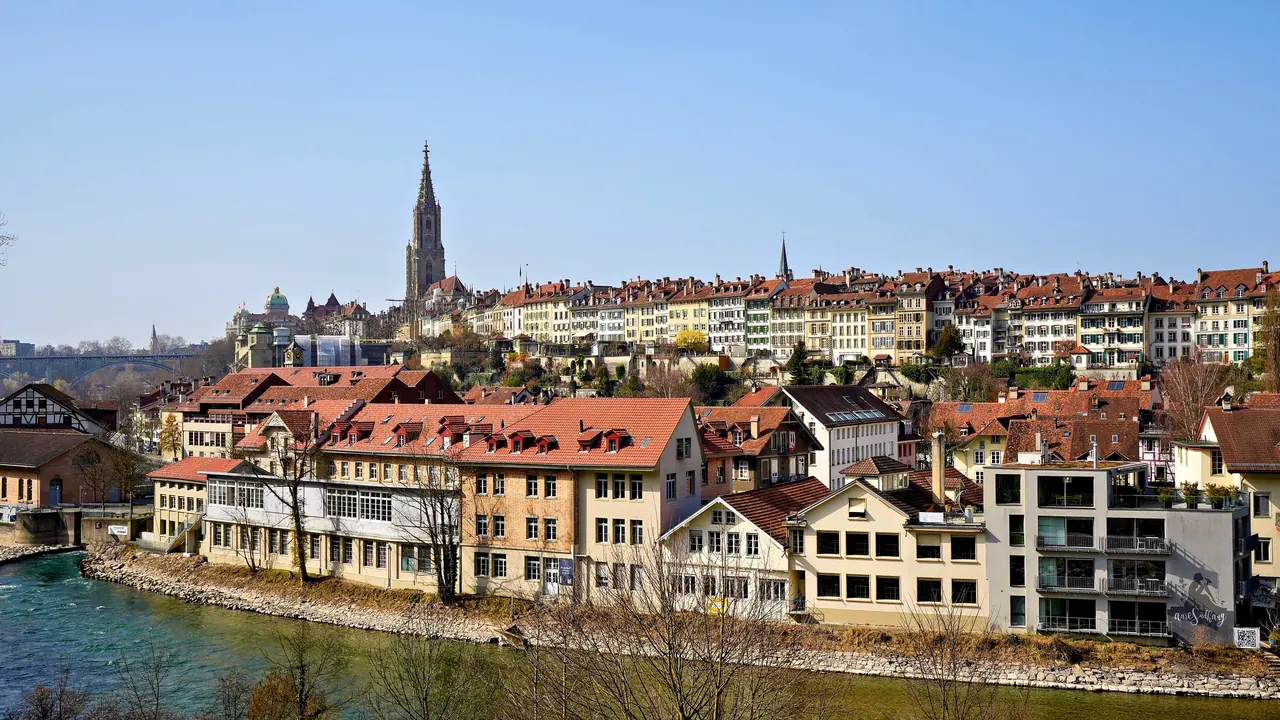
Both reward two or three days, and both have an old centre with a UNESCO listing, but the appeal differs in kind. Bern's is a whole townscape: arcaded sandstone streets on a loop of the Aare, painted fountains, the Zytglogge and the Minster. It adds modern art at the Zentrum Paul Klee and the Einstein connection.
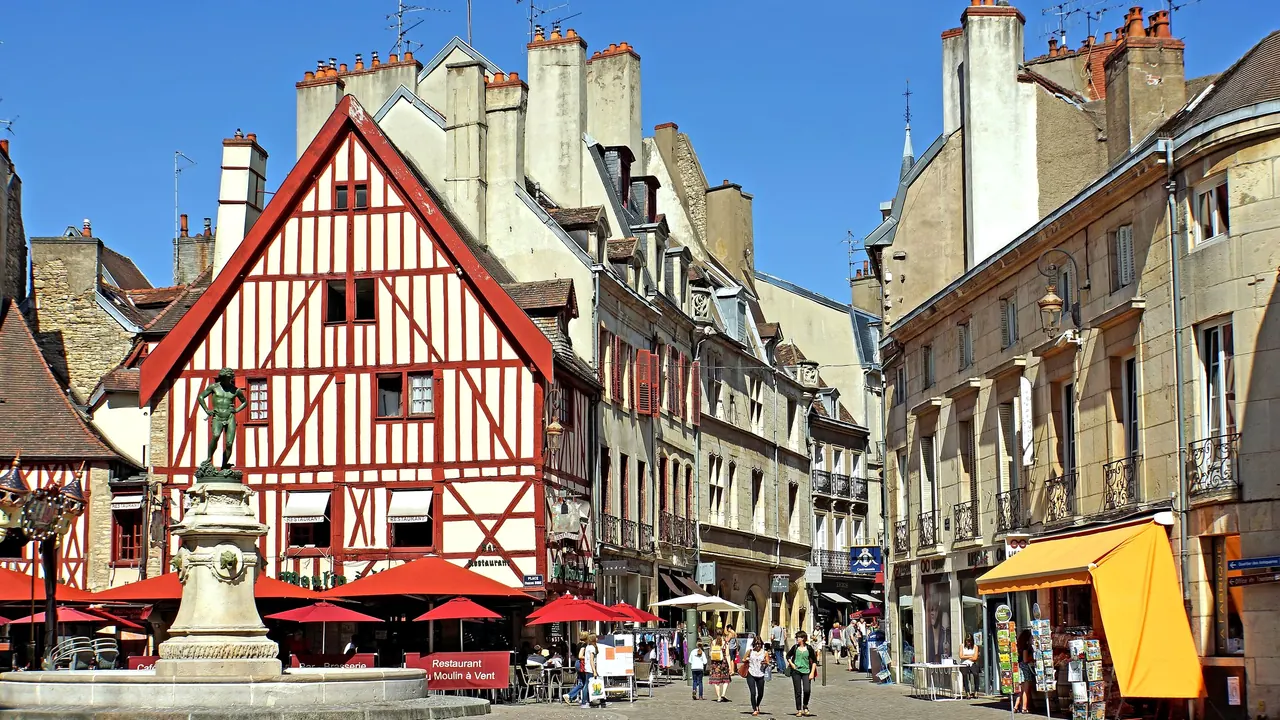
Dijon is about the medieval dukes of Burgundy. Their palace holds the Musée des Beaux-Arts and the ducal tombs with their ring of mourners. Around it are half-timbered houses, Notre-Dame with its rows of gargoyles, and Sluter's Well of Moses at Champmol.
Nightlife
Neither is a place for a big night out, and both go quiet early during the week. In Bern, evenings happen in vaulted cellar bars under the arcades and on summer terraces by the Aare, and the Reitschule is the place for late, rough-edged parties.
Dijon's evenings are shaped by its university: small bars along Rue Berbisey and terraces around Place Émile Zola, with wine bars and late dinners more than dancing.
Nature & outdoors
Bern is far stronger for the outdoors, because the high Alps are on its horizon and only an hour away. The Jungfrau region has hiking, cable cars and skiing, and Lake Thun, the Gurten, the Emmental and the Jura offer gentler days.
Dijon's countryside is softer. West of town are limestone combes with trails and climbing cliffs, and there is the Burgundy Canal towpath, the vineyard cycle route to Beaune and, further out, the granite hills of the Morvan. It is good for easy walking and cycling, but there are no mountains.
Day trips
Both cities make excellent bases, but Bern is the easier one. Its station sits at the centre of the Swiss rail network, so Lucerne, Basel, Zurich, Fribourg, Gruyères, Murten and Thun are all within reach without a car or much planning.
Dijon's day trips are richer for wine lovers, along the Route des Grands Crus to Beaune and out to Fontenay Abbey and Semur-en-Auxois. Apart from Beaune and Besançon, though, most of them need a car, a bike or a tour.
Good for families
Bern works better with children. The bear park, the Dählhölzli zoo, the animal dioramas at the Natural History Museum and the playground at the top of the Gurten funicular fill several days, and the mountains are close for more. The one caution is the Aare, which is for strong swimmers only.
Dijon is calm and safe, with a planetarium at the Jardin de l'Arquebuse, the lawns of the Parc de la Colombière and paddling at Lac Kir. Its main pleasures, tastings and fine art, are aimed at adults.
Getting around
You can walk both centres, and neither needs a car in town. Bern goes further, with punctual trams and buses on one fare and funiculars and a lift down to the river. Its station at the top of the old town puts the rest of Switzerland within reach, although some lanes up from the Aare are steep.
Dijon has a flat, largely pedestrian core and two tram lines, and trains run to Beaune and Paris. The wine villages away from the railway mean hiring a car or a bike.
Shopping & style
Bern's arcades make for the longer browse, and a dry one when it rains. Spitalgasse, Marktgasse and Kramgasse run in one covered line with watch and chocolate shops and a long-established department store near the station. Further down, steep steps off Gerechtigkeitsgasse lead into cellar shops selling antiques, design, books and crafts, and a large shopping centre on the western edge covers mainstream brands.
In Dijon, most of what you carry home is edible: mustard in dozens of flavours, pain d'épices, crème de cassis and bottles from the Burgundy wine merchants. Rue de la Liberté has French chains and a department store, and the lanes off it have antiques and small independents. It is the better town for gifts to eat, but Bern has more range for anything else, and neither has much for fashion or luxury.
Affordability
Dijon costs far less. Prices are those of a French regional city, rooms are moderate and walking replaces most transport. Only the things many visitors come for, serious restaurants, cellar tastings and good bottles, push the bill up.
Bern is very expensive by any European standard, with costly hotels, meals and even a simple terrace beer. Its free pleasures help, such as the hotel transport pass, the river paths, the bear park and Federal Palace tours, but they do not change the overall picture.
Live music & performing arts
The two are similar in scale but have different strengths. Bern has German-language opera and drama at the Stadttheater, its symphony orchestra in the Casino, new dance at the Dampfzentrale, and two well-known festivals: jazz in spring and the Gurtenfestival in July.
Dijon's Opéra splits its programme between the old Grand Théâtre and the Auditorium, known for its acoustics, and there is also a national drama centre. Its season follows the academic year and thins out in summer, just when Bern's festival calendar is at its fullest.
Wellness & relaxation
Bern is the better choice for real spa time. It has a large thermal bath complex on the western edge with pools, saunas and steam rooms, a hammam-style spa in the old town, and mountain spa hotels in the Bernese Oberland not far away.
Dijon has only a handful of hotel spas, some in the wine villages offering grape-based treatments. Both cities move at an unhurried pace, though, and Dijon's long lunches and slow afternoons in the vineyards are restful in their own way.
When should you go?
Pick your month. The climate figures are measured averages, not a forecast.
Bern in July
Dijon in July
Daytime high, °C
Rainfall in the month, mm
Where the figures come from
Bern has no rain gauge within 25 km of the centre, so its rainfall comes from a gridded climate dataset read at the city rather than from a gauge further away.
Bern's sunshine is measured 71 km from the centre, at Herten.
Temperature and rainfall are climate normals, averaged over the years shown. Bern: 2010-2020 (sunshine 1991-2020, rainfall 1991-2020) normals, Bern / Bern - Belp Airport (5.5 km from centre). Dijon: 1991-2020 normals, Dijon (7 km from centre).
Temperatures in the two cities follow almost the same curve through the year. Both are cold and grey in December and January, with highs around 5°C. They warm through spring and peak in July and August, Bern at about 26°C and Dijon a degree warmer, which is comfortable for walking rather than too hot. Sunshine is also close to level month by month, long in summer and short in winter.
The real difference is rain. Bern is wetter from May to August, with May bringing around 118mm, so summer days there often break into showers. That is also the only stretch when swimming in the Aare works, from June to early September. Dijon stays drier through summer, with about 65mm in July, and its rainiest spell comes in October and November. June to September is the best window for Bern, while Dijon is at its best from late May to September, and September is especially pleasant out among the vineyards.
Which traveller are you?
For an outdoors trip, Bern is the clear pick. The Eiger, Mönch and Jungfrau are about an hour away by train, with cable cars, high-mountain hiking and winter skiing, and the Gurten and the Aare paths start right in town. Dijon's combes and canal towpath are pleasant but mild.
On a trip on a tight budget, Dijon makes far more sense. Rooms are moderate and eating well costs much less than in Bern. In Bern even plain guesthouses are pricey, and lunch from a supermarket counter quickly becomes a habit.
For a food and nightlife trip, Dijon wins at the table, with boeuf bourguignon, Époisses from Les Halles and Côte de Nuits wines by the glass. Evenings are modest in both cities, Rue Berbisey's wine bars against Bern's arcade cellars, so the food decides it.
Before you go
| Measure | Bern | Dijon |
|---|---|---|
| Official language | French, German, Italian, Romansh | French |
| Currency | Swiss Franc (CHF) | Euro (EUR) |
| Sockets | CJ230 V, 50 Hz | CE230 V, 50 Hz |
| Driving side | Right | Right |
| Time zone | UTC+1, UTC+2 in summer | UTC+1, UTC+2 in summer |
| Emergency number | 112 | 112 |
| Elevation | 542 m | 220 m |
| Main airport | Zürich Airport (ZRH)101 km from centre226 non-stop destinations | Lyon Saint-Exupéry Airport (LYS)178 km from centre141 non-stop destinations |
| Public holidays this year | 10 days | 11 days |
By the numbers
| Measure | Bern | Dijon |
|---|---|---|
| City population | 136,988 | 161,830 |
| People per km² | 2,655 | 3,890 |
| Museums within 10 km | 30 | 8 |
| UNESCO World Heritage sites within 50 km | 2 | 1 |
Where else could you go?
Every comparison below shares a destination with this one, so you can follow Bern or Dijon somewhere new.