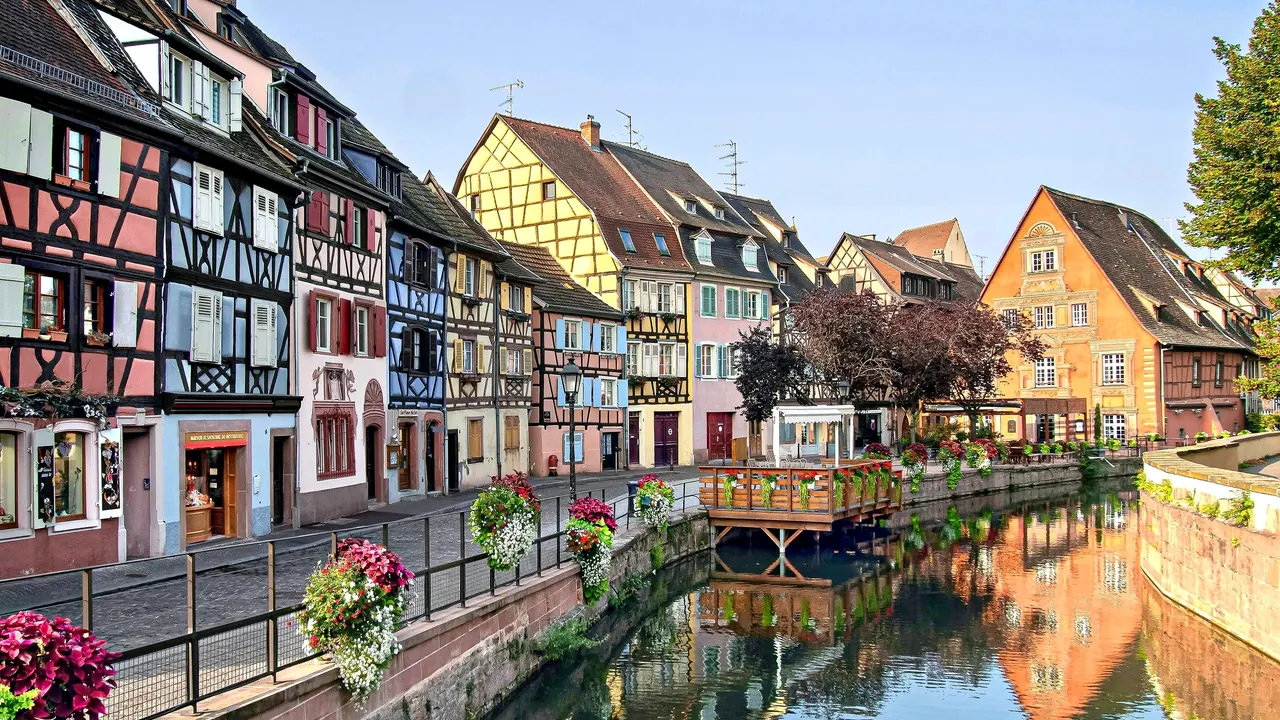
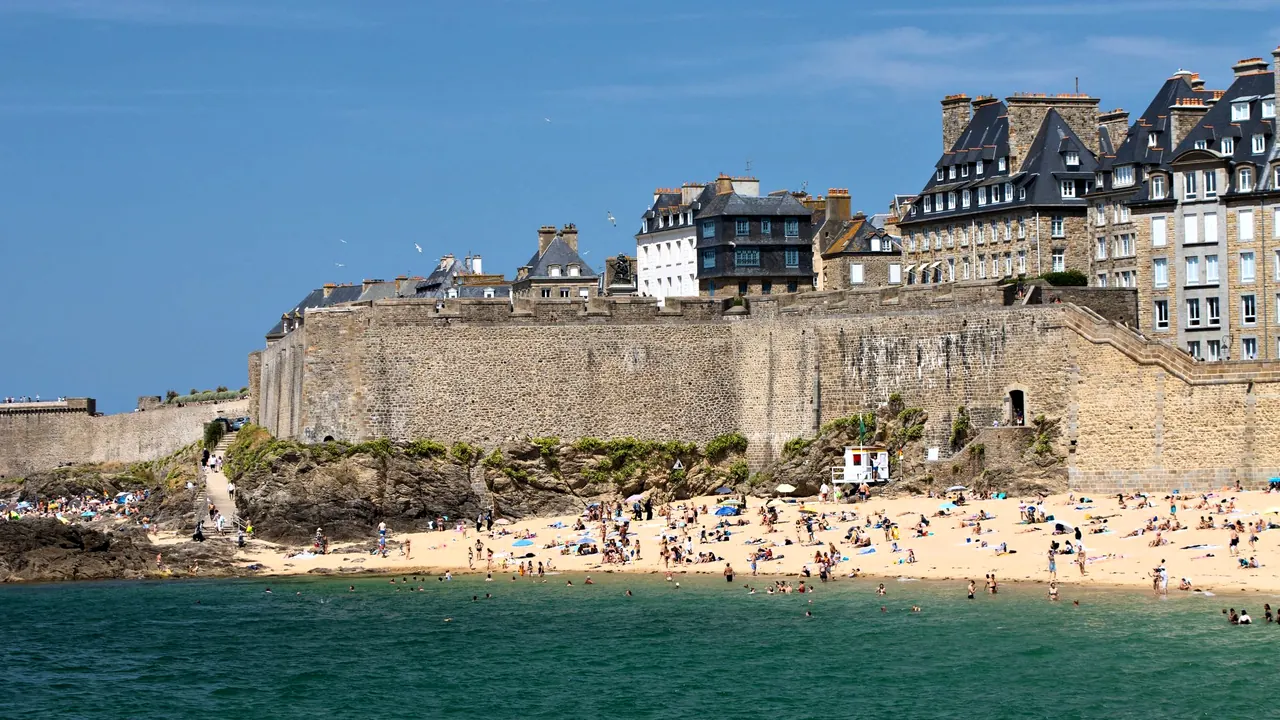
Photos: Colmar by Rolf Kranz, CC BY-SA 4.0, cropped; Saint-Malo by Efrem Efre, Pexels License.
Colmar or Saint-Malo?
Our verdict in twelve categories, each scored against the same fixed benchmark cities, and the climate month by month, so you can choose for your trip.
Choose Colmar for
- culture and sights
- food and drink
- day trips
Colmar suits a traveller who wants to look at things and eat well. It has an intact painted old town, the Isenheim Altarpiece in the Unterlinden Museum, winstub cooking and Alsace wine, and Strasbourg, Basel, Freiburg and a string of wine villages are all within easy reach. It makes a base for a week of outings rather than a place to lie in the sun, and it is a little kinder to the budget.
Choose Saint-Malo for
- beaches
- wellness
- nightlife
Pick Saint-Malo if the sea is the point. The beaches begin at the ramparts, and the huge tides empty the bay so you can walk out to the island forts. The coastal path runs along the cliffs, and the thalassotherapy tradition makes a quiet off-season break properly restful. Expect cold water and a shorter list of sights, and expect to eat better at Cancale than inside the walls.
Scoreboard
Twelve categories on one fixed scale from 0 to 100. The shaded stretch is the gap between the two.
Your match
Pick a travel style or drag the sliders, and both match scores follow your weighting.
Too close to call, 1 point apart
Wins on culture and sights and food and drink with your weighting.
Wins on beaches and wellness with your weighting.
What matters to you?
Category by category
What the scores mean for a trip.
Beaches & swimming
This is the widest gap between the two. Colmar sits in the Alsace plain with no coast at all, so swimming means a municipal pool or a small lake up in the Vosges valleys.
Saint-Malo has sand from the foot of its walls: the 3km Sillon beach towards Paramé, coves below the ramparts and the tidal seawater pool at Bon-Secours. The Channel stays cool even in late summer, so this is a place for the sand, short dips and low-tide walks rather than long swims, and Dinard across the estuary has more sheltered beaches.
Food & drink
Colmar is the stronger place to eat. Alsace cooking is rich and varied, from choucroute and baeckeoffe in wood-panelled winstubs to tarte flambée and munster cheese. Riesling, Gewurztraminer and Pinot Gris from the slopes around town go with every meal, and cellar tastings are a short drive away.
Saint-Malo's food is simpler: galettes with dry cider, kouign-amann, and oysters eaten by the harbour wall at Cancale. The seafood can be excellent, but the crêperies inside the walls are uneven, and the better meals are in Saint-Servan or along the coast towards Cancale. Outside their regional cooking, both towns offer little choice.
Culture & sights
Colmar has much more to see. Its old town of painted half-timbered houses, canals and carved façades came through the wars largely intact. The Unterlinden Museum's Isenheim Altarpiece is reason enough to make the trip, and Schongauer's Madonna in the Dominican church and the Bartholdi museum add to it.
Saint-Malo's walled town is handsome granite, but much of it was rebuilt after 1944. Its history of corsairs and shipowners shows in the walk around the ramparts, the castle keep and the low-tide crossing to Chateaubriand's grave on the Grand Bé, not in museums. One good day covers it.
Nightlife
Neither town is made for a big night out, but Saint-Malo has a little more going on. In July and August the pubs and Irish-style bars inside the walls fill with sailors and young visitors, and a few stay open late at weekends.
In Colmar the evening is a long dinner and a glass of wine by the canals of Petite Venise, and the streets go quiet early. For clubs, you take the train to Strasbourg from Colmar or to Rennes from Saint-Malo.
Nature & outdoors
Both are strong for the outdoors, but the settings are opposite. From Colmar you walk through the vineyards between wine villages and climb into the Vosges, with forest, glacial lakes, the Route des Crêtes past the Grand Ballon and some modest skiing in winter. The flat plain below is good cycling country.
Saint-Malo's outdoors is the sea: the GR34 along the cliffs to Pointe du Grouin and Cap Fréhel, some of Europe's biggest tides, kayaking on the Rance, sailing and kitesurfing. Inland it is flat farmland, so anyone who wants hills belongs in Alsace.
Day trips
Colmar is the better base, mainly because so much is so close. Eguisheim, Riquewihr and Kaysersberg are a few kilometres apart along the wine route, Strasbourg is half an hour away by train, and Basel and Freiburg put two more countries within about an hour.
Saint-Malo has fewer outings, but strong ones: Mont-Saint-Michel about an hour's drive away, medieval Dinan, Dinard by boat, Rennes by train and, in summer, ferries to Jersey. In both places a car opens up most of the list.
Good for families
Both are safe, easy towns for children, and the difference is where the fun is. In Colmar it starts with boat rides through Petite Venise and storks on the roofs. Then you drive out to the stork park at Hunawihr, the macaques at Kintzheim, the Mulhouse train museum or Europa-Park across the Rhine.
Saint-Malo keeps children busy without a car: sandcastles, the sea pool, walks out to the forts and the Grand Aquarium on wet days. You have to watch the fast tides and the cold water, and there are no theme parks nearby.
Getting around
Getting around works much the same way in both. The centres are compact and easy on foot. Colmar has quick regional trains to Strasbourg, Mulhouse and Basel, while Saint-Malo has direct high-speed trains to Rennes and Paris, local buses across town and a passenger boat to Dinard.
Both are harder beyond town. The Alsace wine villages are best reached by car or by bicycle on the vineyard roads. Mont-Saint-Michel and the Breton coast are mostly reached by car or on a tour, and parking near the walls is hard in summer.
Shopping & style
Neither is a shopping destination, and both are best for regional things to take home. In Colmar that means wine bought from the producer, Soufflenheim pottery, kougelhopf moulds and printed table linen, and the Christmas markets are the high point of the year.
Saint-Malo sells striped sailor tops, salted butter and caramels, cider and faience, and has produce markets in the walled town and Saint-Servan. For fashion you go to Strasbourg from Colmar and to Rennes from Saint-Malo.
Affordability
Colmar is slightly easier on the wallet. Set lunches and regional wine are reasonable and village tastings cost little. Rooms in the old town are dear in summer and during the Christmas market weeks, when staying in a nearby village helps.
Saint-Malo is priced like a seaside resort, and rooms inside the walls and along the beach in July and August cost the most. Galettes and cider keep meals cheap, though seafood platters do not, and prices ease in spring and autumn.
Live music & performing arts
Colmar's stage life is classical in temper. The small Italian-style municipal theatre has a season of plays, opera and concerts, the Opéra national du Rhin brings productions on tour, and the year peaks with the international classical music festival in early July and a jazz festival in autumn.
Saint-Malo's festivals draw a different crowd: indie bands at La Route du Rock, writers and readers at Étonnants Voyageurs, comics fans at Quai des Bulles. Between those dates, an occasional organ or chamber concert under the stained glass of Saint-Vincent is about all there is.
Wellness & relaxation
Saint-Malo is clearly the place to unwind. It is one of France's classic thalassotherapy towns, with a large seawater centre on the Sillon beach. Outside August, a long walk on the empty sand at low tide followed by an afternoon in the heated pools makes a genuinely restful break.
Colmar has no bathing tradition and only hotel spas. Its calm is of another kind: quiet canals once the day visitors have gone, long lunches and slow walks through the vines.
When should you go?
Pick your month. The climate figures are measured averages, not a forecast.
Colmar in July
Saint-Malo in July
Daytime high, °C
Rainfall in the month, mm
Where the figures come from
Saint-Malo has no rain gauge within 25 km of the centre, so its rainfall comes from a gridded climate dataset read at the city rather than from a gauge further away.
Saint-Malo's sunshine is measured 68 km from the centre, at Rennes.
Temperature and rainfall are climate normals, averaged over the years shown. Colmar: 1991-2020 normals, Ihringen (21.1 km from centre). Saint-Malo: 2002-2020 (sunshine 1991-2020, rainfall 1991-2020) normals, Dinard (7.9 km from centre).
The two climates are very different. Colmar lies inland, so its summers are warmer and sunnier, with highs around 27°C in August, and its winters are cold at about 6°C. The wettest months there are late spring and summer, with May the rainiest, while winter is fairly dry. May to September is the best time for walking the vineyards and the Vosges, and September brings the harvest without the midsummer heat.
Saint-Malo has a maritime climate. It is milder in winter and cooler in summer, with highs reaching only about 22°C in July and August. The sea warms to 18°C in August and September, so beach days run from July to September and the swimming is always brisk. Its rain comes in autumn and winter, building to 97mm in December, so late spring and early autumn are the best times for walking the coast.
Which traveller are you?
For a beach and sun trip, Saint-Malo is the only real choice of the two. Its long sands start at the ramparts, the sea pool at Bon-Secours works at any tide and Dinard's sheltered coves are a boat ride away. Colmar has no coast at all.
On a culture and arts trip, Colmar gives far more. The painted half-timbered old town survives as a whole, and the Isenheim Altarpiece in the Unterlinden Museum is a major work of European art. Strasbourg and Basel add cathedrals and museums within an hour.
For a relaxing and wellness trip, choose Saint-Malo, ideally outside August. Seawater thalassotherapy is a local tradition, with heated pools and treatments on the seafront, and long walks on empty sand at low tide suit a few slow days. Colmar has only hotel spas.
Before you go
| Measure | Colmar | Saint-Malo |
|---|---|---|
| Official language | French | French |
| Currency | Euro (EUR) | Euro (EUR) |
| Sockets | CE230 V, 50 Hz | CE230 V, 50 Hz |
| Driving side | Right | Right |
| Time zone | UTC+1, UTC+2 in summer | UTC+1, UTC+2 in summer |
| Emergency number | 112 | 112 |
| Elevation | 185 m | 0 m |
| Main airport | EuroAirport Basel–Mulhouse–Freiburg (BSL)55 km from centre112 non-stop destinations | Rennes-Saint-Jacques Airport (RNS)68 km from centre15 non-stop destinations |
| Public holidays this year | 11 days | 11 days |
By the numbers
| Measure | Colmar | Saint-Malo |
|---|---|---|
| City population | 66,970 | 47,439 |
| People per km² | 1,006 | 1,296 |
| Museums within 10 km | 9 | 3 |
| UNESCO World Heritage sites within 50 km | 3 | 2 |
| Swim season, months above 21 °C | - | None |
Where else could you go?
Every comparison below shares a destination with this one, so you can follow Colmar or Saint-Malo somewhere new.