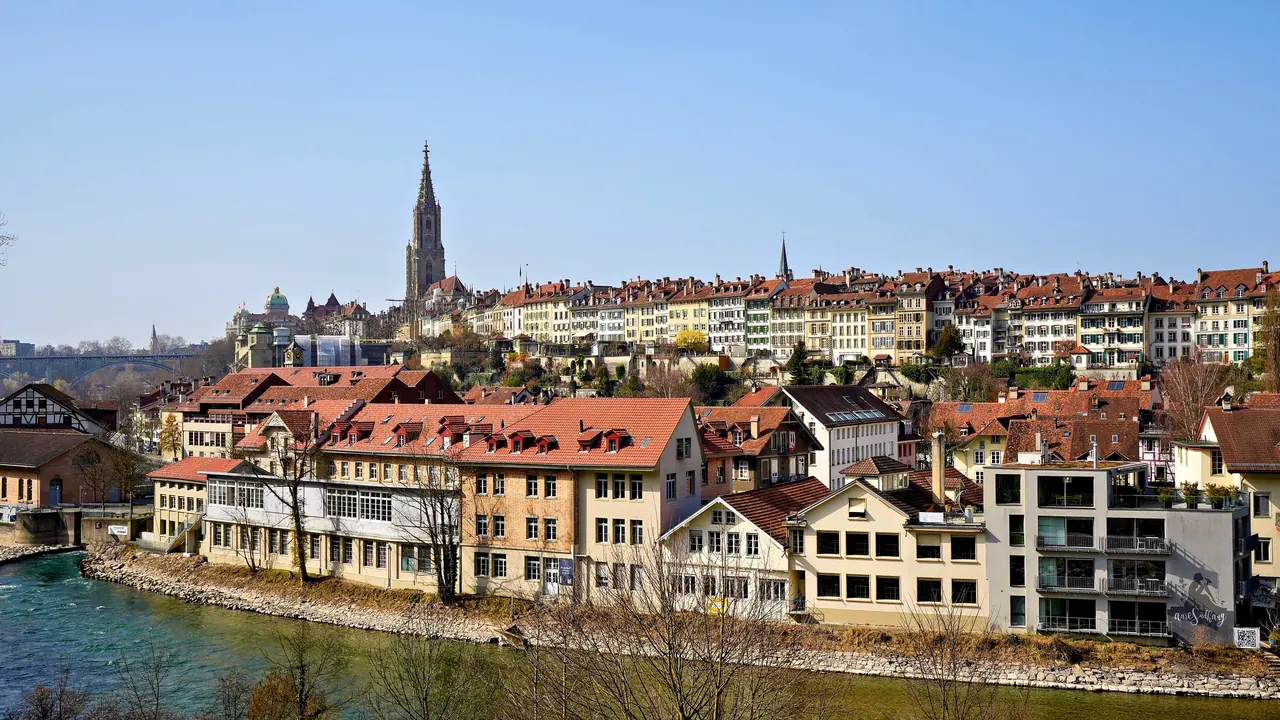
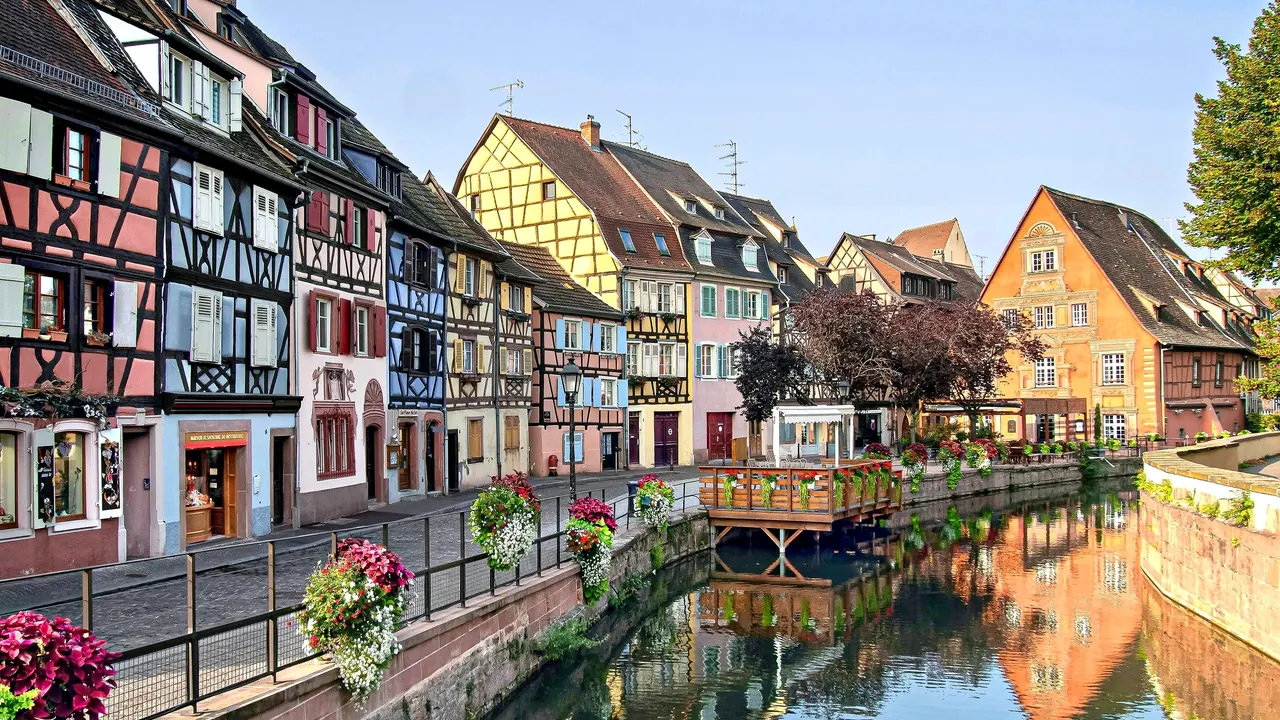
Photos: Bern by Beat Bieri, Pexels License; Colmar by Rolf Kranz, CC BY-SA 4.0, cropped.
Bern or Colmar?
Our verdict in twelve categories, each scored against the same fixed benchmark cities, and the climate month by month, so you can choose for your trip.
Choose Bern for
- beaches
- getting around
- live music and the arts
Bern suits travellers who want the Alps on the doorstep and a railway that does the planning for them. From a UNESCO-listed old town on a loop of the Aare you can be among high mountains, lakes and other Swiss cities within an hour, with no car. Summer adds swimming in the river, and evenings have a bit more going on than in Colmar, with cellar bars, the Reitschule and a proper concert and opera season. The catch is the cost, which is steep in every part of the trip.
Choose Colmar for
- prices
- food and drink
Colmar is the better pick for eating, drinking and spending less. Winstub cooking, cellar tastings among the vines and a famous altarpiece are the heart of a stay. It costs far less than Bern, and its half-timbered streets and canals feel more like a storybook. It is quieter after dark and weaker on mountains and spas, and its best surroundings, the wine villages and the Vosges, are much easier to enjoy with a car or a bike.
Scoreboard
Twelve categories on one fixed scale from 0 to 100. The shaded stretch is the gap between the two.
Your match
Pick a travel style or drag the sliders, and both match scores follow your weighting.
Wins on beaches and getting around with your weighting.
Wins on prices and food and drink with your weighting.
What matters to you?
Category by category
What the scores mean for a trip.
Beaches & swimming
Neither has a coast, but Bern has a real summer swimming culture and Colmar does not. In Bern, locals walk up from the Marzili, jump into the cold green Aare and float back past the Federal Palace. There are riverside lidos with lawns and pools, and Lake Thun has calmer water about twenty minutes away by train.
In Colmar, swimming means a municipal pool or a small lake up in the Vosges valleys. That is fine for cooling off but not something to plan a trip around.
Food & drink
Colmar is the better place to eat, because it sits in one of France's great regional kitchens and in the middle of its own wine country. Winstubs serve baeckeoffe, choucroute and tarte flambée with munster from the valleys, the covered market by the Lauch is good for charcuterie and gingerbread, and there is a fine-dining tier along the wine route.
Bern is hearty but limited: the Berner Platte, rösti and fondue in guildhall rooms and arcade cellars, with excellent chocolate and Emmental cheese at the markets. It costs considerably more for less variety. In Colmar, though, steer clear of the tired menus on the most photographed streets.
Culture & sights
Both are compact old towns that take about two days to see. What draws you differs. Bern's appeal is civic and scientific: arcaded sandstone streets, the Zytglogge, the Minster tower and the Federal Palace, with the Zentrum Paul Klee and the flat where Einstein worked out special relativity.
Colmar is more picturesque and its one great treasure is older. The painted half-timbering of Petite Venise and the tanners' quarter survives as a whole, and the Unterlinden Museum holds Grünewald's Isenheim Altarpiece. Come to Bern for modern art and Swiss history, and to Colmar for late-medieval painting and the look of the streets.
Nightlife
Bern has more of a night out, though neither is a party town. Its vaulted cellar bars, the weekend crowds on Aarbergergasse and late, scruffy parties at the Reitschule give it at least some life after midnight.
Colmar's evenings end with dinner and a glass of Alsace wine at a canal-side terrace or a wine bar. For anything livelier, people take the train to Strasbourg.
Nature & outdoors
Bern has the bigger scenery. The Eiger, Mönch and Jungfrau are visible from the old town, and real alpine terrain with cable cars, glaciers and proper skiing is about an hour away by train. Lake Thun, the Gurten, and the Emmental and Jura for gentler days fill in the rest.
Colmar's outdoors is softer and more rural: footpaths through the vines between wine villages, the rounded forested Vosges with glacial lakes and the Route des Crêtes, and flat cycling on the plain. It is lovely in autumn, but almost all of it is easier with a car.
Day trips
Both are excellent bases, and the difference lies in how you travel and what you see. From Bern the rail network does everything: Lucerne, Basel and Zurich are each about an hour away, and Fribourg, Murten, Thun and Solothurn are closer, so it is a week of different Swiss towns without a car.
Colmar's best outings are the wine villages a few kilometres apart, such as Riquewihr, Kaysersberg and Eguisheim, plus Haut-Koenigsbourg on its ridge. Strasbourg is half an hour by train, and Basel and Freiburg are across nearby borders. For the villages, though, you want a car or a bike.
Good for families
In Bern most of what children enjoy is inside the city, while in Colmar you mostly drive out to it. Bern has the bear park on the riverbank, the Dählhölzli zoo along the Aare, the animal dioramas at the Natural History Museum and the playground at the top of the Gurten funicular. Remember that the river itself is only for strong swimmers.
Colmar's own streets offer flat-bottomed boat rides through Petite Venise and storks on the rooftops. The bigger outings are outside town: the stork and otter park at Hunawihr, the macaques and eagle show at Kintzheim, and Europa-Park about an hour away by car. You need a car for these, but you also get a real theme park, which Bern lacks.
Getting around
Bern is much easier to get around. The arcaded centre is a twenty-minute walk end to end, trams and buses run on one fare system, and funiculars and a public lift save the climb from the river. The station sits at the top of the old town, so day trips start a few steps from your hotel.
Colmar's centre is just as walkable, and trains to Strasbourg and Mulhouse are quick. Once you leave the rail line, though, buses to the wine villages and the Vosges are sparse, and most visitors end up hiring a car or bicycle.
Shopping & style
Bern offers a bit more range. There is a long arcaded line of Swiss chains, watch and chocolate shops down Spitalgasse and Kramgasse, quirky cellar shops selling antiques and design on Gerechtigkeitsgasse, and a large mall on the western edge.
Colmar is better for gifts than for a shopping trip: wine straight from producers, Soufflenheim pottery, kougelhopf moulds and printed Alsatian linen, with the Christmas markets the peak of the year. Neither suits anyone after fashion or luxury labels.
Affordability
This is where the two differ most sharply. Bern is expensive across the board, from plain guesthouses to a terrace beer. Free sights like the bear park, the river paths and Federal Palace tours, plus the transport pass most hotels give, only soften it a little.
Colmar is a moderately priced French provincial town. Set lunches and regional wine are reasonable and village tastings are often free. Rooms are its weak point, especially in the Christmas market weeks, so book early or stay in a nearby village.
Live music & performing arts
Bern has a steadier programme. The Stadttheater runs opera, ballet and drama, the Bern Symphony Orchestra plays at the Casino, the Dampfzentrale hosts contemporary dance, and the jazz festival and the Gurtenfestival bring bigger names. You will usually find something on.
Colmar's small Italian-style theatre has a modest season. Otherwise the town comes alive for festival weeks, classical in July and jazz in autumn, and is quiet in between. Serious opera means going to Strasbourg or Basel.
Wellness & relaxation
Bern gives you more actual spa time. A large thermal complex on the western edge has warm pools, saunas and steam rooms, and there is a hammam-style spa in the old town. The mountain spa hotels of the Bernese Oberland are within easy reach.
Colmar has only hotel spas. Its restfulness is of a different kind: quiet canal-side evenings once the day-trippers leave, and slow walks through the vines.
When should you go?
Pick your month. The climate figures are measured averages, not a forecast.
Bern in July
Colmar in July
Daytime high, °C
Rainfall in the month, mm
Where the figures come from
Bern has no rain gauge within 25 km of the centre, so its rainfall comes from a gridded climate dataset read at the city rather than from a gauge further away.
Bern's sunshine is measured 41 km from the centre, at Payerne.
Temperature and rainfall are climate normals, averaged over the years shown. Bern: 2010-2020 (sunshine 1961-1990, rainfall 1991-2020) normals, Bern / Bern - Belp Airport (5.5 km from centre). Colmar: 1991-2020 normals, Ihringen (21.1 km from centre).
The two follow almost the same temperature curve. From December to February both are cold and grey, with daytime highs of only 5 to 8°C, and November is cool and dull too. That still works for short walks, and Bern's covered arcades help on raw days. Colmar warms up slightly sooner and is a touch milder in late winter and May. By July and August both reach about 26°C, which is comfortable for walking all day without being too hot. In Bern, June to early September is warm enough for the river and the lakes, while in Colmar summer swimming means a pool or a Vosges lake. September and October stay mild in both and are good months for the hills and the vineyards.
Rain is where they differ. Bern is the wetter of the two in every month. From May to August it gets more than 100mm each month, so expect showers and the odd lost afternoon even in midsummer. Colmar sits in the lee of the Vosges and gets about two-thirds of Bern's rain, in summer as across the year, and a little more than half in the depths of winter. Its driest stretch runs from winter into early spring. Sunshine is almost the same in both, peaking in July.
Which traveller are you?
For an outdoors trip, Bern wins. The Jungfrau region's high trails, cable cars and skiing are about an hour away by train, Lake Thun is closer still, and the Gurten and the Aare paths start in town. Colmar's gentler Vosges walks mostly need a car.
On a trip on a tight budget, Colmar is clearly kinder. Set lunches, regional wine and free village tastings keep costs moderate, and staying outside the centre helps too. In Bern even plain rooms and terrace beers are expensive, though the free sights help a little.
For wine lovers, Colmar is the obvious choice. Riesling, Gewurztraminer and Pinot Gris from the slopes around town are poured in every winstub, and cellar doors in Eguisheim, Riquewihr and Turckheim are a short ride away. Bern has nothing like it.
Before you go
| Measure | Bern | Colmar |
|---|---|---|
| Official language | French, German, Italian, Romansh | French |
| Currency | Swiss Franc (CHF) | Euro (EUR) |
| Sockets | CJ230 V, 50 Hz | CE230 V, 50 Hz |
| Driving side | Right | Right |
| Time zone | UTC+1, UTC+2 in summer | UTC+1, UTC+2 in summer |
| Emergency number | 112 | 112 |
| Elevation | 542 m | 185 m |
| Main airport | Zürich Airport (ZRH)101 km from centre226 non-stop destinations | EuroAirport Basel–Mulhouse–Freiburg (BSL)55 km from centre112 non-stop destinations |
| Public holidays this year | 10 days | 11 days |
By the numbers
| Measure | Bern | Colmar |
|---|---|---|
| City population | 136,988 | 66,970 |
| People per km² | 2,655 | 1,006 |
| Museums within 10 km | 30 | 9 |
| UNESCO World Heritage sites within 50 km | 2 | 3 |
Where else could you go?
Every comparison below shares a destination with this one, so you can follow Bern or Colmar somewhere new.