Brittany or Normandy?
Our verdict in twelve categories, each scored against the same fixed benchmark cities, and the climate month by month, so you can choose for your trip.
Choose Brittany for
- beaches
- live music and the arts
- nature and the outdoors
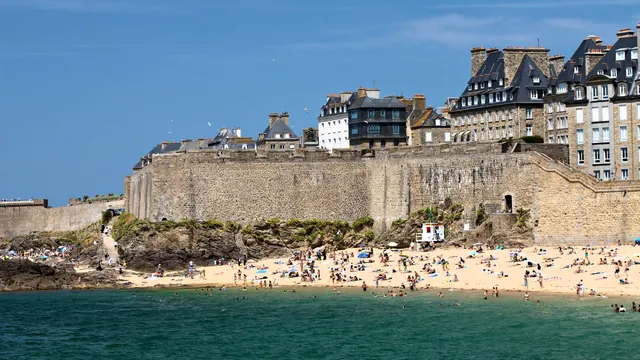
Brittany suits a coastal summer built around the sea itself. It has sandy bays on the south coast, pink granite on the north and the GR34 path along almost the whole shoreline, plus sailing schools for the children and Celtic festivals in August. It is the better choice for families and walkers who are happy to settle into one base with a car and don't mind brisk water.
Choose Normandy for
- culture and sights
For history, Normandy has the stronger hand. Mont-Saint-Michel, the D-Day beaches, the Bayeux Tapestry and Rouen's cathedral are sights of world rank, and the region is close enough to Paris to combine with it. Its coast is better for walking under chalk cliffs than for swimming, and evenings mean long dinners of cheese, cider and calvados rather than nights out.
Scoreboard
Twelve categories on one fixed scale from 0 to 100. The shaded stretch is the gap between the two.
Your match
Pick a travel style or drag the sliders, and both match scores follow your weighting.
Wins on beaches and live music and the arts with your weighting.
Wins on culture and sights with your weighting.
What matters to you?
Category by category
What the scores mean for a trip.
Beaches & swimming
Brittany is the stronger choice for a seaside vacation. The south coast around Carnac, Quiberon and Bénodet has wide sandy bays, the north has pink granite coves at Ploumanac'h, and the Crozon peninsula adds long, quieter strands, so there is a beach for most moods and winds.
In Normandy the beach is more of a backdrop. The Côte Fleurie resorts of Deauville, Cabourg and Houlgate have good sand and boardwalks, but Étretat and the Alabaster Coast are shingle under cliffs. The water is chilly in both regions, and at low tide the sea pulls far out on both coasts, so check the tide tables before you plan a swim.
Food & drink
You eat equally well in both, but from different larders. Brittany means the sea and the crêperie: Cancale oysters, shellfish platters in the harbour towns, buckwheat galettes, salted butter in almost everything and cider drunk from a bowl.
Normandy is cheese and apple country. Expect Camembert and Livarot, cream-rich sauces and a farm route through the Pays d'Auge for cider, pommeau and calvados. Both have strong seafood ports, and in both the choice narrows to regional cooking once you leave Rennes, Rouen or Caen.
Culture & sights
Normandy has the bigger names. Mont-Saint-Michel, the D-Day beaches with the Caen Memorial, the Bayeux Tapestry, Rouen's cathedral and Monet's Giverny each justify a journey, and from a base in Bayeux or Caen you can fit several into a few days.
Brittany's heritage is quieter and more spread out: the long rows of menhirs at Carnac, the walled towns of Saint-Malo, Dinan and Concarneau, and the parish closes of Finistère. It rewards slow touring, but its museums are modest and nothing quite matches Normandy's run of world-famous sights.
Nightlife
Neither region is made for late nights, but Brittany has a little more going on. Rennes is a large student city whose bars around Rue Saint-Michel fill up from Thursday, and a village fest-noz gives you an evening of dancing that Normandy has no equivalent for. In Normandy, Rouen and Caen have bars and a few clubs and Deauville has its casino, but most other places are asleep after dinner.
Nature & outdoors
Brittany has the more varied outdoors, because its coast keeps changing as you walk it: pink granite in the north, high cliffs at Cap Fréhel and bare, wave-beaten headlands at Pointe du Raz. Its islands and the sheltered Gulf of Morbihan put many days on the water as well as beside it, and even inland there are heather moors in the Monts d'Arrée and the old forest of Brocéliande.
Normandy's outdoors is narrower and gentler. Its finest scenery is the white chalk arches at Étretat, seen from the path along the cliff top, along with the wild granite at the tip of the Cotentin, and a guided crossing of the bay of Mont-Saint-Michel at low tide is its most memorable outing. Inland, hedged farmland and orchards suit easy cycling, and only the gorges of the Suisse Normande offer climbing and hillier walks.
Day trips
Both regions make excellent bases for outings, and they share the sights near their border. Mont-Saint-Michel is about an hour from Saint-Malo, and Saint-Malo and Dinan are easy to reach from western Normandy. Brittany's outings lean towards islands, with boats into the Gulf of Morbihan and out to Belle-Île, Ouessant and car-free Bréhat.
Normandy's outings are mostly by road, to harbour towns such as Honfleur and Barfleur and the cider villages of the Pays d'Auge. Jersey is a summer ferry ride from the Cotentin, and Paris is an easy train trip from Rouen.
Good for families
Brittany is the easier family seaside choice. It has sandy beaches with rock pools, sailing and kayak schools, and campsites and gîtes in small resorts. The sights are close together, and Océanopolis in Brest covers a wet day.
Normandy works well enough, with sandcastle beaches on the Côte Fleurie, the walk-through submarine at Cité de la Mer in Cherbourg and the Cerza zoo near Lisieux. But the drives between attractions are longer, and some D-Day sites are heavy going for young children.
Getting around
Brittany is a little simpler to manage. Fast trains reach Rennes from Paris in about an hour and a half and run on to Saint-Malo, Vannes, Quimper and Brest. Toll-free dual carriageways make one well-chosen base with a car work well, though the coastal roads clog in high summer.
Normandy's trains serve its main towns too, but the landing beaches, Étretat and Mont-Saint-Michel are hard to reach without a car or an organised tour. The distances push most visitors to split their stay between two bases.
Shopping & style
In both regions, shopping means food and crafts to take home rather than fashion. Brittany's list runs to Quimper faience, striped sailor tops, Guérande fleur de sel and the Saturday market at Place des Lices in Rennes.
Normandy's is calvados and cider from the farm, cheeses, lace from Alençon and Bayeux and copper from Villedieu-les-Poêles. For browsing, there are Deauville's few upmarket boutiques and Honfleur's many art galleries.
Affordability
Costs are much the same in both, with the same gap between the famous spots and everywhere else. In Brittany, Saint-Malo, Dinard and the Gulf of Morbihan are dearest in high summer, while campsites, gîtes, crêperies and toll-free roads keep a stay reasonable, and June and September are easier on the budget.
In Normandy, Deauville, Honfleur and the area around Mont-Saint-Michel cost more, but many D-Day sites and cemeteries are free and set lunches in the market towns are fair. In both, seafood on the harbour front is where the bills climb, and in Normandy the car you will almost certainly need adds hire costs.
Live music & performing arts
Brittany has the richer music life, rooted in Celtic tradition. Bagad pipe bands and fest-noz dances play in village squares, and summer brings the Festival Interceltique in Lorient and Les Vieilles Charrues at Carhaix. In December the Transmusicales come to Rennes, which also has an opera house and a national theatre.
Normandy's offer is smaller and more conventional: opera and ballet at Rouen's Théâtre des Arts, Caen's theatre and the spring Jazz sous les Pommiers festival in Coutances. Outside these, there is little to see on most evenings.
Wellness & relaxation
Both coasts have a thalassotherapy tradition, but Brittany is where it started, in Roscoff. Seawater spas line the seafront at Quiberon, Carnac, Dinard and Perros-Guirec. Add car-free islands and quiet granite villages, and Brittany suits a restorative stay in spring or autumn.
Normandy has its own seaside spas at Deauville, Cabourg and Granville, plus something Brittany lacks: Bagnoles-de-l'Orne, a thermal spa town in the forests inland. Its calm is more rural, with orchards and long lunches, though the Côte Fleurie fills with visitors in August.
When should you go?
Pick your month. The climate figures are measured averages, not a forecast.
Brittany in July
Normandy in July
Daytime high, °C
Rainfall in the month, mm
Where the figures come from
Brittany has no rain gauge within 25 km of the centre, so its rainfall comes from a gridded climate dataset read at the destination rather than from a gauge further away.
Brittany's sunshine is measured 89 km from the centre, at Rennes.
Temperature and rainfall are climate normals, averaged over the years shown. Brittany: 2004-2020 (sunshine 1991-2020, rainfall 1991-2020) normals, Vannes-Meucon (8.1 km from centre). Normandy: 1991-2020 normals, Caen (21 km from centre).
Both regions have the same mild Atlantic pattern. Only July and August are warm enough for a proper beach day, with highs around 23°C and the sea reaching about 18°C at best. Brittany's early summer is a little drier and its September is sunnier, which makes early autumn a strong month for walking its coast. Normandy's sea stays at its warmest a little longer, into September.
The clearest difference comes in late autumn and winter. Brittany turns markedly wet from October, with November bringing around 121mm. Normandy's rain is spread more evenly through the year, and its wettest months are gentler. Neither region ever gets too hot for walking the streets. From November to March both are cool and grey, better for towns and spas than for the shore.
Which traveller are you?
On a beach and sun trip, Brittany is the clear pick. Its sandy bays around Carnac and Quiberon, the pink granite coves of the north and its many sailing schools make a fuller seaside week than Normandy's cooler, more tidal Channel resorts.
For a culture and arts trip, Normandy wins on its famous sights: Mont-Saint-Michel, the D-Day beaches, the Bayeux Tapestry, Rouen's old centre and Monet's garden at Giverny. Brittany has Carnac's standing stones and its Celtic festivals, but its heritage is smaller in scale.
On an outdoors trip, Brittany gives you more variety. You can follow the GR34 coastal path, walk on Belle-Île and Ouessant, watch puffins in the Sept-Îles, and kayak, sail or surf. Normandy's Étretat cliffs are superb, but most of its inland country is gentle.
Before you go
| Measure | Brittany | Normandy |
|---|---|---|
| Official language | French | French |
| Currency | Euro (EUR) | Euro (EUR) |
| Sockets | CE230 V, 50 Hz | CE230 V, 50 Hz |
| Driving side | Right | Right |
| Time zone | UTC+1, UTC+2 in summer | UTC+1, UTC+2 in summer |
| Emergency number | 112 | 112 |
| Main airport | Nantes Atlantique Airport (NTE)97 non-stop destinations | Caen Carpiquet airport (CFR)10 non-stop destinations |
| Public holidays this year | 11 days | 11 days |
By the numbers
| Measure | Brittany | Normandy |
|---|---|---|
| Population | 4,687,381 | - |
| Swim season, months above 21 °C | None | None |
Where else could you go?
Every comparison below shares a destination with this one, so you can follow Brittany or Normandy somewhere new.
- Devonvs Normandy
- Loire Valleyvs Normandy
- Loire Valleyvs Brittany
- Cotswoldsvs Normandy
- Devonvs Brittany
- Cornwallvs Normandy