Brittany or Dordogne?
Our verdict in twelve categories, each scored against the same fixed benchmark cities, and the climate month by month, so you can choose for your trip.
Choose Brittany for
- beaches
- nightlife
- live music and the arts
Brittany suits travellers who want the sea in their trip: sandy bays and tidal flats for the children, a coastal path for walkers, seawater spas, island ferries and harbour towns with oysters on the quay. It has more going on after dark and on stage, especially around Rennes and the summer Celtic festivals. It is easier to get around, though the sea stays cool and the weather changes quickly.
Choose Dordogne for
- culture and sights
- prices
- food and drink
The Dordogne is the better choice for history and the table. Prehistoric caves in the Vézère valley, castles facing each other across the river and Sarlat's golden-stone streets are all close together, and the duck, truffles and Bergerac wines are reason enough to go. Expect a slow, warm, rural stay built around a rented house with a pool, a canoe and a car, with quiet evenings and no real beach.
Scoreboard
Twelve categories on one fixed scale from 0 to 100. The shaded stretch is the gap between the two.
Your match
Pick a travel style or drag the sliders, and both match scores follow your weighting.
Wins on beaches and nightlife with your weighting.
Wins on culture and sights and prices with your weighting.
What matters to you?
Category by category
What the scores mean for a trip.
Beaches & swimming
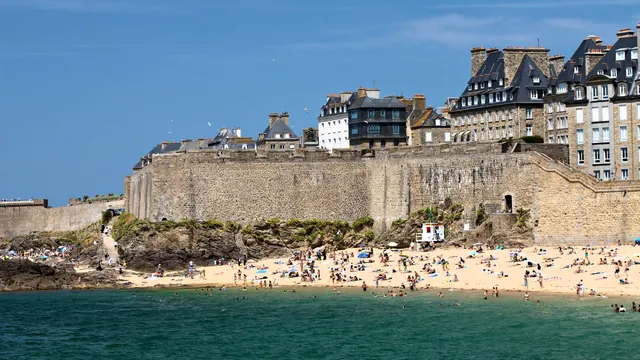
This is the widest gap between the two. Brittany has a full seaside vacation: wide sandy bays on the south coast, pink granite coves around Ploumanac'h, the strands of the Crozon peninsula and huge tidal flats at Saint-Malo. The catch is a cool Atlantic and big tides.
The Dordogne has no coast at all. Swimming there means gravel banks on the Dordogne and Vézère below villages like La Roque-Gageac, or supervised lakes such as Rouffiac. The water is warmer than Brittany's sea, but it is a summer afternoon's pastime rather than the point of the trip, and the rivers run brown after rain.
Food & drink
Both regions eat very well, but from different larders. Brittany is about the sea and the dairy: oysters from Cancale, shellfish platters in the harbours, buckwheat galettes with dry cider, and salted butter in everything from kouign-amann to caramel.
The Dordogne is duck and goose country, with confit, foie gras, walnuts, cèpes and winter truffles, plus the vineyards of Bergerac and Monbazillac for tastings. Both have excellent markets, at Rennes' Place des Lices and Sarlat's old town, and both offer little beyond their regional cooking outside the bigger towns.
Culture & sights
The Dordogne has the richer heritage, and more of it sits close together. The Vézère valley holds Lascaux's replica, the original painted cave of Font-de-Gaume and the National Museum of Prehistory at Les Eyzies. The river is lined with medieval castles, and Sarlat is one of France's finest old towns, so a single base near Sarlat covers most of it.
Brittany competes with the menhir rows of Carnac and the Gulf of Morbihan's dolmens, and adds walled Saint-Malo and Concarneau, half-timbered Dinan and Vannes, and the parish closes of Finistère. These are spread across a much larger region, and the museums are modest.
Nightlife
Neither is a party destination, but Brittany at least has a night out. Rennes is a large student city whose bars around Rue Saint-Michel fill from Thursday onwards, and summer resorts like Saint-Malo and Quiberon stay lively late. A village fest-noz is the local highlight.
The Dordogne goes quiet by eleven. Evenings mean a long terrace dinner or a summer night market with communal tables, which are charming but are no substitute for bars.
Nature & outdoors
Brittany's landscape is wilder and more varied. The GR34 coastal path runs past the cliffs of Cap Fréhel, Pointe du Raz and the Crozon headlands. There are gannets and puffins at Sept-Îles, kayaking among the Gulf of Morbihan's islands, and surf on the Finistère beaches.
The Dordogne is gentler, lived-in country of limestone cliffs, oak woods and walnut orchards, best seen by canoe past La Roque-Gageac and the river castles, or from the gardens of Marqueyssac. It suits easy walking and cycling but has nothing to challenge a serious hiker.
Day trips
Both regions are good for excursions, but of different kinds. From Brittany the outings are often by boat, to Belle-Île, Ouessant, Bréhat or the islands of the Gulf of Morbihan, and Mont-Saint-Michel is about an hour from Saint-Malo.
From the Dordogne they go by road to clifftop and riverside villages: Domme, Rocamadour on its cliff, Saint-Cirq-Lapopie in the Lot valley and the wine village of Saint-Émilion, with Bordeaux possible for a full day.
Good for families
Brittany is the easier family region, particularly with young children. They get sandy beaches, rock pools at low tide, sailing schools and crêpes, and the aquariums at Brest and Saint-Malo cover wet days. Cool water, strong tides and grey spells are the drawbacks.
The Dordogne works best for children of school age. There are gentle canoe trips, siege engines at Castelnaud and prehistoric sites that bring history to life. Long drives, summer heat and steep castle steps make it harder going with toddlers and pushchairs.
Getting around
Brittany lets the train take you further. Rennes is under two hours from Paris by fast train, and regional lines reach the main towns on the north, south and west coasts, so you can arrive at Saint-Malo, Vannes or Quimper and explore it on foot. You still need a car for the coastline, the villages and the megalith sites, but the dual carriageways are toll-free and quick. Island days depend on ferry crossings, and in July and August the coastal roads clog, so a single well-placed base saves hours at the wheel.
In the Dordogne the car does almost everything. Beyond the three railway towns of Périgueux, Bergerac and Sarlat, buses barely reach the valleys where the caves, castles and markets are scattered. The drives are shorter, with the main sights rarely more than an hour apart. The summer squeeze is concentrated in a few places: the narrow river road through La Roque-Gageac and Beynac, and the car parks at Sarlat on market day and at the popular castles. Outside the hottest weeks, cycling between neighbouring villages is a good alternative.
Shopping & style
In both regions shopping is mostly about local produce, but Brittany has a bit more beyond it. Rennes has proper high-street and department-store shopping, and the old towns sell Quimper faience, striped sailor tops, woollen jumpers and Guérande salt alongside the food.
The Dordogne's shopping is almost all edible: foie gras, walnut oil and wine from the estates, bought at the markets of Sarlat, Issigeac and Ribérac. There are also summer brocantes and craft potters, but little else.
Affordability
Costs are similar in both, typical of provincial France. In each, campsites, gîtes, markets and June or September visits keep a stay reasonable, while the peak weeks push prices up. Where the money goes differs. In Brittany it is seafood platters and rooms in Saint-Malo and the Morbihan resorts. In the Dordogne it is summer houses with pools near Sarlat and the entry fees for caves, castles and canoe hire, which add up for a family.
Live music & performing arts
Brittany has the stronger performance culture, and much of it is its own. Bagad pipe bands and fest-noz dances are part of village life. The Festival Interceltique in Lorient and Les Vieilles Charrues at Carhaix are major summer events, and Rennes has an opera house, a national theatre and a programme that runs all year.
The Dordogne's offer is limited to summer: Sarlat's theatre festival, mime and street theatre in Périgueux, and classical concerts in Romanesque churches. Out of season there is little to see.
Wellness & relaxation
Brittany has a real tradition of rest cures. Thalassotherapy began at Roscoff, and seawater spas with heated pools and algae treatments line the seafront from Quiberon and Carnac to Dinard and Perros-Guirec. This is bracing, windswept rest, best in the calm spring and autumn months.
The Dordogne has no bathing tradition and only a few spas in château hotels. Its calm comes from long lunches, a farmhouse pool and quiet lanes in the Périgord Vert, which is easiest to find outside August.
When should you go?
Pick your month. The climate figures are measured averages, not a forecast.
Brittany in July
Dordogne in July
Daytime high, °C
Rainfall in the month, mm
Where the figures come from
Brittany has no rain gauge within 25 km of the centre, so its rainfall comes from a gridded climate dataset read at the destination rather than from a gauge further away.
Brittany's sunshine is measured 89 km from the centre, at Rennes.
Temperature and rainfall are climate normals, averaged over the years shown. Brittany: 2004-2020 (sunshine 1991-2020, rainfall 1991-2020) normals, Vannes-Meucon (8.1 km from centre). Dordogne: 1991-2020 normals, Gourdon (21.2 km from centre).
Brittany is a summer destination with mild warmth rather than heat. Days peak around 24°C in July, and the sea only reaches about 18°C in July and August, so beach days are bracing even then. June to September is the dry, bright stretch. From October the Atlantic rain sets in hard, with November the wettest month at around 121mm, and winter is grey and short on sunshine. Spring and early autumn are the best months for walking the coast.
The Dordogne is warmer and sunnier through the year. July and August reach about 28°C, which is pleasant by a river or a pool but hot for climbing castle steps and steep old towns at midday. Rain is spread more evenly through the year, with a damp spell in April and May at around 83mm, and the winters are drier than Brittany's. May, June and September are the best months for sightseeing on foot, while high summer is for swimming. Brittany is the cooler escape in August.
Which traveller are you?
On a beach and sun trip, Brittany is the clear choice. It has long sandy bays at Carnac and Quiberon, resort beaches at Dinard and Saint-Malo and sailing schools along the coast. The Dordogne has only river banks and small lakes, about three hours from the Atlantic.
For a culture and arts trip, the Dordogne gives you more within a short drive. You can see the painted caves and prehistoric museum of the Vézère valley, the castles of Beynac and Castelnaud, and Sarlat's medieval old town. Brittany's standing stones and walled towns are spread much further apart.
On a food and nightlife trip, the two kitchens are about equally good, so the evenings decide it in Brittany's favour. Rennes gives you the Saturday market and crêperies by day and student bars from Thursday on. In the Dordogne, the night ends when dinner does.
Before you go
| Measure | Brittany | Dordogne |
|---|---|---|
| Official language | French | French |
| Currency | Euro (EUR) | Euro (EUR) |
| Sockets | CE230 V, 50 Hz | CE230 V, 50 Hz |
| Driving side | Right | Right |
| Time zone | UTC+1, UTC+2 in summer | UTC+1, UTC+2 in summer |
| Emergency number | 112 | 112 |
| Main airport | Nantes Atlantique Airport (NTE)97 non-stop destinations | Bergerac Dordogne-Périgord airport (EGC)9 non-stop destinations |
| Public holidays this year | 11 days | 11 days |
By the numbers
| Measure | Brittany | Dordogne |
|---|---|---|
| Population | 4,687,381 | 417,614 |
| People per km² | - | 46 |
| Swim season, months above 21 °C | None | - |
Where else could you go?
Every comparison below shares a destination with this one, so you can follow Brittany or Dordogne somewhere new.
- Normandyvs Brittany
- Loire Valleyvs Dordogne
- Loire Valleyvs Brittany
- Devonvs Brittany
- Provencevs Dordogne
- Cornwallvs Brittany