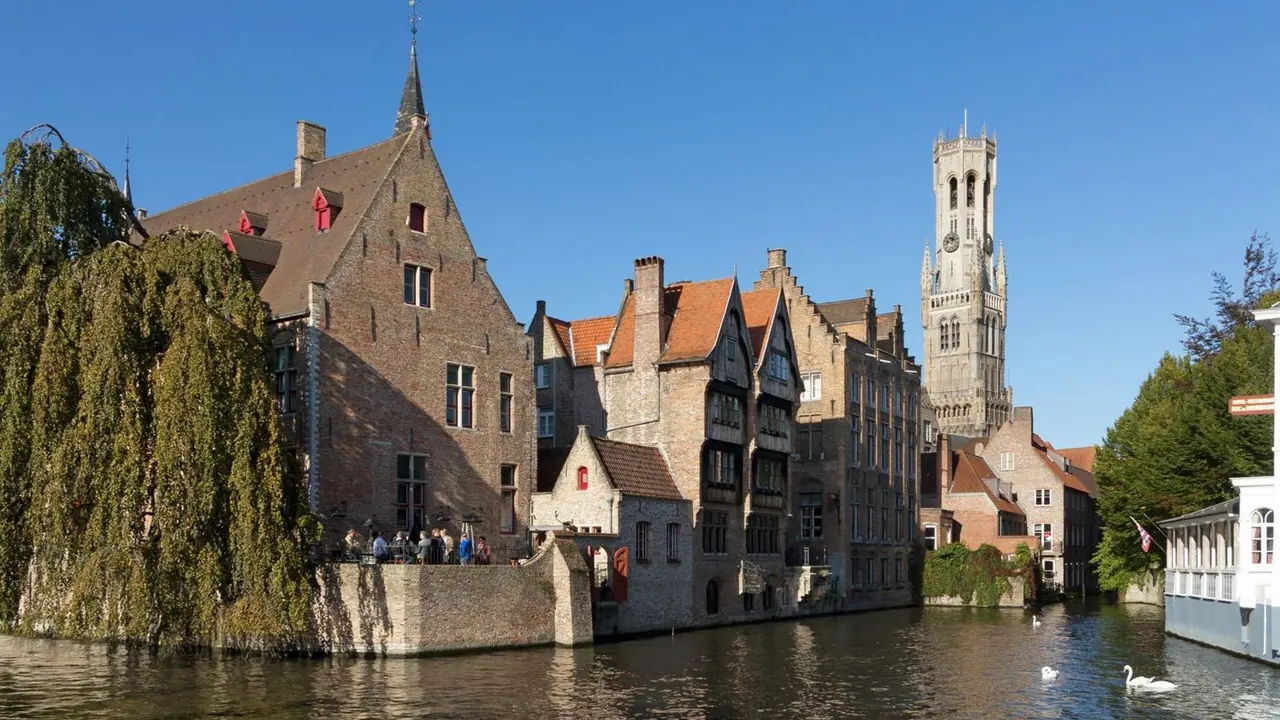
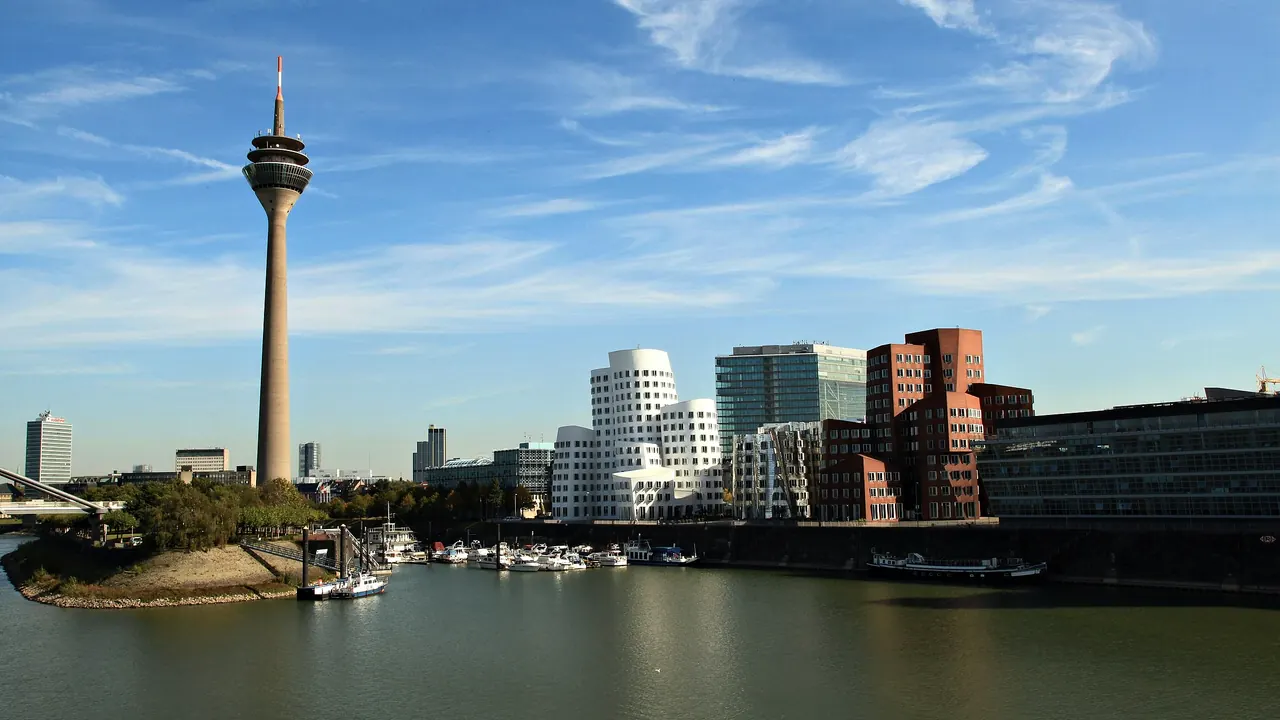
Photos: Bruges by Michielverbeek, CC BY-SA 4.0, cropped; Dusseldorf by Frank Vincentz, CC BY-SA 3.0, cropped.
Bruges or Dusseldorf?
Our verdict in twelve categories, each scored against the same fixed benchmark cities, and the climate month by month, so you can choose for your trip.
Choose Bruges for
- culture and sights
- beaches
- day trips
Bruges suits travellers who want a medieval townscape and early Flemish painting above everything else. Its canal ring, guildhalls and Begijnhof survive almost whole, Van Eyck and Memling hang a short walk apart, and the evenings are slow and quiet, spent over Trappist ales in brown cafés. It works best as a romantic stay of two or three days, with the coast and Ghent close enough for easy outings.
Choose Dusseldorf for
- nightlife
- shopping
- live music and the arts
Düsseldorf is the better pick for a livelier city stay that mixes modern art with opera, shopping and long nights out. Wartime bombing left it with little old fabric, but the Königsallee, the Japanese quarter, the Deutsche Oper am Rhein and the Altstadt's crowded brewhouse lanes give it far more to do after dark and between museums. Families and anyone who wants evenings that run past midnight will find it easier going.
Scoreboard
Twelve categories on one fixed scale from 0 to 100. The shaded stretch is the gap between the two.
Your match
Pick a travel style or drag the sliders, and both match scores follow your weighting.
Wins on culture and sights and beaches with your weighting.
Wins on nightlife and shopping with your weighting.
What matters to you?
Category by category
What the scores mean for a trip.
Beaches & swimming
Bruges has the coast on its doorstep. Blankenberge is about fifteen minutes away by train, and the coast tram links a long line of wide, flat sandy beaches with promenades, so a sunny afternoon at the sea is an easy add-on. The North Sea stays cool and windy, though, so it is for paddling and sandcastles rather than long swims.
Düsseldorf has no beach to speak of. The Rhine's sandy banks look inviting but the currents and shipping make swimming dangerous, and the sea is a long day's travel away. Swimming means Unterbacher See, a lake with lawns on the city's edge, or the outdoor pools.
Food & drink
Both cities eat and drink around beer, but in different styles. Bruges pours long lists of Trappist and abbey beers in wood-panelled cafés and pairs them with mussels and frites, beef stewed in beer and plenty of chocolate. Its main squares mostly serve set menus to day-trippers, however, and the everyday range is narrow.
Düsseldorf comes out a little ahead because it has a second side. Next to the Altstadt brewhouses, where Altbier keeps arriving with sauerbraten and spicy local mustard, the streets around Immermannstrasse hold one of Europe's largest Japanese communities, with ramen counters, izakaya and bakeries. Carlsplatz market adds snacks and produce.
Culture & sights
Bruges is the clear winner for sightseeing. Its canal-ringed centre of guildhalls, stepped gables and almshouses is a UNESCO World Heritage site, the Belfry and the Burg square anchor it, and the Groeninge Museum, St John's Hospital and the Church of Our Lady hold Van Eyck, Memling and Michelangelo. It is compact, though, and two full days cover the main sights.
Düsseldorf is an art city of another kind. Klee and classic modern art at K20, the net under the dome at K21 and the Kunstpalast reward a museum visit. Bombing took most of the old town, however, so beyond Benrath Palace and the Gehry buildings of the Medienhafen there is little historic townscape to wander.
Nightlife
Düsseldorf is far livelier at night. Its Altstadt packs a few hundred pubs and brewhouses into a handful of streets. At weekends the crowds drink standing in the lanes until well past midnight, and it gets loud, with stag groups in the mix. The cocktail bars of Carlstadt and the Medienhafen are a calmer alternative, and Carnival brings the whole city out in costume for days.
Bruges is the place for a quieter evening. You spend a long session over strong ales in a brown café or a vaulted cellar, then walk along the lit canals. A few bars near the Eiermarkt and 't Zand stay busy late, but there are few clubs, and most of the centre is asleep by midnight on weeknights.
Nature & outdoors
Neither city has dramatic scenery, but Düsseldorf has a little more variety. Beyond the long cycle paths on the Rhine meadows, it has Grafenberg forest and the wooded Neandertal close by, and the Bergisches Land hills begin within half an hour.
Bruges is all flat polder land, which makes it ideal for gentle cycling, above all the tree-lined towpath to Damme. The Zwin salt marsh near Knokke is good for birds, and the dunes make for windy coastal walks, but there are no hills or real forests.
Day trips
Both are excellent bases, and the difference lies in what is nearby. From Bruges the trips are to Flemish art cities: Ghent under half an hour away, Brussels and Antwerp a little further, plus the coast and the First World War cemeteries around Ypres.
Düsseldorf looks out over the Rhineland and the Ruhr. Cologne Cathedral is under half an hour away, Bonn and the Brühl palaces lie up the river, Zollverein in Essen shows the region's industrial past, and the castle-lined Middle Rhine gorge makes a longer day.
Good for families
Düsseldorf is the easier city with children. Trams take buggies without fuss, the Aquazoo Löbbecke Museum fills a rainy day, the Rheinturm's tilted windows and the free game park in Grafenberg forest please younger ones, and Phantasialand and Movie Park are within about an hour.
Bruges is safe and small, and boat rides, horse-drawn carriages, the swans on the Minnewater and Boudewijn Seapark all work well. Beyond that its highlights are paintings and churches, and pushchairs struggle over the cobbles in crowded summer streets, though the beach at Blankenberge is close.
Getting around
Both are easy to get around without a car, in different ways. Bruges is a walking and cycling town, crossed on foot in about half an hour, with flat car-free streets and only the cobbles to slow you down. Düsseldorf's walkable centre is backed by trams, light rail and a fast airport link, and its regional network reaches Cologne and the Ruhr, though the fare zones take some getting used to.
Shopping & style
Düsseldorf is the shopping city of the two. The Königsallee lines a canal with luxury flagships, jewellers and arcades, the department stores and Kö-Bogen cover mainstream fashion, and Flingern and the Japanese quarter add design shops, stationery and homeware.
Bruges is mainly about edible souvenirs: pralines from chocolate makers on every street, and beer shops selling bottles and glasses from all over Belgium. The lace is often imported, Steenstraat is mostly chains, and the Saturday market on 't Zand is the pleasantest browse.
Affordability
Neither is cheap, but Düsseldorf is a little kinder day to day. Brewhouse meals, Japanese noodle bars and reasonably priced transport keep costs down, provided you avoid the trade fairs, when hotel rooms become scarce and very expensive.
Bruges charges for its popularity, with pricey rooms inside the canal ring at weekends and in summer and costly meals on the main squares. Staying midweek or near the station and eating on the side streets helps noticeably.
Live music & performing arts
Düsseldorf offers much more to see on stage. The Deutsche Oper am Rhein stages opera and ballet, the domed Tonhalle hosts the symphony orchestra, and the Schauspielhaus is a leading theatre, though mostly for German speakers. Add cabaret, small jazz venues and the city's place in electronic music as the home of Kraftwerk.
Bruges is a specialist rather than an all-rounder. The Concertgebouw and its summer early music festival attract serious listeners, and the Belfry carillon plays over the rooftops, but there is no opera, and the bigger programmes are in Ghent or Brussels.
Wellness & relaxation
Both cities are fairly even here, and the calm comes from different places. Düsseldorf shares the German sauna habit, with mixed, swimwear-free saunas in public baths, thermal complexes within an hour and Aachen's hot springs further on, plus the Hofgarten and the Japanese garden in Nordpark.
Bruges has only hotel and day spas, but early mornings at the Begijnhof and the Minnewater, and the quiet Sint-Anna quarter, are very peaceful before the tour groups arrive.
When should you go?
Pick your month. The climate figures are measured averages, not a forecast.
Bruges in July
Dusseldorf in July
Daytime high, °C
Rainfall in the month, mm
Where the figures come from
Bruges has no rain gauge within 25 km of the centre, so its rainfall comes from a gridded climate dataset read at the city rather than from a gauge further away.
Bruges's sunshine is measured 37 km from the centre, at Vlissingen.
Temperature and rainfall are climate normals, averaged over the years shown. Bruges: 2009-2025 (sunshine 1991-2020, rainfall 1991-2020) normals, Zeebrugge / Zeemanshaard (15.8 km from centre). Dusseldorf: 1991-2020 normals, Düsseldorf (8.3 km from centre).
Bruges has a cool climate, kept mild by the sea. Summer highs rarely go above 21°C, and the North Sea reaches only about 19°C in August, so a beach afternoon means a quick dip rather than a real swim. March and April are the driest months, and May and June bring the most sunshine, so spring into early summer is the best time for walking the canals and cycling to Damme. From July the rain picks up, and it is heaviest from October to December. With short grey days, autumn and early winter suit museums and beer cafés better than long walks.
Düsseldorf warms up faster in spring and gets hotter in summer. July highs of around 25°C are warm enough for evenings on the Rhine meadows and a swim at Unterbacher See. Its rain is spread more evenly through the year, with no clear wet season, but it gets a little less sunshine than Bruges in every month. Winters are cold and dim in both cities, so both are best for walking the streets from May to September. In high summer Bruges is the fresher choice and Düsseldorf the warmer one.
Which traveller are you?
On a culture and arts trip, Bruges is the stronger choice. Its whole centre is a preserved medieval city, and the Groeninge Museum, the Memling paintings and Michelangelo's Madonna sit within a few minutes' walk, whereas Düsseldorf's rebuilt old town leans on modern art.
For a food and nightlife trip, Düsseldorf wins clearly. The Altstadt's packed Altbier lanes run well past midnight at weekends, the Japanese quarter adds ramen and izakaya, and Carnival takes over the streets. Bruges offers fine beer but goes to sleep early.
On a shopping trip, choose Düsseldorf. The Königsallee brings luxury flagships and jewellers, Schadowstrasse and the big department stores cover the mainstream, and Flingern has independent boutiques. Bruges sells mostly chocolate, beer and lace, with chain stores along its high street.
Before you go
| Measure | Bruges | Dusseldorf |
|---|---|---|
| Official language | French, German, Dutch | German |
| Currency | Euro (EUR) | Euro (EUR) |
| Sockets | CE230 V, 50 Hz | CF230 V, 50 Hz |
| Driving side | Right | Right |
| Time zone | UTC+1, UTC+2 in summer | UTC+1, UTC+2 in summer |
| Emergency number | 112 | 112 |
| Elevation | 2 m | 38 m |
| Main airport | Brussels Airport (BRU)94 km from centre191 non-stop destinations | Düsseldorf Airport (DUS)7 km from centre182 non-stop destinations |
| Public holidays this year | 14 days | 11 days |
By the numbers
| Measure | Bruges | Dusseldorf |
|---|---|---|
| City population | 118,509 | 619,444 |
| People per km² | 840 | 2,849 |
| Museums within 10 km | 38 | 25 |
| UNESCO World Heritage sites within 50 km | 3 | 4 |
| Swim season, months above 21 °C | None | - |
Where else could you go?
Every comparison below shares a destination with this one, so you can follow Bruges or Dusseldorf somewhere new.