
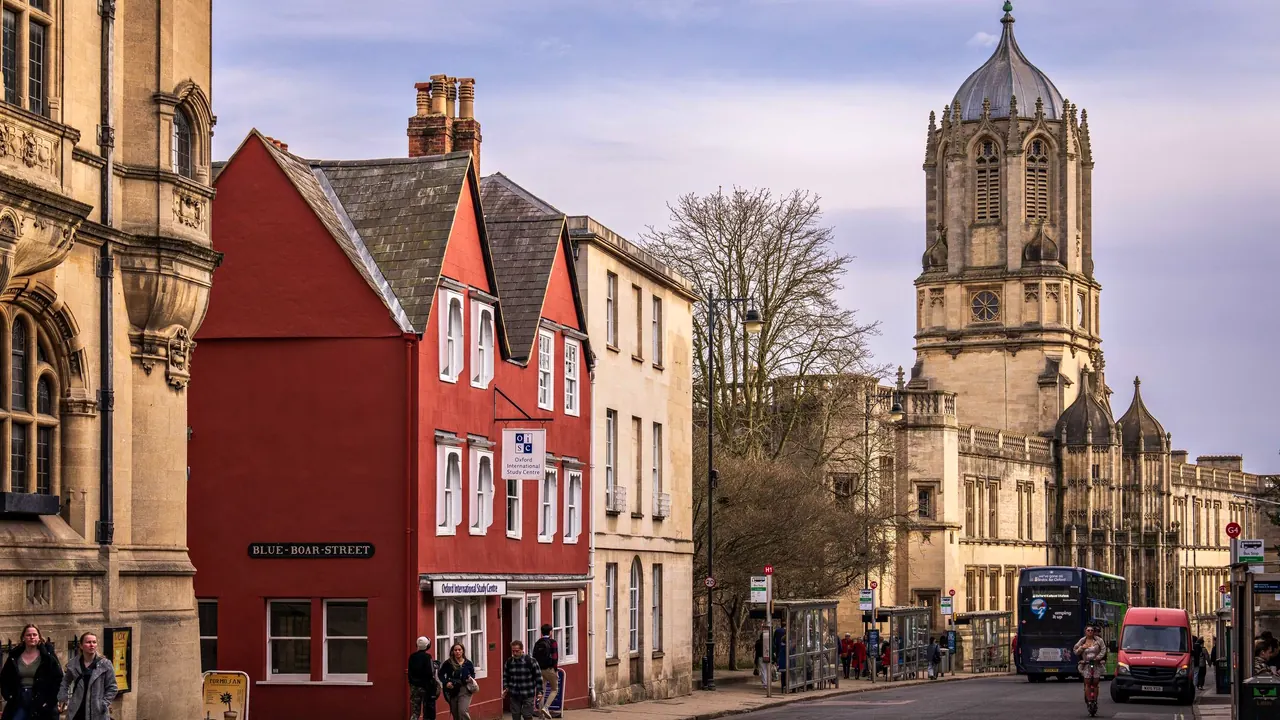
Photos: Brussels by Ettanghe, CC BY-SA 4.0, cropped; Oxford by Mark Stebnicki, Pexels License.
Brussels or Oxford?
Our verdict in twelve categories, each scored against the same fixed benchmark cities, and the climate month by month, so you can choose for your trip.
Choose Brussels for
- food and drink
- nightlife
- live music and the arts
Brussels is the better pick for travellers who plan their days around eating and drinking and want an evening that carries on past dinner. Its beer cafés, frites stands and the restaurants of Matonge and Saint-Gilles give it a table Oxford cannot match. It has an opera house and concert halls for a night of music, and fast trains put Ghent, Bruges and Antwerp on the doorstep. It is also the gentler city on the wallet, especially at weekends.
Choose Oxford for
- nature and the outdoors
- getting around
Oxford suits someone who wants a compact, quiet stay among college quadrangles, libraries and meadows, with the evening ending in a riverside pub or at Evensong. Everything in the centre is a short, flat walk, the countryside starts at Port Meadow, and Blenheim and the Cotswolds lie close by. Expect to pay more for a bed, and to eat well rather than memorably.
Scoreboard
Twelve categories on one fixed scale from 0 to 100. The shaded stretch is the gap between the two.
Your match
Pick a travel style or drag the sliders, and both match scores follow your weighting.
Wins on food and drink and nightlife with your weighting.
Wins on nature and the outdoors and getting around with your weighting.
What matters to you?
Category by category
What the scores mean for a trip.
Beaches & swimming
Neither city is for a beach vacation, but Brussels at least puts a sandy shore within reach. Ostend, De Haan and Knokke are a little over an hour away by train, better for a windy walk along the promenade than a swim. Oxford is further from the sea, and swimming there means a dip in the Thames at Port Meadow, in the Cherwell or in the open-air pool at Hinksey on a warm afternoon.
Food & drink
Brussels is a real eating city. Its own dishes, from waterzooi and shrimp croquettes to carbonnade stewed in beer, sit beside the Sablon chocolatiers and a beer culture built on lambics and gueuzes brewed nowhere else. Congolese cooking in Matonge and Moroccan and Turkish food around Schaerbeek add more range.
Oxford eats around the pub: good ale, a Sunday roast by the river and lunch from the stalls of the Covered Market. Cowley Road and Jericho add variety, but there is no local cuisine to seek out, and someone who travels for food will run out of reasons to stay long before they would in Brussels.
Culture & sights
The two are evenly matched, but they offer different experiences. Oxford's sights form one intact whole: colleges, chapels and the Radcliffe Camera in honey-coloured stone, all within a few minutes' walk, with the Ashmolean and the Pitt Rivers close by. Two or three days cover it well.
Brussels has the single greatest showpiece in the Grand-Place, plus Bruegel, Rubens and Magritte in the Royal Museums and Horta's Art Nouveau houses in Saint-Gilles. Its sights are more spread out, with office blocks between them, so it suits a visitor who comes for particular collections more than one who comes for a townscape.
Nightlife
Brussels is the better place to go out. You can choose between the bar streets around Saint-Géry and the Bourse, the local terraces of Flagey and Châtelain, a Marolles techno club that draws DJs from across Europe, and the queer bars of Rue du Marché au Charbon.
Oxford's evenings belong to the pub, with Cowley Road for a late bar and little more. Nightlife follows the university year, so outside term it is quieter still, and the centre usually goes quiet before midnight.
Nature & outdoors
Both offer mild, gentle green spaces rather than wild landscape, and the difference is how close they start. In Oxford you walk out of the centre onto Christ Church Meadow or Port Meadow, follow the Thames Path or take a punt. The Cotswolds, the Chilterns and the Ridgeway are all within an hour.
Brussels has one outstanding natural area in the tall beech woods of the Sonian Forest, along with the Bois de la Cambre and the ponds of Ixelles. For hills and kayaking you go to the Meuse valley around Dinant, a longer trip than anything Oxford asks of you.
Day trips
Both are excellent bases, but for different kinds of outing. From Brussels, quick trains do the work: Ghent in about half an hour, Antwerp in forty minutes, Bruges in an hour and even Paris within easy reach, so every trip is a car-free visit to a major town.
From Oxford the draw is country houses and villages as much as towns. Blenheim is twenty minutes away and London an hour by train, but the Cotswold villages, Stratford and Warwick are easier with a car or on a tour.
Good for families
Brussels has more to keep children busy for a week. There are the Atomium and Mini-Europe at Heysel, the Iguanodon hall at the Natural Sciences museum, Train World and the comic murals, and Walibi and Pairi Daiza are close enough for a day out. The downside is the cobbles and the traffic.
Oxford is calmer, and its flat centre is easier with a pushchair. Its free dinosaur and Pitt Rivers museums, punting and the Harry Potter connections at Christ Church make for a good couple of days. After that the city is mostly for adults, and the bigger attractions need a trip out.
Getting around
Both are easy to get around, in different ways. Oxford has a small, flat centre you can cross on foot in twenty minutes, with several streets closed to traffic and the station a short walk away.
Brussels relies more on public transport, and it has plenty: metro, trams and buses you pay for by tapping a bank card, and direct trains from the main stations to the airport. Its core is walkable too, though the climb to the upper town is steep. In neither city is a car worth having.
Shopping & style
Brussels gives a shopper more to do. The chocolatiers in the Galeries Royales Saint-Hubert and on the Sablon, the antiques shops and weekend market there, the flea market on Place du Jeu de Balle and the Belgian designers on Rue Antoine Dansaert all feel particular to the city.
Oxford's centre is mostly chains and a shopping centre. It is saved by the Covered Market, the independent shops of Jericho, the antique map and print sellers and the great bookshop on Broad Street. Its biggest draw for fashion is the outlet village near Bicester, outside the city.
Affordability
Neither is cheap, but Brussels is easier on the budget. Its hotels mostly serve business travellers, so rooms are cheaper at weekends, and frites, sandwiches and cooking from the immigrant neighbourhoods keep daily spending down.
Oxford's problem is the bed. There are few central rooms, and steady demand from university events keeps them expensive, so many visitors stay out by the ring road or come for the day from London. Free museums and pub meals help once you are there, but college entry fees add up.
Live music & performing arts
Brussels offers a broader range. La Monnaie puts on adventurous opera, Bozar and Flagey host the national orchestra and visiting ensembles, and contemporary dance and theatre are staged in both French and Dutch. Big rock tours and an old marionette theatre add to the mix.
Oxford's strength is narrower but memorable: Evensong sung by the choirs of Christ Church, Magdalen and New College in term, and chamber music in the historic Holywell Music Room. Its theatres mostly take touring shows.
Wellness & relaxation
Neither city is built for a restorative break, and neither has a bathing tradition, so the difference lies in the kind of calm on offer. Oxford's is green and quiet: the Botanic Garden, the walled college gardens and Addison's Walk early in the morning, or an afternoon on a punt.
Brussels has North African hammams and fine Art Deco pools, but it moves at the pace of a working capital. Its slow moments are a long lunch or an afternoon on a terrace in Ixelles.
When should you go?
Pick your month. The climate figures are measured averages, not a forecast.
Brussels in July
Oxford in July
Daytime high, °C
Rainfall in the month, mm
Where the figures come from
Oxford's temperatures are measured 37 km from the centre, at Fairford Royal Air Force Base.
Oxford has no rain gauge within 25 km of the centre, so its rainfall comes from a gridded climate dataset read at the city rather than from a gauge further away.
Oxford's sunshine is measured 57 km from the centre, at Lyneham.
Temperature and rainfall are climate normals, averaged over the years shown. Brussels: 1991-2020 normals, Uccle (5.2 km from centre). Oxford: 1961-1990 (sunshine 1991-2020, rainfall 1991-2020) normals, Fairford Royal Air Force Base (37 km from centre).
The two climates follow almost the same curve through the year. Summer peaks at about 23°C in Brussels and 22°C in Oxford. That is pleasant for walking the streets but nowhere near warm enough for a beach, and both cities get their best sunshine from May to August. Winters are cold and dark in both, with daytime highs of around 6°C and little sun from November to January.
The real difference is rain. Brussels is wetter all year, and wettest in high summer and December, with about 90mm in August, so a summer trip there needs an umbrella. Oxford is drier throughout, with no month above about 69mm, and its rainiest stretch runs from October to December. Late spring and early autumn suit both cities, and May and September are the most comfortable months for long days on foot.
Which traveller are you?
For a food and nightlife trip, pick Brussels and leave the evenings unplanned. A long dinner rolls easily into a beer café and then a late bar, with plenty to choose from. In Oxford the same night usually ends with a pint after dinner.
On a trip on a tight budget, Brussels stretches the money further. Book a Friday-to-Sunday stay, eat where the locals do and you can have a full trip without much strain. In Oxford, pay for the room first and fill your days with free museums and walks.
For an outdoors trip, the two suit different habits. Oxford is best for someone who likes to step out each morning on foot, by bike or in a punt. Brussels suits a traveller happy to take a train for a full day in the Ardennes.
Before you go
| Measure | Brussels | Oxford |
|---|---|---|
| Official language | French, German, Dutch | English |
| Currency | Euro (EUR) | Pound Sterling (GBP) |
| Sockets | CE230 V, 50 Hz | G230 V, 50 Hz |
| Driving side | Right | Left |
| Time zone | UTC+1, UTC+2 in summer | UTC, UTC+1 in summer |
| Emergency number | 112 | 112 or 999 |
| Elevation | 70 m | 73 m |
| Main airport | Brussels Airport (BRU)11 km from centre191 non-stop destinations | London Heathrow Airport (LHR)63 km from centre224 non-stop destinations |
| Public holidays this year | 14 days | 8 days |
By the numbers
| Measure | Brussels | Oxford |
|---|---|---|
| City population | 195,546 | 147,500 |
| People per km² | 5,908 | 3,235 |
| Museums within 10 km | 106 | 11 |
| UNESCO World Heritage sites within 50 km | 11 | 1 |
Where else could you go?
Every comparison below shares a destination with this one, so you can follow Brussels or Oxford somewhere new.
- Antwerpvs Brussels
- Ghentvs Brussels
- Londonvs Oxford
- Bathvs Oxford
- Brugesvs Brussels
- Maastrichtvs Brussels