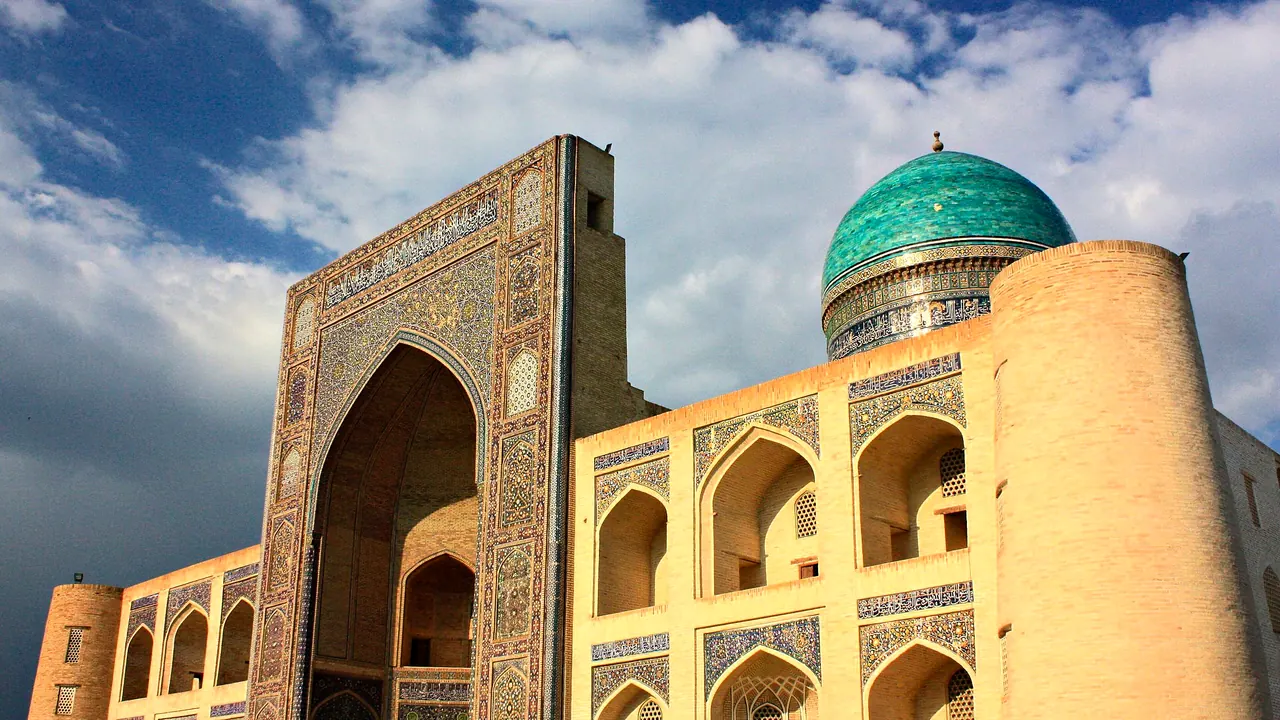
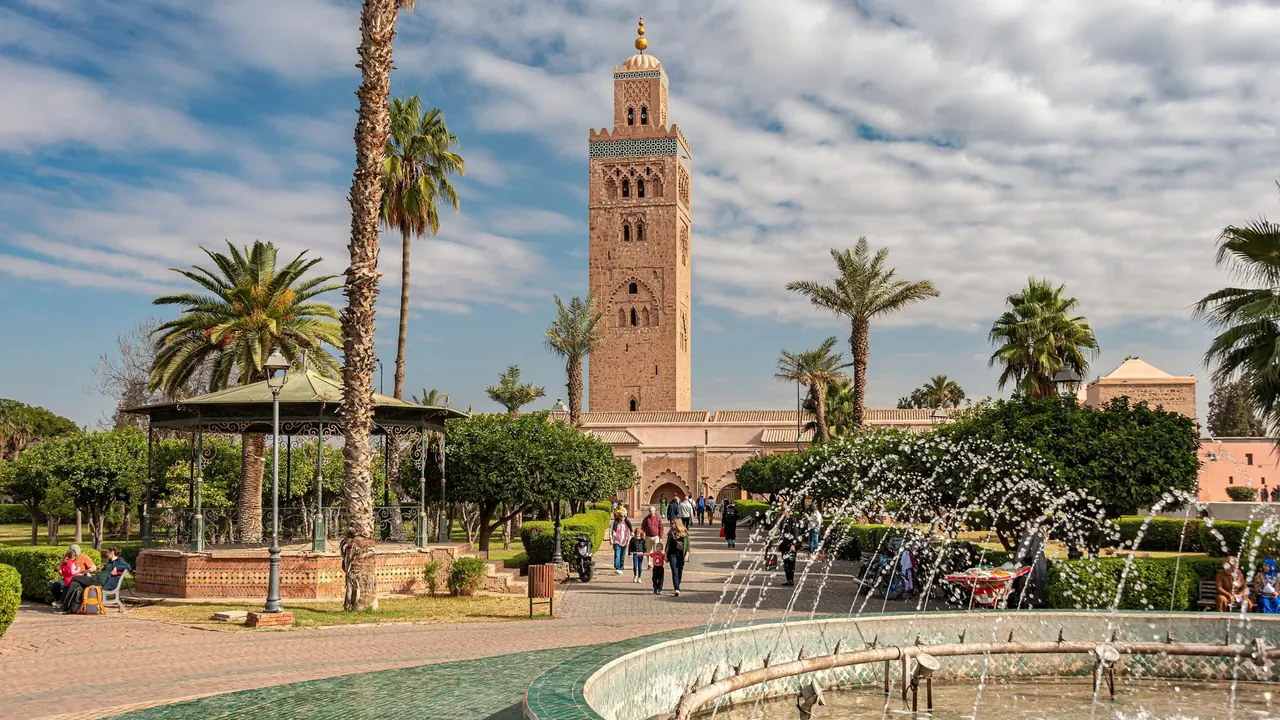
Photos: Bukhara by RK, CC BY-SA 4.0, cropped; Marrakech by Jorge Franganillo, CC BY 2.0, cropped.
Bukhara or Marrakech?
Our verdict in twelve categories, each scored against the same fixed benchmark cities, and the climate month by month, so you can choose for your trip.
Choose Bukhara for
- day trips
- getting around
- prices
Bukhara suits the traveller who wants an old Silk Road city still in one piece, seen at an easy pace. Its monuments stand close together in a flat, largely car-free centre. Evenings are quiet and costs are low, and Samarkand is close enough by train for a day out. Come for architecture and calm, not for nights out or the outdoors.
Choose Marrakech for
- nature and the outdoors
- food and drink
- nightlife
For a trip with more range, Marrakech is the better pick. The souks, hammams and food stalls of the medina give each day more texture. The High Atlas and the Agafay desert add mountain walks and desert nights that Bukhara cannot match. Expect more noise and more bargaining, and harder work if you bring small children.
Scoreboard
Twelve categories on one fixed scale from 0 to 100. The shaded stretch is the gap between the two.
Your match
Pick a travel style or drag the sliders, and both match scores follow your weighting.
Wins on day trips and getting around with your weighting.
Wins on nature and the outdoors and food and drink with your weighting.
What matters to you?
Category by category
What the scores mean for a trip.
Beaches & swimming
Neither city is a place to swim in open water, and in both a pool where you stay matters most in summer. Bukhara lies deep in Central Asia with no beach or bathing lake within reach, and its old pools such as Lyabi-Hauz are for sitting beside.
Marrakech at least offers a day away. The Lalla Takerkoust reservoir is about 40km off in the Atlas foothills, and the windy Atlantic at Essaouira, where the water is cool, is two and a half to three hours' drive.
Food & drink
Both cities have narrow kitchens, but Marrakech's is broader and more of a show. Bukhara centres on plov at lunchtime, with samsa, shashlik and noodles on teahouse platforms. Menus repeat across the old town, and there is little for vegetarians and almost no fine dining.
In Marrakech you get tagines, pastilla, harira and the slow-cooked tanjia, plus the evening grill stalls of Jemaa el-Fna and the mechoui counters in the medina. Riad menus repeat as well, but Gueliz and Hivernage add the international choice that Bukhara lacks.
Culture & sights
These are two of the great old Islamic cities, and in both you come for the buildings rather than the museums. Bukhara's strength is how complete it is. The Poi Kalon ensemble with the Kalon Minaret, the Ark, the Samanid Mausoleum and Chor Minor all stand within walking distance, among caravanserais and lanes that are still lived in.
Marrakech is less a set of monuments than a living medina, with its medieval street plan, the Koutoubia minaret and the storytellers of Jemaa el-Fna, plus the Bahia Palace and Ben Youssef Madrasa inside the walls. It also has a twentieth-century side that Bukhara lacks, in the Jardin Majorelle and the Yves Saint Laurent museum.
Nightlife
Neither is a party city, but Marrakech gives you more of an evening out. In Bukhara the night means tea and dinner around Lyabi-Hauz under the floodlit madrasas, maybe a hotel bar, and then bed.
The streets of Marrakech's medina are just as dry. In Hivernage and Gueliz, though, there are lounge bars, rooftop terraces and a few large clubs with DJs that stay open late, at resort-style prices.
Nature & outdoors
This is where the two cities differ most. Bukhara sits in a flat oasis of cotton fields and canals at the edge of the Kyzylkum. Its desert yurt camps towards Nurata are a long drive and mean a night away.
From Marrakech the High Atlas is on the horizon. The Ourika valley and Imlil, the starting point for Jebel Toubkal at 4,167m, are about an hour and a half away, and Oukaimeden has winter skiing. The Agafay desert, dawn balloon flights and the Ouzoud waterfalls give Marrakech an outdoor range Bukhara cannot touch.
Day trips
For visiting other towns, Bukhara is the better base. The main reason is the high-speed train to Samarkand, which takes a little under two hours and makes the Registan and Shah-i-Zinda a long but realistic day. The ceramic workshops of Gijduvon, the Vabkent minaret and Chor Bakr make shorter outings.
The places people most want to see from Marrakech, Essaouira and Ait Benhaddou, are two and a half hours or more away and really need a night. Closer in, there are only the weekly Berber souks at Asni and Amizmiz and the Almohad mosque at Tinmel. Marrakech's excursions are about mountains and desert instead.
Good for families
Bukhara's great asset with children is the welcome. Uzbek families go out together in the evenings, and strangers will fuss over a toddler. There is very little to entertain children, though: a puppet show or a camel at the summer palace, and otherwise mosques and fortresses. Summer heat often passes 40°C, so spring and autumn are the seasons to bring them.
Marrakech has slightly more aimed at children, with a water park on the edge of the city and camel rides in the palm grove. Even so, it is the more demanding city to spend a day in. The snake charmers and acrobats of Jemaa el-Fna delight some children and unsettle others. It works best with older children who enjoy markets, and with a riad or resort hotel that has a pool and a garden to retreat to.
Getting around
Bukhara is far simpler on foot. The Kalon Minaret, the Ark, Bolo Hauz and Lyabi-Hauz are all within about 20 minutes' walk across a flat, largely car-free centre, and cheap ride-hailing covers the outlying sights and the station.
You can walk Marrakech's medina too, but it is a maze of unnamed alleys shared with motorbikes and carts, where unofficial guides offer directions for a tip. To reach Gueliz or the Majorelle garden you take a petit taxi, often agreeing the fare first, and the mountains need a driver.
Shopping & style
Bukhara's shopping fits under a few sixteenth-century trading domes and in the madrasa courtyards beside them. There you find suzani, ikat, carpets and the stork-shaped scissors, often made in the next room. Quality is uneven and many stalls sell the same printed fabrics, but gentle haggling is enough.
Marrakech gives a shopper far more ground. Its souks fill whole lanes arranged by trade, from leatherworkers and dyers to lantern and babouche makers. Gueliz adds design boutiques that rework Moroccan crafts, and decorators buy in the Sidi Ghanem showrooms. Neither city has luxury fashion, and in Marrakech the bargaining takes longer and the sellers push harder.
Affordability
In Bukhara even a comfortable stay is cheap. Entry to the monuments is modest. The costliest choices, a boutique hotel in a restored mansion or dinner beside the old pools rather than in the backstreets, still cost far less than they would in most of Europe.
Marrakech's food stalls, local canteens and simple medina riads are cheap too. The difference is the city's large luxury tier of boutique riads, palace hotels and smart restaurants charging international prices. It is a far bigger part of a stay in Marrakech than Bukhara's few mansion hotels are in Bukhara, so a trip that drifts upmarket costs noticeably more.
Live music & performing arts
The difference is between shows put on for visitors and a street tradition that would go on without them, and Marrakech has the livelier evenings. In Bukhara you mostly get folk dance, music and costume shows in a madrasa courtyard near Lyabi-Hauz, plus puppet plays based on local stories. You are more likely to hear the classical Shashmaqam by chance at a wedding than at a concert you could book.
Marrakech's music needs no ticket. At dusk, gnawa players with clattering metal castanets and the three-stringed guembri gather on Jemaa el-Fna, along with drummers and storytellers. The custom is old enough to be protected by UNESCO, and the Popular Arts Festival brings in troupes from around Morocco. Neither city has opera, an orchestra season or theatre a visitor could follow.
Wellness & relaxation
In Bukhara a traditional bath means one of a few centuries-old bathhouses under brick domes near the trading halls, with steam, a scrub and a vigorous herbal massage. Beyond those there are only a few hotel spas. The real rest is the pace of the town: mornings in a courtyard, tea by the pools and empty lanes at dusk.
Marrakech offers far more for bathing. Every quarter of the medina has a public hammam with black soap and the kessa glove. Riads and hotels run spa hammams with argan oil massages and rhassoul wraps, from simple rooms to lavish marble ones. Calm comes from retreating into a riad courtyard or the Majorelle and Agdal gardens, away from the noise of the lanes.
When should you go?
Pick your month. The climate figures are measured averages, not a forecast.
Bukhara in July
Marrakech in July
Daytime high, °C
Rainfall in the month, mm
Temperature and rainfall are climate normals, averaged over the years shown. Bukhara: 2004-2020 (rainfall 1991-2020) normals, Bukhara / Tsyplan (3.4 km from centre). Marrakech: 1991-2020 normals, Marrakech (5.1 km from centre).
Bukhara has two short good seasons. April, at around 24°C, and October, at around 22°C, are ideal for walking, and late September is nearly as good. From May to August it is very hot, peaking at 38°C in July, and almost completely dry. Winter is properly cold, with January highs of 7°C, and the little rain the city gets falls between late autumn and spring.
Marrakech is just as hot in midsummer but far milder in winter, at about 19°C in January with plenty of sunshine. That makes it a comfortable choice from October right through to April, when Bukhara is cold. March brings its most rain, though even then not much. Neither city has a beach season, and in both cities summer means pool afternoons and sightseeing in the early morning.
Which traveller are you?
On an outdoors trip, Marrakech is the clear choice. The High Atlas lies within about an hour and a half, with village walks from Imlil, the Toubkal climb and winter skiing, and the Agafay desert is closer still. Bukhara offers only flat oasis and distant yurt camps.
For a trip on a tight budget, Bukhara goes further. Courtyard guesthouses, plates of plov and cheap taxis keep costs down, and because the old town is compact you will rarely need a fare. Marrakech is cheap day to day, but alcohol and high first prices in the souks add up.
On a family trip with young children, Bukhara is the gentler option. Its flat, mostly pedestrian centre suits a pushchair, and evenings by Lyabi-Hauz are calm. In Marrakech, crowded lanes, motorbikes and persistent sellers quickly tire parents out.
Before you go
| Measure | Bukhara | Marrakech |
|---|---|---|
| Official language | Uzbek | Arabic, Standard Moroccan Tamazight |
| Currency | Uzbekistan Sum (UZS) | Moroccan Dirham (MAD) |
| Sockets | CFI220 V, 50 Hz | CE50 Hz |
| Driving side | Right | Right |
| Time zone | UTC+5 | UTC+1 |
| Emergency number | 112 | Police 19/112, ambulance 15, fire 15 |
| Elevation | 225 m | 465 m |
| Main airport | Bukhara International Airport (BHK)5 km from centre11 non-stop destinations | Marrakesh Menara Airport (RAK)6 km from centre113 non-stop destinations |
| Public holidays this year | - | 11 days |
By the numbers
| Measure | Bukhara | Marrakech |
|---|---|---|
| City population | 280,187 | 1,002,697 |
| People per km² | 7,111 | 4,360 |
| Museums within 10 km | 2 | 14 |
| UNESCO World Heritage sites within 50 km | 1 | 1 |
Where else could you go?
Every comparison below shares a destination with this one, so you can follow Bukhara or Marrakech somewhere new.
- Essaouiravs Marrakech
- Agadirvs Marrakech
- Samarkandvs Bukhara
- Casablancavs Marrakech
- Rabatvs Marrakech
- Fesvs Marrakech