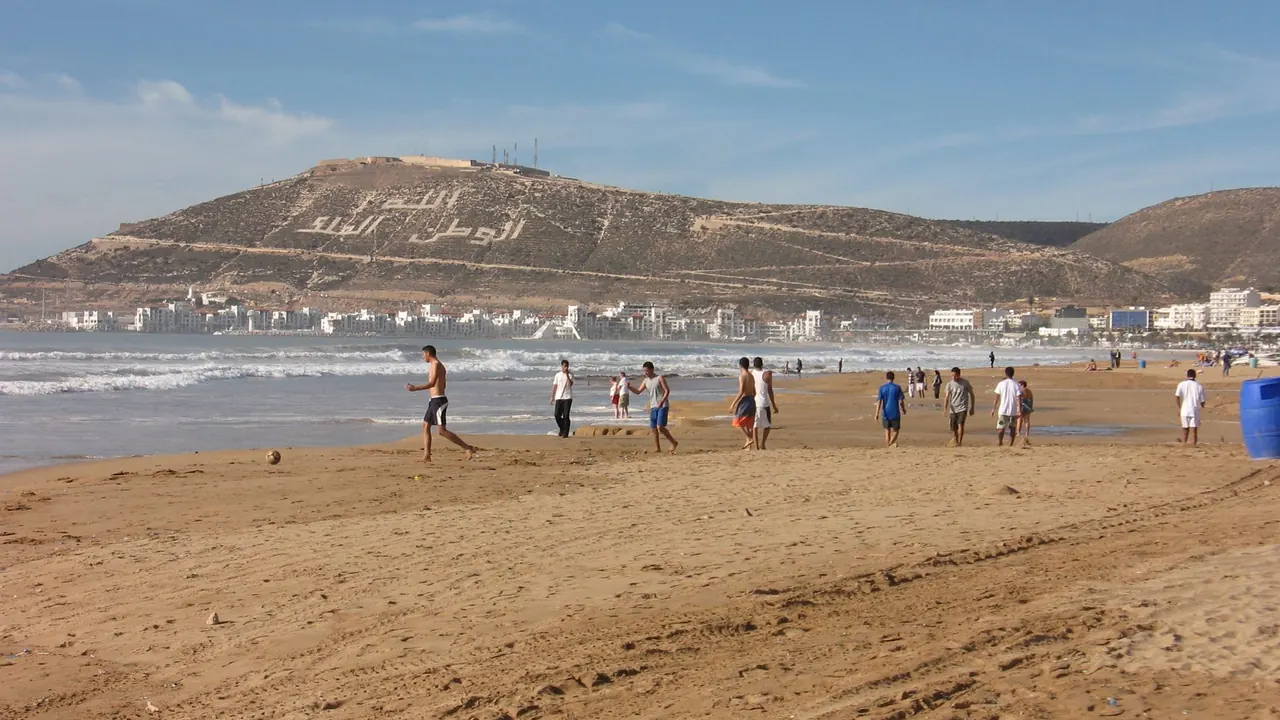
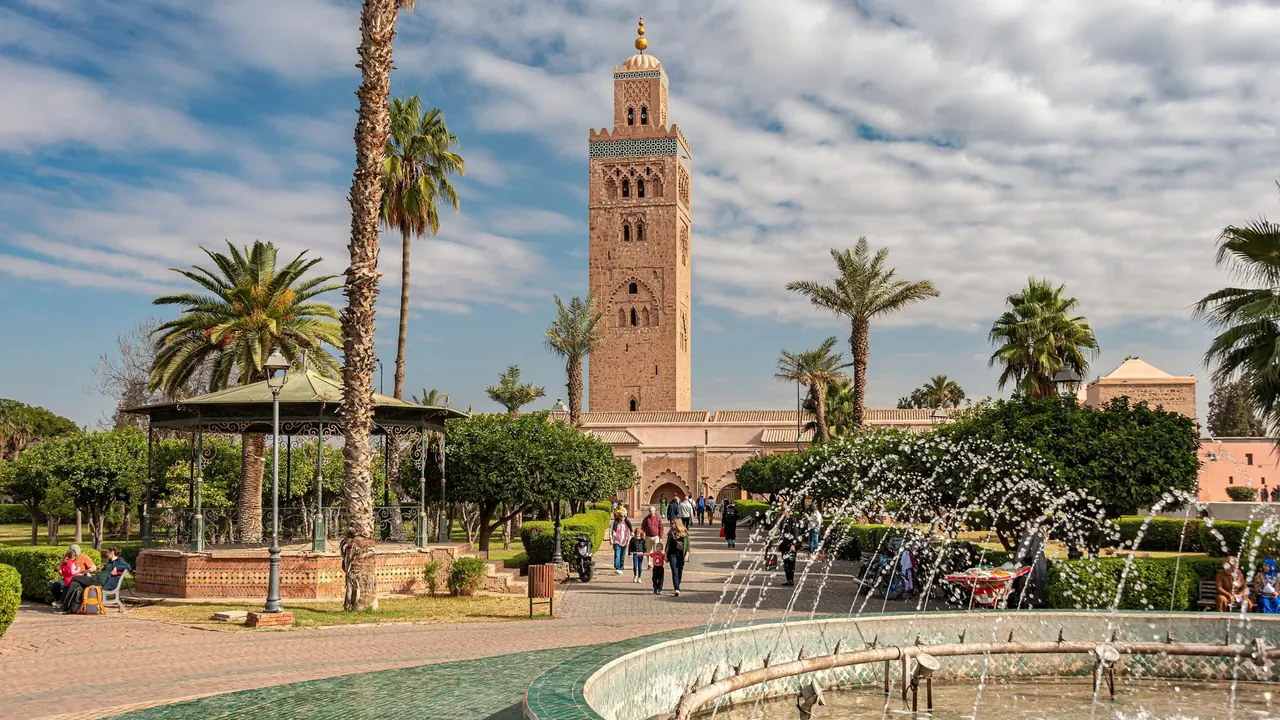
Photos: Agadir by michiel1972, CC BY-SA 3.0, cropped; Marrakech by Jorge Franganillo, CC BY 2.0, cropped.
Agadir or Marrakech?
Our verdict in twelve categories, each scored against the same fixed benchmark cities, and the climate month by month, so you can choose for your trip.
Choose Agadir for
- beaches
- families
- day trips
Agadir is the choice for a sun-and-sand trip. It has a long, sheltered bay of fine sand, a flat promenade, resort hotels with pools and a mild climate that works in winter as well as summer. Families with young children will find it much easier going than Marrakech, and so will anyone who mainly wants to rest by the sea. Surf villages and the occasional walled market town are within reach for a change of scene.
Choose Marrakech for
- culture and sights
- shopping
- wellness
Travellers who want Morocco at full strength should pick Marrakech. Its walled medina, palaces and madrasas, the souks arranged by trade and the evening scene on Jemaa el-Fna give it the history, shopping and food that Agadir lost when it was rebuilt after its earthquake. It asks more of you, with crowds, persistent sellers and summer heat, but the riads and hammams give you somewhere quiet to retreat to.
Scoreboard
Twelve categories on one fixed scale from 0 to 100. The shaded stretch is the gap between the two.
Your match
Pick a travel style or drag the sliders, and both match scores follow your weighting.
Too close to call, 2 points apart
Wins on beaches and families with your weighting.
Wins on culture and sights and shopping with your weighting.
What matters to you?
Category by category
What the scores mean for a trip.
Beaches & swimming
Agadir is a true beach destination. Close to 10km of fine sand curves around a sheltered bay where the water is usually calm, and the surf beaches of Tamraght and Taghazout are half an hour to the north. The Atlantic is cool, but the steady sunshine makes it a beach for winter as well as summer.
Marrakech has no beach at all. Swimming there means a riad plunge pool or a hotel pool. The nearest sea is at Essaouira, a long drive away, where the water is cool and the wind is strong.
Food & drink
Marrakech is the better place to eat Moroccan food. Tanjia slow-cooked in the embers of a hammam furnace, mechoui lamb from underground ovens and the grill stalls that fill Jemaa el-Fna at dusk give it a real food culture, even if medina menus start to repeat after a few days.
Agadir's best meals are simpler: fish grilled at the port stalls, with Souss flavours such as argan oil and amlou. Beyond that, most eating happens in hotels and along the promenade, where the cooking is uneven.
Culture & sights
This is where the two cities differ most. Marrakech's walled medina is a UNESCO site in its own right. The Koutoubia minaret, the Saadian Tombs, the El Badi and Bahia palaces and the Jardin Majorelle are all within easy reach, enough for two or three full days.
Agadir lost almost all of its old town in the earthquake of 1960. The kasbah walls on Agadir Oufella, the rebuilt Medina Polizzi and a small Amazigh museum fill a day, and the view from the hill is the real reward.
Nightlife
Neither city is a place to go for nights out, and in both, alcohol stays inside hotels and licensed venues. What differs is the setting. Agadir's nights are resort nights, with beach clubs at sunset, lounges by the marina and hotel bars that run late mostly in summer.
In Marrakech the evening means Jemaa el-Fna and a long dinner, perhaps with a cocktail on a rooftop over the medina. Anyone looking for clubs heads to Hivernage and Gueliz in the new town.
Nature & outdoors
Both cities have strong outdoor country nearby, but of different kinds. From Agadir it is the coast and the dry land behind it. Tamraght, Taghazout and Imsouane have surf schools and long point breaks. About an hour inland, the road crosses plains of argan trees, where goats climb into the branches, to Paradise Valley, a palm-filled gorge with rock pools and easy walks. To the south, Souss-Massa National Park shelters the rare northern bald ibis, and Agadir suits anyone who wants to spend their outdoor days in or by the water.
Marrakech looks to the High Atlas and the desert instead. Imlil is the trailhead for walks between Berber villages and for the two-day climb of Jebel Toubkal, North Africa's highest peak. The Ourika valley, winter skiing at Oukaimeden, and camel rides and dawn balloon flights over the stony Agafay desert are all within easy reach. Walkers and trekkers get a little more from Marrakech, though summer heat on the plain keeps activity to the early mornings.
Day trips
Agadir is the better base for days out, mainly because of Taroudant. This market town, enclosed by ochre earthen walls, is an hour and a half inland and has calm souks. Tiznit and its silver jewellery are to the south, and the surf villages up the coast make easy half days.
Most excursions from Marrakech go to mountains and desert, and the towns people most want to see, Essaouira and Ait Benhaddou, are better with a night away. Closer to the city there are the foothill souks at Asni and Amizmiz and the Almohad mosque at Tinmel.
Good for families
Agadir is far easier with children. The bay is gentle and the promenade suits buggies and scooters. All-inclusive hotels provide pools and kids' clubs, and the crocodile park and the Vallée des Oiseaux make a break from the sand.
Marrakech is harder going, with crowded lanes shared with motorbikes and carts, persistent sellers and draining summer heat. A riad with a plunge pool helps. Older children who like markets enjoy it most, ideally in spring or autumn.
Getting around
Agadir is a little simpler to get around. You can walk the beachfront promenade between hotels, restaurants and the marina, and orange petit taxis cover the short rides to the souk, the port and the kasbah hill.
The Marrakech medina has to be explored on foot, but its unnamed alleys are easy to get lost in and are shared with motorbikes. Beige petit taxis link it to Gueliz and Majorelle. Neither city has a metro or tram, and trips into the mountains or along the surf coast need a driver, a hire car or a tour.
Shopping & style
In Marrakech, shopping is a reason to go in itself. The souks north of Jemaa el-Fna are arranged by trade, from leather and lanterns to carpets and babouches, and Gueliz and Sidi Ghanem add design boutiques and showrooms. The long bargaining tires some visitors.
Agadir has Souk El Had, a large and calmer market where locals actually shop, and the Souss is the place to buy argan oil from the women's cooperatives. Beyond that there are seafront souvenir shops and a mall.
Affordability
Both cities are inexpensive by European standards, and in both, alcohol costs more because only licensed places sell it. In Agadir the savings come from fish at the port, taxis and off-season beach packages, while prices rise along the promenade.
Marrakech is cheap at the street stalls and for entry to the palaces, and simple medina riads offer character for modest money. It also has a large luxury tier, and what you pay in the souks depends on how patiently you bargain.
Live music & performing arts
Neither city has opera, theatre or a concert season. Marrakech has more to offer because its performances happen in the open every night: gnawa musicians, drummers and storytellers in Jemaa el-Fna, along with the long-running Popular Arts Festival.
Agadir's big moment is the Timitar festival of Amazigh music in summer. For the rest of the year, live performance mostly means hotel entertainment and folk shows put on for visitors.
Wellness & relaxation
Marrakech has the deeper bathing culture. Every quarter of the medina has a public hammam, the spa hammams range up to lavish marble spaces, and a riad courtyard with a fountain and orange trees is a real retreat, even though the lanes outside are loud.
In Agadir, the rest comes from the pace of the place instead. Days settle into sun, sea and walks along the promenade. Hotel spas offer black-soap scrubs and argan massages, there is seawater thalassotherapy around the bay, and yoga and surf retreats run along the coast to the north.
When should you go?
Pick your month. The climate figures are measured averages, not a forecast.
Agadir in July
Marrakech in July
Daytime high, °C
Rainfall in the month, mm
Where the figures come from
Agadir has no rain gauge within 25 km of the centre, so its rainfall comes from a gridded climate dataset read at the city rather than from a gauge further away.
Temperature and rainfall are climate normals, averaged over the years shown. Agadir: 1945-2025 (rainfall 1991-2020) normals, Agadir (4.5 km from centre). Marrakech: 1991-2020 normals, Marrakech (5.1 km from centre).
Agadir barely changes through the year. Daytime highs stay in the low to mid twenties from winter to spring and reach about 28°C in July and August. The Atlantic stays cool, around 17°C in winter and 20°C at best in late summer. Almost no rain falls from May to September. What rain there is comes between November and February and is heaviest in December. That makes it a steady winter-sun choice, with summer and early autumn the warmest months for swimming.
Marrakech swings much more. From June to September the heat is fierce, peaking near 38°C in July, which is too hot for walking the medina except early or late in the day. Spring from March to May and October into November are the best months for sightseeing, warm and very sunny. Winter days are mild at around 20°C, with light rain spread from late autumn into early spring. In high summer the coast is far more comfortable than the plain.
Which traveller are you?
On a beach and sun trip, Agadir is the obvious pick. Its long sandy bay is usually calm enough for easy swimming, the sun is reliable even in winter, and surf beaches lie just up the coast. Marrakech offers only hotel and riad pools.
For a culture and arts trip, Marrakech wins clearly. The UNESCO-listed medina, the Bahia Palace, the Ben Youssef Madrasa and the musicians and storytellers of Jemaa el-Fna fill several days. Agadir's old town was almost entirely destroyed by the 1960 earthquake.
On a family trip with young children, Agadir is far easier. A gentle bay, a flat promenade for buggies and hotels with pools and kids' clubs keep days simple. In Marrakech, crowded lanes, motorbikes and summer heat tire children out quickly.
Before you go
| Measure | Agadir | Marrakech |
|---|---|---|
| Official language | Arabic, Standard Moroccan Tamazight | Arabic, Standard Moroccan Tamazight |
| Currency | Moroccan Dirham (MAD) | Moroccan Dirham (MAD) |
| Sockets | CE50 Hz | CE50 Hz |
| Driving side | Right | Right |
| Time zone | UTC+1 | UTC+1 |
| Emergency number | Police 19/112, ambulance 15, fire 15 | Police 19/112, ambulance 15, fire 15 |
| Elevation | 74 m | 465 m |
| Main airport | Al Massira Airport (AGA)20 km from centre75 non-stop destinations | Marrakesh Menara Airport (RAK)6 km from centre113 non-stop destinations |
| Public holidays this year | 11 days | 11 days |
By the numbers
| Measure | Agadir | Marrakech |
|---|---|---|
| City population | 538,000 | 1,002,697 |
| People per km² | - | 4,360 |
| Museums within 10 km | 1 | 14 |
| UNESCO World Heritage sites within 50 km | 0 | 1 |
| Swim season, months above 21 °C | None | - |
Where else could you go?
Every comparison below shares a destination with this one, so you can follow Agadir or Marrakech somewhere new.