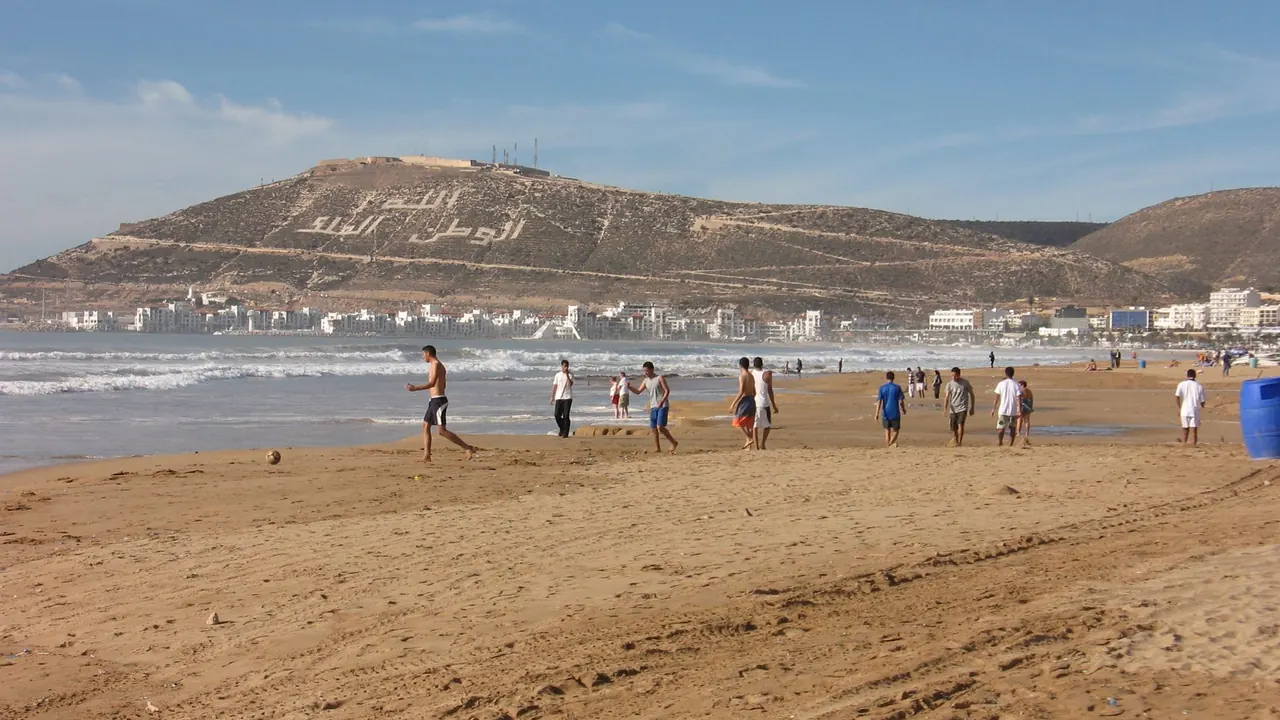
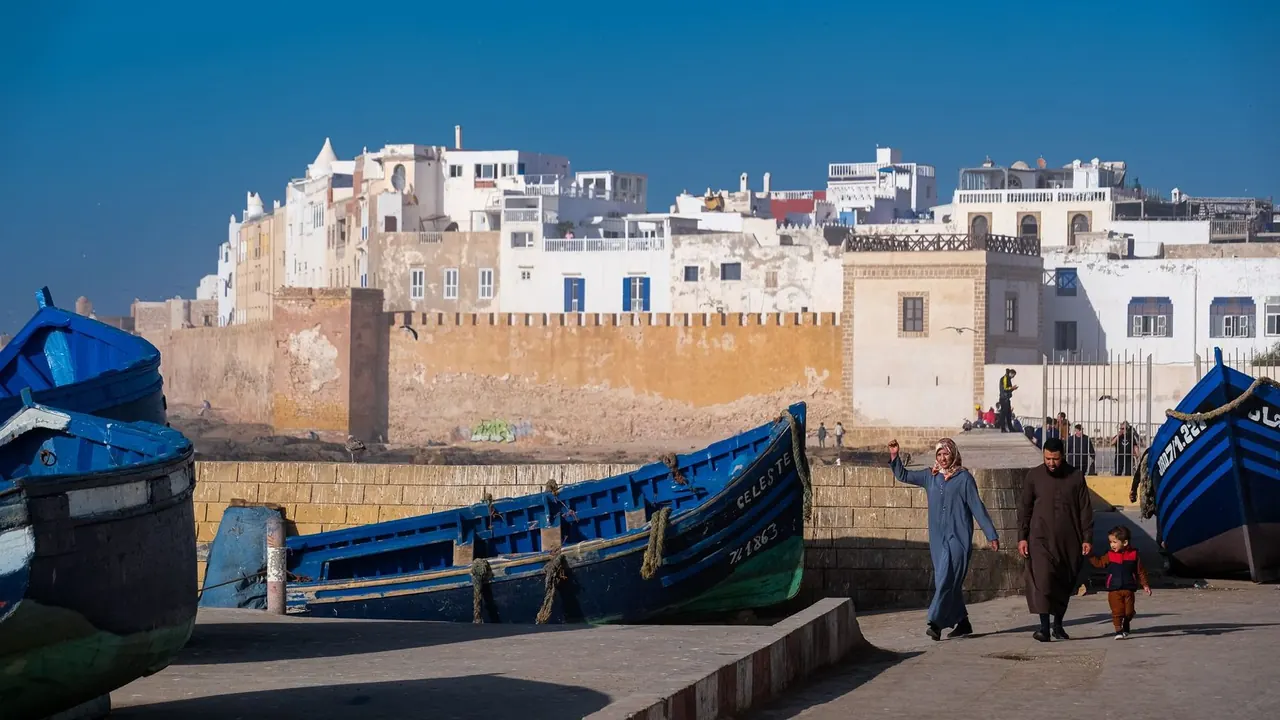
Photos: Agadir by michiel1972, CC BY-SA 3.0, cropped; Essaouira by Manel Cusido, Pexels License.
Agadir or Essaouira?
Our verdict in twelve categories, each scored against the same fixed benchmark cities, and the climate month by month, so you can choose for your trip.
Choose Agadir for
- beaches
- day trips
- nightlife
Agadir is the one for a proper beach vacation, and especially for winter sun. The sheltered bay is calm enough to swim, the sand is long, and the hotels are built around pools, spas and kids' clubs. It suits families, couples who want warmth and an easy routine, and groups who want a few nights out. The surf coast, Paradise Valley and walled Taroudant are all close enough for days away from the sand. What it lacks is history, because the old town was lost in the 1960 earthquake.
Choose Essaouira for
- culture and sights
- getting around
- live music and the arts
Travellers who would rather wander than sunbathe will be happier in Essaouira. Its walled medina is a real historic town, small and largely free of cars, so it is a pleasure to explore on foot. It is also the home of gnawa music, and the slow pace of riad roof terraces suits a quiet, unhurried stay. Its trade wind makes it a magnet for kitesurfers but a poor place for lying on the beach, and the evenings end early.
Scoreboard
Twelve categories on one fixed scale from 0 to 100. The shaded stretch is the gap between the two.
Your match
Pick a travel style or drag the sliders, and both match scores follow your weighting.
Too close to call, 2 points apart
Wins on beaches and day trips with your weighting.
Wins on culture and sights and getting around with your weighting.
What matters to you?
Category by category
What the scores mean for a trip.
Beaches & swimming
Agadir is the real beach destination of the two. Its sheltered bay has close to 10km of sand in front of the promenade, the water near town is usually calm enough to swim in, and there are lifeguards in season. Surf beaches such as Tamraght and Taghazout lie a short way up the coast.
Essaouira's beach is just as wide and starts right at the medina walls. From spring to late summer, though, the trade wind blows across it, and it becomes a place for walking, horse riding and watching kites. Swimming is limited to calm mornings and the corner by the port, and Sidi Kaouki to the south is wilder, not gentler.
Food & drink
The best meal in both towns is grilled fish at the port, chosen from the day's catch and eaten at shared tables, with argan oil and amlou from the countryside around. Agadir has a little more range. Souk El Had is a huge produce market, the Souss is known for slow-cooked Amazigh tagines, and the resort strip, though uneven, has more hotels and licensed restaurants serving international food and alcohol.
Essaouira's food is narrower: Moroccan home cooking such as fish tagine and Friday couscous, mint tea in the squares, and a small group of riad dining rooms. Very few places serve alcohol.
Culture & sights
Here Essaouira is clearly the richer stop. The whole medina was laid out in the 18th century and is listed by UNESCO as a fortified port: a grid of whitewashed houses with blue shutters inside sea walls. Cannons line the Skala ramparts, and the old mellah recalls the town's Jewish trading past. A day or two covers it, but all of that time is spent in real historic streets.
Agadir lost almost everything in the 1960 earthquake, and the city that replaced it is modern and planned. The kasbah walls on Agadir Oufella are worth the climb mainly for the view, and the Medina Polizzi is a modern reconstruction. For real heritage you have to travel out to Taroudant or Tiznit.
Nightlife
Neither is a party town, but Agadir at least has a night out to offer. Its hotel bars, few nightclubs, marina lounges and beach clubs with music at sunset can stay open late in summer and around European school breaks.
Essaouira has no clubs to speak of. There are rooftop terraces at sunset, some riad bars and a couple of beach bars where surfers and kitesurfers gather. The medina is quiet well before midnight, and most evenings end with a walk on the ramparts.
Nature & outdoors
Agadir has the bigger and more varied outdoors, because it sits where the High Atlas meets the sea. Paradise Valley, a palm-filled gorge with rock pools, is about an hour inland, and the point breaks of Taghazout and Imsouane draw surfers. Souss-Massa National Park shelters the rare northern bald ibis, and the Anti-Atlas has trekking.
Essaouira's landscape is gentler and flatter, with argan hills, dunes towards Diabat and Eleonora's falcons on the islands off the bay, and no mountains nearby. Its strength is the wind, and for kitesurfing and windsurfing it is the better of the two.
Day trips
Agadir is better placed for days out. Taroudant, with its ochre earthen ramparts and calm souks, is about an hour and a half inland. Tiznit, another walled town, lies to the south, and the surf villages up the coast make easy half days.
Essaouira is more isolated, and its outings are small: the woodcarving workshops at Ghazoua, the argan cooperatives, the fort ruins near Diabat half buried in sand, and Sidi Kaouki. Safi's pottery quarter is about two hours up the coast. From either town, Marrakech is around three hours away and works better as an overnight stop than a day trip.
Good for families
Agadir is built for family beach time. It has a calm, sandy bay, a flat promenade for buggies and scooters, and all-inclusive hotels with pools and kids' clubs. The crocodile park and the Vallée des Oiseaux fill a couple of afternoons.
Essaouira appeals to children in a different way, with camels on the sand, fishing boats in the port and a small medina that is mostly free of cars. But there is nothing built for children, and the cool sea and summer wind make beach days harder for small ones. Many riads also have steep stairs and open roof terraces.
Getting around
Essaouira is the easier town to manage without transport. The flat, mostly car-free medina, the port and the beach promenade are all within about twenty minutes' walk of each other, and porters with hand carts take your luggage to the riad.
In Agadir only the beachfront promenade is walkable. The souk, the kasbah hill and the port are spread out, so you rely on the orange petit taxis. For anything further, both towns need a grand taxi or a hired car, and driving around Agadir is fairly straightforward once you are out of the city.
Shopping & style
Essaouira has the more distinctive shopping. Thuya-wood boxes and inlaid trays are made in workshops under the ramparts, and small galleries sell naive and gnawa-inspired paintings that are hard to find anywhere else in Morocco. The souk lanes are calm and easy to browse.
Agadir's Souk El Had is bigger and more of a working market, where locals buy produce and household goods and visitors find rugs and Amazigh silver. Beyond it there are seafront souvenir shops and a mall. In both towns, argan oil from the women's cooperatives is the thing to take home.
Affordability
Both towns are cheap for European visitors, with grilled fish at the port, low taxi fares and little to pay for sightseeing. What differs is where the savings are. In Agadir they are in off-season beach hotels and all-inclusive packages, while the seafront strip and alcohol cost more.
In Essaouira the good value is in riad rooms outside summer and the festival weekends, and the medina and ramparts are free to wander. The smarter rooftop restaurants and anywhere serving alcohol charge more than in an ordinary Moroccan town.
Live music & performing arts
Essaouira has the stronger musical identity as the home of gnawa, the trance music of Morocco's Afro-Moroccan brotherhoods. Its Gnaoua World Music Festival brings gnawa masters and jazz musicians together on free stages, and the rest of the year you can still hear the music informally in squares and restaurants.
Agadir has the Timitar festival of Amazigh music in summer. Outside it, live performance mostly means hotel entertainment and folk shows put on for visitors. Neither town has a theatre or an opera.
Wellness & relaxation
Both suit a slow vacation, and both offer the black-soap hammam scrub followed by an argan-oil massage. For simply slowing down, Essaouira has the edge. The medina has no traffic, and days go on long riad breakfasts, books and sunsets on the ramparts, though the wind can make lounging outdoors less restful.
Agadir's calm comes from the resort. It has hotel spas, seawater thalassotherapy centres along the bay and an easy rhythm of sun and walks on the promenade, with yoga and surf retreats up the coast.
When should you go?
Pick your month. The climate figures are measured averages, not a forecast.
Agadir in July
Essaouira in July
Daytime high, °C
Rainfall in the month, mm
Where the figures come from
Agadir has no rain gauge within 25 km of the centre, so its rainfall comes from a gridded climate dataset read at the city rather than from a gauge further away.
Essaouira has no rain gauge within 25 km of the centre, so its rainfall comes from a gridded climate dataset read at the city rather than from a gauge further away.
Temperature and rainfall are climate normals, averaged over the years shown. Agadir: 1945-2025 (rainfall 1991-2020) normals, Agadir (4.5 km from centre). Essaouira: 1991-2020 normals, Essaouira (1.4 km from centre).
Both cities are mild all year and dry from May to September, but Agadir is several degrees warmer. Its highs reach 28°C in July and August, warm enough for real beach days, and even in January the afternoons stay in the low twenties, which is why it works for winter sun. Essaouira is cooler all year and peaks at only about 24°C in September. Summer there is pleasant for walking the medina but seldom hot enough to make the beach the point, and the trade wind blows hardest from spring to late summer.
The sea is much the same in both, cool at about 17°C in winter and reaching only 20°C by late summer. The rain comes in late autumn and winter. Essaouira has the wetter season, with December its rainiest month at 49mm, while Agadir's rain is lighter and starts later. Neither town is ever too hot for sightseeing.
Which traveller are you?
On a beach and sun trip, Agadir is the clear choice. Its sheltered bay is calm enough for swimming, the sand runs for kilometres and the days are noticeably warmer. In Essaouira the wind and cool water make the beach better for walking than for lying on.
For a culture and arts trip, Essaouira wins easily. It has a UNESCO-listed walled medina, the Skala ramparts lined with cannons, the old Jewish quarter and the gnawa music it is famous for. That is far more to explore than in Agadir, which was rebuilt after the 1960 earthquake.
On a family trip with young children, Agadir is the easier base. The gentle bay, the flat promenade and the all-inclusive hotels with pools and kids' clubs keep everyone busy. Essaouira has nothing built for children, and its beach is windy and cool.
Before you go
| Measure | Agadir | Essaouira |
|---|---|---|
| Official language | Arabic, Standard Moroccan Tamazight | Arabic, Standard Moroccan Tamazight |
| Currency | Moroccan Dirham (MAD) | Moroccan Dirham (MAD) |
| Sockets | CE50 Hz | CE50 Hz |
| Driving side | Right | Right |
| Time zone | UTC+1 | UTC+1 |
| Emergency number | Police 19/112, ambulance 15, fire 15 | Police 19/112, ambulance 15, fire 15 |
| Elevation | 74 m | 11 m |
| Main airport | Al Massira Airport (AGA)20 km from centre75 non-stop destinations | Essaouira-Mogador Airport (ESU)15 km from centre13 non-stop destinations |
| Public holidays this year | 11 days | 11 days |
By the numbers
| Measure | Agadir | Essaouira |
|---|---|---|
| City population | 538,000 | 82,962 |
| People per km² | - | 16,592 |
| Museums within 10 km | 1 | 2 |
| UNESCO World Heritage sites within 50 km | 0 | 1 |
| Swim season, months above 21 °C | None | None |
Where else could you go?
Every comparison below shares a destination with this one, so you can follow Agadir or Essaouira somewhere new.