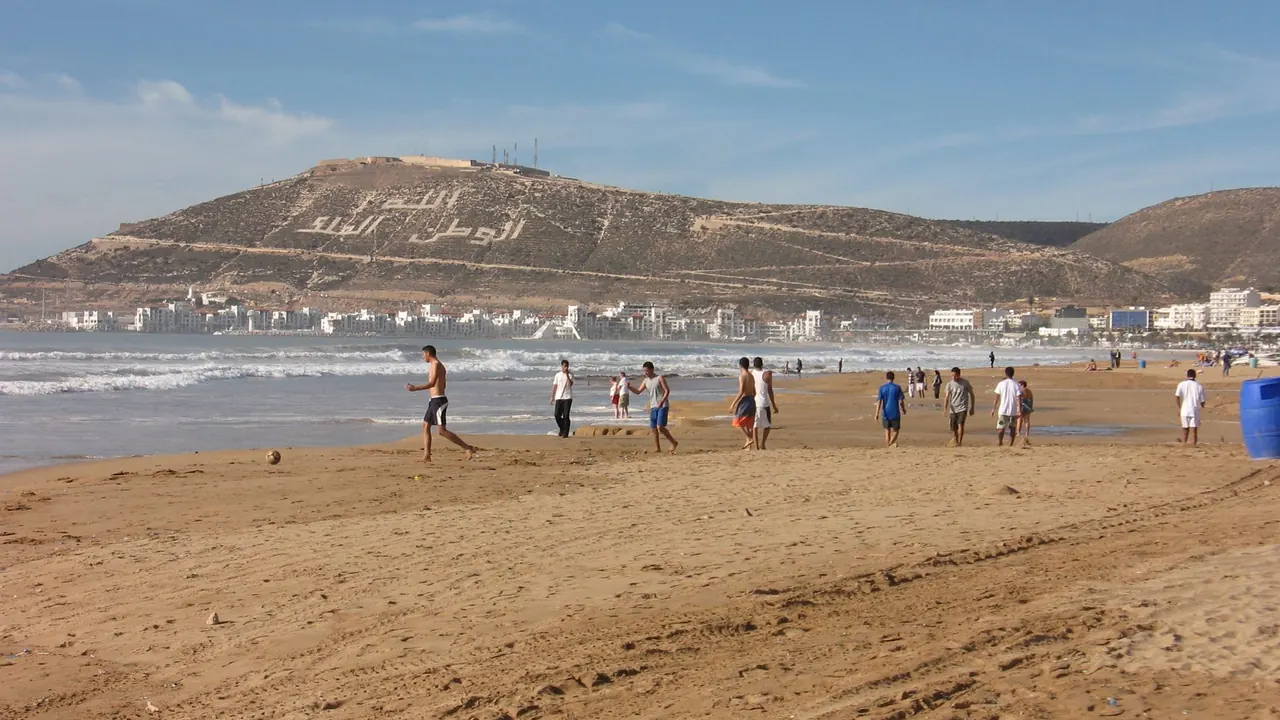
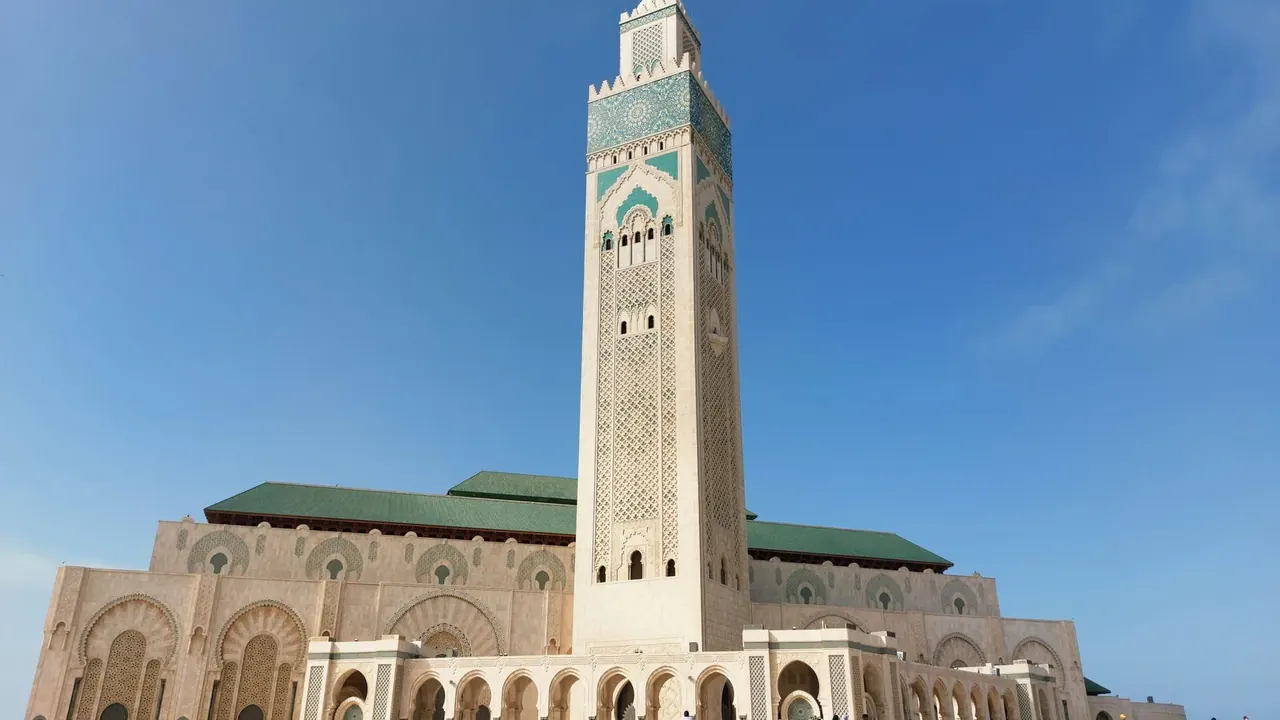
Photos: Agadir by michiel1972, CC BY-SA 3.0, cropped; Casablanca by Samir Bakkah, Pexels License.
Agadir or Casablanca?
Our verdict in twelve categories, each scored against the same fixed benchmark cities, and the climate month by month, so you can choose for your trip.
Choose Agadir for
- nature and the outdoors
- beaches
- families
Agadir suits a slow beach vacation, especially in winter. Its long sandy bay has calm water and easy swimming, which Casablanca's open, current-prone shore cannot offer. Families, surfers bound for Taghazout and anyone who prefers argan plains, Paradise Valley and spa afternoons to sightseeing will be happier here.
Choose Casablanca for
- culture and sights
- live music and the arts
- day trips
Pick Casablanca for a city trip. The Hassan II Mosque, the Art Deco boulevards and the Habous quarter give it far more to see, and its restaurants and Corniche nights have more life. The train also puts Rabat and El Jadida within an easy day. It works best as a few days at the start or end of a wider tour of Morocco, not as a place to lie in the sun.
Scoreboard
Twelve categories on one fixed scale from 0 to 100. The shaded stretch is the gap between the two.
Your match
Pick a travel style or drag the sliders, and both match scores follow your weighting.
Too close to call, 2 points apart
Wins on nature and the outdoors and beaches with your weighting.
Wins on culture and sights and live music and the arts with your weighting.
What matters to you?
Category by category
What the scores mean for a trip.
Beaches & swimming
This is where Agadir pulls clearly ahead. Close to 10km of fine sand curves around a bay that softens the Atlantic swell, so you can swim straight from the promenade, and there are lifeguards in season. Surfers have smaller beaches and point breaks up the coast within half an hour.
Casablanca's Ain Diab Corniche has a long stretch of sand too, but the sea there is rough, the currents can be dangerous and water quality varies. Many locals swim in beach club pools instead. A good beach day usually means driving out to Dar Bouazza or Bouznika.
Food & drink
Both cities eat best on grilled fish, but Casablanca has much more range. You can choose fish at the Marché Central and have it grilled next door, try street snacks in the Old Medina, and eat at French-style brasseries and pâtisseries in Maarif and Gauthier. Café terraces are a part of every street.
In Agadir the highlight is the shared tables at the fishing port, along with Souss flavours such as amlou and argan oil. Beyond that, most meals are in hotels or on the promenade, where the menus lean international and the cooking is uneven.
Culture & sights
Casablanca has far more to see. The Hassan II Mosque, which non-Muslims can enter on a guided tour, stands over the ocean. Around Boulevard Mohammed V there are streets of Art Deco and neo-Moorish buildings, and the Habous quarter and the Museum of Moroccan Judaism fill two or three days.
Agadir was rebuilt after the 1960 earthquake as a planned modern town. The kasbah ruins on Agadir Oufella are mostly worth climbing for the view, and with the Medina Polizzi and a small Amazigh museum, one day covers it all.
Nightlife
Neither city has street drinking or a bar-hopping quarter, but Casablanca has more of a scene. Its clubs and lounges at Ain Diab play house and Arabic pop late into weekend nights for a well-dressed local crowd, and the protectorate-era bars and cocktail lounges downtown fill the rest of the week.
Agadir's evenings revolve around hotel bars, the marina lounges and sunset beach clubs. They are busiest in summer and during European school breaks and are often quiet the rest of the year.
Nature & outdoors
Agadir has much more landscape on its doorstep. To the north are the surf points of Tamraght, Taghazout and Imsouane, and inland lie Paradise Valley's rock pools and argan plains where goats climb the trees. Souss-Massa National Park to the south is a refuge for the rare northern bald ibis, and the Anti-Atlas offers trekking further out.
Casablanca sits on a flat plain. Outdoors there means running the Corniche to the El Hank lighthouse, learner surf breaks and the eucalyptus trails of Bouskoura forest, with the mountains too far for a day.
Day trips
Casablanca is far better placed for days out. Rabat is about an hour away by train, with the Kasbah des Oudayas, the Hassan Tower and the Chellah ruins. The Portuguese sea walls of El Jadida and the whitewashed medina of Azemmour are an easy trip down the coast.
From Agadir, the best outing is to the earthen ramparts and calm souks of Taroudant, and the silversmiths of Tiznit come second. Beyond those, Essaouira, Marrakech and Tafraoute are far enough away that they need an overnight stay.
Good for families
Agadir is the easier choice with children. It has a gentle sandy bay, a flat promenade for buggies and scooters, and all-inclusive hotels with pools and kids' clubs. The crocodile park and the Vallée des Oiseaux fill the gaps between beach days.
Casablanca actually has more attractions aimed at children, including the mall aquarium and the old amusement park and zoo at Ain Diab. But heavy traffic, broken pavements and a risky sea make it hard work, and it suits older children on a short stop.
Getting around
Getting around is about equally easy in both cities, but in different ways. Agadir's tourist life sits along one promenade you can walk end to end, and orange petits taxis cover the rides to the souk, the port and the kasbah hill. For the surf coast or Paradise Valley you need a grand taxi or a hire car.
Casablanca is bigger. Its tram links downtown, the stations and Ain Diab, and red petits taxis fill the gaps, though meters are sometimes ignored. Fast trains make onward travel simple, but driving in the city is best avoided.
Shopping & style
Casablanca has more to offer shoppers, mainly in modern retail. The Corniche mall carries international and luxury brands, Maarif has fashion streets and local designers, and the Habous quarter sells leather, lamps and babouches with little pressure from sellers.
Agadir's strength is Souk El Had, a huge market where locals do their own shopping. It is also the better place for argan products from Souss cooperatives, Amazigh silver and woven rugs, which Casablanca has few of, but there is little fashion or design.
Affordability
Both cities are cheap for everyday spending such as taxis, grilled fish and local cafés. Where they differ is in where you sleep. Agadir's beach hotels and all-inclusive packages can be very cheap outside European school breaks, though the promenade restaurants charge more.
Casablanca's hotels are aimed at business travellers and priced to match, and there are fewer good guesthouses. Drinks and dining on the Corniche are expensive by local standards, so the savings come from eating where locals eat.
Live music & performing arts
Without a theatre or any regular music venue, Agadir's year of live performance comes down to one summer event: Timitar, the long-established festival of Amazigh music, with large free stages. Outside it, an evening of performance means hotel entertainment or a folk show staged for visitors.
In Casablanca there are real stages that work through the year. The large theatre on Place Mohammed V puts on concerts, dance and touring productions, and the foreign cultural institutes run film, theatre and music. A long-running jazz festival and a hip-hop festival grown from the city's own scene are the yearly highlights, and chaabi, rap and gnawa all have a home here. An ordinary week can still be thin, so check the programme first.
Wellness & relaxation
Agadir is the better place to unwind. Resort hotels have their own hammams with black-soap scrubs and argan-oil massages, there is thalassotherapy along the bay, and yoga and surf retreats lie up the coast. The unhurried rhythm of the town does the rest.
Casablanca has a stronger everyday hammam culture, with a steam bath in every neighbourhood and smart spas in Maarif. Outside them, though, the noise and traffic of the city make it hard to relax.
When should you go?
Pick your month. The climate figures are measured averages, not a forecast.
Agadir in July
Casablanca in July
Daytime high, °C
Rainfall in the month, mm
Where the figures come from
Agadir has no rain gauge within 25 km of the centre, so its rainfall comes from a gridded climate dataset read at the city rather than from a gauge further away.
Temperature and rainfall are climate normals, averaged over the years shown. Agadir: 1945-2025 (rainfall 1991-2020) normals, Agadir (4.5 km from centre). Casablanca: 1991-2020 normals, Casablanca (5.6 km from centre).
Agadir is the warmer and drier of the two all year. Even in January, days reach about 21°C. What rain there is falls mostly from November to February and is rarely heavy, and the summer months are almost completely dry. That makes it a winter beach as much as a summer one, and the streets are comfortable for walking in every month. The sea never gets truly warm, though, and only reaches about 20°C from August to October.
Casablanca is cooler in winter, around 18°C by day, and much wetter. From October to January rain is a regular part of a visit, peaking near 78mm in November, and those are also its least sunny months. Its best spell runs from late spring to September, with long sunny days, mild warmth for exploring on foot and a sea that reaches about 23°C in August, a little warmer than Agadir's.
Which traveller are you?
For a beach and sun trip, Agadir is the clear choice. Its sheltered bay of fine sand is calm enough for easy swimming and dependably warm through the winter, while Casablanca's beaches face strong swell and currents that make the sea a matter of caution.
On a culture and arts trip, Casablanca gives far more. There is the Hassan II Mosque, the protectorate-era Art Deco centre, two museums worth an hour each and a proper theatre with festivals. Agadir lost its old town in 1960 and has only a summer music festival.
For an outdoors trip, Agadir sits where the High Atlas meets the ocean. That puts the surf points of Taghazout and Imsouane, the palm gorge of Paradise Valley and birdwatching in Souss-Massa all within reach. Casablanca's flat plain offers little beyond the Corniche and Bouskoura forest.
Before you go
| Measure | Agadir | Casablanca |
|---|---|---|
| Official language | Arabic, Standard Moroccan Tamazight | Arabic, Standard Moroccan Tamazight |
| Currency | Moroccan Dirham (MAD) | Moroccan Dirham (MAD) |
| Sockets | CE50 Hz | CE50 Hz |
| Driving side | Right | Right |
| Time zone | UTC+1 | UTC+1 |
| Emergency number | Police 19/112, ambulance 15, fire 15 | Police 19/112, ambulance 15, fire 15 |
| Elevation | 74 m | 115 m |
| Main airport | Al Massira Airport (AGA)20 km from centre75 non-stop destinations | Mohammed V International Airport (CMN)26 km from centre112 non-stop destinations |
| Public holidays this year | 11 days | 11 days |
By the numbers
| Measure | Agadir | Casablanca |
|---|---|---|
| City population | 538,000 | 3,215,935 |
| People per km² | - | 8,375 |
| Museums within 10 km | 1 | 3 |
| UNESCO World Heritage sites within 50 km | 0 | 0 |
| Swim season, months above 21 °C | None | 5 months |
Where else could you go?
Every comparison below shares a destination with this one, so you can follow Agadir or Casablanca somewhere new.