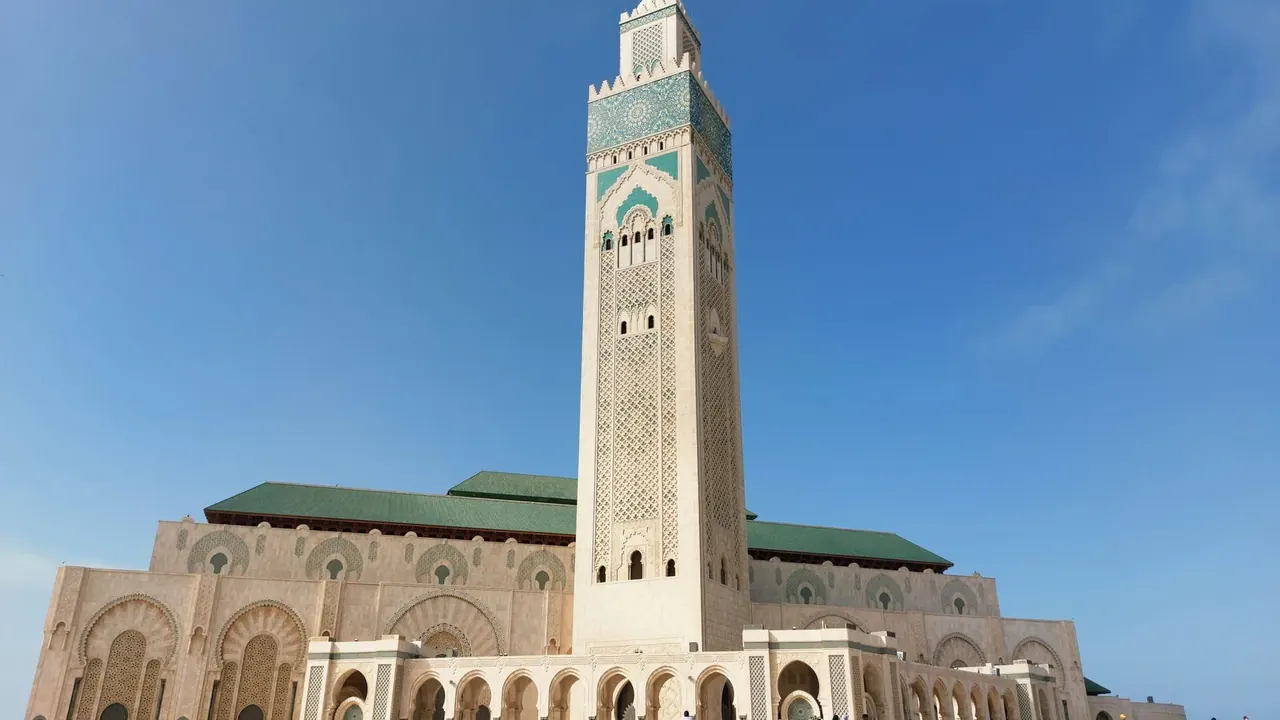
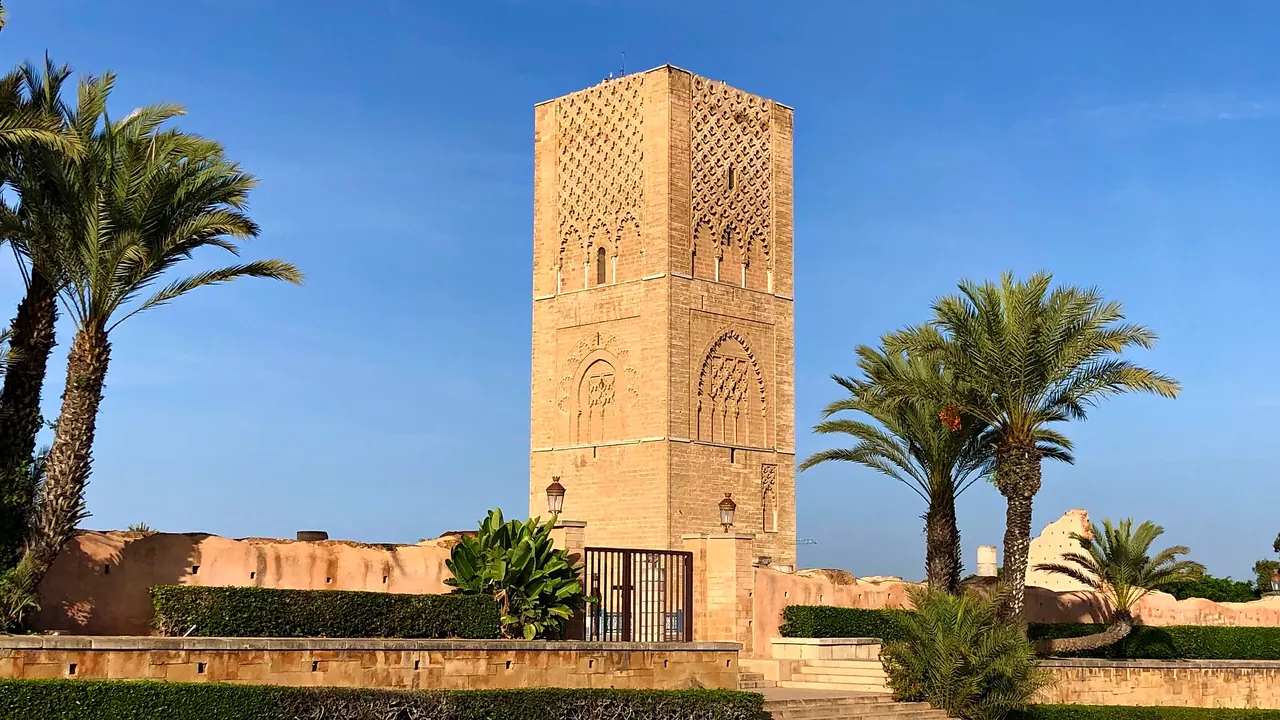
Photos: Casablanca by Samir Bakkah, Pexels License; Rabat by Aemazy, CC BY-SA 4.0, cropped.
Casablanca or Rabat?
Our verdict in twelve categories, each scored against the same fixed benchmark cities, and the climate month by month, so you can choose for your trip.
Choose Casablanca for
- nightlife
- beaches
- food and drink
Casablanca suits travellers who want a modern Moroccan city with a proper night out at the end of the day. The Corniche at Ain Diab has the liveliest lounges and clubs in the country, the Corniche mall and Maarif's fashion streets offer Morocco's best modern shopping, and the Hassan II Mosque and the Art Deco downtown fill a couple of days well. It also works as the natural first or last stop on a wider trip through Morocco.
Choose Rabat for
- getting around
- culture and sights
- families
Rabat is the better pick for a calm stay with plenty to see. The kasbah, the Hassan Tower, the Chellah ruins and the compact medina are all within walking distance or a short tram ride of one another, the trains make onward travel easy, and families find it far less tiring. Evenings are quiet and spent in cafés, which some visitors will see as the whole appeal and others as a drawback.
Scoreboard
Twelve categories on one fixed scale from 0 to 100. The shaded stretch is the gap between the two.
Your match
Pick a travel style or drag the sliders, and both match scores follow your weighting.
Too close to call, 2 points apart
Wins on nightlife and beaches with your weighting.
Wins on getting around and culture and sights with your weighting.
What matters to you?
Category by category
What the scores mean for a trip.
Beaches & swimming
Neither city is a beach destination, and both face the same strong Atlantic swell, so swimming means staying close to shore. Where they differ is the setting. Casablanca's sand runs below the beach clubs of the Corniche at Ain Diab, where many people swim in private pools rather than the sea, and the better beaches at Dar Bouazza and Bouznika need a drive.
Rabat's city beach lies right under the kasbah walls at the river mouth and belongs to football, surf lessons and family outings. The calmer, cleaner sand is south at Harhoura, Temara and Skhirat, a short taxi ride away.
Food & drink
Both cook the same Moroccan home food, with tagines, Friday couscous, harira and grilled sardines, and Atlantic seafood as the best thing on the table. Casablanca has more range: you can pick fish at the Marché Central and have it grilled next door, Maarif and Gauthier keep up a solid mid-range and upscale scene, and alcohol is a little easier to find.
Rabat eats more quietly, in simple medina eateries, plain seafood places by the port and the river, and terrace cafés with almond and honey pastries. Its embassy districts of Agdal and Hassan add French and Lebanese kitchens.
Culture & sights
Rabat is the richer city for sightseeing. Its monuments are UNESCO-listed as a whole and cover nearly two thousand years, from the Roman and Marinid ruins of the Chellah, full of fig trees and storks, to the blue-and-white Kasbah of the Udayas and the unfinished Hassan Tower beside the Mohammed V Mausoleum.
Casablanca has one great monument, the Hassan II Mosque, which non-Muslims can visit on a guided tour. Beyond that its story is twentieth-century, told in the Art Deco and neo-Moorish boulevards downtown, the 1930s Habous quarter and the Museum of Moroccan Judaism. Each takes two or three days, but Rabat's days are fuller.
Nightlife
Casablanca is the clear choice for going out. The Corniche at Ain Diab has lounges, beach clubs and clubs playing house and Arabic pop until late at weekends, and Maarif and Gauthier add cocktail lounges and old protectorate-era bars. You take taxis between them, because there is no street to wander from bar to bar.
In Rabat an evening means a walk along the river and a café terrace, with drinks in hotel bars and a few lounges in Agdal. Anyone in Rabat who wants to dance usually heads down the coast to Casablanca.
Nature & outdoors
Neither city has hills, but Rabat has more to do outdoors. The Bou Regreg estuary suits rowing and paddling, the Maamora cork oak forest has easy walking and cycling, and the lake reserve at Sidi Boughaba and the Bouknadel gardens draw birdwatchers.
Casablanca's outdoors is mostly the sea: runs along the Corniche towards the El Hank lighthouse, surf breaks at Ain Diab and Dar Bouazza for learners, and the shaded eucalyptus trails of the Bouskoura forest.
Day trips
Both make good bases, and each is the other's best day out, about an hour apart by train. Rabat has a slight edge because the high-speed line north puts Tangier and Asilah within easy reach, Meknes is a manageable two hours, and Salé is just across the river by tram.
Casablanca looks south along the coast instead, to the Portuguese cistern and sea walls of El Jadida, the whitewashed riverside medina of Azemmour and the oyster lagoon at Oualidia.
Good for families
Rabat is the easier city with children, mainly because it is calm. The medina has little hassle, the tram covers the distances, and the national zoo with its open enclosures and the Jardin d'Essais give children space to run.
Casablanca has more that is built for children, with the aquarium and indoor rides in the Corniche mall, the old amusement park at Ain Diab and calm beach-club pools. The traffic, broken pavements and long distances between these places make every outing more effort.
Getting around
Rabat is much simpler to get around. The medina, the kasbah, the Hassan Tower and the Ville Nouvelle are within walking distance of one another on broad, flat streets, and the tram and blue petits taxis cover the Chellah, Agdal and Salé.
In Casablanca, walking works downtown but not much beyond it. The mosque and the Corniche are a long way out, the big roundabouts are hard to cross, and visitors combine the tram with red petits taxis whose drivers share rides and sometimes ignore the meter. Both cities have central stations on the national rail network.
Shopping & style
The two are good for opposite kinds of shopping. Casablanca is Morocco's modern retail capital, with a vast mall on the Corniche, Maarif's fashion streets and local designers, a tidy crafts row in the Habous quarter and the Derb Ghallef flea market for curiosities.
Rabat is the place for traditional crafts, above all the covered Rue des Consuls with its carpet dealers, leather and brass, and the city's own dense, deep-coloured pile carpets. Haggling is gentle there, and Salé's pottery is close by. Its mall and the Agdal high streets are useful rather than a reason to visit.
Affordability
Day-to-day costs are much the same. Taxis, trams, café terraces and market food are cheap in both, and rooms are the expensive part, since both cities have more business hotels than budget guesthouses. Rabat's main sights charge little or nothing, while in Casablanca the costs to watch are the mosque tour and the dining and drinks along the Corniche.
Live music & performing arts
Neither city has much on in an ordinary week, so the festival calendar matters more than the venues. Casablanca's highlights are its long-running jazz festival and a festival of urban music and hip-hop that came out of the city's own rap and chaabi scene.
Rabat has the national stages, the Mohammed V National Theatre and the Grand Theatre on the Bou Regreg, and hosts Mawazine, which brings international pop stars alongside Gnawa, Arab and African musicians to open-air stages across the city.
Wellness & relaxation
Both offer the full hammam ritual, from neighbourhood bathhouses with black soap and the kessa glove to quieter hotel spas. Casablanca adds seawater thalassotherapy along the Corniche, but once you leave the spa the city is loud and full of traffic.
Rabat's advantage is its pace. Quiet medina lanes, the Andalusian garden inside the kasbah and evening walks along the river make the whole stay feel unhurried.
When should you go?
Pick your month. The climate figures are measured averages, not a forecast.
Casablanca in July
Rabat in July
Daytime high, °C
Rainfall in the month, mm
Temperature and rainfall are climate normals, averaged over the years shown. Casablanca: 1991-2020 normals, Casablanca (5.6 km from centre). Rabat: 1991-2020 normals, Rabat-Sale (7.6 km from centre).
The two share almost the same Atlantic climate: mild all year and never too hot for walking the streets. Summer is the dry, sunny stretch in both, with almost no rain from June to August and highs in the mid to high twenties, Rabat reaching 28°C in August. The sea is at its warmest then, about 23°C, which still feels bracing. July and August are the beach months, while May, June, September and October suit sightseeing in comfortable warmth.
Rain returns in October and is heaviest from November to January, and Rabat gets noticeably more of it, close to 100mm in November against 78mm in Casablanca. Winter days stay mild at about 18°C in both cities, fine for walking between showers, and Casablanca is a little sunnier through the darker months.
Which traveller are you?
On a culture and arts trip, Casablanca gives you the Hassan II Mosque and an Art Deco downtown, but Rabat is the stronger choice. Its UNESCO-listed sights take in Roman Sala, the Almohad gate of the kasbah and the Hassan Tower, plus a modern art museum.
For a food and nightlife trip, Casablanca wins once the sun sets. Grilled fish at the Marché Central, then brasseries in Gauthier and lounges on the Corniche until late make a full evening. Rabat winds down on a café terrace.
On a family trip with children, Casablanca is best kept for older children and a day or two at the start or end of a wider tour of Morocco. Rabat is the better base for families, and its unhurried pace suits even young children.
Before you go
| Measure | Casablanca | Rabat |
|---|---|---|
| Official language | Arabic, Standard Moroccan Tamazight | Arabic, Standard Moroccan Tamazight |
| Currency | Moroccan Dirham (MAD) | Moroccan Dirham (MAD) |
| Sockets | CE50 Hz | CE50 Hz |
| Driving side | Right | Right |
| Time zone | UTC+1 | UTC+1 |
| Emergency number | Police 19/112, ambulance 15, fire 15 | Police 19/112, ambulance 15, fire 15 |
| Elevation | 115 m | 87 m |
| Main airport | Mohammed V International Airport (CMN)26 km from centre112 non-stop destinations | Rabat-Salé Airport (RBA)9 km from centre45 non-stop destinations |
| Public holidays this year | 11 days | 11 days |
By the numbers
| Measure | Casablanca | Rabat |
|---|---|---|
| City population | 3,215,935 | 515,619 |
| People per km² | 8,375 | 4,370 |
| Museums within 10 km | 3 | 7 |
| UNESCO World Heritage sites within 50 km | 0 | 1 |
| Swim season, months above 21 °C | 5 months | 4 months |
Where else could you go?
Every comparison below shares a destination with this one, so you can follow Casablanca or Rabat somewhere new.
- Fesvs Rabat
- Tangiervs Rabat
- Marrakechvs Casablanca
- Fesvs Casablanca
- Marrakechvs Rabat
- Tangiervs Casablanca