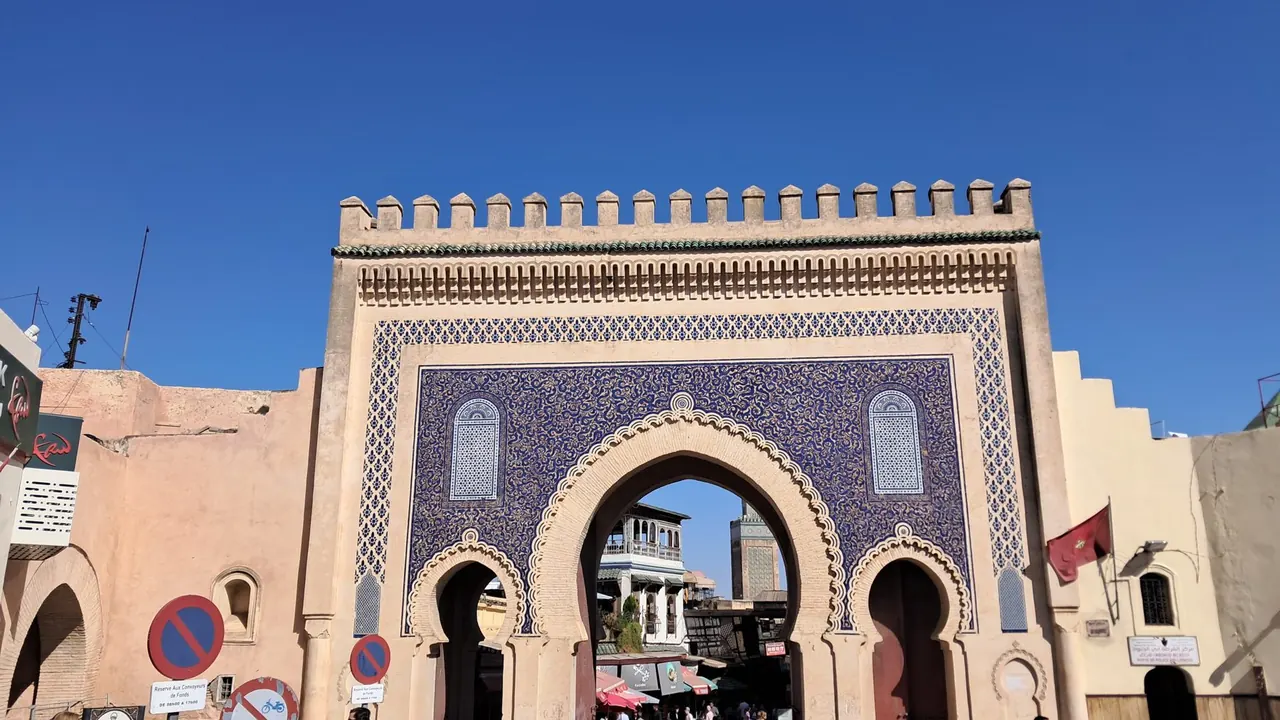
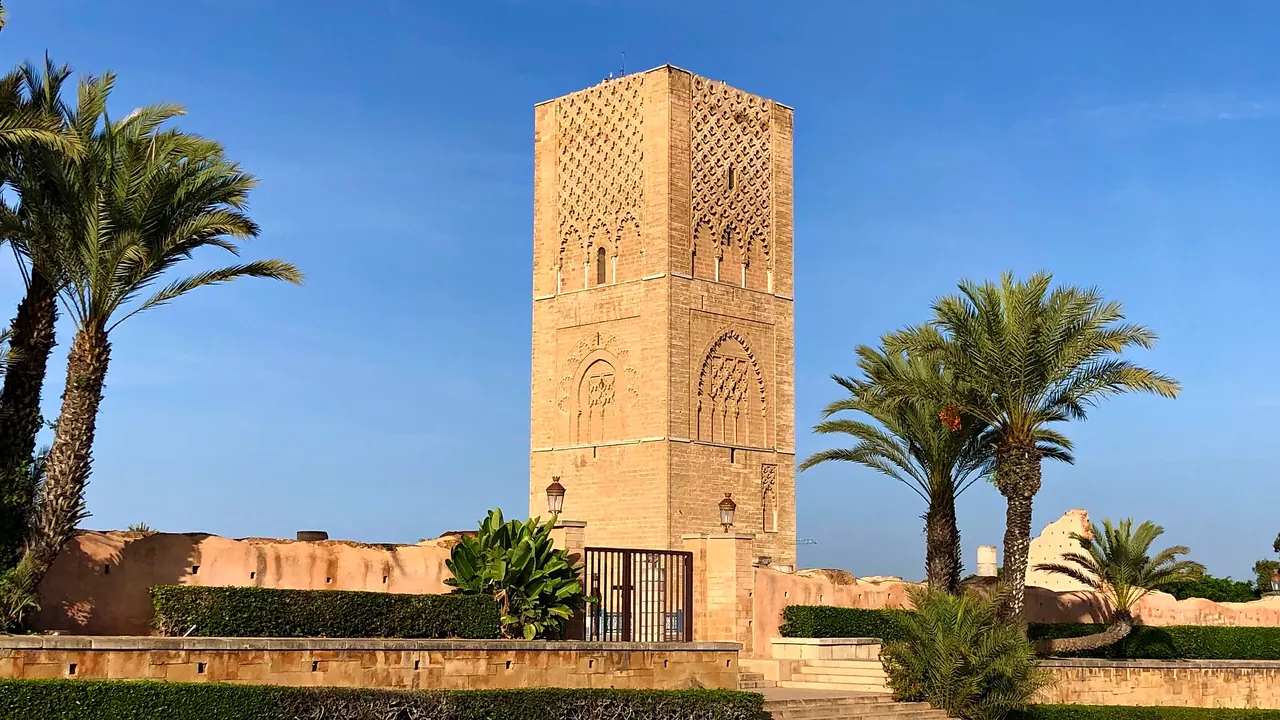
Photos: Fes by Ideophagous, CC BY-SA 4.0, cropped; Rabat by Aemazy, CC BY-SA 4.0, cropped.
Fes or Rabat?
Our verdict in twelve categories, each scored against the same fixed benchmark cities, and the climate month by month, so you can choose for your trip.
Choose Fes for
- shopping
- culture and sights
- wellness
Fes is for travellers who want to step into a medieval city that still works. They will spend their days in the lanes of Fes el-Bali, between Marinid madrasas, tanneries and copper workshops, eat the most refined of Morocco's classic cooking in riad dining rooms, and end the day in a hammam rather than a bar. It asks for patience and stamina in the medina, and it pays that back in craft shopping, depth of sights and slightly lower costs.
Choose Rabat for
- beaches
- families
- getting around
Rabat suits anyone who wants an easier, gentler Morocco. Its streets are flat and walkable, a tram connects the sights, the medina brings little hassle, and the Atlantic runs below the kasbah walls. Families, first-time visitors wary of touts and travellers using the train to see several cities will find it the more comfortable base, even if its monuments and souks make less of an impression than those of Fes.
Scoreboard
Twelve categories on one fixed scale from 0 to 100. The shaded stretch is the gap between the two.
Your match
Pick a travel style or drag the sliders, and both match scores follow your weighting.
Too close to call, 2 points apart
Wins on shopping and culture and sights with your weighting.
Wins on beaches and families with your weighting.
What matters to you?
Category by category
What the scores mean for a trip.
Beaches & swimming
Fes has no beach worth the trip, since the coast is about three hours away. Swimming means a hotel pool or a riad plunge pool, which is worth having in the summer heat.
Rabat has the Atlantic on its doorstep, with the city beach right below the Kasbah of the Udayas and calmer, cleaner sand south towards Temara, Harhoura and Skhirat. The swell, the currents and the cool water make it a place for surfing and a local afternoon out rather than lying in the sun, but it is still a real beach, which Fes cannot offer.
Food & drink
Fes has the more accomplished cooking. Its Andalusian-influenced kitchen gives you pastilla with almonds and cinnamon, tagines with quince and preserved lemon, and long multi-course dinners in riads. The medina breakfast counters serve bissara and sfenj.
Rabat eats more plainly: home-style tagines, grilled sardines and Atlantic seafood by the port and river, and a strong café-and-pastry culture on the Ville Nouvelle terraces. Where it beats Fes is range. Being the capital, it has French, Lebanese and other international restaurants in Agdal and Hassan, and wine is a little easier to find.
Culture & sights
In Fes the city itself is the monument. Fes el-Bali is a car-free medieval maze with intact trades and quarters, and it holds some of the finest Marinid buildings anywhere, plus the Chouara tannery, the Seffarine square and the Mellah. You could spend days there and still find new corners.
Rabat's heritage is spread out in time and in space: the blue-and-white Kasbah of the Udayas, the unfinished Hassan Tower beside the Mausoleum of Mohammed V, and the storks nesting in the Chellah ruins. It also has something Fes lacks, a modern art museum. The whole set is calm and well kept, and most visitors cover it in two or three days.
Nightlife
Neither city is for a night out, but Rabat has a bit more going on after dark. In Fes the medina empties when the shops close. An evening is a long rooftop dinner and tea, with only a few hotel bars in the Ville Nouvelle.
Rabat's evenings happen outdoors, along the Bou Regreg promenade, on café terraces and in medina streets that stay lively on summer nights. Drinks are served in hotel bars and a handful of lounges in Agdal and Hassan. If you want clubs, you have to go to Casablanca.
Nature & outdoors
Fes has the mountains close by. Within about an hour you reach the Middle Atlas cedar forests around Azrou, where Barbary macaques live wild, along with limestone plateaux dotted with lakes and the caves and ridges of Tazekka National Park. All of it needs a car or driver, and spring or autumn is the time to go.
Rabat's outdoors is flat and coastal: the estuary for paddling, surf schools at the river mouth, the cork oaks of the Maamora forest and birdwatching at Sidi Boughaba. It is easy and pleasant all year round, but there is no proper hiking within a day.
Day trips
The two are evenly matched, but the outings are very different. From Fes, the classic long day with a driver takes in imperial Meknes, the Roman mosaics of Volubilis and the holy town of Moulay Idriss. Alpine-looking Ifrane and the cave houses near Sefrou are other options.
Rabat is the train traveller's base. Casablanca is about an hour away, Tangier and Asilah are reached on the high-speed line, and Salé's old medina is only a tram ride across the river. Fes gives you ancient and imperial sites by road, while Rabat gives you other cities by rail.
Good for families
Rabat is far easier with children. The medina is calm and hassle is rare, the tram removes long walks, and the national zoo, the Jardin d'Essais and the Bouknadel gardens give children open space. The strong waves at the city beach call for close supervision.
Fes is hard going with small children: steep lanes shared with laden donkeys, persistent touts, the smell of the tanneries and very hot summer afternoons. Older children who enjoy getting lost and watching craftsmen can love it, as long as outings are kept short and a pool is waiting back at the riad.
Getting around
In Fes everything inside the medina is on foot, along twisting lanes that climb and dead-end. Many first-timers take a guide on day one, and petit taxis connect the gates with the Ville Nouvelle and the station. For most day trips you need a car.
Rabat is much simpler. The medina, the kasbah, the Hassan Tower and the Ville Nouvelle sit close together on broad, flat streets, and a tram runs out to Agdal, the Chellah and Salé. Rabat Ville station is in the centre, so you can manage without a car for both the city and its day trips.
Shopping & style
Fes is one of Morocco's great craft centres. In its medina, tannery leather, Seffarine copper, blue-and-white Fassi pottery, zellige and carved cedar are made and sold lane by lane. Haggling is hard, and guides on commission will steer you to certain shops, so it pays to wander alone.
Rabat's buying is concentrated on Rue des Consuls, which is strongest in the city's own dense pile carpets. Haggling there is gentler, and Salé adds pottery. Rabat's modern high streets in Agdal and its riverside mall are more useful than anything Fes offers, but the souks are much thinner.
Affordability
Both cities are cheap on the ground, with low costs for street food, mint tea, petit taxis and entry to sights. Fes keeps your budget lower mainly because of where you sleep. Its medina is full of modest riads with real character.
Rabat, as the capital, leans towards business hotels, and its Agdal and Hassan restaurants cost more. In both cities alcohol is the one expensive item.
Live music & performing arts
Rabat has more on stage. The Mohammed V National Theatre and the Grand Theatre on the Bou Regreg put on Moroccan and Arab music and theatre, though programmes run irregularly and are mostly in Arabic and French. The Mawazine festival brings international and African acts to open-air stages.
Fes has the deeper musical roots, in Andalusian classical and Sufi devotional music, and its Festival of World Sacred Music fills palace gardens with concerts. Outside the festival you will mostly hear music at riad dinners.
Wellness & relaxation
Fes offers more to soak in. Every medina quarter has its public hammam, many riads run their own calmer ones, and the historic hot springs at Moulay Yacoub and Sidi Harazem are within easy reach. The irony is that the medina itself is loud and intense, so you find your calm back in a riad courtyard or on a roof terrace at dusk.
In Rabat the restfulness comes from the city rather than the spa. Its bathhouses are simple and local, and the hotel spas are the comfortable alternative, but the quiet lanes, the kasbah garden and the evening river walks make the whole stay feel unhurried.
When should you go?
Pick your month. The climate figures are measured averages, not a forecast.
Fes in July
Rabat in July
Daytime high, °C
Rainfall in the month, mm
Where the figures come from
Fes's station stands 171 m above the city centre, so the centre is likely a little warmer than the figures say.
Fes has no rain gauge within 25 km of the centre, so its rainfall comes from a gridded climate dataset read at the city rather than from a gauge further away.
Fes's sunshine is measured 52 km from the centre, at Meknes.
Temperature and rainfall are climate normals, averaged over the years shown. Fes: 1999-2020 (sunshine 1991-2020, rainfall 1991-2020) normals, Fes-Sais (12.4 km from centre). Rabat: 1991-2020 normals, Rabat-Sale (7.6 km from centre).
The two cities part ways in summer. Fes sits inland on a hot plain, and from June to September afternoons reach 36°C, far too hot for long walks through the medina, so spring and October are the time to explore. Rabat stays mild on the coast, peaking around 28°C in August. That makes high summer its best season, when the Atlantic warms to about 23°C and the beaches are at their most inviting. Both cities are very dry and sunny from June to August.
Winter is mild in both but wet, and the rain comes back in October. November and December are the wettest months, with Rabat catching close to 100mm. Fes is a little cooler in winter, but those days are pleasant for sightseeing. Rabat is comfortable to walk around in almost any month.
Which traveller are you?
On a culture and arts trip, Fes is the stronger choice. The whole medieval medina is the main sight, with the Bou Inania and Al-Attarine madrasas, the Quaraouiyine at its centre and craftsmen still working in the lanes. Rabat's monuments are fine but fewer.
On a family trip with young children, choose Rabat. Its medina is calm, the tram makes getting around simple, and the zoo and gardens give children room to play. In Fes you face steep lanes shared with donkeys, persistent touts and almost nothing built for children.
On a shopping trip, Fes wins clearly. It is where much of Morocco's leather, copperware, blue pottery and carved cedar is made, often in the workshop behind the counter. Rabat's Rue des Consuls is pleasant and easy to bargain in, but much smaller.
Before you go
| Measure | Fes | Rabat |
|---|---|---|
| Official language | Arabic, Standard Moroccan Tamazight | Arabic, Standard Moroccan Tamazight |
| Currency | Moroccan Dirham (MAD) | Moroccan Dirham (MAD) |
| Sockets | CE50 Hz | CE50 Hz |
| Driving side | Right | Right |
| Time zone | UTC+1 | UTC+1 |
| Emergency number | Police 19/112, ambulance 15, fire 15 | Police 19/112, ambulance 15, fire 15 |
| Elevation | 408 m | 87 m |
| Main airport | Fes Saïss International Airport (FEZ)13 km from centre35 non-stop destinations | Rabat-Salé Airport (RBA)9 km from centre45 non-stop destinations |
| Public holidays this year | 11 days | 11 days |
By the numbers
| Measure | Fes | Rabat |
|---|---|---|
| City population | 1,167,842 | 515,619 |
| People per km² | 3,650 | 4,370 |
| Museums within 10 km | 2 | 7 |
| UNESCO World Heritage sites within 50 km | 2 | 1 |
| Swim season, months above 21 °C | - | 4 months |
Where else could you go?
Every comparison below shares a destination with this one, so you can follow Fes or Rabat somewhere new.