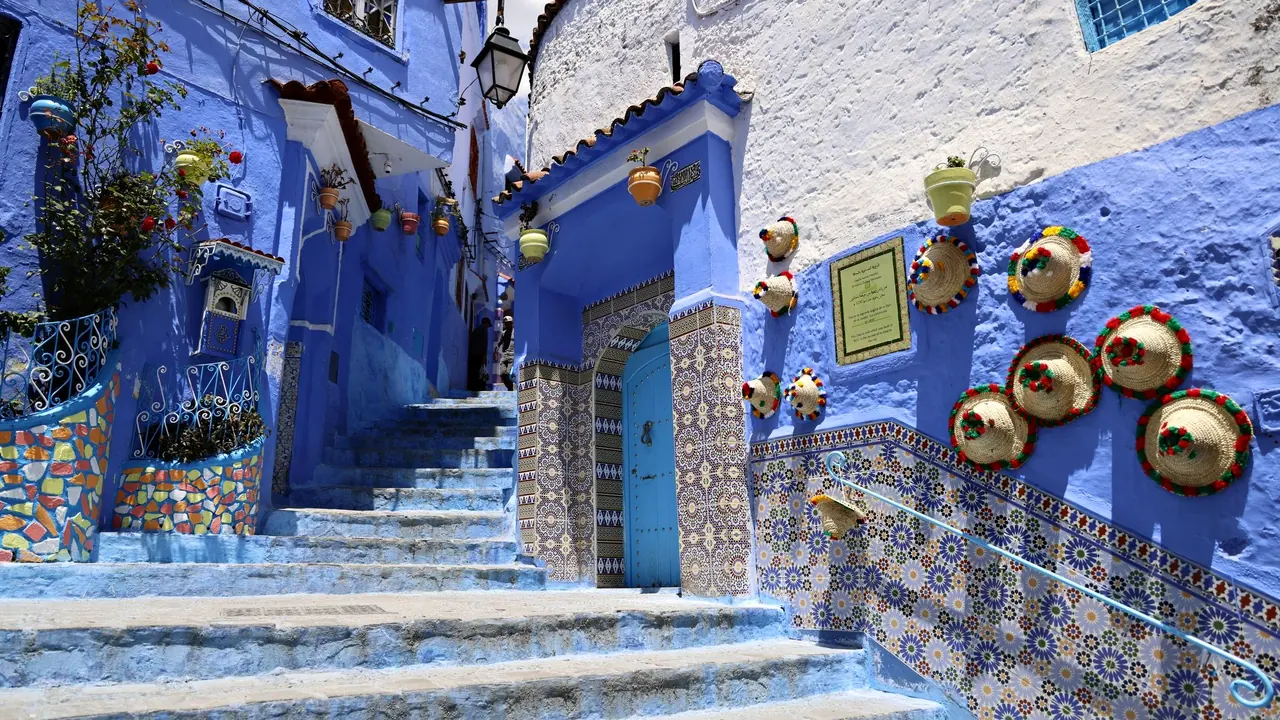
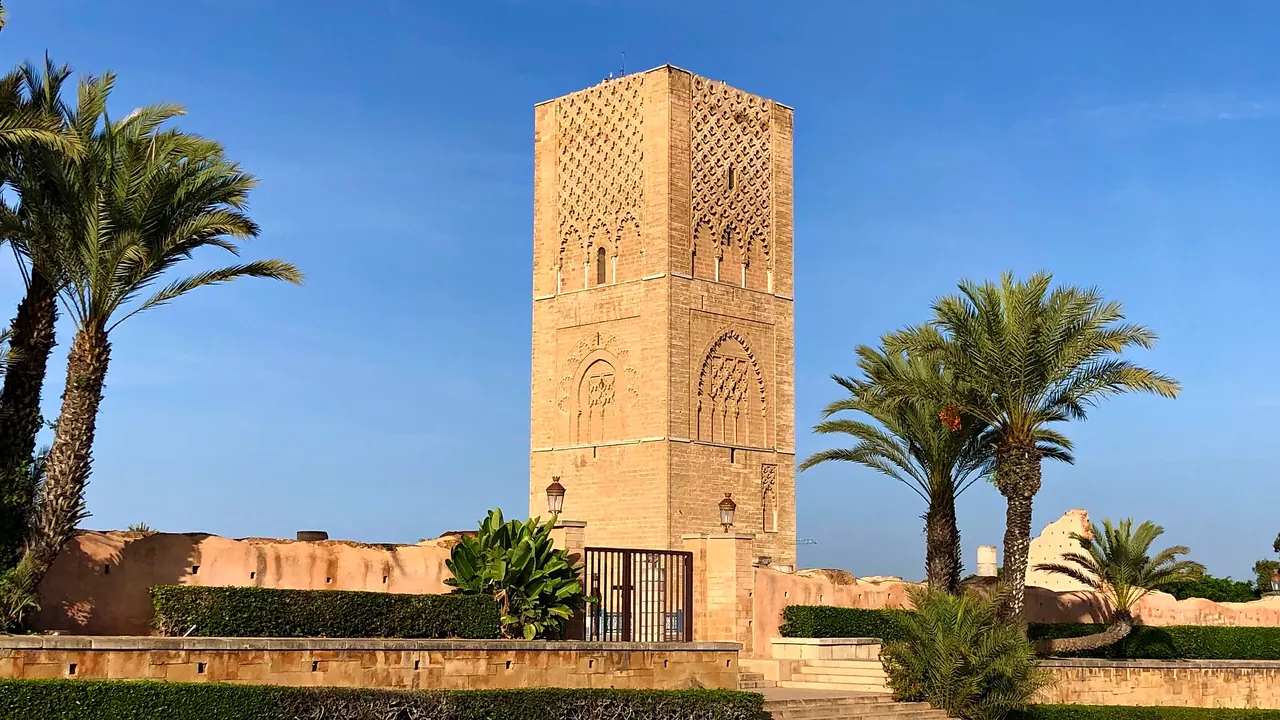
Photos: Chefchaouen by Christophe RASCLE, Pexels License; Rabat by Aemazy, CC BY-SA 4.0, cropped.
Chefchaouen or Rabat?
Our verdict in twelve categories, each scored against the same fixed benchmark cities, and the climate month by month, so you can choose for your trip.
Choose Chefchaouen for
- nature and the outdoors
- prices
Chefchaouen suits travellers who want mountains, quiet and a very cheap few days. The blue medina is a place to wander slowly and photograph, and the Rif starts at the edge of town, with Talassemtane's gorges, waterfalls and cedar forests close by. It works best as a stop of two to four days on a route through northern Morocco, for walkers and anyone happy with early nights and simple food.
Choose Rabat for
- live music and the arts
- day trips
- beaches
For a broader city stay, Rabat is the stronger base. Its UNESCO-listed sights run from Roman ruins to art deco boulevards, it has the national theatres and a better spread of restaurants, and the train puts Casablanca, Tangier and Meknes within easy reach. It is calm for a capital and easy with children, though it has the coast rather than the mountains.
Scoreboard
Twelve categories on one fixed scale from 0 to 100. The shaded stretch is the gap between the two.
Your match
Pick a travel style or drag the sliders, and both match scores follow your weighting.
Wins on nature and the outdoors and prices with your weighting.
Wins on live music and the arts and day trips with your weighting.
What matters to you?
Category by category
What the scores mean for a trip.
Beaches & swimming
Neither city is a beach destination, but Rabat at least has the sea on its doorstep. The city beach sits below the kasbah walls, and calmer sand stretches south towards Temara, Harhoura and Skhirat, though Atlantic swell keeps most swimmers near the shore.
From Chefchaouen the sea means a winding drive of over an hour to the grey sand at Oued Laou, a full day out by grand taxi. The cold river pools at Akchour are the nearest place to cool off.
Food & drink
Rabat eats better, mainly because a capital brings range. Alongside medina tagines and Friday couscous there are grilled sardines and plain Atlantic fish near the port, snail broth and msemen at night stalls, and French and Lebanese cooking in Agdal and Hassan.
Chefchaouen's restaurants largely share one menu, and the rewards are rustic: Rif goat cheese in palm leaf, bissara for breakfast and bread from the communal ovens. Wine is scarce in both, though Rabat's hotels make it easier to find.
Culture & sights
In Chefchaouen the town itself is the sight. The whole medina is washed in blue, with stairways, tiled doorways and wooden balconies best enjoyed slowly with a camera. Add the small kasbah museum on Outa el-Hammam and the sunset view from the Spanish Mosque, and a day or two covers it.
Rabat has far more to see, across nearly two thousand years: the Almohad gate and Andalusian garden of the Kasbah of the Udayas, the Hassan Tower beside the Mohammed V Mausoleum, the stork-topped ruins of the Chellah, and museums of modern art and archaeology. The kasbah's blue-and-white lanes give a small taste of Chefchaouen's look. They are a few streets inside one citadel, though, not a whole town painted blue.
Nightlife
Both are quiet after dark, but Chefchaouen is quieter still: dinner, tea in the square and a walk through the lit lanes, with only a couple of hotel bars. Rabat adds riverside promenades, busy café terraces, and hotel bars and lounges in Agdal frequented by diplomats. Neither suits clubbing, and Casablanca is the usual escape.
Nature & outdoors
Chefchaouen is the place for the outdoors. Paths lead straight from the Ras el-Maa spring onto terraced slopes and Jebel el-Kelaa. Forty minutes away, Talassemtane National Park offers the Akchour gorge, God's Bridge, cedar forests and Barbary macaques. Trails are poorly marked, so a guide helps.
Rabat's nature is flat and coastal: surf at the river mouth, paddling on the Bou Regreg, easy rides in the Maamora cork forest and birdwatching at Sidi Boughaba. Pleasant, but serious hiking is hours away.
Day trips
Rabat is by far the better base for excursions, thanks to the rail line. Casablanca's Hassan II Mosque, Tangier and Asilah on the high-speed route, and imperial Meknes are all simple return trips, and Salé's medina and madrasa are a tram ride across the river.
Chefchaouen really has one strong outing, the quiet UNESCO medina of Tetouan, with Martil beyond it. Tangier and Fes are better treated as the next stop than as a day trip.
Good for families
Rabat is easier with children. It has flat streets, a tram, a large modern zoo with open enclosures, and green space at the Jardin d'Essais and Bouknadel, though the waves at the city beach need close watching.
Chefchaouen is calm and welcoming, but its stepped lanes defeat pushchairs and the town offers children little beyond the river pools at Akchour. Offers of hashish to adults in the lanes are another drawback, so it suits a short stop with older children who can walk.
Getting around
Both centres are walkable, but in different ways. Chefchaouen's medina is small enough to cross in fifteen minutes, yet almost every route involves polished, slippery steps, and beyond the petit taxis to the gates, trips out depend on grand taxis or a driver, with no railway at all.
Rabat's main sights sit along the river on broad, level streets, the tram and plentiful petit taxis reach the Chellah and Salé, and the central station links to the national network, so a car is never needed.
Shopping & style
Rabat has the broader choice. Rue des Consuls is a long covered street of deep-coloured Rabat carpets, brass, leather and embroidery, Salé adds pottery, and Agdal and the riverside mall cover everyday needs. Chefchaouen is smaller and more local: Rif blankets woven on looms in shopfronts, djellabas, baskets and bottles of blue pigment. Haggling is gentle in both, but Chefchaouen's range runs out after a few lanes.
Affordability
Chefchaouen is the cheaper stay. Simple guesthouses and riads are plentiful, the town itself is free to explore, and shared taxis to the valleys cost little. Rabat is inexpensive day to day, with cheap medina meals, trams and taxis. Its accommodation leans towards business hotels, however, and Agdal's restaurants cost more, so the bill climbs mainly at night.
Live music & performing arts
Here the gap is wide. Chefchaouen has no stage at all; an occasional Andalusian music performance at festival time and the call to prayer over the rooftops are about all a visitor will hear.
Rabat holds the Mohammed V National Theatre and the Grand Theatre on the Bou Regreg, with Arab music, theatre and touring productions, mostly in Arabic and French. The Mawazine festival fills open-air stages with Gnawa, African and international acts.
Wellness & relaxation
Both are restful in a slow, unpolished way, and both have simple neighbourhood hammams for a black-soap scrub. Rabat edges ahead on comfort, with hotel spas and argan oil massages for first-timers. Chefchaouen offers mountain air, roof terraces and the sound of the spring, but only a handful of riads offer treatments.
When should you go?
Pick your month. The climate figures are measured averages, not a forecast.
Chefchaouen in July
Rabat in July
Daytime high, °C
Rainfall in the month, mm
Where the figures come from
Chefchaouen has no weather station within reach, so its figures come from a gridded climate model rather than a measured record, and read a broad area rather than the city itself.
Temperature and rainfall are climate normals, averaged over the years shown. Chefchaouen: 2001-2020 normals, NASA POWER reanalysis grid, no weather station within 90 km. Rabat: 1991-2020 normals, Rabat-Sale (7.6 km from centre).
Chefchaouen has much sharper seasons. Its best spells are May, early June and September, when the days are warm, the rain has mostly stopped and the hills are good for walking. July and August reach about 35°C, too hot for the steep stairways by midday. From October to April it is cool and wet: November is the wettest month at 141mm, and March is nearly as wet. Spring brings wildflowers and full rivers at Akchour, but you should expect plenty of rain with them. The sea at Oued Laou is only properly warm in late summer.
Rabat is mild all year. The Atlantic keeps summer highs near 28°C, and winter days stay comfortable for sightseeing. Most of its rain falls from November to January. From May to September it is dry and very sunny, and the sea reaches about 23°C in August. That makes Rabat the safer choice in midsummer and through the wet months. Chefchaouen is at its best only in the short dry spells before and after the summer heat.
Which traveller are you?
On an outdoors trip, Chefchaouen is the clear pick. Trails climb from the edge of the medina into the Rif, and Akchour's gorge, waterfalls and God's Bridge are a short drive away. Rabat's estuary paddling and cork forest walks are gentler.
For a culture and arts trip, Rabat offers far more. The Kasbah of the Udayas, the Hassan Tower, the Chellah and two serious museums fill several days, and the national theatres and Mawazine festival add live performance. Chefchaouen has almost none of this.
On a food and nightlife trip, Rabat is the better of two modest options. It has Atlantic seafood, evening street stalls, international kitchens in Agdal and a few lounges serving drinks. Chefchaouen repeats one menu, and its lanes go silent after mint tea.
Before you go
| Measure | Chefchaouen | Rabat |
|---|---|---|
| Official language | Arabic, Standard Moroccan Tamazight | Arabic, Standard Moroccan Tamazight |
| Currency | Moroccan Dirham (MAD) | Moroccan Dirham (MAD) |
| Sockets | CE50 Hz | CE50 Hz |
| Driving side | Right | Right |
| Time zone | UTC+1 | UTC+1 |
| Emergency number | Police 19/112, ambulance 15, fire 15 | Police 19/112, ambulance 15, fire 15 |
| Elevation | 564 m | 87 m |
| Main airport | Tangier Ibn Battuta Airport (TNG)86 km from centre50 non-stop destinations | Rabat-Salé Airport (RBA)9 km from centre45 non-stop destinations |
| Public holidays this year | 11 days | 11 days |
By the numbers
| Measure | Chefchaouen | Rabat |
|---|---|---|
| City population | 46,168 | 515,619 |
| People per km² | 2,998 | 4,370 |
| Museums within 10 km | 1 | 7 |
| UNESCO World Heritage sites within 50 km | 1 | 1 |
| Swim season, months above 21 °C | 3 months | 4 months |
Where else could you go?
Every comparison below shares a destination with this one, so you can follow Chefchaouen or Rabat somewhere new.
- Tangiervs Chefchaouen
- Casablancavs Rabat
- Fesvs Chefchaouen
- Fesvs Rabat
- Tangiervs Rabat
- Casablancavs Chefchaouen