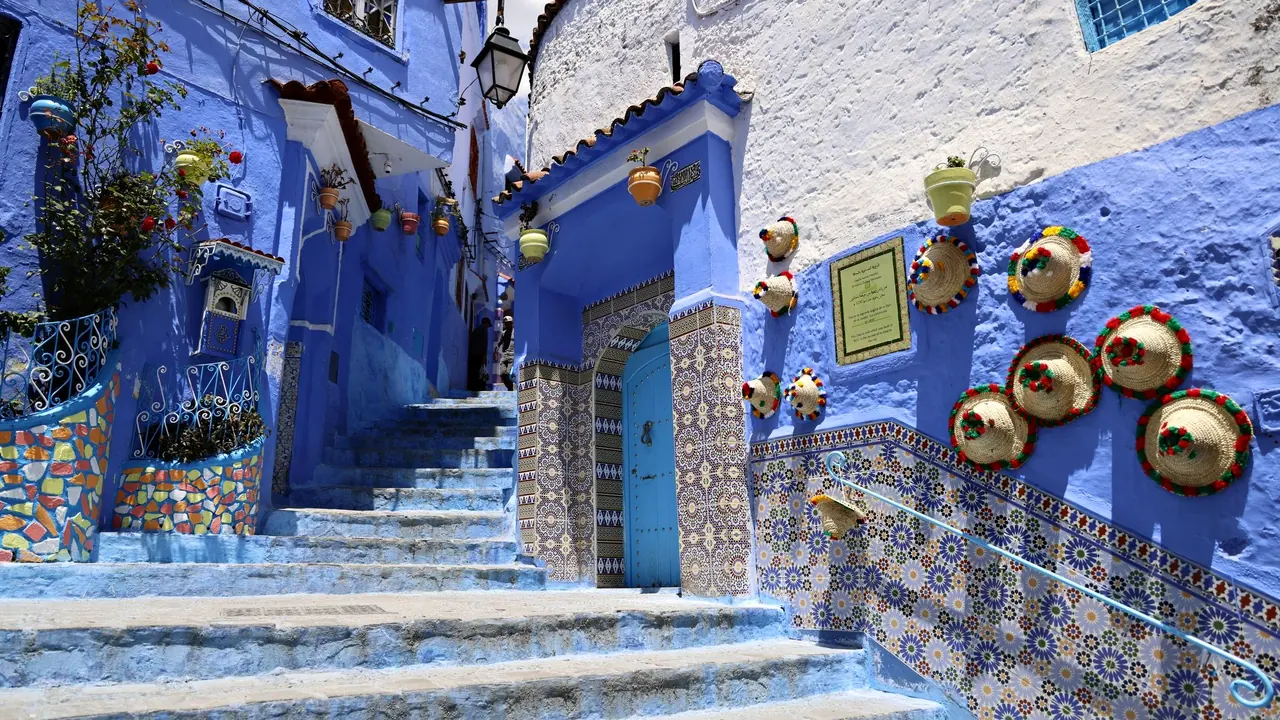
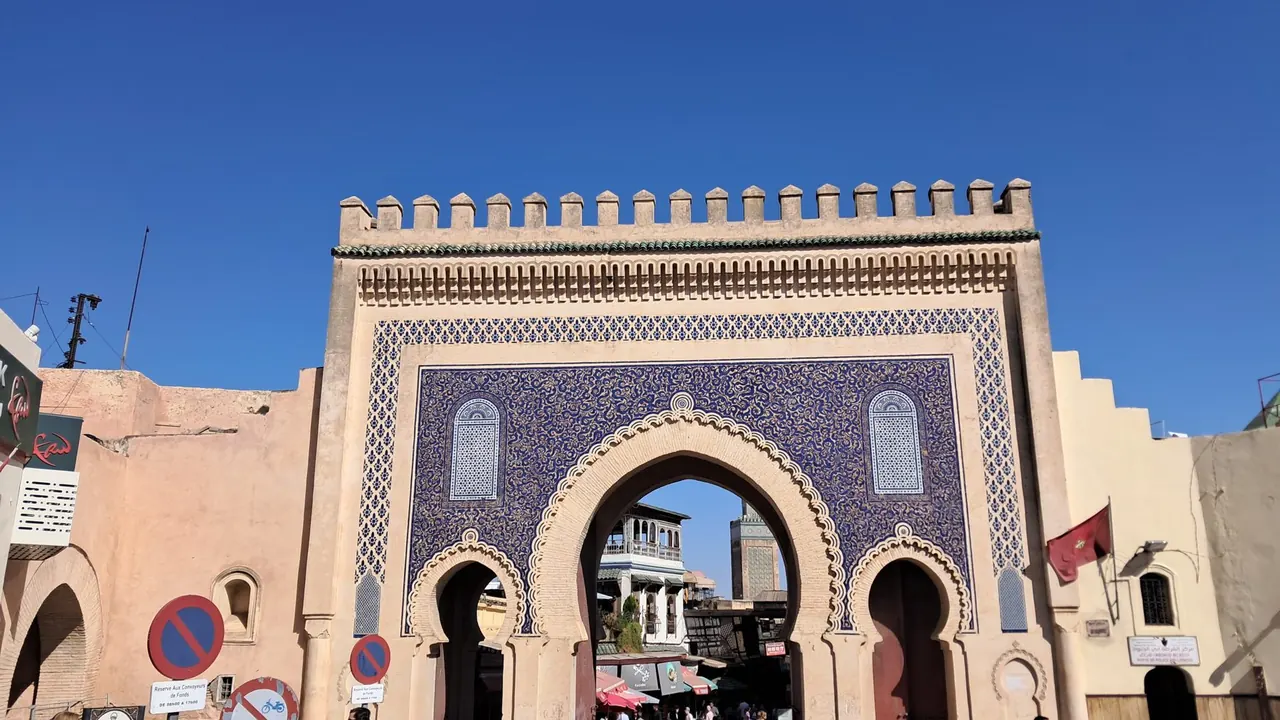
Photos: Chefchaouen by Christophe RASCLE, Pexels License; Fes by Ideophagous, CC BY-SA 4.0, cropped.
Chefchaouen or Fes?
Our verdict in twelve categories, each scored against the same fixed benchmark cities, and the climate month by month, so you can choose for your trip.
Choose Chefchaouen for
- nature and the outdoors
- beaches
- getting around
Chefchaouen suits travellers who want to slow down in the mountains. The blue medina takes a day or two to see, and after that the trip is about walking: trails start at the edge of town and climb into the Rif, and the waterfalls and God's Bridge at Akchour are a short taxi ride away. It is small, calm and easy to cross on foot, and it works best as a few quiet days on a wider route through northern Morocco.
Choose Fes for
- culture and sights
- shopping
- food and drink
Fes is for travellers who come for the old city itself. Fes el-Bali is one of the great medieval medinas, with Marinid madrasas, working tanneries and whole lanes of craftsmen. It has the stronger kitchen and far more to buy, and Meknes and Volubilis make an easy day out. You get more in return for the noise, the crowds and the effort of finding your way.
Scoreboard
Twelve categories on one fixed scale from 0 to 100. The shaded stretch is the gap between the two.
Your match
Pick a travel style or drag the sliders, and both match scores follow your weighting.
Wins on nature and the outdoors and beaches with your weighting.
Wins on culture and sights and shopping with your weighting.
What matters to you?
Category by category
What the scores mean for a trip.
Beaches & swimming
Neither town is a place for swimming, but Chefchaouen at least has a beach within a day's reach. Oued Laou, with a long grey-sand shore on the Mediterranean, is a winding drive of about an hour and a quarter through a gorge. The cold, shallow river pools at Akchour are closer for a dip on a hot day.
From Fes the coast is about three hours away in either direction, so swimming means a hotel pool or a small plunge pool in a riad courtyard. If you go in summer, choose where you stay with that in mind.
Food & drink
Fes is the better place to eat. It is known across Morocco for its refined, Andalusian-influenced cooking, such as pastilla with almonds and cinnamon and tagines with quince and preserved lemon. Long multi-course dinners in riad dining rooms are part of a stay there, and the medina adds sfenj doughnuts, snail broth and grilled skewers.
In Chefchaouen the restaurants around Outa el-Hammam mostly serve the same tagines and couscous. The food worth seeking out is local: Rif goat cheese wrapped in palm leaf, and bread from the communal ovens. Alcohol is scarce in both, though Fes has a few licensed places in the Ville Nouvelle.
Culture & sights
Fes has much more to see. Fes el-Bali has the Bou Inania and Al-Attarine madrasas with carved cedar and zellige tilework, the Quaraouiyine at its centre, the Chouara tannery seen from the terraces and the Seffarine metalworkers' square. Beyond the walls are the Royal Palace gates, the Mellah and the Marinid tombs, so serious sightseeing can fill several days.
Chefchaouen's appeal is the look of the place: blue-washed stairways and doorways laid out by Andalusian refugees in the fifteenth century. The red-walled kasbah and its small museum are the only formal visit, so the town works better for wandering with a camera than for a list of monuments.
Nightlife
Neither town is for going out, but Fes has a little more. The Ville Nouvelle has a few hotel bars and licensed lounges for a drink after a riad dinner, though there are no clubs. In Chefchaouen the evening is mint tea in the square and a walk through the lit lanes, and only a couple of hotel bars serve alcohol at all.
Nature & outdoors
Chefchaouen is the stronger choice for the outdoors because the mountains start at the edge of the medina. A path climbs past the Spanish Mosque towards the twin peaks above town. Akchour is the way into Talassemtane National Park, with its river gorge, waterfalls, God's Bridge and multi-day treks through Rif villages. Trails are poorly marked, so a local guide helps.
Fes has good country too, with the cedar forests around Azrou, plateau lakes and Tazekka's caves and cork oaks. You can see Barbary macaques there as well as in the Rif. The difference is that it all lies an hour or more away by car, whereas Chefchaouen lets you walk out of your guesthouse door.
Day trips
Fes is far better placed for day trips. Meknes is a short train ride away, and a long day with a driver can add the Roman mosaics of Volubilis and the holy town of Moulay Idriss. Alpine-style Ifrane and the cave houses of Bhalil are quieter options to the south.
From Chefchaouen there is really one good outing. Tetouan's larger, little-visited UNESCO medina is about an hour and a quarter away, and the coast at Martil is just beyond it. Each town is around three hours from the other, so it makes more sense to stay in both than to visit one from the other.
Good for families
With children, Chefchaouen is the easier of the two, if only by a little. There is hardly any traffic inside its walls, locals make a fuss of young visitors, and older children often like the river pools at Akchour best of all. The lanes are stepped throughout, so leave the pushchair at home, and expect adults to be offered hashish in the medina.
Fes asks more of parents. Its lanes are shared with loaded donkeys and handcarts, the touts are persistent and the tannery smell is strong. A riad with a pool, short outings and a guide make it workable, and curious older children often love watching the craftsmen at work.
Getting around
Chefchaouen is easier to get around simply because it is small. You can cross the medina in about fifteen minutes, but nearly every route involves steep stairs and polished steps. There is no railway, so you arrive by bus or road, and grand taxis cover the nearby valleys.
In Fes the problem is finding your way through a twisting, car-free maze that maps only partly solve, which is why many first-time visitors hire a guide. Outside the walls, petit taxis link the gates to the Ville Nouvelle, and the city has the railway that Chefchaouen lacks.
Shopping & style
Fes is a real craft city, where things are made behind the counter. There is leather from the tanneries, copper and brass hammered in the Seffarine, blue-and-white Fassi pottery, zellige and carved cedar. Wander without a guide, since many guides steer visitors to shops that pay them commission.
Chefchaouen has a smaller, gentler selection: thick Rif blankets and weavings, djellabas, baskets and bottles of the blue pigment used on the walls, sometimes with a loom at work in the shop. Haggling is relaxed, but after a few streets the same goods come round again.
Affordability
Both towns are very cheap, and the difference is in where the money goes. In Chefchaouen the main sight is the town itself and costs nothing to walk. Guesthouses are simple, and shared taxis to the valleys are inexpensive.
In Fes the madrasas and museums charge small entrance fees. A typical visit also tempts you into extras: grander restored riads, long riad dinners, a private guide for the medina and a driver for Volubilis.
Live music & performing arts
Fes has a real musical tradition. Andalusian classical and Sufi devotional music are rooted there, and the annual Festival of World Sacred Music fills palace gardens and old gates with concerts. Outside festival time you can still find Sufi evenings and music at riad dinners. Chefchaouen shares the Andalusian heritage but rarely performs it, and the call to prayer over the rooftops is most of what visitors hear.
Wellness & relaxation
Fes takes bathing seriously. Every quarter has a working public hammam, many riads run calm massage and hammam rooms, and the centuries-old hot springs of Moulay Yacoub are about half an hour away. Rest there means getting away from the busy medina, into a fountain courtyard or onto a shaded terrace.
In Chefchaouen the calm is all around you: cool mountain air, roof terraces and the sound of water at Ras el-Maa. Its neighbourhood hammams give a simple scrub, but only a handful of riads offer massages or a private hammam.
When should you go?
Pick your month. The climate figures are measured averages, not a forecast.
Chefchaouen in July
Fes in July
Daytime high, °C
Rainfall in the month, mm
Where the figures come from
Chefchaouen has no weather station within reach, so its figures come from a gridded climate model rather than a measured record, and read a broad area rather than the city itself.
Fes's station stands 171 m above the city centre, so the centre is likely a little warmer than the figures say.
Fes has no rain gauge within 25 km of the centre, so its rainfall comes from a gridded climate dataset read at the city rather than from a gauge further away.
Fes's sunshine is measured 52 km from the centre, at Meknes.
Temperature and rainfall are climate normals, averaged over the years shown. Chefchaouen: 2001-2020 normals, NASA POWER reanalysis grid, no weather station within 90 km. Fes: 1999-2020 (sunshine 1991-2020, rainfall 1991-2020) normals, Fes-Sais (12.4 km from centre).
Both towns are at their best in spring and autumn, but the timing differs a little. Chefchaouen sits higher and is wetter. From October to April the rain is heavy, peaking at about 141mm in November, so the steep polished steps are often slippery and the hills are cold. May and late September give the best walking weather, and spring has full rivers for Akchour. In July and August the town reaches about 35°C. That is when the sea at Oued Laou is warmest, at around 23°C, if you want a day at the coast.
Fes is a few degrees warmer all year and has much drier winters, with no month much above 80mm. That makes a winter city break there more reliable than in the Rif. High summer is hard, with highs of about 36°C and long hours of sunshine on the plain, so medina walks have to happen early or late. April, May and October are the comfortable months for exploring the lanes.
Which traveller are you?
On a culture and arts trip, choose Fes. Its madrasas, the Quaraouiyine, the Batha museum and the Mellah give you days of sightseeing, and it has Andalusian and Sufi music too. Chefchaouen's photogenic blue lanes and small kasbah take a day or two.
On an outdoors trip, choose Chefchaouen. You can walk straight from the Ras el-Maa spring into the Rif, and the Talassemtane gorge, waterfalls and cedar forests are a short taxi ride away. Around Fes, the Middle Atlas hiking needs a car and most of a day.
On a relaxing and wellness trip, Fes has more to offer. Every quarter has a public hammam, many riads have massage rooms, and the old hot springs of Moulay Yacoub are nearby. Chefchaouen is restful in its own way, with a slow pace and roof terraces, but there are few treatments.
Before you go
| Measure | Chefchaouen | Fes |
|---|---|---|
| Official language | Arabic, Standard Moroccan Tamazight | Arabic, Standard Moroccan Tamazight |
| Currency | Moroccan Dirham (MAD) | Moroccan Dirham (MAD) |
| Sockets | CE50 Hz | CE50 Hz |
| Driving side | Right | Right |
| Time zone | UTC+1 | UTC+1 |
| Emergency number | Police 19/112, ambulance 15, fire 15 | Police 19/112, ambulance 15, fire 15 |
| Elevation | 564 m | 408 m |
| Main airport | Tangier Ibn Battuta Airport (TNG)86 km from centre50 non-stop destinations | Fes Saïss International Airport (FEZ)13 km from centre35 non-stop destinations |
| Public holidays this year | 11 days | 11 days |
By the numbers
| Measure | Chefchaouen | Fes |
|---|---|---|
| City population | 46,168 | 1,167,842 |
| People per km² | 2,998 | 3,650 |
| Museums within 10 km | 1 | 2 |
| UNESCO World Heritage sites within 50 km | 1 | 2 |
| Swim season, months above 21 °C | 3 months | - |
Where else could you go?
Every comparison below shares a destination with this one, so you can follow Chefchaouen or Fes somewhere new.
- Tangiervs Chefchaouen
- Rabatvs Fes
- Rabatvs Chefchaouen
- Tangiervs Fes
- Casablancavs Fes
- Casablancavs Chefchaouen