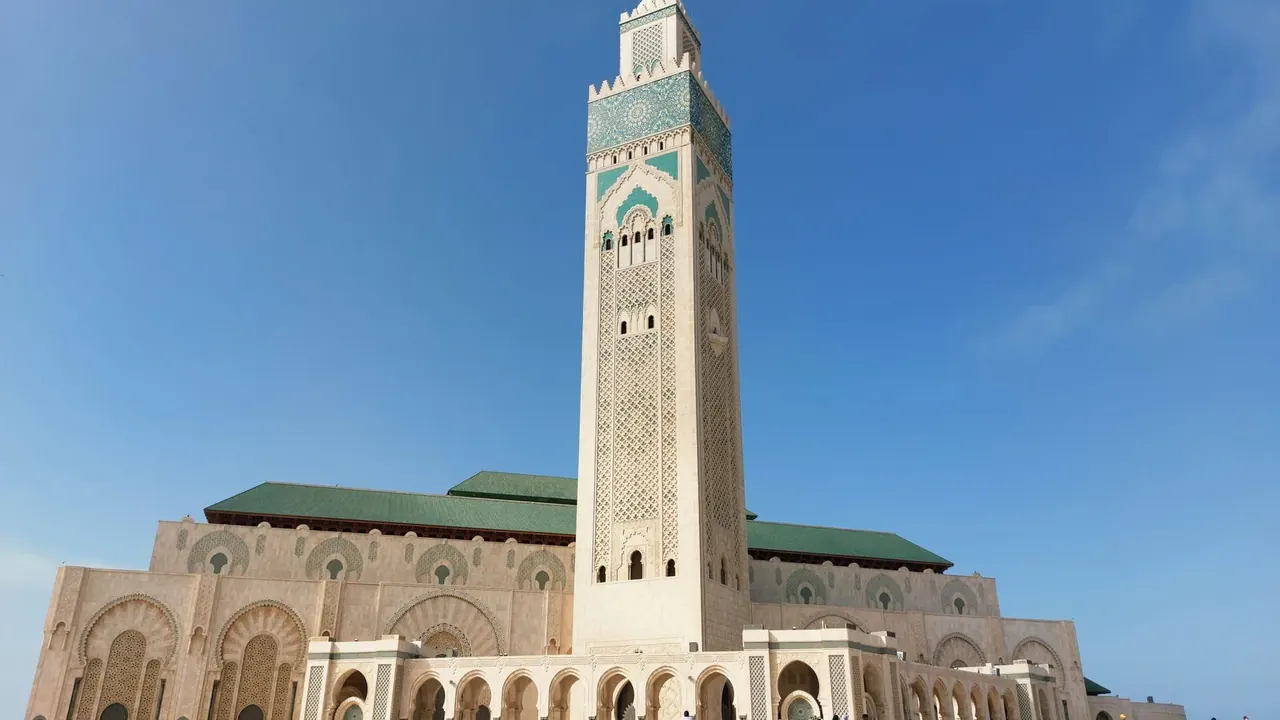
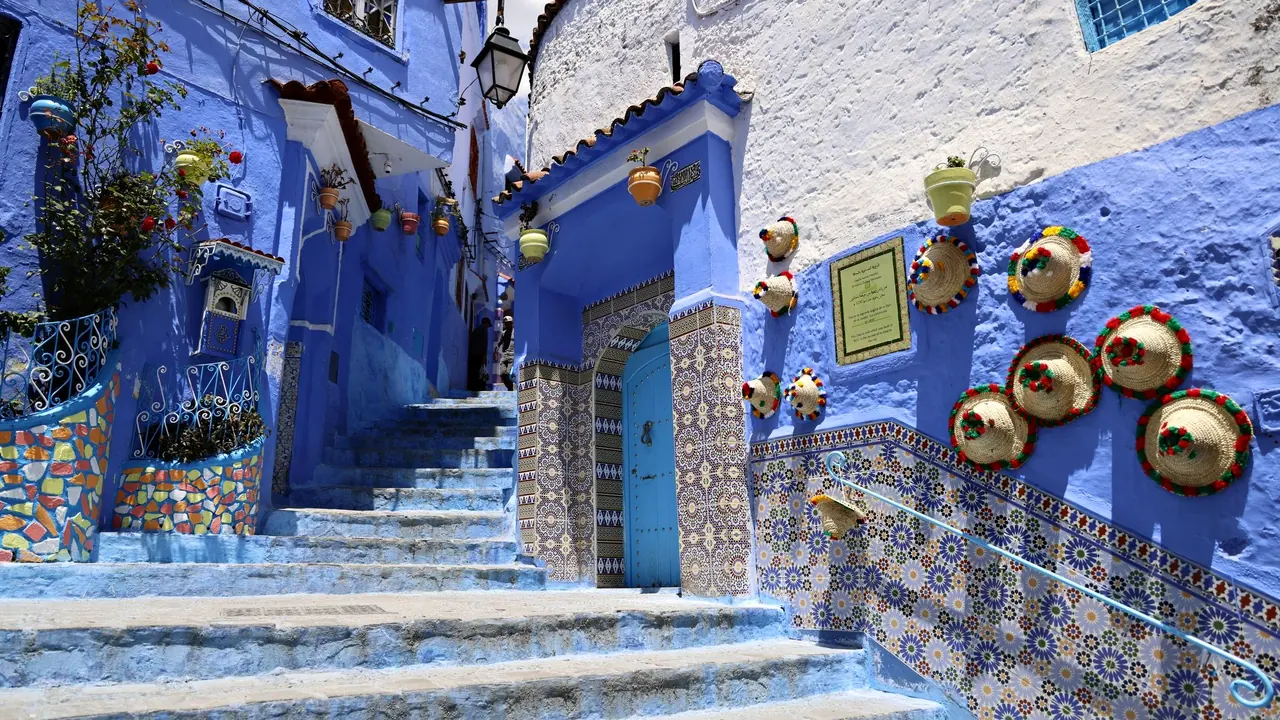
Photos: Casablanca by Samir Bakkah, Pexels License; Chefchaouen by Christophe RASCLE, Pexels License.
Casablanca or Chefchaouen?
Our verdict in twelve categories, each scored against the same fixed benchmark cities, and the climate month by month, so you can choose for your trip.
Choose Casablanca for
- nightlife
- live music and the arts
- beaches
Casablanca suits travellers who want a real city: grilled fish at the Marché Central, the Art Deco boulevards and the Hassan II Mosque by day, a well-dressed night out on the Corniche at Ain Diab, and fast trains to Rabat for a day out. It is a working port and business capital rather than a postcard. It works best for a few days at the start or end of a route through Morocco, and the weather is mild almost all year.
Choose Chefchaouen for
- nature and the outdoors
- prices
- getting around
Pick Chefchaouen for the opposite kind of trip. It is a small blue medina in the Rif where the lanes go quiet after dinner, rooms cost little and the hills start at the edge of town. Walkers have Talassemtane National Park and God's Bridge. Everyone else has slow days on roof terraces. Expect simple food, no nightlife and a long journey by road, as there is no railway.
Scoreboard
Twelve categories on one fixed scale from 0 to 100. The shaded stretch is the gap between the two.
Your match
Pick a travel style or drag the sliders, and both match scores follow your weighting.
Wins on nightlife and live music and the arts with your weighting.
Wins on nature and the outdoors and prices with your weighting.
What matters to you?
Category by category
What the scores mean for a trip.
Beaches & swimming
Neither is a beach destination, but Casablanca at least has the sea in town. The Corniche at Ain Diab has a long stretch of sand, though the Atlantic swell and currents send many people into the beach-club pools instead. Better sands at Dar Bouazza, Bouznika and Mohammedia are less than an hour away.
Chefchaouen has no beach of its own. The nearest is a grey-sand beach on the Mediterranean at Oued Laou, a winding hour and a quarter away by grand taxi. The river pools at Akchour are good for a cold dip, not a proper swim.
Food & drink
Casablanca eats much better. As a big port, its strength is seafood: you can choose fish at the Marché Central and have it grilled next door, or eat at the plain places by the fishing harbour. Maarif, Gauthier and the Corniche add French-influenced brasseries and pâtisseries, and alcohol is available in licensed places.
Chefchaouen's restaurants around Outa el-Hammam square serve much the same tagines and kefta. Its best food is local: Rif goat cheese wrapped in palm leaf, bissara for breakfast and bread from the communal ovens. A few days is enough to try it all.
Culture & sights
Casablanca has more to see, though neither city needs long. Its sights are one great monument and a twentieth-century cityscape: the Hassan II Mosque, which non-Muslims can enter on guided tours, the protectorate-era Art Deco and neo-Moorish buildings around Boulevard Mohammed V, the Habous quarter and the Museum of Moroccan Judaism.
Chefchaouen's sight is the town itself, the blue medina founded in 1471 and settled by refugees from Andalusia, best seen by wandering slowly with a camera. The kasbah and its small museum are the only formal visit, and the walk up to the Spanish Mosque at sunset rounds it off.
Nightlife
Only Casablanca has a night out. Lounges and clubs on the Corniche at Ain Diab play house and Arabic pop until late at weekends, and downtown and Maarif have hotel bars, cocktail lounges and a few bars from the protectorate era. It is a dressed-up scene where you take taxis between places, not a street to wander.
In Chefchaouen the evening is dinner, mint tea in the square and a stroll through the lit lanes before the medina goes quiet. Only a couple of hotel bars serve alcohol.
Nature & outdoors
This is where Chefchaouen is strongest. The Rif begins where the medina ends: paths climb past the Spanish Mosque towards the twin peaks and Jebel el-Kelaa. Akchour, forty minutes away, leads into Talassemtane National Park, with waterfalls, God's Bridge, cedar forests and Barbary macaques. Trails are poorly marked, so many walkers hire a local guide.
Casablanca sits on a flat coastal plain. Outdoors here means running along the Corniche to the El Hank lighthouse, learning to surf at Ain Diab or Dar Bouazza, or following shaded trails in the Bouskoura forest. The mountains are too far for a day out.
Day trips
Being on the railway makes Casablanca the better base. Rabat is about an hour away by train and has the Kasbah des Oudayas, the Hassan Tower and the Chellah ruins. Down the coast are El Jadida's Portuguese cistern, whitewashed Azemmour and the lagoon at Oualidia.
From Chefchaouen there is one strong outing: Tetouan, an hour and a quarter by road, whose UNESCO-listed medina is larger and far quieter than Chefchaouen's. After that come Martil on the coast and Ouezzane. Tangier and Fes are too far to go and come back in a day.
Good for families
Neither is easy with children, but Casablanca has more for them to do. There is the Corniche mall with its aquarium and indoor rides, the amusement park and zoo at Ain Diab, and beach-club pools that are safer than the sea. On the downside, traffic is heavy and pavements are often broken.
Chefchaouen is calmer, with little traffic inside the walls, but nothing there is aimed at children. The steep, stepped lanes rule out pushchairs, and the river pools at Akchour are the main treat. Both suit older children better than toddlers.
Getting around
Chefchaouen is simpler to get around once you are there. You can cross the medina on foot in fifteen minutes, though the stairs and polished steps are tiring with luggage. The hard part is arriving, by long-distance bus or road, since there is no railway.
Casablanca is a spread-out city where you combine the tram with red petits taxis. Drivers often share rides and sometimes ignore the meter, traffic is dense, and the big roundabouts are hard to cross on foot. In return it has fast trains to Rabat and the rest of the country.
Shopping & style
Casablanca has the wider choice, and most of it is modern. There is the large Corniche mall with international brands, fashion streets and local designers in Maarif, and the Derb Ghallef flea market. The Habous quarter has a tidy, low-pressure selection of crafts.
Chefchaouen is the place for things made in the region: thick woollen blankets, striped Rif weavings, djellabas, baskets and bottles of the blue pigment, sometimes sold by weavers working at looms in their shops. The range repeats after a few lanes, and there are no boutiques.
Affordability
Chefchaouen is the cheaper place to stay, mostly because rooms cost so little. Guesthouses and riads are cheap, and the town's main sight is free to walk. Only the restaurants on the main square and the best-restored riads charge noticeably more.
Daily costs in Casablanca are low too, from the tram to fish at the market. Hotels, though, are priced for business travellers, good guesthouses are scarce, and drinks and dining on the Corniche add up.
Live music & performing arts
Casablanca has stages and Chefchaouen has almost none. The large theatre on Place Mohammed V, the film and music programmes at the cultural institutes, the long-running jazz festival and the urban music festival give the city a real calendar. It is also a home of chaabi and Moroccan rap, though an ordinary week can be quiet.
In Chefchaouen, music means occasional Andalusian performances around festivals and the call to prayer drifting over the rooftops.
Wellness & relaxation
Both suit a few unhurried days, in different ways. Casablanca has the facilities: neighbourhood hammams, upscale hammams and spas in Maarif, and thalassotherapy centres on the Corniche. The loud city outside is what spoils the calm.
Chefchaouen is the reverse. Beyond simple hammams and a few riads offering massage there is little in the way of treatments, but the slow pace, cool mountain air and roof terraces make doing nothing easy.
When should you go?
Pick your month. The climate figures are measured averages, not a forecast.
Casablanca in July
Chefchaouen in July
Daytime high, °C
Rainfall in the month, mm
Where the figures come from
Chefchaouen has no weather station within reach, so its figures come from a gridded climate model rather than a measured record, and read a broad area rather than the city itself.
Temperature and rainfall are climate normals, averaged over the years shown. Casablanca: 1991-2020 normals, Casablanca (5.6 km from centre). Chefchaouen: 2001-2020 normals, NASA POWER reanalysis grid, no weather station within 90 km.
Casablanca is mild all year. The warmest month, August, reaches only about 27°C and winter days stay pleasant, so walking the streets works in any month. The beach season runs from June to September. In those months the days are long and sunny, rain all but stops and the Atlantic warms to about 23°C by August. October is still warm enough for a swim, but it brings the first autumn rain, and November to January are the wettest months.
Chefchaouen has much bigger swings. July and August reach 35°C, which is too hot for long walks in the lanes or the valleys. Winter is cool, around 13°C in January, and the wet season runs from October to April, with November the rainiest month at 141mm. The best time for the town and the hills is May, and late September is nearly as good. April is also mild but still showery. If you want a swim at Oued Laou, the Mediterranean is warmest from July to September.
Which traveller are you?
For a food and nightlife trip, Casablanca is the clear choice. You can have fish grilled at the Marché Central, eat at French-style brasseries in Maarif and Gauthier, then go on to lounges and clubs on the Corniche. Chefchaouen offers tagines, mint tea and a medina that falls silent.
On an outdoors trip, Chefchaouen is far ahead. Paths climb from the Ras el-Maa spring into the Rif, and Akchour is the way into Talassemtane National Park, with its gorge, waterfalls and God's Bridge. In Casablanca the outdoors means the Corniche promenade, surfing and the Bouskoura forest.
On a tight budget, your money goes further in Chefchaouen. Guesthouses and riads are cheap, walking the town itself costs nothing, and shared taxis to the valleys cost little. Casablanca is cheap day to day, but its hotels are priced for business travellers.
Before you go
| Measure | Casablanca | Chefchaouen |
|---|---|---|
| Official language | Arabic, Standard Moroccan Tamazight | Arabic, Standard Moroccan Tamazight |
| Currency | Moroccan Dirham (MAD) | Moroccan Dirham (MAD) |
| Sockets | CE50 Hz | CE50 Hz |
| Driving side | Right | Right |
| Time zone | UTC+1 | UTC+1 |
| Emergency number | Police 19/112, ambulance 15, fire 15 | Police 19/112, ambulance 15, fire 15 |
| Elevation | 115 m | 564 m |
| Main airport | Mohammed V International Airport (CMN)26 km from centre112 non-stop destinations | Tangier Ibn Battuta Airport (TNG)86 km from centre50 non-stop destinations |
| Public holidays this year | 11 days | 11 days |
By the numbers
| Measure | Casablanca | Chefchaouen |
|---|---|---|
| City population | 3,215,935 | 46,168 |
| People per km² | 8,375 | 2,998 |
| Museums within 10 km | 3 | 1 |
| UNESCO World Heritage sites within 50 km | 0 | 1 |
| Swim season, months above 21 °C | 5 months | 3 months |
Where else could you go?
Every comparison below shares a destination with this one, so you can follow Casablanca or Chefchaouen somewhere new.
- Tangiervs Chefchaouen
- Rabatvs Casablanca
- Fesvs Chefchaouen
- Rabatvs Chefchaouen
- Marrakechvs Casablanca
- Fesvs Casablanca